第4章二次元・三次元の運動
4.4 Uniform and Nonuniform Circular Motion4.4 等速円運動と非等速円運動
Learning Objectives学習目標
Learning Objectives学習目標
By the end of this section, you will be able to:
英語のヒント
この節を終えると、次のことができるようになる。
- Solve for the centripetal acceleration of an object moving on a circular path.
英語のヒント
円形の経路を動く物体の向心加速度を求める。 - Use the equations of circular motion to find the position, velocity, and acceleration of a particle executing circular motion.
英語のヒント
円運動を表す式を使って、円運動する粒子の位置、速度、加速度を求める。 - Explain the differences between centripetal acceleration and tangential acceleration resulting from nonuniform circular motion.
英語のヒント
非等速円運動で生じる向心加速度と接線加速度の違いを説明する。 - Evaluate centripetal and tangential acceleration in nonuniform circular motion, and find the total acceleration vector.
英語のヒント
非等速円運動の向心加速度と接線加速度を計算し、全加速度ベクトルを求める。
Uniform circular motion is a specific type of motion in which an object travels in a circle with a constant speed. For example, any point on a propeller spinning at a constant rate is executing uniform circular motion. Other examples are the second, minute, and hour hands of a watch. It is remarkable that points on these rotating objects are actually accelerating, although the rotation rate is a constant. To see this, we must analyze the motion in terms of vectors.
英語のヒント
等速円運動とは、物体が一定の速さで円周上を進む運動である。例えば、一定の割合で回転するプロペラ上のどの点も、等速円運動をしている。時計の秒針、分針、時針もその例である。回転の割合が一定なのに、回転する物体上の点には実際には加速度があるということは、注目に値する。これを理解するには、ベクトルを使って運動を分析しなければならない。
Centripetal Acceleration向心加速度
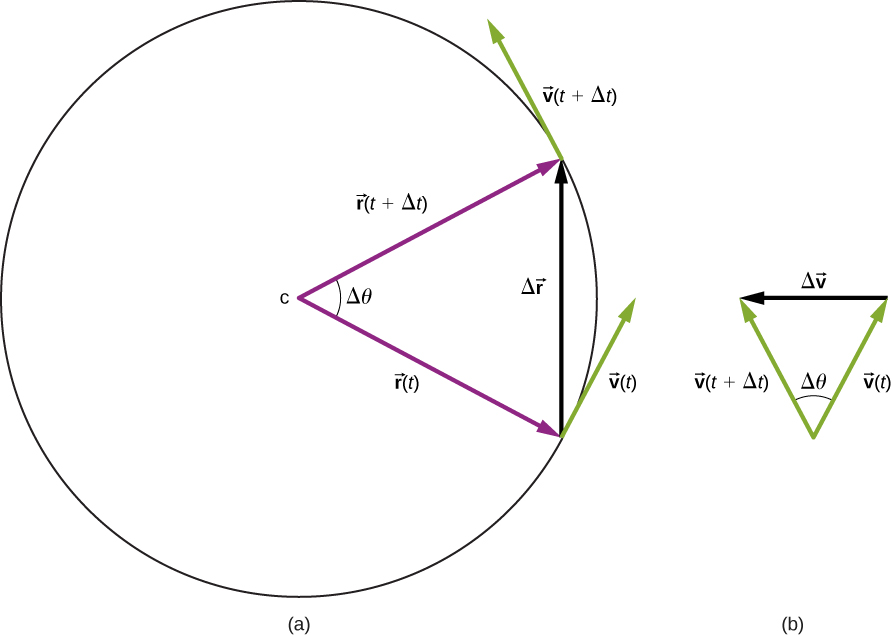
In one-dimensional kinematics, objects with a constant speed have zero acceleration. However, in two- and three-dimensional kinematics, even if the speed is a constant, a particle can have acceleration if it moves along a curved trajectory such as a circle. In this case the velocity vector is changing, or This is shown in Figure 4.18. As the particle moves counterclockwise in time on the circular path, its position vector moves from to The velocity vector has constant magnitude and is tangent to the path as it changes from to changing its direction only. Since the velocity vector is perpendicular to the position vector the triangles formed by the position vectors and and the velocity vectors and are similar. Furthermore, since and the two triangles are isosceles. From these facts we can make the assertion
英語のヒント
1次元の運動学では、速さが一定の物体の加速度は0である。しかし、2次元や3次元の運動学では、速さが一定でも、粒子が円のような曲がった軌道に沿って動くと加速度を持ちうる。この場合、速度ベクトルが変化する。つまり、である。図4.18にこれを示す。粒子が時間の間に円周上を反時計回りに動くと、位置ベクトルはからへ移る。速度ベクトルは大きさが一定で、軌道に接しており、からへ変化するとき、向きだけが変わる。速度ベクトルは位置ベクトルと垂直なので、位置ベクトルとで作る三角形と、速度ベクトルとで作る三角形は相似である。さらに、かつなので、二つの三角形はいずれも二等辺三角形である。これらの事実から、次が成り立つ。
or
英語のヒント
、すなわち。
OpenStax / Rice University, University Physics Volume 1, CC BY 4.0. Source-book artwork retained. · CC BY 4.0 · Source出典

Figure 4.18図 4.18
(a) A particle is moving in a circle at a constant speed, with position and velocity vectors at times and (b) Velocity vectors forming a triangle. The two triangles in the figure are similar. The vector points toward the center of the circle in the limit
英語のヒント
(a)一定の速さで円周上を動く粒子の、時刻とにおける位置ベクトルと速度ベクトル。(b)三角形を作る速度ベクトル。図の二つの三角形は相似である。極限では、ベクトルは円の中心へ向く。
We can find the magnitude of the acceleration from
英語のヒント
加速度の大きさは、次の式から求められる。
The direction of the acceleration can also be found by noting that as and therefore approach zero, the vector approaches a direction perpendicular to In the limit is perpendicular to Since is tangent to the circle, the acceleration points toward the center of the circle. Summarizing, a particle moving in a circle at a constant speed has an acceleration with magnitude
英語のヒント
、したがってが0へ近づくと、ベクトルの向きはに垂直な向きへ近づく。このことから加速度の向きも求められる。極限では、はと垂直になる。は円に接するので、加速度は円の中心へ向く。まとめると、一定の速さで円周上を動く粒子は、次の大きさの加速度を持つ。
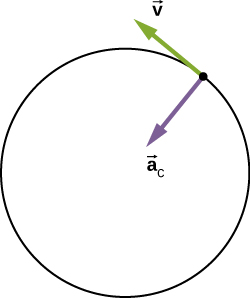
The direction of the acceleration vector is toward the center of the circle (Figure 4.19). This is a radial acceleration and is called the centripetal acceleration, which is why we give it the subscript c. The word centripetal comes from the Latin words centrum (meaning “center”) and petere (meaning “to seek”), and thus takes the meaning “center seeking.”
英語のヒント
加速度ベクトルは円の中心へ向く(図4.19)。これは半径方向の加速度であり、向心加速度と呼ぶ。そのため添字cを付けている。centripetalという語は、ラテン語のcentrum(中心)とpetere(求める)に由来し、「中心を求める」という意味を持つ。
OpenStax / Rice University, University Physics Volume 1, CC BY 4.0. Source-book artwork retained. · CC BY 4.0 · Source出典

Figure 4.19図 4.19
The centripetal acceleration vector points toward the center of the circular path of motion and is an acceleration in the radial direction. The velocity vector is also shown and is tangent to the circle.
英語のヒント
向心加速度ベクトルは、円形の運動経路の中心へ向く、半径方向の加速度である。円に接する速度ベクトルも示す。
Let’s investigate some examples that illustrate the relative magnitudes of the velocity, radius, and centripetal acceleration.
英語のヒント
速度、半径、向心加速度の大きさの関係を示す例を調べよう。
Example 4.10例題 4.10
Creating an Acceleration of 1 g1 gの加速度を生じさせる
A jet is flying at 134.1 m/s along a straight line and makes a turn along a circular path level with the ground. What does the radius of the circle have to be to produce a centripetal acceleration of 1 g on the pilot and jet toward the center of the circular trajectory?
英語のヒント
ジェット機が直線上を134.1 m/sで飛行した後、地面に平行な円軌道に沿って旋回する。パイロットと機体に、円軌道の中心へ向かう1 gの向心加速度を生じさせるには、円の半径をいくらにする必要があるか。
Strategy方針
Given the speed of the jet, we can solve for the radius of the circle in the expression for the centripetal acceleration.
英語のヒント
ジェット機の速さが与えられているので、向心加速度の式を円の半径について解ける。
Solution解答
Set the centripetal acceleration equal to the acceleration of gravity:
英語のヒント
向心加速度を重力加速度と等しく置く。。
Solving for the radius, we find
英語のヒント
半径について解くと、次を得る。
Significance意味の検討
To create a greater acceleration than g on the pilot, the jet would either have to decrease the radius of its circular trajectory or increase its speed on its existing trajectory or both.
英語のヒント
パイロットにgより大きな加速度を生じさせるには、ジェット機は円軌道の半径を小さくするか、現在の軌道上で速さを増すか、その両方を行う必要がある。
Centripetal acceleration can have a wide range of values, depending on the speed and radius of curvature of the circular path. Typical centripetal accelerations are given in the following table.
英語のヒント
向心加速度は、速さと円軌道の曲率半径によって、幅広い値を取る。代表的な向心加速度を次の表に示す。
Object 物体 |
Centripetal Acceleration (m/s2 or factors of g) 向心加速度(m/s2またはgの倍数) |
|---|---|
Earth around the Sun 太陽を回る地球 |
|
Moon around the Earth 地球を回る月 |
|
Satellite in geosynchronous orbit 地球同期軌道上の衛星 |
0.233 |
Outer edge of a CD when playing 再生中のCDの外縁 |
|
Jet in a barrel roll バレルロール中のジェット機 |
(2–3 g) (2~3 g) |
Roller coaster ジェットコースター |
(5 g) (5 g) |
Electron orbiting a proton in a simple Bohr model of the atom 原子の単純なボーア模型で陽子を周回する電子 |