第15章振動
Equations of SHM単振動の運動の式
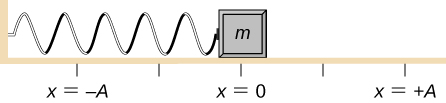
Consider a block attached to a spring on a frictionless table (Figure 15.4). The equilibrium position (the position where the spring is neither stretched nor compressed) is marked as . At the equilibrium position, the net force is zero.
英語のヒント
摩擦のない台の上で、ばねにつながれたブロックを考える(図15.4)。ばねが伸びも縮みもしていないつり合いの位置をとする。この位置で合力はゼロである。
OpenStax / Rice University, University Physics Volume 1, CC BY 4.0. Source-book artwork retained. · CC BY 4.0 · Source出典

Figure 15.4図 15.4
A block is attached to a spring and placed on a frictionless table. The equilibrium position, where the spring is neither extended nor compressed, is marked as
英語のヒント
ブロックをばねにつなぎ、摩擦のない台に置く。ばねが伸びも縮みもしていないつり合いの位置をとする。
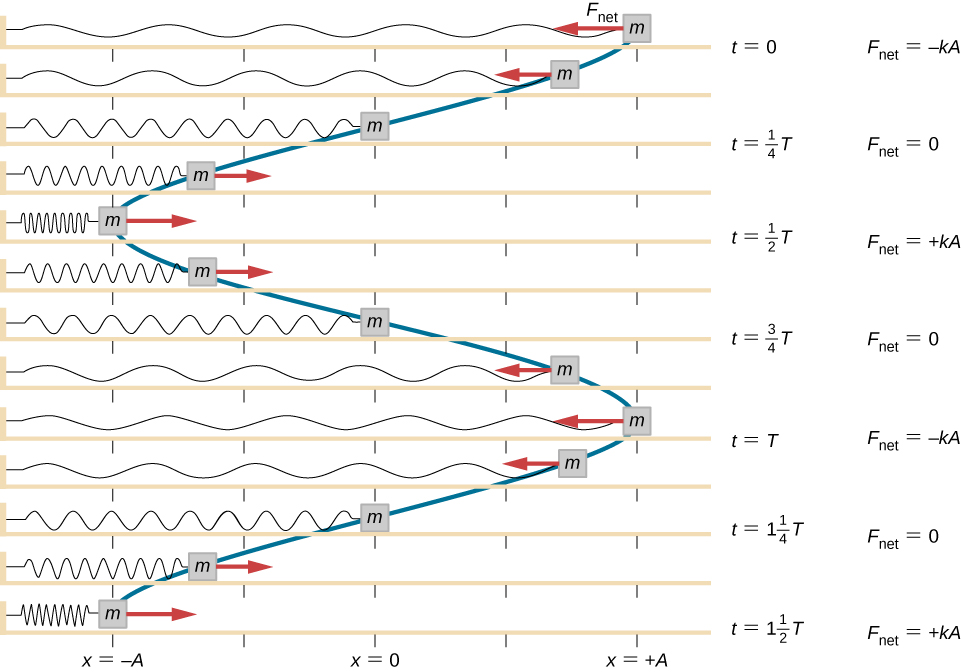
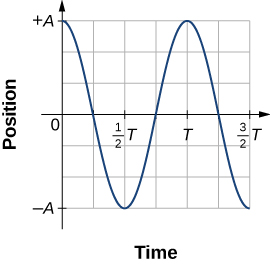
Work is done on the block to pull it out to a position of and it is then released from rest. The maximum x-position (A) is called the amplitude of the motion. The block begins to oscillate in SHM between and where A is the amplitude of the motion and T is the period of the oscillation. The period is the time for one oscillation. Figure 15.5 shows the motion of the block as it completes one and a half oscillations after release. Figure 15.6 shows a plot of the position of the block versus time. When the position is plotted versus time, it is clear that the data can be modeled by a cosine function with an amplitude A and a period T. The cosine function repeats every multiple of whereas the motion of the block repeats every period T. However, the function repeats every integer multiple of the period. The maximum of the cosine function is one, so it is necessary to multiply the cosine function by the amplitude A.
英語のヒント
Recall from the chapter on rotation that the angular frequency equals . In this case, the period is constant, so the angular frequency is defined as divided by the period, .
英語のヒント
回転の章で、角振動数がに等しいことを学んだ。この場合、周期は一定なので、角振動数をを周期で割ったもの、すなわちと定義する。
OpenStax / Rice University, University Physics Volume 1, CC BY 4.0. Source-book artwork retained. · CC BY 4.0 · Source出典

Figure 15.5図 15.5
A block is attached to one end of a spring and placed on a frictionless table. The other end of the spring is anchored to the wall. The equilibrium position, where the net force equals zero, is marked as Work is done on the block, pulling it out to , and the block is released from rest. The block oscillates between and . The force is also shown as a vector.
英語のヒント
ブロックをばねの一端につなぎ、摩擦のない台に置く。他端は壁に固定する。合力がゼロになるつり合いの位置をとする。ブロックに仕事を加えてまで引き、静かに放すと、との間を振動する。力もベクトルとして示している。
OpenStax / Rice University, University Physics Volume 1, CC BY 4.0. Source-book artwork retained. · CC BY 4.0 · Source出典

Figure 15.6図 15.6
A graph of the position of the block shown in Figure 15.5 as a function of time. The position can be modeled as a periodic function, such as a cosine or sine function.
英語のヒント
図15.5のブロックの位置を時間の関数として示したグラフ。位置は、余弦や正弦のような周期関数で表せる。
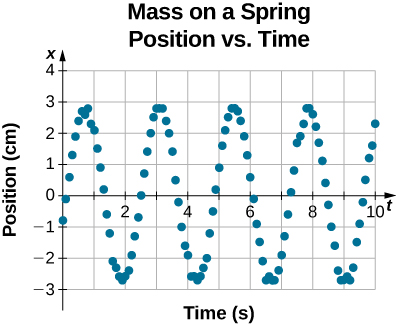
The equation for the position as a function of time is good for modeling data, where the position of the block at the initial time is at the amplitude A and the initial velocity is zero. Often when taking experimental data, the position of the mass at the initial time is not equal to the amplitude and the initial velocity is not zero. Consider 10 seconds of data collected by a student in lab, shown in Figure 15.7.
英語のヒント
位置を時間の関数として表す式は、初期時刻で位置が振幅Aに等しく、初速度がゼロの場合のデータによく合う。しかし、実験データを取るとき、初期時刻で質点の位置が振幅に等しくなく、初速度もゼロでないことが多い。図15.7に示した、学生が実験室で集めた10秒間のデータを考えよう。
OpenStax / Rice University, University Physics Volume 1, CC BY 4.0. Source-book artwork retained. · CC BY 4.0 · Source出典

Figure 15.7図 15.7
Data collected by a student in lab indicate the position of a block attached to a spring, measured with a sonic range finder. The data are collected starting at time but the initial position is near position , so the initial position does not equal the amplitude . The velocity is the time derivative of the position, which is the slope at a point on the graph of position versus time. The velocity is not at time , as evident by the slope of the graph of position versus time, which is not zero at the initial time.
英語のヒント
学生が実験で集めたデータは、ばねにつながれたブロックの位置を、音波式距離計で測ったものである。時刻から記録しているが、初期位置は付近であり、振幅とは等しくない。速度は位置の時間微分で、位置と時間のグラフ上の各点の傾きに当たる。初期時刻でグラフの傾きがゼロでないことから明らかなように、時刻の速度はではない。
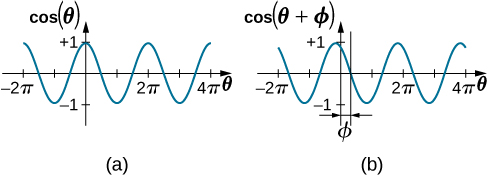
The data in Figure 15.7 can still be modeled with a periodic function, like a cosine function, but the function is shifted to the right. This shift is known as a phase shift and is usually represented by the Greek letter phi . The equation of the position as a function of time for a block on a spring becomes
英語のヒント
図15.7のデータも余弦のような周期関数で表せるが、関数を右へずらす必要がある。このずれを位相のずれと呼び、通常はギリシャ文字ファイで表す。ばねにつながれたブロックの位置の時間変化は、次の式になる。
This is the generalized equation for SHM where t is the time measured in seconds, is the angular frequency with units of inverse seconds, A is the amplitude measured in meters or centimeters, and is the phase shift measured in radians (Figure 15.8). It should be noted that because sine and cosine functions differ only by a phase shift, this motion could be modeled using either the cosine or sine function.
英語のヒント
これは単振動の一般的な式である。tは秒で測る時間、は単位が秒の逆数である角振動数、Aはメートルまたはセンチメートルで測る振幅、はラジアンで測る位相のずれである(図15.8)。正弦と余弦は位相のずれだけが異なるため、この運動はどちらの関数でも表せることに注意しよう。
OpenStax / Rice University, University Physics Volume 1, CC BY 4.0. Source-book artwork retained. · CC BY 4.0 · Source出典

Figure 15.8図 15.8
(a) A cosine function. (b) A cosine function shifted to the left by an angle . The angle is known as the phase shift of the function.
英語のヒント
(a) 余弦関数。(b) 角度だけ左へずらした余弦関数。角度を、関数の位相のずれと呼ぶ。
The velocity of the mass on a spring, oscillating in SHM, can be found by taking the derivative of the position equation:
英語のヒント
ばねにつながれて単振動する質点の速度は、位置の式を微分すれば求められる。
Because the sine function oscillates between –1 and +1, the maximum velocity is the amplitude times the angular frequency, . The maximum velocity occurs at the equilibrium position when the mass is moving toward . The maximum velocity in the negative direction is attained at the equilibrium position when the mass is moving toward and is equal to .
英語のヒント
正弦関数は−1から+1の間を振動するので、最大速度は振幅と角振動数の積である。質点がに向かって動き、つり合いの位置を通過するときに最大速度となる。負方向の最大速度は、質点がへ向かい、つり合いの位置を通過するときに達し、その値はとなる。
The acceleration of the mass on the spring can be found by taking the time derivative of the velocity:
英語のヒント
ばねにつながれた質点の加速度は、速度を時間で微分すれば求められる。
The maximum acceleration is . The maximum acceleration in the positive direction occurs at the position , and is equal to .
英語のヒント
加速度の最大の大きさはである。正方向の最大加速度は、位置で生じ、その値はとなる。