第15章振動
15.5 Damped Oscillations15.5 減衰振動
Learning Objectives学習目標
Learning Objectives学習目標
By the end of this section, you will be able to:
英語のヒント
この節を終えると、次のことができるようになる。
- Describe the motion of damped harmonic motion
英語のヒント
減衰する調和振動の運動を説明する。 - Write the equations of motion for damped harmonic oscillations
英語のヒント
減衰する調和振動の運動の式を書く。 - Describe the motion of driven, or forced, damped harmonic motion
英語のヒント
駆動された、すなわち強制された減衰調和振動の運動を説明する。 - Write the equations of motion for forced, damped harmonic motion
英語のヒント
強制減衰調和振動の運動の式を書く。
In the real world, oscillations seldom follow true SHM. Friction of some sort usually acts to dampen the motion so it dies away, or needs more force to continue. In this section, we examine some examples of damped harmonic motion and see how to modify the equations of motion to describe this more general case.
英語のヒント
現実の振動が、厳密な単振動に従うことは少ない。たいてい何らかの摩擦が運動を弱めるため、振動は消えるか、続けるためにさらに力が必要となる。この節では、減衰する調和振動の例を調べ、この一般的な場合を表すには運動の式をどう変えるかを見る。
A guitar string stops oscillating a few seconds after being plucked. To keep swinging on a playground swing, you must keep pushing (Figure 15.24). Although we can often make friction and other nonconservative forces small or negligible, completely undamped motion is rare. In fact, we may even want to damp oscillations, such as with car shock absorbers.
英語のヒント
ギターの弦は、はじいてから数秒で振動を止める。遊び場のブランコを揺らし続けるには、押し続ける必要がある(図15.24)。摩擦などの非保存力は、小さくしたり無視できるほどにしたりできるが、まったく減衰しない運動はまれである。車のショックアブソーバーのように、むしろ振動を減衰させたい場合もある。
Image omitted because its reuse rights could not be verified.権利の確認ができないため画像を割愛。
Figure 15.24図 15.24
To counteract dampening forces, you need to keep pumping a swing. (credit: Bob Mical)
英語のヒント
減衰させる力に対抗するには、ブランコをこぎ続ける必要がある。(クレジット:Bob Mical)
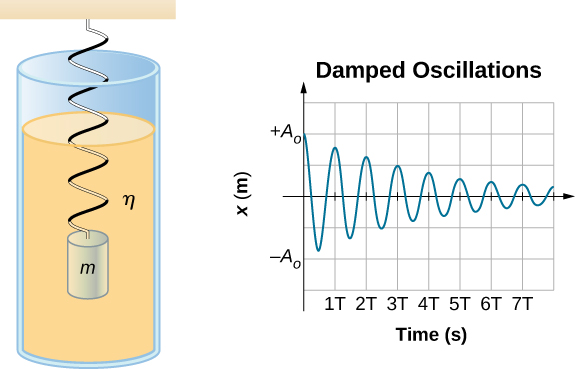
Figure 15.25 shows a mass m attached to a spring with a force constant The mass is raised to a position , the initial amplitude, and then released. The mass oscillates around the equilibrium position in a fluid with viscosity but the amplitude decreases for each oscillation. For a system that has a small amount of damping, the period and frequency are constant and are nearly the same as for SHM, but the amplitude gradually decreases as shown. This occurs because the non-conservative damping force removes energy from the system, usually in the form of thermal energy.
英語のヒント
図15.25は、力の定数のばねにつながれた質量mを示す。初期振幅に相当する位置まで持ち上げて放すと、粘性流体中でつり合いの位置の周りを振動するが、振幅は1回ごとに減る。減衰が小さい系では、周期と振動数は一定で、単振動の場合とほぼ同じだが、図のように振幅が徐々に減少する。これは、非保存的な減衰力が、通常は熱エネルギーとして、系からエネルギーを取り去るためである。
OpenStax / Rice University, University Physics Volume 1, CC BY 4.0. Source-book artwork retained. · CC BY 4.0 · Source出典

Figure 15.25図 15.25
For a mass on a spring oscillating in a viscous fluid, the period remains constant, but the amplitudes of the oscillations decrease due to the damping caused by the fluid.
英語のヒント
粘性流体中でばねにつながれて振動する質点は、周期は一定のまま、流体による減衰によって振幅が小さくなる。
Consider the forces acting on the mass. Note that the only contribution of the weight is to change the equilibrium position, as discussed earlier in the chapter. Therefore, the net force is equal to the force of the spring and the damping force . If the magnitude of the velocity is small, meaning the mass oscillates slowly, the damping force is proportional to the velocity and acts against the direction of motion . The net force on the mass is therefore
英語のヒント
質点に働く力を考えよう。この章で前に述べたように、重力の効果はつり合いの位置を変えることだけである。したがって、合力はばねの力と減衰力の和となる。速度の大きさが小さく、質点がゆっくり振動するとき、減衰力は速度に比例して運動と逆向きに働く:。よって質点への合力は次のようになる。
Writing this as a differential equation in x, we obtain
英語のヒント
これをxに関する微分方程式で書くと、次のようになる。
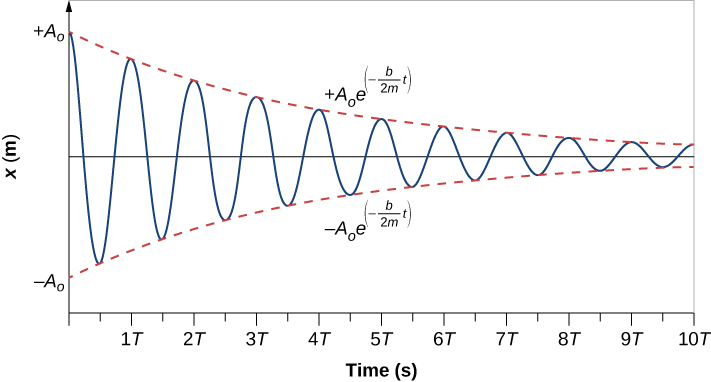
To determine the solution to this equation, consider the plot of position versus time shown in Figure 15.26. The curve resembles a cosine curve oscillating in the envelope of an exponential function where . The solution is
英語のヒント
この方程式の解を求めるため、図15.26の位置と時間のグラフを考える。曲線は、指数関数を包絡線とする余弦曲線のように見える。ここでである。解は次のとおりとなる。
It is left as an exercise to prove that this is, in fact, the solution. To prove that it is the right solution, take the first and second derivatives with respect to time and substitute them into Equation 15.23. It is found that Equation 15.24 is the solution if
英語のヒント
これが実際に解となることの証明は練習問題とする。時間に関する1階微分と2階微分を求め、減衰振動の微分方程式へ代入すれば確かめられる。次の条件を満たすとき、先ほどの位置の式が解となる。
Recall that the angular frequency of a mass undergoing SHM is equal to the square root of the force constant divided by the mass. This is often referred to as the natural angular frequency, which is represented as
英語のヒント
単振動する質点の角振動数は、力の定数を質量で割った値の平方根に等しいことを思い出そう。これを固有角振動数と呼ぶことが多く、次のように表す。
The angular frequency for damped harmonic motion becomes
英語のヒント
減衰する調和振動の角振動数は、次のようになる。
OpenStax / Rice University, University Physics Volume 1, CC BY 4.0. Source-book artwork retained. · CC BY 4.0 · Source出典

Figure 15.26図 15.26
Position versus time for the mass oscillating on a spring in a viscous fluid. Notice that the curve appears to be a cosine function inside an exponential envelope.
英語のヒント
粘性流体中でばねにつながれて振動する質点の、位置と時間のグラフ。指数関数の包絡線の内側に、余弦関数があるように見える。
Recall that when we began this description of damped harmonic motion, we stated that the damping must be small. Two questions come to mind. Why must the damping be small? And how small is small? If you gradually increase the amount of damping in a system, the period and frequency begin to be affected, because damping opposes and hence slows the back and forth motion. (The net force is smaller in both directions.) If there is very large damping, the system does not even oscillate—it slowly moves toward equilibrium. The angular frequency is equal to
英語のヒント
減衰する調和振動の説明を始めたとき、減衰が小さいことを条件にした。ここで二つの疑問が生じる。なぜ小さい必要があるのか。そして、どれほど小さければよいのか。減衰を徐々に大きくすると、往復運動に逆らって遅くするため、周期と振動数も影響を受け始める。(どちらの向きでも合力が小さくなる。)減衰が非常に大きければ振動さえ起こらず、系はゆっくりつり合いへ近づく。角振動数は次のとおりである。
As b increases, becomes smaller and eventually reaches zero when . If b becomes any larger, becomes a negative number and is a complex number.
英語のヒント
bが増すとは小さくなり、のときにゼロへ達する。bがさらに大きくなるとは負となり、は複素数になる。
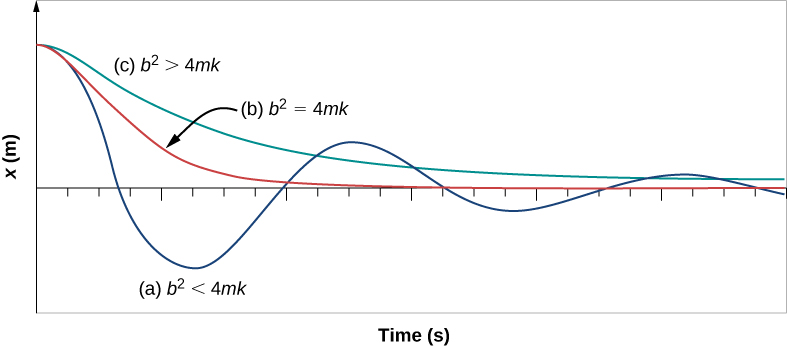
Figure 15.27 shows the displacement of a harmonic oscillator for different amounts of damping. When the damping constant is small, , the system oscillates while the amplitude of the motion decays exponentially. This system is said to be underdamped, as in curve (a). Many systems are underdamped, and oscillate while the amplitude decreases exponentially, such as the mass oscillating on a spring. The damping may be quite small, but eventually the mass comes to rest. If the damping constant is , the system is said to be critically damped, as in curve (b). An example of a critically damped system is the shock absorbers in a car. It is advantageous to have the oscillations decay as fast as possible. Here, the system does not oscillate, but asymptotically approaches the equilibrium condition as quickly as possible. Curve (c) in Figure 15.27 represents an overdamped system where An overdamped system will approach equilibrium over a longer period of time.
英語のヒント
図15.27は、減衰の大きさを変えた場合の調和振動子の変位を示す。減衰定数が小さくのとき、振幅が指数関数的に減りながら振動する。この系は、曲線(a)のように不足減衰の状態にあるという。ばねにつながれた質点のように、多くの系は不足減衰となり、振幅を指数関数的に減らしながら振動する。減衰がごく小さくても、やがて質点は静止する。減衰定数がの場合は、曲線(b)のように臨界減衰と呼ぶ。車のショックアブソーバーはその例であり、振動をできるだけ速く消すのが望ましい。このとき系は振動せず、可能な限り速く平衡状態へ漸近する。図15.27の曲線(c)はの過減衰を表す。過減衰の系は、より長い時間をかけて平衡へ近づく。
OpenStax / Rice University, University Physics Volume 1, CC BY 4.0. Source-book artwork retained. · CC BY 4.0 · Source出典

Figure 15.27図 15.27
The position versus time for three systems consisting of a mass and a spring in a viscous fluid. (a) If the damping is small , the mass oscillates, slowly losing amplitude as the energy is dissipated by the non-conservative force(s). The limiting case is (b) where the damping is . (c) If the damping is very large , the mass does not oscillate when displaced, but attempts to return to the equilibrium position.
英語のヒント
粘性流体中のばねと質点からなる三つの系の、位置と時間の関係。(a) 減衰が小さいの場合、質点は振動し、非保存力によるエネルギー散逸に伴って振幅を徐々に失う。(b) は限界の場合で、減衰はである。(c) 減衰が非常に大きいの場合、質点を変位させても振動せず、つり合いの位置へ戻ろうとする。
Critical damping is often desired, because such a system returns to equilibrium rapidly and remains at equilibrium as well. In addition, a constant force applied to a critically damped system moves the system to a new equilibrium position in the shortest time possible without overshooting or oscillating about the new position.
英語のヒント
臨界減衰は、系が速やかにつり合いへ戻り、そこで静止し続けるため、望ましいことが多い。また、臨界減衰の系に一定の力を加えると、新しいつり合いの位置を行き過ぎたり、その周りを振動したりせず、最短の時間でその位置へ移る。