第15章振動
Summary of Equations of Motion for SHM単振動の運動の式のまとめ
In summary, the oscillatory motion of a block on a spring can be modeled with the following equations of motion:
英語のヒント
まとめると、ばねにつながれたブロックの振動は、次の運動の式で表せる。
Here, A is the amplitude of the motion, T is the period, is the phase shift, and is the angular frequency of the motion of the block.
英語のヒント
ここでAは振幅、Tは周期、は位相のずれ、はブロックの運動の角振動数である。
Example 15.2例題 15.2
Determining the Equations of Motion for a Block and a Springブロックとばねの運動の式を求める
A 2.00-kg block is placed on a frictionless surface. A spring with a force constant of is attached to the block, and the opposite end of the spring is attached to the wall. The spring can be compressed or extended. The equilibrium position is marked as
英語のヒント
質量2.00 kgのブロックを摩擦のない面に置く。力の定数のばねをブロックにつなぎ、他端を壁に固定する。ばねは縮めることも伸ばすこともできる。つり合いの位置をとする。
Work is done on the block, pulling it out to The block is released from rest and oscillates between and The period of the motion is 1.57 s. Determine the equations of motion.
英語のヒント
ブロックに仕事を加え、まで引く。静かに放すと、との間を振動する。運動の周期は1.57 sである。運動の式を求めよ。
Strategy方針
We first find the angular frequency. The phase shift is zero, because the block is released from rest at Once the angular frequency is found, we can determine the maximum velocity and maximum acceleration.
英語のヒント
まず角振動数を求める。ブロックはで静かに放されるので、位相のずれはゼロ、すなわちである。角振動数が分かれば、最大速度と最大加速度を求められる。
Solution解答
The angular frequency can be found and used to find the maximum velocity and maximum acceleration:
英語のヒント
角振動数を求め、それを使って最大速度と最大加速度を計算する。
All that is left is to fill in the equations of motion:
英語のヒント
あとは、運動の式に値を入れればよい。
Significance考察
The position, velocity, and acceleration can be found for any time. It is important to remember that when using these equations, your calculator must be in radians mode.
英語のヒント
これらの式から、任意の時刻の位置、速度、加速度が求められる。式を使うときには、電卓をラジアンのモードにしておくことが大切である。
The Period and Frequency of a Mass on a Springばねにつながれた質点の周期と振動数
One interesting characteristic of the SHM of an object attached to a spring is that the angular frequency, and therefore the period and frequency of the motion, depend on only the mass and the force constant, and not on other factors such as the amplitude of the motion. We can use the equations of motion and Newton’s second law to find equations for the angular frequency, frequency, and period.
英語のヒント
ばねにつながれた物体の単振動には、角振動数、したがって周期と振動数が、質量と力の定数だけで決まり、振幅などのほかの要因には依存しないという興味深い性質がある。運動の式とニュートンの第2法則を用いると、角振動数、振動数、周期の式を求められる。
Consider the block on a spring on a frictionless surface. There are three forces on the mass: the weight, the normal force, and the force due to the spring. The only two forces that act perpendicular to the surface are the weight and the normal force, which have equal magnitudes and opposite directions, and thus sum to zero. The only force that acts parallel to the surface is the force due to the spring, so the net force must be equal to the force of the spring:
英語のヒント
摩擦のない面でばねにつながれたブロックを考えよう。質点には、重力、垂直抗力、ばねの力の三つが働く。面に垂直な力は重力と垂直抗力だけであり、大きさが等しく向きが反対なので、和はゼロとなる。面に平行な力はばねの力だけだから、合力はばねの力に等しい。
Substituting the equations of motion for x and a gives us
英語のヒント
xとaに運動の式を代入すると、次の式になる。
Cancelling out like terms and solving for the angular frequency yields
英語のヒント
共通する項を消去し、角振動数について解くと、次のようになる。
The angular frequency depends only on the force constant and the mass, and not the amplitude. The angular frequency is defined as which yields an equation for the period of the motion:
英語のヒント
角振動数は、力の定数と質量だけに依存し、振幅には依存しない。角振動数の定義から、周期の式を得る。
The period also depends only on the mass and the force constant. The greater the mass, the longer the period. The stiffer the spring, the shorter the period. The frequency is
英語のヒント
周期も質量と力の定数だけで決まる。質量が大きいほど周期は長く、ばねが硬いほど周期は短い。振動数は次のようになる。
Vertical Motion and a Horizontal Spring鉛直方向の運動と水平なばね
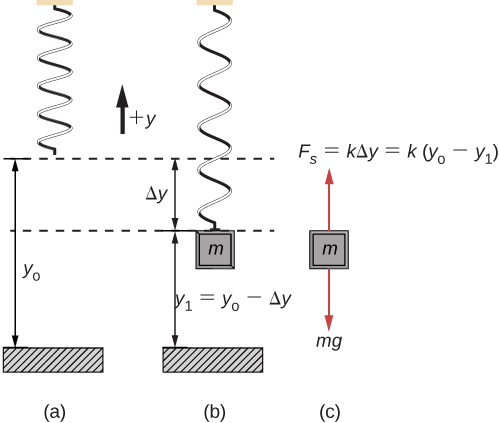
When a spring is hung vertically and a block is attached and set in motion, the block oscillates in SHM. In this case, there is no normal force, and the net effect of the force of gravity is to change the equilibrium position. Consider Figure 15.9. Two forces act on the block: the weight and the force of the spring. The weight is constant and the force of the spring changes as the length of the spring changes.
英語のヒント
ばねを鉛直につり下げ、ブロックを取り付けて動かすと、ブロックは単振動する。この場合は垂直抗力がなく、重力の正味の効果はつり合いの位置を変えることである。図15.9を考えよう。ブロックには重力とばねの力が働く。重力は一定だが、ばねの力はばねの長さとともに変わる。
OpenStax / Rice University, University Physics Volume 1, CC BY 4.0. Source-book artwork retained. · CC BY 4.0 · Source出典

Figure 15.9図 15.9
A spring is hung from the ceiling. When a block is attached, the block is at the equilibrium position where the weight of the block is equal to the force of the spring. (a) The spring is hung from the ceiling and the equilibrium position is marked as . (b) A mass is attached to the spring and a new equilibrium position is reached () when the force provided by the spring equals the weight of the mass. (c) The free-body diagram of the mass shows the two forces acting on the mass: the weight and the force of the spring.
英語のヒント
天井からばねをつり下げる。ブロックを付けると、重力とばねの力が等しいつり合いの位置で静止する。(a) ばねを天井からつり下げ、そのつり合いの位置をとする。(b) 質点を付けると、ばねの力が質点の重さと等しくなる位置で、新たにつり合う。(c) 質点の力の図には、働く二つの力、すなわち重力とばねの力を示す。
When the block reaches the equilibrium position, as seen in Figure 15.9, the force of the spring equals the weight of the block, , where
英語のヒント
図15.9のように、ブロックがつり合いの位置に達すると、ばねの力は重力と等しくなり、となる。ここで、次の関係がある。
From the figure, the change in the position is and since , we have
英語のヒント
図から、位置の変化はである。なので、次の式を得る。
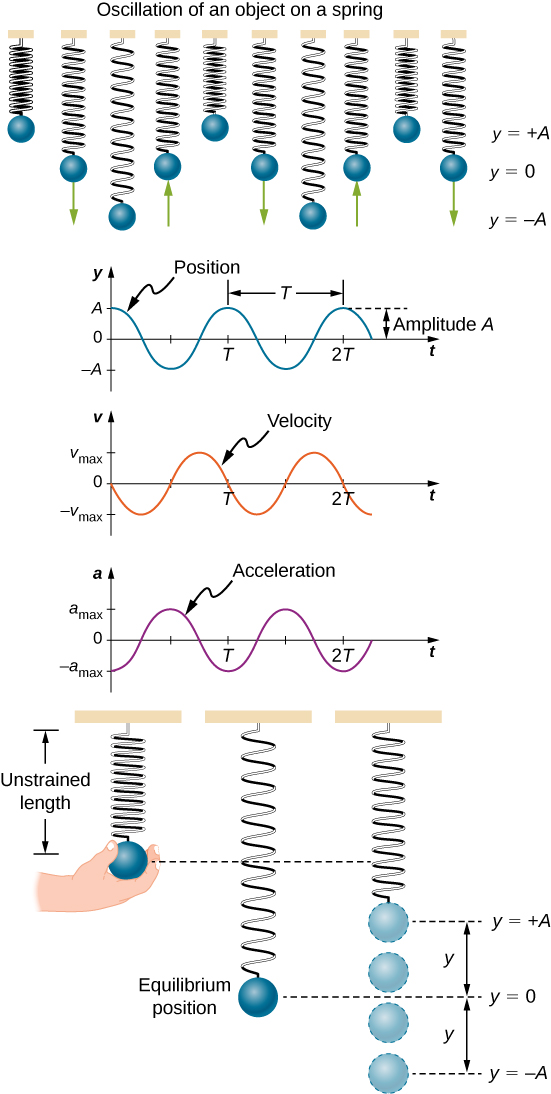
If the block is displaced and released, it will oscillate around the new equilibrium position. As shown in Figure 15.10, if the position of the block is recorded as a function of time, the recording is a periodic function.
英語のヒント
ブロックを変位させて放すと、新しいつり合いの位置の周りで振動する。図15.10のように位置を時間の関数として記録すると、その記録は周期関数となる。
If the block is displaced to a position y, the net force becomes . But we found that at the equilibrium position, . Substituting for the weight in the equation yields
英語のヒント
ブロックを位置yまで変位させると、合力はとなる。つり合いの位置ではであった。重さをこの関係で置き換えると、次の式になる。
Recall that is just the equilibrium position and any position can be set to be the point So let’s set to The net force then becomes
英語のヒント
は単につり合いの位置であり、どの位置をに選んでもよいことを思い出そう。そこでをとおく。このとき合力は次のようになる。
This is just what we found previously for a horizontally sliding mass on a spring. The constant force of gravity only served to shift the equilibrium location of the mass. Therefore, the solution should be the same form as for a block on a horizontal spring, The equations for the velocity and the acceleration also have the same form as for the horizontal case. Note that the inclusion of the phase shift means that the motion can actually be modeled using either a cosine or a sine function, since these two functions only differ by a phase shift.
英語のヒント
これは、水平面上を滑る、ばねにつながれた質点について先ほど得た式と同じである。一定の重力は、質点のつり合いの位置をずらすだけだった。したがって、解は水平なばねの場合と同じ形になるはずである。速度と加速度の式も、水平の場合と同じ形になる。位相のずれを含めれば、運動は余弦でも正弦でも表せることに注意しよう。この二つの関数の違いは、位相のずれだけだからである。
OpenStax / Rice University, University Physics Volume 1, CC BY 4.0. Source-book artwork retained. · CC BY 4.0 · Source出典

Figure 15.10図 15.10
Graphs of y(t), v(t), and a(t) versus t for the motion of an object on a vertical spring. The net force on the object can be described by Hooke’s law, so the object undergoes SHM. Note that the initial position has the vertical displacement at its maximum value A; v is initially zero and then negative as the object moves down; the initial acceleration is negative, back toward the equilibrium position and becomes zero at that point.
英語のヒント
鉛直なばねにつながれた物体の、y(t)、v(t)、a(t)とtのグラフ。物体への合力はフックの法則で表せるので、運動は単振動となる。初期位置では鉛直変位が最大値Aである。速度vは初めゼロで、物体が下がると負になる。初期加速度はつり合いの位置へ向かう負方向で、つり合いの位置ではゼロとなる。