第15章振動
15.6 Forced Oscillations15.6 強制振動
Learning Objectives学習目標
Learning Objectives学習目標
By the end of this section, you will be able to:
英語のヒント
この節を終えると、次のことができるようになる。
- Define forced oscillations
英語のヒント
強制振動を定義する。 - List the equations of motion associated with forced oscillations
英語のヒント
強制振動に関わる運動の式を挙げる。 - Explain the concept of resonance and its impact on the amplitude of an oscillator
英語のヒント
共振の概念と、振動子の振幅に与える影響を説明する。 - List the characteristics of a system oscillating in resonance
英語のヒント
共振している系の性質を挙げる。
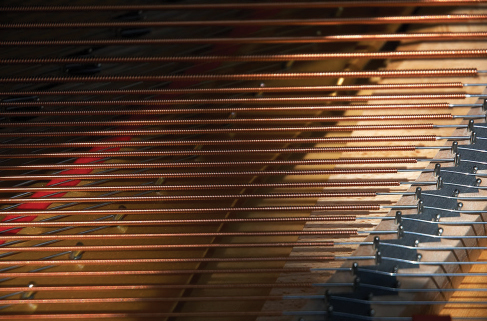
Sit in front of a piano sometime and sing a loud brief note at it with the dampers off its strings (Figure 15.28). It will sing the same note back at you—the strings, having the same frequencies as your voice, are resonating in response to the forces from the sound waves that you sent to them. This is a good example of the fact that objects—in this case, piano strings—can be forced to oscillate, and oscillate most easily at their natural frequency. In this section, we briefly explore applying a periodic driving force acting on a simple harmonic oscillator. The driving force puts energy into the system at a certain frequency, not necessarily the same as the natural frequency of the system. Recall that the natural frequency is the frequency at which a system would oscillate if there were no driving and no damping force.
英語のヒント
いつかピアノの前に座り、弦のダンパーを外して、短く大きな声で一つの音を歌ってみよう(図15.28)。ピアノは同じ音を返す。声と同じ振動数の弦が、届いた音波の力に応じて共振するからである。これは、物体、ここではピアノの弦に外から振動を起こせること、そして固有振動数で最も振動しやすいことの、よい例である。この節では、単振動子に周期的な駆動力を加える場合を簡単に調べる。駆動力はある振動数で系へエネルギーを与えるが、その振動数は系の固有振動数と同じとは限らない。固有振動数とは、駆動力も減衰力もないときに系が振動する振動数である。
Matt Billings, Piano strings. Modified in OpenStax University Physics Volume 1. CC BY 2.0. · CC BY 2.0 · Source出典

Figure 15.28図 15.28
You can cause the strings in a piano to vibrate simply by producing sound waves from your voice. (credit: Matt Billings)
英語のヒント
声で音波を発するだけで、ピアノの弦を振動させられる。(クレジット:Matt Billings)
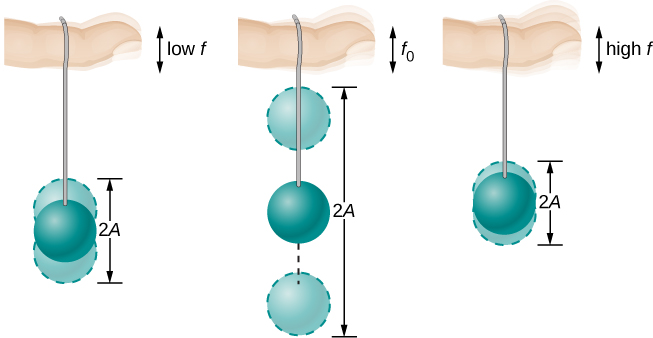
Most of us have played with toys involving an object supported on an elastic band, something like the paddle ball suspended from a finger in Figure 15.29. Imagine the finger in the figure is your finger. At first, you hold your finger steady, and the ball bounces up and down with a small amount of damping. If you move your finger up and down slowly, the ball follows along without bouncing much on its own. As you increase the frequency at which you move your finger up and down, the ball responds by oscillating with increasing amplitude. When you drive the ball at its natural frequency, the ball’s oscillations increase in amplitude with each oscillation for as long as you drive it. The phenomenon of driving a system with a frequency equal to its natural frequency is called resonance. A system being driven at its natural frequency is said to resonate. As the driving frequency gets progressively higher than the resonant or natural frequency, the amplitude of the oscillations becomes smaller until the oscillations nearly disappear, and your finger simply moves up and down with little effect on the ball.
英語のヒント
多くの人は、図15.29で指からつるしたゴムひも付きのボールのように、物体をゴムで支えたおもちゃで遊んだことがあるだろう。図の指を自分の指だと思おう。初めに指を動かさずにいると、ボールは少しずつ減衰しながら上下する。指をゆっくり上下させると、ボールは自分ではあまり跳ねず、指の動きについてくる。指を上下させる振動数を増すと、ボールはより大きな振幅で振動する。固有振動数でボールを駆動すると、駆動し続ける限り、1回の振動ごとに振幅が増す。系を固有振動数と等しい振動数で駆動する現象を共振と呼び、その状態の系は共振しているという。駆動振動数を固有振動数、すなわち共振振動数よりさらに高くしていくと、振幅は小さくなり、やがて振動はほぼ消える。指だけが上下し、ボールにはほとんど影響しなくなる。
OpenStax / Rice University, University Physics Volume 1, CC BY 4.0. Source-book artwork retained. · CC BY 4.0 · Source出典

Figure 15.29図 15.29
The paddle ball on its rubber band moves in response to the finger supporting it. If the finger moves with the natural frequency of the ball on the rubber band, then a resonance is achieved, and the amplitude of the ball’s oscillations increases dramatically. At higher and lower driving frequencies, energy is transferred to the ball less efficiently, and it responds with lower-amplitude oscillations.
英語のヒント
ゴムひも付きのボールは、それを支える指の動きに応答する。指がボールとゴムひもの固有振動数で動くと共振し、ボールの振幅が大きく増す。それより高い、または低い振動数では、ボールへのエネルギー伝達の効率が下がり、振幅も小さくなる。
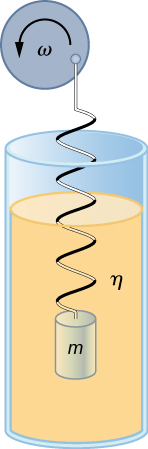
Consider a simple experiment. Attach a mass m to a spring in a viscous fluid, similar to the apparatus discussed in the damped harmonic oscillator. This time, instead of fixing the free end of the spring, attach the free end to a disk that is driven by a variable-speed motor. The motor turns with an angular driving frequency of . The rotating disk provides energy to the system by the work done by the driving force . The experimental apparatus is shown in Figure 15.30.
英語のヒント
簡単な実験を考えよう。減衰振動子で扱った装置と同様に、粘性流体中の質量mをばねにつなぐ。今回はばねの自由端を固定する代わりに、可変速モーターで回す円板へ取り付ける。モーターは駆動角振動数で回る。回転円板は、駆動力の仕事によって系へエネルギーを与える。図15.30に装置を示す。
OpenStax / Rice University, University Physics Volume 1, CC BY 4.0. Source-book artwork retained. · CC BY 4.0 · Source出典

Figure 15.30図 15.30
Forced, damped harmonic motion produced by driving a spring and mass with a disk driven by a variable-speed motor.
英語のヒント
可変速モーターで回す円板によってばねと質点を駆動し、強制減衰調和振動を起こす。
Using Newton’s second law we can analyze the motion of the mass. The resulting equation is similar to the force equation for the damped harmonic oscillator, with the addition of the driving force:
英語のヒント
ニュートンの第2法則を使って、質点の運動を調べられる。得られる式は、減衰調和振動子の力の式に駆動力を加えたものである。
When an oscillator is forced with a periodic driving force, the motion may seem chaotic. The motions of the oscillator is known as transients. After the transients die out, the oscillator reaches a steady state, where the motion is periodic. After some time, the steady state solution to this differential equation is
英語のヒント
振動子に周期的な駆動力を加えると、運動は一見カオス的に見えることがある。この初期の運動を過渡運動と呼ぶ。過渡運動が消えると、周期的な運動をする定常状態に達する。十分に時間がたった後、この微分方程式の定常解は次のようになる。
Once again, it is left as an exercise to prove that this equation is a solution. Taking the first and second time derivative of x(t) and substituting them into the force equation shows that is a solution as long as the amplitude is equal to
英語のヒント
この式が解となる証明も、練習問題とする。x(t)を時間で1回および2回微分し、力の式へ代入すると、振幅が次の値に等しい限り、が解となることが分かる。
where is the natural frequency of the mass/spring system. Recall that the angular frequency, and therefore the frequency, of the motor can be adjusted. Looking at the denominator of the equation for the amplitude, when the driving frequency is much smaller, or much larger, than the natural frequency, the square of the difference of the two angular frequencies is positive and large, making the denominator large, and the result is a small amplitude for the oscillations of the mass. As the frequency of the driving force approaches the natural frequency of the system, the denominator becomes small and the amplitude of the oscillations becomes large. The maximum amplitude results when the frequency of the driving force equals the natural frequency of the system .
英語のヒント
ここでは質点とばねの系の固有振動数である。モーターの角振動数、したがって振動数は調節できることを思い出そう。振幅の式の分母を見ると、駆動振動数が固有振動数よりはるかに小さい、または大きい場合、二つの角振動数の差に関する2乗の項は大きな正の値になる。分母が大きくなるため、質点の振幅は小さい。駆動力の振動数を系の固有振動数へ近づけると、分母が小さくなり、振幅は大きくなる。駆動振動数が固有振動数と等しいとき、振幅は最大値となる。
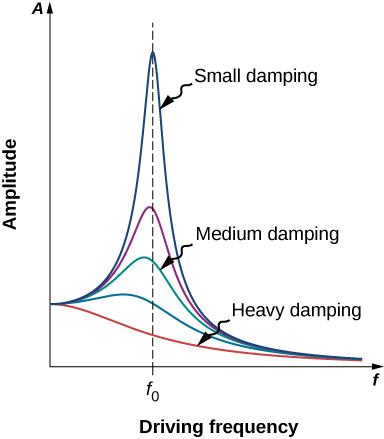
Figure 15.31 shows a graph of the amplitude of a damped harmonic oscillator as a function of the frequency of the periodic force driving it. Each of the three curves on the graph represents a different amount of damping. All three curves peak at the point where the frequency of the driving force equals the natural frequency of the harmonic oscillator. The highest peak, or greatest response, is for the least amount of damping, because less energy is removed by the damping force. Note that since the amplitude grows as the damping decreases, taking this to the limit where there is no damping , the amplitude becomes infinite.
英語のヒント
図15.31は、減衰調和振動子の振幅を、それを駆動する周期力の振動数の関数として示す。3本の曲線は、それぞれ異なる減衰量に対応する。どの曲線も、駆動振動数が固有振動数に等しい位置でピークを持つ。減衰力によって失われるエネルギーが少ないため、減衰が最小の場合にピーク、すなわち応答が最大となる。減衰を減らすと振幅が増すので、減衰がない極限では振幅は無限大となる。
Note that a small-amplitude driving force can produce a large-amplitude response. This phenomenon is known as resonance. A common example of resonance is a parent pushing a small child on a swing. When the child wants to go higher, the parent does not move back and then, getting a running start, slam into the child, applying a great force in a short interval. Instead, the parent applies small pushes to the child at just the right frequency, and the amplitude of the child’s swings increases.
英語のヒント
振幅の小さい駆動力でも、大振幅の応答を生めることに注目しよう。この現象が共振である。よくある例は、親が小さな子どものブランコを押す場合である。子どもがもっと高く上がりたいとき、親は後ろへ下がって助走し、短時間に大きな力で子どもへ体当たりするわけではない。代わりに、ちょうどよい頻度で小さく押すことで、ブランコの振幅を増している。
OpenStax / Rice University, University Physics Volume 1, CC BY 4.0. Source-book artwork retained. · CC BY 4.0 · Source出典

Figure 15.31図 15.31
Amplitude of a harmonic oscillator as a function of the frequency of the driving force. The curves represent the same oscillator with the same natural frequency but with different amounts of damping. Resonance occurs when the driving frequency equals the natural frequency, and the greatest response is for the least amount of damping. The narrowest response is also for the least damping.
英語のヒント
駆動力の振動数に対する、調和振動子の振幅。曲線は固有振動数が同じ一つの振動子について、減衰の大きさを変えたものである。駆動振動数が固有振動数と等しいとき共振し、減衰が最小の場合に応答が最大となる。応答の幅も、減衰が最小の場合に最も狭い。
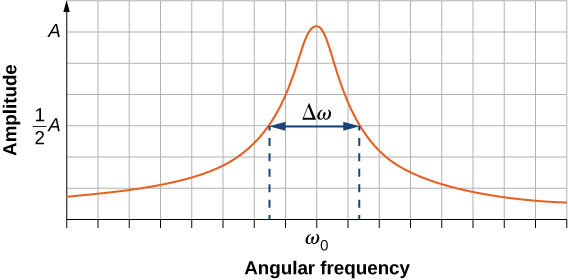
It is interesting to note that the widths of the resonance curves shown in Figure 15.31 depend on damping: the less the damping, the narrower the resonance. The consequence is that if you want a driven oscillator to resonate at a very specific frequency, you need as little damping as possible. For instance, a radio has a circuit that is used to choose a particular radio station. In this case, the forced damped oscillator consists of a resistor, capacitor, and inductor, which will be discussed later in this course. The circuit is “tuned” to pick a particular radio station. Here it is desirable to have the resonance curve be very narrow, to pick out the exact frequency of the radio station chosen. The narrowness of the graph, and the ability to pick out a certain frequency, is known as the quality of the system. The quality, Q, is defined as the spread of the angular frequency, or equivalently, as inverse of the fractional bandwidth, i.e., the natural frequency divided by the spread in the frequency at half the maximum amplitude as shown in Figure 15.32. For a small damping, the quality is approximately equal to .
英語のヒント
図15.31の共振曲線の幅が、減衰に依存することは興味深い。減衰が小さいほど、共振の幅は狭くなる。したがって、ごく特定の振動数で振動子を共振させたい場合、減衰をできる限り小さくする必要がある。たとえばラジオには、特定の放送局を選ぶ回路がある。この場合、強制減衰振動子は抵抗、コンデンサー、インダクターからなり、後で詳しく扱う。回路を「同調」させて、特定の放送局を選ぶのである。選んだ局の正確な振動数を拾うため、共振曲線は非常に狭いほうがよい。グラフの幅の狭さ、すなわち特定の振動数を選び出す能力を、系のQ値と呼ぶ。Q値は角振動数の広がりから定義され、比帯域幅の逆数に相当する。すなわち図15.32のように、固有振動数を、最大振幅の半分の高さでの振動数の幅で割ったである。減衰が小さいとき、Q値は近似的にとなる。
OpenStax / Rice University, University Physics Volume 1, CC BY 4.0. Source-book artwork retained. · CC BY 4.0 · Source出典

Figure 15.32図 15.32
The quality of a system is defined as the spread in the frequencies at half the amplitude divided by the natural frequency.
英語のヒント
系のQ値は、半振幅の高さでの振動数の幅を、固有振動数で割ったものと定義する。
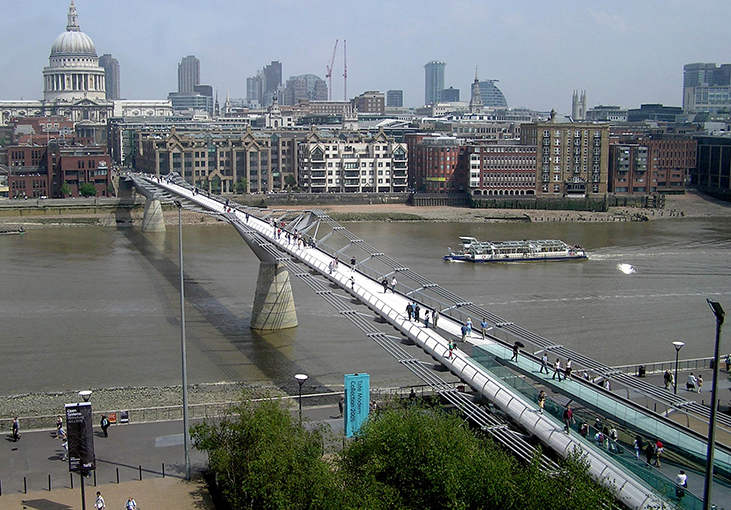
These features of driven harmonic oscillators apply to a huge variety of systems. For instance, magnetic resonance imaging (MRI) is a widely used medical diagnostic tool in which atomic nuclei (mostly hydrogen nuclei or protons) are made to resonate by incoming radio waves (on the order of 100 MHz). In all of these cases, the efficiency of energy transfer from the driving force into the oscillator is best at resonance. Figure 15.33 shows the London Millennium Footbridge that allows pedestrians to cross the River Thames in London. This bridge was nicknamed “Wobbly Bridge” when pedestrians experienced swaying motion while crossing it. The bridge was closed for roughly two years to get rid of this motion.
英語のヒント
駆動される調和振動子のこれらの性質は、非常に多くの系に当てはまる。たとえば、広く使われる医療診断装置の磁気共鳴画像法(MRI)では、原子核、主に水素原子核である陽子を、約100 MHzの電波によって共鳴させる。こうした場合はいずれも、共振時に駆動力から振動子へのエネルギー伝達が最も効率よく起こる。図15.33は、ロンドンのテムズ川を歩いて渡れるミレニアム歩道橋である。開通時、歩行者が橋の揺れを感じたため「揺れる橋」と呼ばれた。この動きを取り除くため、約2年間閉鎖された。
Adrian Pingstone (Arpingstone). Public-domain photograph. Modified in OpenStax University Physics Volume 1. · Public Domain · Source出典

Figure 15.33図 15.33
Initially when people crossed the London Millennium Footbridge, they experienced a swaying motion. People continuing to cross reinforced the oscillation’s amplitude, thereby increasing the problematic swaying. (credit: Adrian Pingstone/Wikimedia Commons)
英語のヒント
ロンドンのミレニアム歩道橋は、開通当初、渡る人が揺れを感じた。人が渡り続けることで振動の振幅が増し、問題となる揺れがさらに大きくなった。(クレジット:Adrian Pingstone/Wikimedia Commons)