第15章振動
15.1 Simple Harmonic Motion15.1 単振動
Learning Objectives学習目標
Learning Objectives学習目標
By the end of this section, you will be able to:
英語のヒント
この節を終えると、次のことができるようになる。
- Define the terms period and frequency
英語のヒント
周期と振動数という用語を定義する。 - List the characteristics of simple harmonic motion
英語のヒント
単振動の性質を列挙する。 - Explain the concept of phase shift
英語のヒント
位相のずれの概念を説明する。 - Write the equations of motion for the system of a mass and spring undergoing simple harmonic motion
英語のヒント
単振動する質点とばねの系について、運動の式を書く。 - Describe the motion of a mass oscillating on a vertical spring
英語のヒント
鉛直なばねにつながれた質点の振動を説明する。
When you pluck a guitar string, the resulting sound has a steady tone and lasts a long time (Figure 15.2). The string vibrates around an equilibrium position, and one oscillation is completed when the string starts from the initial position, travels to one of the extreme positions, then to the other extreme position, and returns to its initial position. We define periodic motion to be any motion that repeats itself at regular time intervals, such as exhibited by the guitar string or by a child swinging on a swing. In this section, we study the basic characteristics of oscillations and their mathematical description.
英語のヒント
ギターの弦をはじくと、音の高さが安定した音が長く続く(図15.2)。弦はつり合いの位置の周りを振動する。初めの位置から一方の端へ進み、反対側の端を経て初めの位置に戻ると、1回の振動が完了する。ギターの弦や、子どもがこぐブランコのように、一定の時間間隔で繰り返す運動を周期運動と定義する。この節では、振動の基本的な性質と、その数学的な表し方を学ぶ。
Image omitted because its reuse rights could not be verified.権利の確認ができないため画像を割愛。
Figure 15.2図 15.2
When a guitar string is plucked, the string oscillates up and down in periodic motion. The vibrating string causes the surrounding air molecules to oscillate, producing sound waves. (credit: Yutaka Tsutano)
英語のヒント
ギターの弦をはじくと、弦は上下に周期運動する。振動する弦が周囲の空気分子を振動させ、音波を生む。(クレジット:Yutaka Tsutano)
Period and Frequency in Oscillations振動の周期と振動数
In the absence of friction, the time to complete one oscillation remains constant and is called the period (T). Its units are usually seconds, but may be any convenient unit of time. The word ‘period’ refers to the time for some event whether repetitive or not, but in this chapter, we shall deal primarily in periodic motion, which is by definition repetitive.
英語のヒント
摩擦がなければ、1回の振動にかかる時間は一定であり、これを周期Tと呼ぶ。単位には通常は秒を使うが、適当な時間の単位なら何でもよい。英語のperiodという語は、繰り返しかどうかによらず、ある出来事にかかる時間を指す。しかし、この章では主に、定義上繰り返しである周期運動を扱う。
A concept closely related to period is the frequency of an event. Frequency (f) is defined to be the number of events per unit time. For periodic motion, frequency is the number of oscillations per unit time. The relationship between frequency and period is
英語のヒント
周期に密接に関係する概念が、出来事の頻度である。頻度fは、単位時間当たりの出来事の回数と定義する。周期運動の場合は、単位時間当たりの振動回数であり、振動数と呼ぶ。振動数と周期の関係は次のとおりである。
The SI unit for frequency is the hertz (Hz) and is defined as one cycle per second:
英語のヒント
振動数のSI単位はヘルツ(Hz)であり、1秒当たり1回の振動と定義する。
A cycle is one complete oscillation.
英語のヒント
1サイクルは、完全な1回の振動である。
Example 15.1例題 15.1
Determining the Frequency of Medical Ultrasound医療用超音波の振動数を求める
Ultrasound machines are used by medical professionals to make images for examining internal organs of the body. An ultrasound machine emits high-frequency sound waves, which reflect off the organs, and a computer receives the waves, using them to create a picture. We can use the formulas presented in this module to determine the frequency, based on what we know about oscillations. Consider a medical imaging device that produces ultrasound by oscillating with a period of . What is the frequency of this oscillation?
英語のヒント
医療従事者は、体内の臓器を調べる画像を作るために超音波装置を使う。装置が発する高周波の音波は臓器で反射し、コンピューターがその波を受け取って画像を作る。この節で示した式を使い、振動について分かっていることから振動数を求められる。周期で振動して超音波を発生させる医療用画像装置を考えよう。この振動の振動数はいくらか。
Strategy方針
The period (T) is given and we are asked to find frequency (f).
英語のヒント
周期Tが与えられているので、振動数fを求める。
Solution解答
Substitute for T in :
英語のヒント
のTに、を代入する。
Solve to find
英語のヒント
計算すると、次の値を得る。
Significance考察
This frequency of sound is much higher than the highest frequency that humans can hear (the range of human hearing is 20 Hz to 20,000 Hz); therefore, it is called ultrasound. Appropriate oscillations at this frequency generate ultrasound used for noninvasive medical diagnoses, such as observations of a fetus in the womb.
英語のヒント
この音の振動数は、人が聞き取れる最大の振動数よりはるかに高い。人の可聴域は20 Hzから20,000 Hzであり、このため超音波と呼ばれる。この振動数の適切な振動から生じる超音波は、子宮内の胎児の観察など、体を傷つけない医療診断に使われる。
Characteristics of Simple Harmonic Motion単振動の性質
A very common type of periodic motion is called simple harmonic motion (SHM). A system that oscillates with SHM is called a simple harmonic oscillator.
英語のヒント
非常によく見られる周期運動の一つを、単振動(SHM)と呼ぶ。単振動する系は、単振動子と呼ばれる。
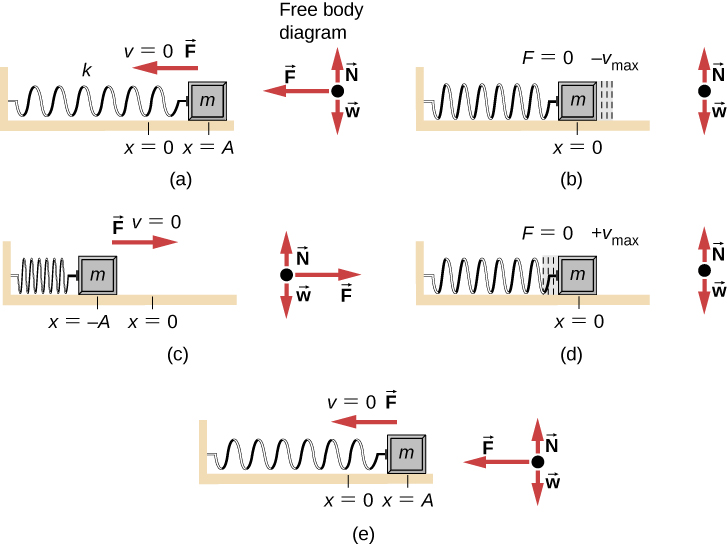
A good example of SHM is an object with mass m attached to a spring on a frictionless surface, as shown in Figure 15.3. The object oscillates around the equilibrium position, and the net force on the object is equal to the force provided by the spring. This force obeys Hooke’s law as discussed in a previous chapter.
英語のヒント
単振動のよい例は、図15.3のように、摩擦のない面上でばねにつながれた質量mの物体である。物体はつり合いの位置の周りを振動し、物体への合力はばねの力に等しい。この力は、前の章で扱ったフックの法則に従う。
If the net force can be described by Hooke’s law and there is no damping (slowing down due to friction or other nonconservative forces), then a simple harmonic oscillator oscillates with equal displacement on either side of the equilibrium position, as shown for an object on a spring in Figure 15.3. The maximum displacement from equilibrium is called the amplitude (A). The units for amplitude and displacement are the same but depend on the type of oscillation. For the object on the spring, the units of amplitude and displacement are meters.
英語のヒント
合力がフックの法則で表せ、摩擦などの非保存力による減速、すなわち減衰がなければ、単振動子はつり合いの位置の両側で同じだけ変位して振動する。図15.3のばねにつながれた物体がその例である。つり合いの位置からの最大変位を振幅Aと呼ぶ。振幅と変位の単位は同じだが、振動の種類によって異なる。ばねにつながれた物体では、どちらもメートルで測る。
OpenStax / Rice University, University Physics Volume 1, CC BY 4.0. Source-book artwork retained. · CC BY 4.0 · Source出典

Figure 15.3図 15.3
An object attached to a spring sliding on a frictionless surface is an uncomplicated simple harmonic oscillator. In the above set of figures, a mass is attached to a spring and placed on a frictionless table. The other end of the spring is attached to the wall. The position of the mass, when the spring is neither stretched nor compressed, is marked as and is the equilibrium position. (a) The mass is displaced to a position and released from rest. (b) The mass accelerates as it moves in the negative x-direction, reaching a maximum negative velocity at . (c) The mass continues to move in the negative x-direction, slowing until it comes to a stop at . (d) The mass now begins to accelerate in the positive x-direction, reaching a positive maximum velocity at . (e) The mass then continues to move in the positive direction until it stops at . The mass continues in SHM that has an amplitude A and a period T. The object’s maximum speed occurs as it passes through equilibrium. The stiffer the spring is, the smaller the period T. The greater the mass of the object is, the greater the period T.
英語のヒント
ばねにつながれ、摩擦のない面上を滑る物体は、単純な単振動子である。上の図では、ばねにつないだ質点を摩擦のない台に置き、ばねの他端を壁に固定している。ばねが伸びも縮みもしていないときの質点の位置をとし、これをつり合いの位置とする。(a) 質点をまで変位させ、静かに放す。(b) 質点はxの負方向へ進みながら加速し、で負方向の最大の速さに達する。(c) さらに負方向へ進み、減速してで止まる。(d) 次に正方向へ加速し、で正方向の最大速度に達する。(e) その後も正方向へ進み、で止まる。質点は振幅A、周期Tで単振動を続ける。つり合いの位置を通るときに速さが最大となる。ばねが硬いほど周期Tは短く、物体の質量が大きいほど周期Tは長い。
What is so significant about SHM? For one thing, the period T and frequency f of a simple harmonic oscillator are independent of amplitude. The string of a guitar, for example, oscillates with the same frequency whether plucked gently or hard.
英語のヒント
単振動には、どのような大切な性質があるのだろうか。一つは、周期Tと振動数fが振幅によらないことである。たとえば、ギターの弦は弱くはじいても強くはじいても、同じ振動数で振動する。
Two important factors do affect the period of a simple harmonic oscillator. The period is related to how stiff the system is. A very stiff object has a large force constant (k), which causes the system to have a smaller period. For example, you can adjust a diving board’s stiffness—the stiffer it is, the faster it vibrates, and the shorter its period. Period also depends on the mass of the oscillating system. The more massive the system is, the longer the period. For example, a heavy person on a diving board bounces up and down more slowly than a light one. In fact, the mass m and the force constant k are the only factors that affect the period and frequency of SHM. To derive an equation for the period and the frequency, we must first define and analyze the equations of motion. Note that the force constant is sometimes referred to as the spring constant.
英語のヒント
単振動子の周期に影響する重要な要因は二つある。周期は系の硬さに関係する。非常に硬い物体は力の定数kが大きく、周期が短くなる。たとえば、飛び込み板の硬さを調節すると、硬くするほど速く振動し、周期が短くなる。周期は振動する系の質量にも依存し、質量が大きいほど長い。重い人が飛び込み板に乗ると、軽い人よりゆっくり上下する。実際、単振動の周期と振動数に影響する要因は、質量mと力の定数kだけである。周期と振動数の式を導くには、まず運動の式を定義し、解析する必要がある。力の定数は、ばね定数と呼ばれることもある。