第15章振動
Oscillations About an Equilibrium Positionつり合いの位置の周りの振動
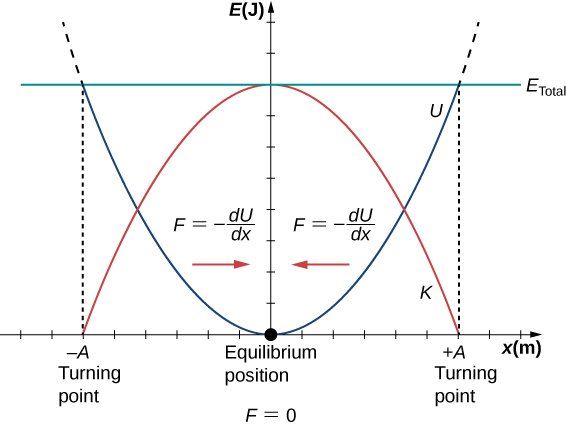
We have just considered the energy of SHM as a function of time. Another interesting view of the simple harmonic oscillator is to consider the energy as a function of position. Figure 15.13 shows a graph of the energy versus position of a system undergoing SHM.
英語のヒント
ここまでは単振動のエネルギーを時間の関数として考えた。別の興味深い見方は、位置の関数として考えることである。図15.13は、単振動する系のエネルギーと位置の関係を示す。
OpenStax / Rice University, University Physics Volume 1, CC BY 4.0. Source-book artwork retained. · CC BY 4.0 · Source出典

Figure 15.13図 15.13
A graph of the kinetic energy (red), potential energy (blue), and total energy (green) of a simple harmonic oscillator. The force is equal to . The equilibrium position is shown as a black dot and is the point where the force is equal to zero. The force is positive when , negative when , and equal to zero when .
英語のヒント
単振動子の運動エネルギー(赤)、位置エネルギー(青)、全エネルギー(緑)。力はに等しい。黒い点はつり合いの位置で、力がゼロとなる点である。力はで正、で負、でゼロとなる。
The potential energy curve in Figure 15.13 resembles a bowl. When a marble is placed in a bowl, it settles to the equilibrium position at the lowest point of the bowl . This happens because a restoring force points toward the equilibrium point. This equilibrium point is sometimes referred to as a fixed point. When the marble is disturbed to a different position , the marble oscillates around the equilibrium position. Looking back at the graph of potential energy, the force can be found by looking at the slope of the potential energy graph . Since the force on either side of the fixed point points back toward the equilibrium point, the equilibrium point is called a stable equilibrium point. The points and are called the turning points. (See Potential Energy and Conservation of Energy.)
英語のヒント
図15.13の位置エネルギー曲線は、お椀の形に似ている。お椀にビー玉を入れると、最も低い点のつり合いの位置へ落ち着く。復元力がつり合いの点へ向くからである。このつり合いの点は固定点とも呼ぶ。ビー玉を別の位置へずらすと、その周りを振動する。位置エネルギーのグラフへ戻ると、力はその傾きからで求められる。固定点の両側で力がつり合いの点へ向くので、ここを安定な平衡点と呼ぶ。とを折り返し点という。「位置エネルギーとエネルギー保存」も参照。
Stability is an important concept. If an equilibrium point is stable, a slight disturbance of an object that is initially at the stable equilibrium point will cause the object to oscillate around that point. The stable equilibrium point occurs because the force on either side is directed toward it. For an unstable equilibrium point, if the object is disturbed slightly, it does not return to the equilibrium point.
英語のヒント
安定性は重要な概念である。平衡点が安定なら、そこに静止している物体を少しずらすと、物体はその点の周りを振動する。両側の力が平衡点へ向くため、安定な平衡が生じる。不安定な平衡点では、物体をわずかにずらしても、その点へ戻らない。
Consider the marble in the bowl example. If the bowl is right-side up, the marble, if disturbed slightly, will oscillate around the stable equilibrium point. If the bowl is turned upside down, the marble can be balanced on the top, at the equilibrium point where the net force is zero. However, if the marble is disturbed slightly, it will not return to the equilibrium point, but will instead roll off the bowl. The reason is that the force on either side of the equilibrium point is directed away from that point. This point is an unstable equilibrium point.
英語のヒント
お椀とビー玉の例を考えよう。お椀を通常の向きに置けば、ビー玉を少しずらすと安定な平衡点の周りを振動する。お椀を逆さにすると、頂上の合力ゼロの点にビー玉をつり合わせることはできる。しかし、わずかにずらすと、そこへ戻らず、お椀から転がり落ちる。平衡点のどちら側でも、力がその点から離れる向きだからである。ここは不安定な平衡点である。
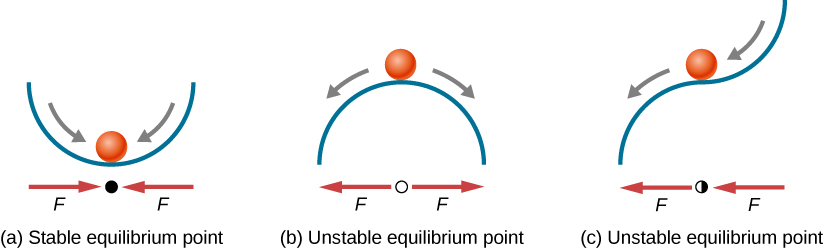
Figure 15.14 shows three conditions. The first is a stable equilibrium point (a), the second is an unstable equilibrium point (b), and the last is also an unstable equilibrium point (c), because the force on only one side points toward the equilibrium point.
英語のヒント
図15.14は三つの場合を示す。(a) は安定な平衡点、(b) は不安定な平衡点である。(c) も、一方の側の力しか平衡点へ向かないため、不安定な平衡点である。
OpenStax / Rice University, University Physics Volume 1, CC BY 4.0. Source-book artwork retained. · CC BY 4.0 · Source出典

Figure 15.14図 15.14
Examples of equilibrium points. (a) Stable equilibrium point; (b) unstable equilibrium point; (c) unstable equilibrium point (sometimes referred to as a half-stable equilibrium point).
英語のヒント
平衡点の例。(a) 安定な平衡点。(b) 不安定な平衡点。(c) 不安定な平衡点で、半安定な平衡点と呼ぶこともある。
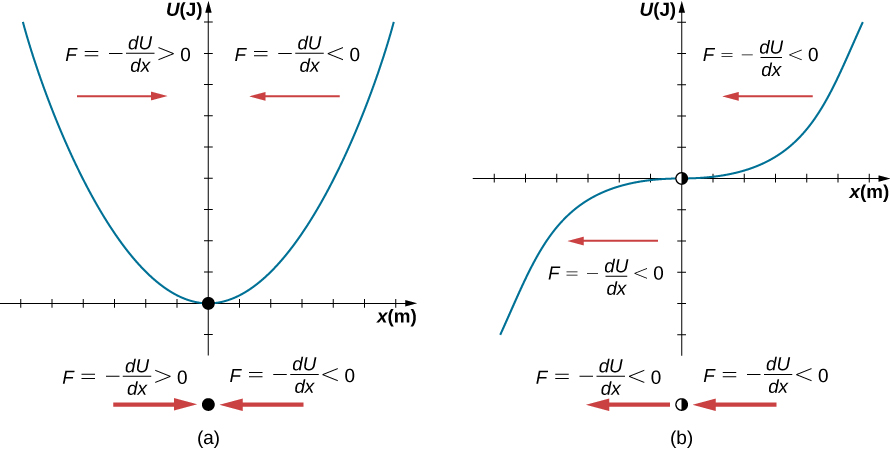
The process of determining whether an equilibrium point is stable or unstable can be formalized. Consider the potential energy curves shown in Figure 15.15. The force can be found by analyzing the slope of the graph. The force is In (a), the fixed point is at When the force is positive. When the force is negative. This is a stable point. In (b), the fixed point is at When the force is negative. When the force is also negative. This is an unstable point.
英語のヒント
平衡点が安定か不安定かを判定する手順は、数式で明確に表せる。図15.15の位置エネルギー曲線を考えよう。力はグラフの傾きから求められ、である。(a) の固定点はにあり、では力が正、では負となる。したがって安定である。(b) の固定点はにあり、でもでも力は負となる。こちらは不安定である。
OpenStax / Rice University, University Physics Volume 1, CC BY 4.0. Source-book artwork retained. · CC BY 4.0 · Source出典

Figure 15.15図 15.15
Two examples of a potential energy function. The force at a position is equal to the negative of the slope of the graph at that position. (a) A potential energy function with a stable equilibrium point. (b) A potential energy function with an unstable equilibrium point. This point is sometimes called half-stable because the force on one side points toward the fixed point.
英語のヒント
位置エネルギー関数の二つの例。ある位置の力は、その位置でのグラフの傾きの符号を逆にしたものに等しい。(a) 安定な平衡点を持つ関数。(b) 不安定な平衡点を持つ関数。一方の側では力が固定点へ向くため、この点を半安定と呼ぶこともある。
A practical application of the concept of stable equilibrium points is the force between two neutral atoms in a molecule. If two molecules are in close proximity, separated by a few atomic diameters, they can experience an attractive force. If the molecules move close enough so that the electron shells of the other electrons overlap, the force between the molecules becomes repulsive. The attractive force between the two atoms may cause the atoms to form a molecule. The force between the two molecules is not a linear force and cannot be modeled simply as two masses separated by a spring, but the atoms of the molecule can oscillate around an equilibrium point when displaced a small amount from the equilibrium position. The atoms oscillate due the attractive force and repulsive force between the two atoms.
英語のヒント
安定な平衡点の概念の実例は、分子を構成する二つの中性原子の間の力である。二つの分子が原子の直径の数倍ほどの近い距離にあると、引力が働くことがある。さらに近づいて互いの電子殻が重なると、分子間の力は反発力になる。二つの原子の間の引力によって、原子が分子を作ることがある。二つの分子の間の力は線形ではなく、二つの質点をばねでつないだものとして単純には表せないが、分子の原子はつり合いの位置から少しずれると、その周りを振動できる。この振動は、二つの原子の間の引力と反発力によって生じる。
Consider one example of the interaction between two atoms known as the van Der Waals interaction. It is beyond the scope of this chapter to discuss in depth the interactions of the two atoms, but the oscillations of the atoms can be examined by considering one example of a model of the potential energy of the system. One suggestion to model the potential energy of this molecule is with the Lennard-Jones 6-12 potential:
英語のヒント
二つの原子間の相互作用の例として、ファンデルワールス相互作用を考える。原子間の相互作用を詳しく論じることは本章の範囲を超えるが、系の位置エネルギーのモデルを一つ考えれば、原子の振動を調べられる。この分子の位置エネルギーを表す候補の一つが、レナード=ジョーンズの6–12ポテンシャルである。
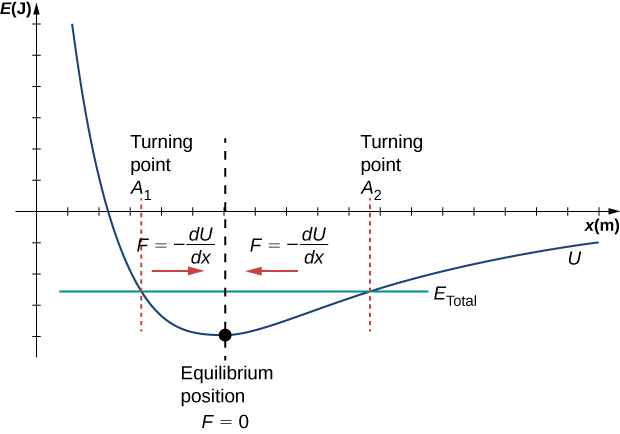
A graph of this function is shown in Figure 15.16. The two parameters and are found experimentally.
英語のヒント
図15.16に、この関数のグラフを示す。二つのパラメーターとは、実験で求める。
OpenStax / Rice University, University Physics Volume 1, CC BY 4.0. Source-book artwork retained. · CC BY 4.0 · Source出典

Figure 15.16図 15.16
The Lennard-Jones potential energy function for a system of two neutral atoms. If the energy is below some maximum energy, the system oscillates near the equilibrium position between the two turning points.
英語のヒント
二つの中性原子からなる系の、レナード=ジョーンズの位置エネルギー関数。エネルギーがある上限より低ければ、系は二つの折り返し点の間で、つり合いの位置付近を振動する。
From the graph, you can see that there is a potential energy well, which has some similarities to the potential energy well of the potential energy function of the simple harmonic oscillator discussed in Figure 15.13. The Lennard-Jones potential has a stable equilibrium point where the potential energy is minimum and the force on either side of the equilibrium point points toward equilibrium point. Note that unlike the simple harmonic oscillator, the potential well of the Lennard-Jones potential is not symmetric. This is due to the fact that the force between the atoms is not a Hooke’s law force and is not linear. The atoms can still oscillate around the equilibrium position because when , the force is positive; when , the force is negative. Notice that as x approaches zero, the slope is quite steep and negative, which means that the force is large and positive. This suggests that it takes a large force to try to push the atoms close together. As x becomes increasingly large, the slope becomes less steep and the force is smaller and negative. This suggests that if given a large enough energy, the atoms can be separated.
英語のヒント
グラフには、図15.13の単振動子の位置エネルギー関数と似た、ポテンシャルの井戸がある。レナード=ジョーンズ・ポテンシャルには、位置エネルギーが最小となり、その両側の力がそこへ向かう、安定な平衡点がある。ただし、単振動子と異なり、井戸は左右対称ではない。原子間の力がフックの法則に従う線形な力ではないからである。それでも原子はつり合いの位置の周りを振動できる。では力が正、では負だからである。xがゼロに近づくと傾きは急な負となり、力は大きな正の値を取る。原子を互いに近づけて押し込むには、大きな力が必要だと分かる。xが非常に大きくなると傾きは緩くなり、力は小さな負となる。したがって、十分に大きなエネルギーを与えれば、原子を引き離せる。
If you are interested in this interaction, find the force between the molecules by taking the derivative of the potential energy function. You will see immediately that the force does not resemble a Hooke’s law force , but if you are familiar with the binomial theorem:
英語のヒント
この相互作用に興味があれば、位置エネルギー関数を微分して、分子間の力を求めてみよう。フックの法則の力とは似ていないことがすぐ分かる。ただし、次の二項定理を知っていれば、
the force can be approximated by a Hooke’s law force.
英語のヒント
この力を、フックの法則の力で近似できる。