第15章振動
15.2 Energy in Simple Harmonic Motion15.2 単振動のエネルギー
Learning Objectives学習目標
Learning Objectives学習目標
By the end of this section, you will be able to:
英語のヒント
この節を終えると、次のことができるようになる。
- Describe the energy conservation of the system of a mass and a spring
英語のヒント
質点とばねの系のエネルギー保存を説明する。 - Explain the concepts of stable and unstable equilibrium points
英語のヒント
安定な平衡点と不安定な平衡点の概念を説明する。
To produce a deformation in an object, we must do work. That is, whether you pluck a guitar string or compress a car’s shock absorber, a force must be exerted through a distance. If the only result is deformation, and no work goes into thermal, sound, or kinetic energy, then all the work is initially stored in the deformed object as some form of potential energy.
英語のヒント
物体を変形させるには、仕事を加えなければならない。ギターの弦をはじく場合でも、車のショックアブソーバーを縮める場合でも、力を加えながらある距離を動かす必要がある。変形だけが起こり、熱、音、運動のエネルギーに仕事が使われなければ、その仕事のすべてが初めに、変形した物体の何らかの位置エネルギーとして蓄えられる。
Consider the example of a block attached to a spring on a frictionless table, oscillating in SHM. The force of the spring is a conservative force (which you studied in the chapter on potential energy and conservation of energy), and we can define a potential energy for it. This potential energy is the energy stored in the spring when the spring is extended or compressed. In this case, the block oscillates in one dimension with the force of the spring acting parallel to the motion:
英語のヒント
摩擦のない台上で、ばねにつながれて単振動するブロックを考える。ばねの力は、位置エネルギーとエネルギー保存の章で学んだ保存力であり、それに対応する位置エネルギーを定義できる。これは、ばねが伸び縮みしたときに蓄えられるエネルギーである。この場合、ばねの力は運動に平行に働き、ブロックは1次元で振動する。
When considering the energy stored in a spring, the equilibrium position, marked as is the position at which the energy stored in the spring is equal to zero. When the spring is stretched or compressed a distance x, the potential energy stored in the spring is
英語のヒント
ばねに蓄えられるエネルギーを考えるとき、と示したつり合いの位置では、そのエネルギーをゼロとする。ばねが距離xだけ伸びたり縮んだりすると、蓄えられる位置エネルギーは次のようになる。
Energy and the Simple Harmonic Oscillatorエネルギーと単振動子
To study the energy of a simple harmonic oscillator, we need to consider all the forms of energy. Consider the example of a block attached to a spring, placed on a frictionless surface, oscillating in SHM. The potential energy stored in the deformation of the spring is
英語のヒント
単振動子のエネルギーを調べるには、すべての形のエネルギーを考える必要がある。摩擦のない面上で、ばねにつながれて単振動するブロックを考えよう。ばねの変形に蓄えられる位置エネルギーは次のとおりである。
In a simple harmonic oscillator, the energy oscillates between kinetic energy of the mass and potential energy stored in the spring. In the SHM of the mass and spring system, there are no dissipative forces, so the total energy is the sum of the potential energy and kinetic energy. In this section, we consider the conservation of energy of the system. The concepts examined are valid for all simple harmonic oscillators, including those where the gravitational force plays a role.
英語のヒント
単振動子のエネルギーは、質点の運動エネルギーと、ばねに蓄えられた位置エネルギーとの間を行き来する。質点とばねの単振動には散逸力がないので、全エネルギーは位置エネルギーと運動エネルギーの和である。この節では、系のエネルギー保存を考える。ここで扱う概念は、重力が関わる場合を含め、すべての単振動子に成り立つ。
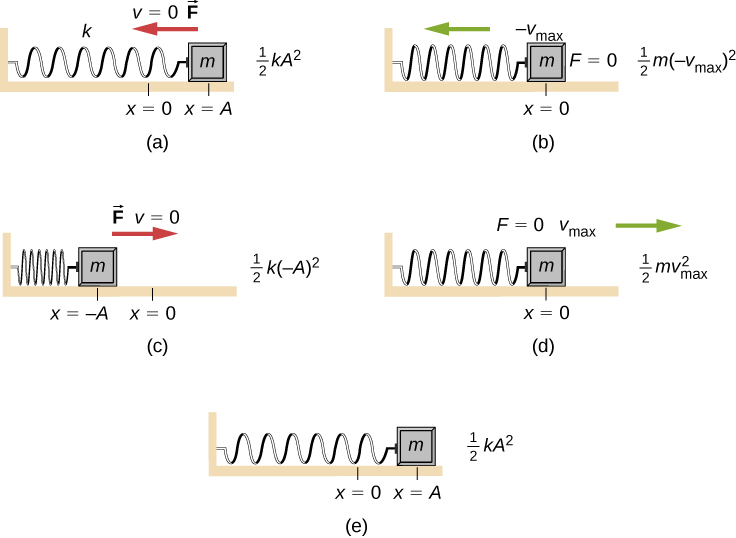
Consider Figure 15.11, which shows an oscillating block attached to a spring. In the case of undamped SHM, the energy oscillates back and forth between kinetic and potential, going completely from one form of energy to the other as the system oscillates. So for the simple example of an object on a frictionless surface attached to a spring, the motion starts with all of the energy stored in the spring as elastic potential energy. As the object starts to move, the elastic potential energy is converted into kinetic energy, becoming entirely kinetic energy at the equilibrium position. The energy is then converted back into elastic potential energy by the spring as it is stretched or compressed. The velocity becomes zero when the kinetic energy is completely converted, and this cycle then repeats. Understanding the conservation of energy in these cycles will provide extra insight here and in later applications of SHM, such as alternating circuits.
英語のヒント
ばねにつながれて振動するブロックを示した図15.11を考えよう。減衰のない単振動では、振動とともにエネルギーが運動エネルギーと位置エネルギーの間を往復し、一方の形から他方へ完全に移り変わる。摩擦のない面上でばねにつながれた物体の例では、初めにすべてのエネルギーが、ばねの弾性位置エネルギーとして蓄えられている。物体が動き始めると、弾性位置エネルギーは運動エネルギーへ変わり、つり合いの位置ではすべてが運動エネルギーとなる。その後、ばねが伸びたり縮んだりするにつれ、再び弾性位置エネルギーへ変わる。運動エネルギーがすべて変換されると速度はゼロになり、この循環を繰り返す。この過程でのエネルギー保存を理解すると、ここでの運動だけでなく、後で扱う交流回路などの単振動の応用も、より深く理解できる。
OpenStax / Rice University, University Physics Volume 1, CC BY 4.0. Source-book artwork retained. · CC BY 4.0 · Source出典

Figure 15.11図 15.11
The transformation of energy in SHM for an object attached to a spring on a frictionless surface. (a) When the mass is at the position , all the energy is stored as potential energy in the spring . The kinetic energy is equal to zero because the velocity of the mass is zero. (b) As the mass moves toward , the mass crosses the position . At this point, the spring is neither extended nor compressed, so the potential energy stored in the spring is zero. At , the total energy is all kinetic energy where . (c) The mass continues to move until it reaches where the mass stops and starts moving toward . At the position , the total energy is stored as potential energy in the compressed and the kinetic energy is zero. (d) As the mass passes through the position , the kinetic energy is and the potential energy stored in the spring is zero. (e) The mass returns to the position , where and .
英語のヒント
摩擦のない面上でばねにつながれた物体の、単振動におけるエネルギーの変換。(a) 質点がにあるとき、すべてのエネルギーはばねの位置エネルギーとして蓄えられている。速度がゼロなので運動エネルギーもゼロである。(b) 質点はへ向かう途中でを通過する。この位置ではばねが伸びも縮みもしていないため、ばねの位置エネルギーはゼロである。では全エネルギーが運動エネルギーであり、となる。(c) 質点はまで進んで止まり、へ向かって動き始める。位置では、全エネルギーが縮んだばねの位置エネルギーとして蓄えられ、運動エネルギーはゼロとなる。(d) を通るとき、運動エネルギーはで、ばねの位置エネルギーはゼロである。(e) 質点はに戻り、、となる。
Consider Figure 15.11, which shows the energy at specific points on the periodic motion. While staying constant, the energy oscillates between the kinetic energy of the block and the potential energy stored in the spring:
英語のヒント
周期運動の特定の点でのエネルギーを示した図15.11を考える。全エネルギーは一定だが、その内訳はブロックの運動エネルギーとばねの位置エネルギーの間を移り変わる。
The motion of the block on a spring in SHM is defined by the position with a velocity of . Using these equations, the trigonometric identity and , we can find the total energy of the system:
英語のヒント
ばねにつながれたブロックの単振動は、位置、速度で表される。これらの式と三角関数の恒等式、さらにを使えば、系の全エネルギーが求められる。
The total energy of the system of a block and a spring is equal to the sum of the potential energy stored in the spring plus the kinetic energy of the block and is proportional to the square of the amplitude The total energy of the system is constant.
英語のヒント
ブロックとばねの系の全エネルギーは、ばねに蓄えられた位置エネルギーとブロックの運動エネルギーの和に等しく、振幅の2乗に比例する:。系の全エネルギーは一定である。
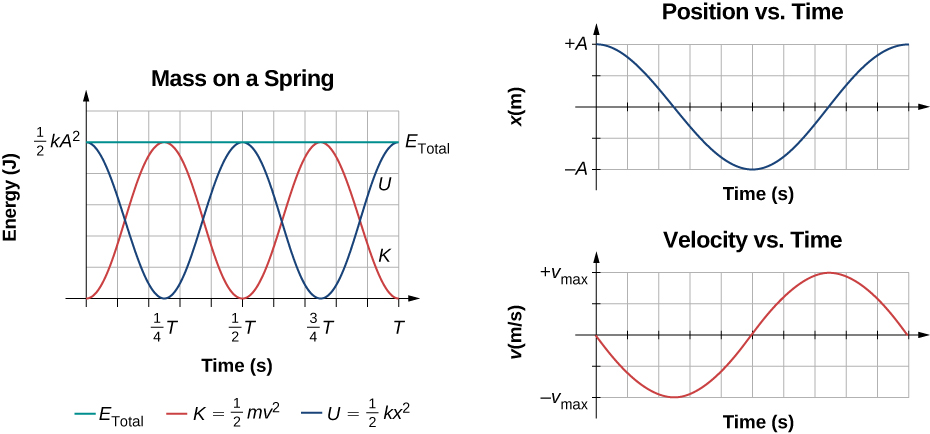
A closer look at the energy of the system shows that the kinetic energy oscillates like a sine-squared function, while the potential energy oscillates like a cosine-squared function. However, the total energy for the system is constant and is proportional to the amplitude squared. Figure 15.12 shows a plot of the potential, kinetic, and total energies of the block and spring system as a function of time. Also plotted are the position and velocity as a function of time. Before time the block is attached to the spring and placed at the equilibrium position. Work is done on the block by applying an external force, pulling it out to a position of . The system now has potential energy stored in the spring. At time the position of the block is equal to the amplitude, the potential energy stored in the spring is equal to , and the force on the block is maximum and points in the negative x-direction . The velocity and kinetic energy of the block are zero at time At time the block is released from rest.
英語のヒント
系のエネルギーを詳しく見ると、運動エネルギーは正弦の2乗のように、位置エネルギーは余弦の2乗のように変動する。ただし、全エネルギーは一定であり、振幅の2乗に比例する。図15.12は、ブロックとばねの系の位置エネルギー、運動エネルギー、全エネルギーを時間の関数として示す。位置と速度の時間変化も示している。時刻より前には、ばねにつながれたブロックをつり合いの位置に置く。外力を加えてまで引くことで仕事を加えると、ばねに位置エネルギーが蓄えられる。時刻では、ブロックの位置は振幅に等しく、ばねの位置エネルギーはで、ブロックへの力は最大となり、xの負方向を向く:。時刻の速度と運動エネルギーはゼロである。時刻に、ブロックを静かに放す。
OpenStax / Rice University, University Physics Volume 1, CC BY 4.0. Source-book artwork retained. · CC BY 4.0 · Source出典

Figure 15.12図 15.12
Graph of the kinetic energy, potential energy, and total energy of a block oscillating on a spring in SHM. Also shown are the graphs of position versus time and velocity versus time. The total energy remains constant, but the energy oscillates between kinetic energy and potential energy. When the kinetic energy is maximum, the potential energy is zero. This occurs when the velocity is maximum and the mass is at the equilibrium position. The potential energy is maximum when the speed is zero. The total energy is the sum of the kinetic energy plus the potential energy and it is constant.
英語のヒント
ばねにつながれたブロックの単振動における、運動エネルギー、位置エネルギー、全エネルギーのグラフ。位置と時間、速度と時間のグラフも示す。全エネルギーは一定だが、エネルギーは運動エネルギーと位置エネルギーの間を移り変わる。運動エネルギーが最大のとき、位置エネルギーはゼロであり、速度が最大、質点はつり合いの位置にある。速さがゼロのときには位置エネルギーが最大となる。全エネルギーは両者の和であり、一定である。