第3章直線上の運動
3.4 Motion with Constant Acceleration3.4 等加速度運動
Learning Objectives学習目標
Learning Objectives学習目標
By the end of this section, you will be able to:
英語のヒント
この節を終えると、次のことができるようになる。
- Identify which equations of motion are to be used to solve for unknowns.
英語のヒント
未知量を求めるために使うべき運動の式を特定する。 - Use appropriate equations of motion to solve a two-body pursuit problem.
英語のヒント
適切な運動の式を使い、二つの物体の追跡問題を解く。
You might guess that the greater the acceleration of a car moving away from a stop sign, the greater the car’s displacement in a given time. But, we have not developed a specific equation that relates acceleration and displacement. In this section, we look at some convenient equations for kinematic relationships, starting from the definitions of displacement, velocity, and acceleration. We first investigate a single object in motion, called single-body motion. Then we investigate the motion of two objects, called two-body pursuit problems.
英語のヒント
一時停止の標識から発進する自動車は、加速度が大きいほど、一定時間内の変位も大きいだろうと予想できる。しかし、加速度と変位を結びつける具体的な式はまだ導いていない。本節では、変位、速度、加速度の定義から出発し、運動学的な関係を表す便利な式を調べる。まず、単一の物体の運動を扱う。その後、二つの物体の運動を、追跡問題として扱う。
Notation記号の表し方
First, let us make some simplifications in notation. Taking the initial time to be zero, as if time is measured with a stopwatch, is a great simplification. Since elapsed time is , taking means that, the final time on the stopwatch. When initial time is taken to be zero, we use the subscript 0 to denote initial values of position and velocity. That is, is the initial position and is the initial velocity. We put no subscripts on the final values. That is, t is the final time, x is the final position, and v is the final velocity. This gives a simpler expression for elapsed time, . It also simplifies the expression for x displacement, which is now . Also, it simplifies the expression for change in velocity, which is now . To summarize, using the simplified notation, with the initial time taken to be zero,
英語のヒント
まず記号の表し方を簡単にしよう。ストップウォッチで時間を測るように、最初の時刻を0とすると大幅に簡単になる。経過時間はなので、とすればとなり、ストップウォッチの最後の時刻に等しくなる。最初の時刻を0としたとき、位置と速度の初期値には添字0を使う。つまり、が初期位置、が初速度である。最後の値には添字を付けない。したがって、tは最後の時刻、xは最終位置、vは最終速度である。これにより、経過時間の式はと簡単になる。x方向の変位の式もとなり、速度の変化の式もとなる。まとめると、最初の時刻を0に取り、簡単にした記号を使えば、次のようになる。
where the subscript 0 denotes an initial value and the absence of a subscript denotes a final value in whatever motion is under consideration.
英語のヒント
ここで、どのような運動を考えている場合でも、添字0は初期値を表し、添字のないものは最後の値を表す。
We now make the important assumption that acceleration is constant. This assumption allows us to avoid using calculus to find instantaneous acceleration. Since acceleration is constant, the average and instantaneous accelerations are equal—that is,
英語のヒント
ここで、加速度は一定であるという重要な仮定を置く。この仮定により、微積分を使わずに瞬間加速度を求められる。加速度が一定なので、平均加速度と瞬間加速度は等しい。すなわち、
Thus, we can use the symbol a for acceleration at all times. Assuming acceleration to be constant does not seriously limit the situations we can study nor does it degrade the accuracy of our treatment. For one thing, acceleration is constant in a great number of situations. Furthermore, in many other situations we can describe motion accurately by assuming a constant acceleration equal to the average acceleration for that motion. Lastly, for motion during which acceleration changes drastically, such as a car accelerating to top speed and then braking to a stop, motion can be considered in separate parts, each of which has its own constant acceleration.
英語のヒント
したがって、どの時刻の加速度にも記号aを使える。加速度を一定と仮定しても、調べられる状況が著しく制限されたり、扱いの精度が低下したりするわけではない。まず、加速度が一定である状況は非常に多い。さらに、それ以外の多くの状況でも、平均加速度に等しい一定の加速度を仮定することで、運動を正確に記述できる。最後に、最高速度まで加速した後にブレーキをかけて停止する自動車のように、加速度が大きく変わる運動も、それぞれ固有の一定の加速度を持つ別々の部分に分けて考えられる。
Displacement and Position from Velocity速度から変位と位置を求める
To get our first two equations, we start with the definition of average velocity:
英語のヒント
最初の二つの式を得るため、平均速度の定義から出発する。
Substituting the simplified notation for and yields
英語のヒント
とを簡単にした記号で置き換えると、次のようになる。
Solving for x gives us
英語のヒント
xについて解くと、次の式を得る。
where the average velocity is
英語のヒント
ここで平均速度は、次の式で与えられる。
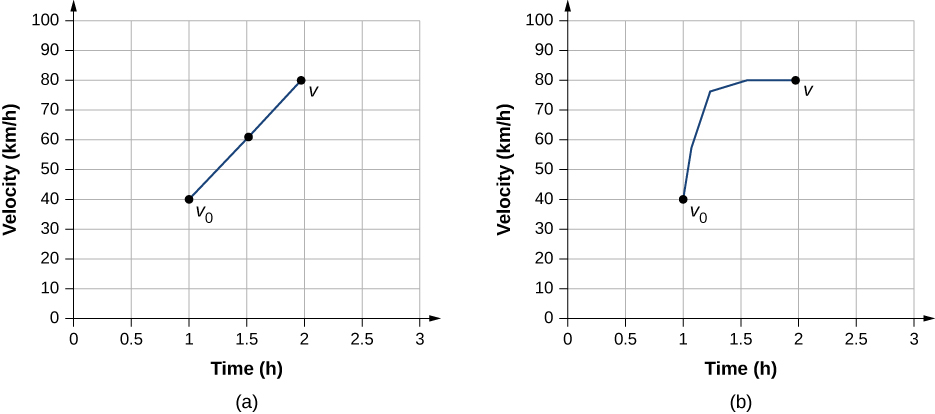
The equation reflects the fact that when acceleration is constant, is just the simple average of the initial and final velocities. Figure 3.18 illustrates this concept graphically. In part (a) of the figure, acceleration is constant, with velocity increasing at a constant rate. The average velocity during the 1-h interval from 40 km/h to 80 km/h is 60 km/h:
英語のヒント
式は、加速度が一定なら、は初速度と最終速度の単純な平均に等しいという事実を反映している。図3.18はこの考えをグラフで示す。(a)では加速度が一定で、速度が一定の割合で増加している。40 km/hから80 km/hまでの1時間の区間の平均速度は60 km/hである。
In part (b), acceleration is not constant. During the 1-h interval, velocity is closer to 80 km/h than 40 km/h. Thus, the average velocity is greater than in part (a).
英語のヒント
(b)では加速度が一定ではない。この1時間の区間では、速度は40 km/hより80 km/hに近い。そのため平均速度は(a)より大きい。
OpenStax / Rice University, University Physics Volume 1, CC BY 4.0. Source-book artwork retained. · CC BY 4.0 · Source出典

Figure 3.18図 3.18
(a) Velocity-versus-time graph with constant acceleration showing the initial and final velocities . The average velocity is . (b) Velocity-versus-time graph with an acceleration that changes with time. The average velocity is not given by , but is greater than 60 km/h.
英語のヒント
(a)等加速度運動の速度と時間のグラフ。初速度と最終速度を示す。平均速度はである。(b)加速度が時間とともに変わる場合の速度と時間のグラフ。平均速度はでは与えられず、60 km/hより大きい。
Solving for Final Velocity from Acceleration and Time加速度と時間から最終速度を求める
We can derive another useful equation by manipulating the definition of acceleration:
英語のヒント
加速度の定義を変形すると、別の便利な式を導ける。
Substituting the simplified notation for and gives us
英語のヒント
とに簡単にした記号を代入すると、次のようになる。
Solving for v yields
英語のヒント
vについて解くと、次の式を得る。
Example 3.7例題 3.7
Calculating Final Velocity最終速度の計算
An airplane lands with an initial velocity of 70.0 m/s and then accelerates opposite to the motion at 1.50 m/s2 for 40.0 s. What is its final velocity?
英語のヒント
飛行機が初速度70.0 m/sで着陸し、その後40.0 sにわたり、運動と逆向きに1.50 m/s2で加速する。最終速度はいくらか。
Strategy方針
First, we identify the knowns: .
英語のヒント
まず既知量を確認する。である。
Second, we identify the unknown; in this case, it is final velocity .
英語のヒント
次に未知量を確認する。この場合は最終速度である。
Last, we determine which equation to use. To do this we figure out which kinematic equation gives the unknown in terms of the knowns. We calculate the final velocity using Equation 3.12, .
英語のヒント
最後に使う式を決める。そのためには、既知量を使って未知量を求められる運動学の式を見つける。式3.12、すなわちを使って最終速度を計算する。
Solution解答
Substitute the known values and solve:
英語のヒント
既知の値を代入して解く。
Figure 3.19 is a sketch that shows the acceleration and velocity vectors.
英語のヒント
図3.19は、加速度ベクトルと速度ベクトルを示した略図である。

OpenStax / Rice University, University Physics Volume 1, CC BY 4.0. Source-book artwork retained. · CC BY 4.0 · Source出典

Figure 3.19図 3.19
The airplane lands with an initial velocity of 70.0 m/s and slows to a final velocity of 10.0 m/s before heading for the terminal. Note the acceleration is negative because its direction is opposite to its velocity, which is positive.
英語のヒント
飛行機は初速度70.0 m/sで着陸し、ターミナルへ向かう前に最終速度10.0 m/sまで減速する。正の速度に対して加速度は逆向きなので、加速度が負であることに注意しよう。
Significance意味の検討
The final velocity is much less than the initial velocity, as desired when slowing down, but is still positive (see figure). With jet engines, reverse thrust can be maintained long enough to stop the plane and start moving it backward, which is indicated by a negative final velocity, but is not the case here.
英語のヒント
最終速度は、減速させたいときに期待するように初速度よりずっと小さいが、依然として正である(図を参照)。ジェットエンジンでは、逆噴射を十分に長く続けると飛行機を停止させ、さらに後方へ動かし始めることができる。その場合は最終速度が負になるが、ここではそこまでは達していない。
In addition to being useful in problem solving, the equation gives us insight into the relationships among velocity, acceleration, and time. We can see, for example, that
英語のヒント
式は、問題を解くのに役立つだけでなく、速度、加速度、時間の関係への理解を深める。例えば、次のことが分かる。
- Final velocity depends on how large the acceleration is and how long it lasts
英語のヒント
最終速度は、加速度がどれほど大きいかと、どれほど長く続くかに依存する。 - If the acceleration is zero, then the final velocity equals the initial velocity (v = v0), as expected (in other words, velocity is constant)
英語のヒント
加速度が0なら、予想されるように最終速度は初速度に等しい(v = v0)。言い換えれば、速度は一定である。 - If a is negative, then the final velocity is less than the initial velocity
英語のヒント
aが負なら、最終速度は初速度より小さい。
All these observations fit our intuition. Note that it is always useful to examine basic equations in light of our intuition and experience to check that they do indeed describe nature accurately.
英語のヒント
これらはすべて直感と一致する。基本的な式を直感や経験に照らして調べ、実際に自然を正しく記述していることを確かめるのは、常に役立つ。