第3章直線上の運動
Speed速さ
In everyday language, most people use the terms speed and velocity interchangeably. In physics, however, they do not have the same meaning and are distinct concepts. One major difference is that speed has no direction; that is, speed is a scalar.
英語のヒント
日常語では、多くの人がspeed(速さ)とvelocity(速度)を同じ意味で使う。しかし物理学では同じ意味ではなく、別々の概念である。大きな違いの一つは、速さに方向がないこと、つまり速さがスカラーであることである。
We can calculate the average speed by finding the total distance traveled divided by the elapsed time:
英語のヒント
全移動距離を経過時間で割れば、平均の速さを計算できる。
Average speed is not necessarily the same as the magnitude of the average velocity, which is found by dividing the magnitude of the total displacement by the elapsed time. For example, if a trip starts and ends at the same location, the total displacement is zero, and therefore the average velocity is zero. The average speed, however, is not zero, because the total distance traveled is greater than zero. If we take a road trip of 300 km and need to be at our destination at a certain time, then we would be interested in our average speed.
英語のヒント
平均の速さは、平均速度の大きさと必ずしも同じではない。平均速度の大きさは、全変位の大きさを経過時間で割って求める。例えば、同じ場所を出発点と到着点にする移動では、全変位が0なので、平均速度も0である。しかし、全移動距離は0より大きいため、平均の速さは0ではない。300 kmの車の旅で、ある時刻までに目的地へ着く必要があるなら、関心があるのは平均の速さである。
However, we can calculate the instantaneous speed from the magnitude of the instantaneous velocity:
英語のヒント
一方、瞬間の速さは、瞬間速度の大きさから計算できる。
If a particle is moving along the x-axis at +7.0 m/s and another particle is moving along the same axis at −7.0 m/s, they have different velocities, but both have the same speed of 7.0 m/s. Some typical speeds are shown in the following table.
英語のヒント
一つの粒子がx軸に沿って+7.0 m/s、別の粒子が同じ軸に沿って−7.0 m/sで動いているとする。両者の速度は異なるが、速さはともに7.0 m/sである。次の表に、代表的な速さをいくつか示す。
Speed 速さ |
m/s |
mi/h |
|---|---|---|
Continental drift 大陸移動 |
||
Brisk walk 速足の歩行 |
1.7 |
3.9 |
Cyclist 自転車 |
4.4 |
10 |
Sprint runner 短距離走者 |
12.2 |
27 |
Rural speed limit 郊外道路の制限速度 |
24.6 |
56 |
Official land speed record 地上最高速度の公式記録 |
341.1 |
763 |
Speed of sound at sea level 海面上の音速 |
343 |
768 |
Space shuttle on reentry 再突入時のスペースシャトル |
7800 |
17,500 |
Escape velocity of Earth* 地球の脱出速度* |
11,200 |
25,000 |
Orbital speed of Earth around the Sun 地球が太陽の周囲を回る軌道速度 |
29,783 |
66,623 |
Speed of light in a vacuum 真空中の光速 |
299,792,458 |
670,616,629 |
Calculating Instantaneous Velocity瞬間速度の計算
When calculating instantaneous velocity, we need to specify the explicit form of the position function . If each term in the equation has the form of where is a constant and is an integer, this can be differentiated using the power rule to be:
英語のヒント
瞬間速度を計算するには、位置関数の具体的な形を指定する必要がある。の式の各項がの形で、が定数、が整数なら、べき乗の微分法則を使って次のように微分できる。
Note that if there are additional terms added together, this power rule of differentiation can be done multiple times and the solution is the sum of those terms. The following example illustrates the use of Equation 3.7.
英語のヒント
ほかの項も加えられている場合には、各項へこのべき乗の微分法則を適用し、その結果を足せばよい。次の例で、式3.7の使い方を示す。
Example 3.3例題 3.3
Instantaneous Velocity Versus Average Velocity瞬間速度と平均速度の比較
The position of a particle is given by .
英語のヒント
粒子の位置がで与えられる。
- Using Equation 3.4 and Equation 3.7, find the instantaneous velocity at s.
英語のヒント
- Calculate the average velocity between 1.0 s and 3.0 s.
英語のヒント
1.0 sから3.0 sまでの平均速度を計算せよ。
Strategy方針
Equation 3.4 gives the instantaneous velocity of the particle as the derivative of the position function. Looking at the form of the position function given, we see that it is a polynomial in t. Therefore, we can use Equation 3.7, the power rule from calculus, to find the solution. We use Equation 3.6 to calculate the average velocity of the particle.
英語のヒント
Solution解答
- .
Substituting t = 2.0 s into this equation gives .英語のヒント
。この式へt = 2.0 sを代入すると、を得る。 - To determine the average velocity of the particle between 1.0 s and 3.0 s, we calculate the values of x(1.0 s) and x(3.0 s):
英語のヒント
1.0 sから3.0 sの間の粒子の平均速度を求めるため、x(1.0 s)とx(3.0 s)を計算する。Then the average velocity is英語のヒント
したがって平均速度は次のようになる。
Significance意味の検討
In the limit that the time interval used to calculate goes to zero, the value obtained for converges to the value of v. The value of that we calculated in part a for the instantaneous value at is close to the average value of found in b for a short interval that includes . If we were to make the interval shorter, the values in the calculation of the average would become even closer.
英語のヒント
の計算に使う時間間隔を0へ近づける極限では、得られるの値はvの値へ収束する。(a)で求めたでの瞬間の値は、(b)で求めたを含む短い区間の平均値に近い。区間をさらに短くすれば、平均値を求める計算の値はさらに近づく。
Example 3.4例題 3.4
Instantaneous Velocity Versus Speed瞬間速度と速さの比較
Consider the motion of a particle in which the position is .
英語のヒント
位置がで表される粒子の運動を考える。
- What is the instantaneous velocity at t = 0.25 s, t = 0.50 s, and t = 1.0 s?
英語のヒント
t = 0.25 s、t = 0.50 s、t = 1.0 sでの瞬間速度はいくらか。 - What is the speed of the particle at these times?
英語のヒント
これらの時刻で粒子の速さはいくらか。
Strategy方針
The instantaneous velocity is the derivative of the position function and the speed is the magnitude of the instantaneous velocity. We use Equation 3.4 and Equation 3.7 to solve for instantaneous velocity.
英語のヒント
Solution解答
Significance意味の検討
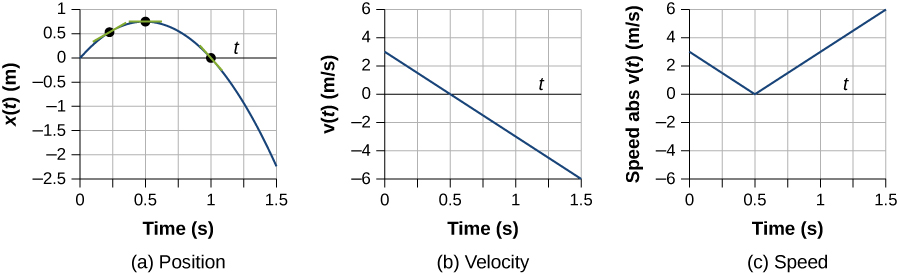
The velocity of the particle gives us direction information, indicating the particle is moving to the left (west) or right (east). The speed gives the magnitude of the velocity. By graphing the position, velocity, and speed as functions of time, we can understand these concepts visually Figure 3.9. In (a), the graph shows the particle moving in the positive direction until t = 0.5 s, when it reverses direction. The reversal of direction can also be seen in (b) at 0.5 s where the velocity is zero and then turns negative. At 1.0 s it is back at the origin where it started. The particle’s velocity at 1.0 s in (b) is negative, because it is traveling in the negative direction. But in (c), however, its speed is positive and remains positive throughout the travel time. We can also interpret velocity as the slope of the position-versus-time graph. The slope of x(t) is decreasing toward zero, becoming zero at 0.5 s and increasingly negative thereafter. This analysis of comparing the graphs of position, velocity, and speed helps catch errors in calculations. The graphs must be consistent with each other and help interpret the calculations.
英語のヒント
粒子の速度からは、左(西)へ動いているか右(東)へ動いているかという向きの情報が得られる。速さは速度の大きさを示す。位置、速度、速さを時間の関数としてグラフに描けば、これらの概念を視覚的に理解できる(図3.9)。(a)のグラフでは、粒子はt = 0.5 sまで正方向へ動き、そこで向きを逆にする。この反転は(b)でも0.5 sのところに見られ、速度は0となってから負になる。1.0 sには、出発点である原点へ戻る。(b)で1.0 sの粒子の速度が負なのは、負方向へ進んでいるためである。しかし(c)では、その速さは正であり、運動の間ずっと正のままである。速度は、位置と時間のグラフの傾きとしても解釈できる。x(t)の傾きは0へ向かって減少し、0.5 sで0となり、その後は負で絶対値がますます大きくなる。このように位置、速度、速さのグラフを比較して分析すると、計算の誤りを見つけやすくなる。グラフは互いに整合していなければならず、計算結果の解釈にも役立つ。
OpenStax / Rice University, University Physics Volume 1, CC BY 4.0. Source-book artwork retained. · CC BY 4.0 · Source出典

Figure 3.9図 3.9
(a) Position: x(t) versus time. (b) Velocity: v(t) versus time. The slope of the position graph is the velocity. A rough comparison of the slopes of the tangent lines in (a) at 0.25 s, 0.5 s, and 1.0 s with the values for velocity at the corresponding times indicates they are the same values. (c) Speed: versus time. Speed is always a positive number.
英語のヒント
(a)位置:x(t)と時間の関係。(b)速度:v(t)と時間の関係。位置グラフの傾きが速度である。(a)の0.25 s、0.5 s、1.0 sにおける接線の傾きを、対応する時刻の速度の値と大まかに比較すると、同じ値であることが分かる。(c)速さ:と時間の関係。速さは常に正の数である。