第6章ニュートンの法則の応用
Particle Equilibrium粒子のつり合い
Recall that a particle in equilibrium is one for which the external forces are balanced. Static equilibrium involves objects at rest, and dynamic equilibrium involves objects in motion without acceleration, but it is important to remember that these conditions are relative. For example, an object may be at rest when viewed from our frame of reference, but the same object would appear to be in motion when viewed by someone moving at a constant velocity. We now make use of the knowledge attained in Newton’s Laws of Motion, regarding the different types of forces and the use of free-body diagrams, to solve additional problems in particle equilibrium.
英語のヒント
つり合った粒子とは、外力がつり合っている粒子である。静的つり合いは静止した物体、動的つり合いは加速度なしで運動する物体を扱うが、これらの状態は相対的である。たとえば、こちらの基準系からは静止して見える物体も、一定の速度で動く人から見れば運動して見える。ここでは、「ニュートンの運動の法則」で学んだ力の種類と力の図の知識を使い、粒子のつり合いの問題をさらに解く。
Example 6.1例題 6.1
Different Tensions at Different Angles角度が違えば張力も違う
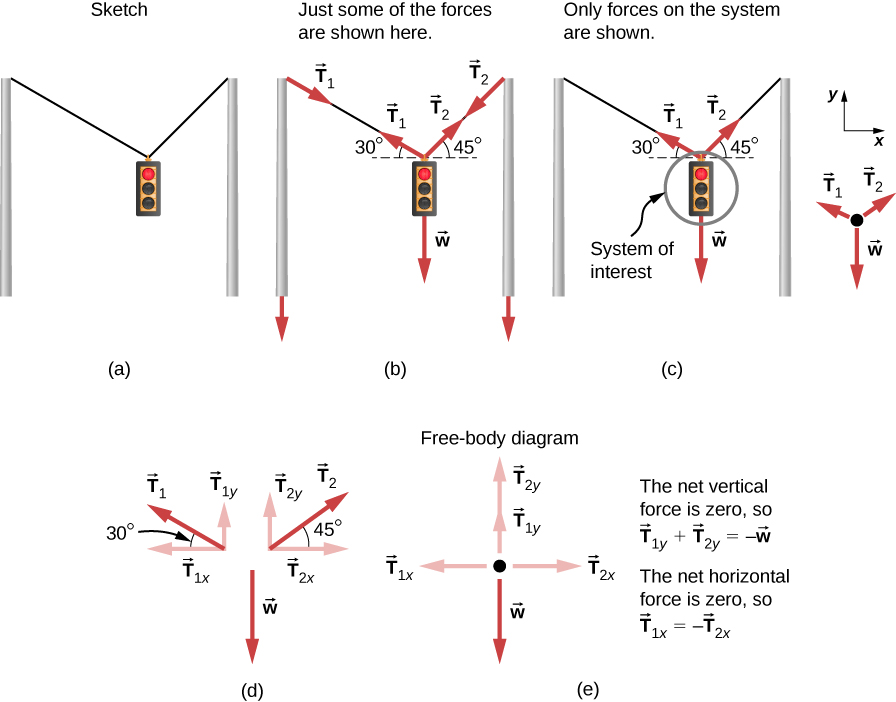
Consider the traffic light (mass of 15.0 kg) suspended from two wires as shown in Figure 6.3. Find the tension in each wire, neglecting the masses of the wires.
英語のヒント
図6.3のように、質量15.0 kgの信号機を二本のワイヤーでつり下げている。ワイヤーの質量を無視し、それぞれの張力を求めよ。
OpenStax / Rice University, University Physics Volume 1, CC BY 4.0. Source-book artwork retained. · CC BY 4.0 · Source出典

Figure 6.3図 6.3
A traffic light is suspended from two wires. (b) Some of the forces involved. (c) Only forces acting on the system are shown here. The free-body diagram for the traffic light is also shown. (d) The forces projected onto vertical (y) and horizontal (x) axes. The horizontal components of the tensions must cancel, and the sum of the vertical components of the tensions must equal the weight of the traffic light. (e) The free-body diagram shows the vertical and horizontal forces acting on the traffic light.
英語のヒント
二本のワイヤーからつり下げられた信号機。(b) 関わる力の一部。(c) 系に働く力だけを示し、信号機の力の図も描く。(d) 力を鉛直のy軸と水平のx軸に投影する。張力の水平成分は打ち消し合い、鉛直成分の和は信号機の重さに等しくなければならない。(e) 信号機に働く鉛直方向と水平方向の力を示す力の図。
Strategy方針
The system of interest is the traffic light, and its free-body diagram is shown in Figure 6.3(c). The three forces involved are not parallel, and so they must be projected onto a coordinate system. The most convenient coordinate system has one axis vertical and one horizontal, and the vector projections on it are shown in Figure 6.3(d). There are two unknowns in this problem ( and ), so two equations are needed to find them. These two equations come from applying Newton’s second law along the vertical and horizontal axes, noting that the net external force is zero along each axis because acceleration is zero.
英語のヒント
Solution解答
First consider the horizontal or x-axis:
英語のヒント
まず、水平方向、すなわちx軸を考える。
Thus, as you might expect,
英語のヒント
したがって、予想されるように、
This gives us the following relationship:
英語のヒント
これより、次の関係が得られる。
Thus,
英語のヒント
よって、
Note that and are not equal in this case because the angles on either side are not equal. It is reasonable that ends up being greater than because it is exerted more vertically than
英語のヒント
この場合は左右の角が違うので、とが等しくないことに注意しよう。はより鉛直に近い向きに働くので、より大きくなるという結果は妥当である。
Now consider the force components along the vertical or y-axis:
英語のヒント
次に、鉛直方向、すなわちy軸に沿う力の成分を考える。
This implies
英語のヒント
これは次の関係を意味する。
Substituting the expressions for the vertical components gives
英語のヒント
鉛直成分の式を代入すると、
There are two unknowns in this equation, but substituting the expression for in terms of reduces this to one equation with one unknown:
英語のヒント
この式には未知量が二つあるが、をで表した式を代入すると、未知量一つの方程式一本になる。
which yields
英語のヒント
これより、
Solving this last equation gives the magnitude of to be
英語のヒント
この最後の式を解くと、の大きさは次のようになる。
Finally, we find the magnitude of by using the relationship between them, , found above. Thus we obtain
英語のヒント
最後に、先に求めた両者の関係を使い、の大きさを求める。したがって、
Significance考察
Both tensions would be larger if both wires were more horizontal, and they will be equal if and only if the angles on either side are the same (as they were in the earlier example of a tightrope walker in Newton’s Laws of Motion.
英語のヒント
両方のワイヤーがより水平に近ければ、張力はどちらも大きくなる。左右の角が等しい場合、そしてその場合に限って、張力は等しくなる。「ニュートンの運動の法則」の綱渡り師の例は、この場合だった。
Particle Acceleration粒子の加速度
We have given a variety of examples of particles in equilibrium. We now turn our attention to particle acceleration problems, which are the result of a nonzero net force. Refer again to the steps given at the beginning of this section, and notice how they are applied to the following examples.
英語のヒント
ここまで、つり合った粒子の例をいろいろ扱った。次は、0でない合力によって生じる粒子の加速度を考える。この節の初めに挙げた手順をもう一度参照し、以下の例でどのように使うかを見よう。
Example 6.2例題 6.2
Drag Force on a Bargeはしけに働く抗力
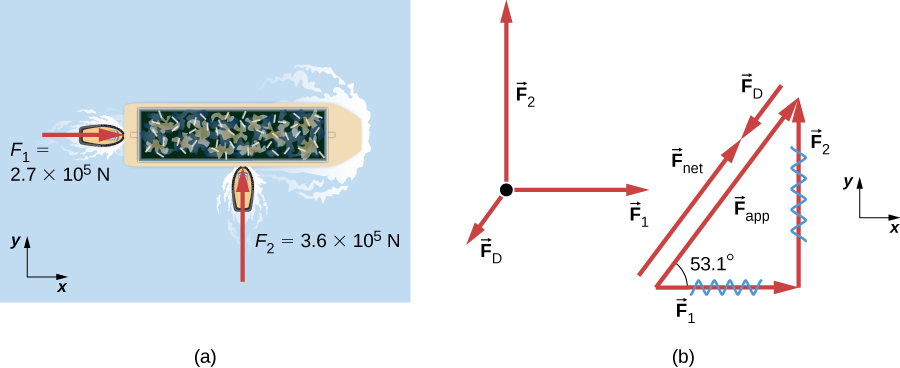
Two tugboats push on a barge at different angles (Figure 6.4). The first tugboat exerts a force of in the x-direction, and the second tugboat exerts a force of in the y-direction. The mass of the barge is and its acceleration is observed to be in the direction shown. What is the drag force of the water on the barge resisting the motion? (Note: Drag force is a frictional force exerted by fluids, such as air or water. The drag force opposes the motion of the object. Since the barge is flat bottomed, we can assume that the drag force is in the direction opposite of motion of the barge.) Assume that the motion and acceleration of the barge are in the same direction.
英語のヒント
二隻のタグボートが、異なる角度ではしけを押す(図6.4)。一隻目はx方向に、二隻目はy方向にの力を及ぼす。はしけの質量はで、図の方向にの加速度をもつことが観測された。水がはしけに及ぼし、運動を妨げる抗力はいくらか。注意:抗力とは、空気や水などの流体が及ぼす摩擦力であり、物体の運動に逆らう。はしけは船底が平らなので、抗力の向きは、はしけの運動と逆向きと仮定できる。はしけの運動と加速度は同じ方向を向くものとする。
OpenStax / Rice University, University Physics Volume 1, CC BY 4.0. Source-book artwork retained. · CC BY 4.0 · Source出典

Figure 6.4図 6.4
(a) A view from above of two tugboats pushing on a barge. (b) The free-body diagram for the ship contains only forces acting in the plane of the water. It omits the two vertical forces—the weight of the barge and the buoyant force of the water supporting it cancel and are not shown. Note that is the total applied force of the tugboats.
英語のヒント
(a) 二隻のタグボートがはしけを押す様子を上から見た図。(b) 船の力の図には、水面内に働く力だけを含める。鉛直方向の二つの力、すなわち重さと、それを支える水の浮力は打ち消し合うので省いている。は、タグボートが加える力の合計である。
Strategy方針
The directions and magnitudes of acceleration and the applied forces are given in Figure 6.4(a). We define the total force of the tugboats on the barge as so that
英語のヒント
図6.4(a)に加速度と加えられた力の大きさ・向きが示されている。タグボートがはしけに及ぼす力の合計をと定めると、
The drag of the water is in the direction opposite to the direction of motion of the boat; this force thus works against as shown in the free-body diagram in Figure 6.4(b). The system of interest here is the barge, since the forces on it are given as well as its acceleration. Because the applied forces are perpendicular, the x- and y-axes are in the same direction as and The problem quickly becomes a one-dimensional problem along the direction of , since friction is in the direction opposite to Our strategy is to find the magnitude and direction of the net applied force and then apply Newton’s second law to solve for the drag force
英語のヒント
水の抗力は、船の運動と逆向きである。したがって、図6.4(b)の力の図にあるように、に逆らう。力と加速度が与えられているはしけを、着目する系とする。加える力は互いに垂直なので、x軸とy軸はそれぞれとの方向である。摩擦力はと逆向きなので、問題はすぐにに沿う一次元の問題になる。方針は、加えられた力の合計の大きさと向きを求め、ニュートンの第2法則を適用して抗力を求めることである。
Solution解答
Since and are perpendicular, we can find the magnitude and direction of directly. First, the resultant magnitude is given by the Pythagorean theorem:
英語のヒント
とは垂直なので、の大きさと向きを直接求められる。まず、合力の大きさはピタゴラスの定理から得られる。
The angle is given by
英語のヒント
角度は、次の式で与えられる。
From Newton’s first law, we know this is the same direction as the acceleration. We also know that is in the opposite direction of since it acts to slow down the acceleration. Therefore, the net external force is in the same direction as but its magnitude is slightly less than The problem is now one-dimensional. From the free-body diagram, we can see that
英語のヒント
ニュートンの第1法則から、これは加速度と同じ向きだと分かる。また、は加速を抑える向きに働くので、と逆向きである。したがって、外力の合力はと同じ向きで、大きさはより少し小さい。問題は一次元となり、力の図から次の式が得られる。
However, Newton’s second law states that
英語のヒント
一方、ニュートンの第2法則によれば、
Thus,
英語のヒント
したがって、
This can be solved for the magnitude of the drag force of the water in terms of known quantities:
英語のヒント
これを水の抗力の大きさについて解き、既知量で表すと、
Substituting known values gives
英語のヒント
既知の値を代入すると、
The direction of has already been determined to be in the direction opposite to or at an angle of south of west.
英語のヒント
の向きは、すでにと逆向き、すなわち西から南へと求めている。
Significance考察
The numbers used in this example are reasonable for a moderately large barge. It is certainly difficult to obtain larger accelerations with tugboats, and small speeds are desirable to avoid running the barge into the docks. Drag is relatively small for a well-designed hull at low speeds, consistent with the answer to this example, where is less than 1/600th of the weight of the ship.
英語のヒント
この例の数値は、やや大型のはしけとして妥当である。タグボートでこれより大きな加速度を得るのは難しく、岸壁に衝突させないためにも、速度は小さいほうがよい。よく設計された船体では低速時の抗力は比較的小さい。が船の重さの600分の1未満となった、この例の答えとも一致する。
In Newton’s Laws of Motion, we discussed the normal force, which is a contact force that acts normal to the surface so that an object does not have an acceleration perpendicular to the surface. The bathroom scale is an excellent example of a normal force acting on a body. It provides a quantitative reading of how much it must push upward to support the weight of an object. But can you predict what you would see on the dial of a bathroom scale if you stood on it during an elevator ride? Will you see a value greater than your weight when the elevator starts up? What about when the elevator moves upward at a constant speed? Take a guess before reading the next example.
英語のヒント
「ニュートンの運動の法則」で扱った垂直抗力は、物体が面に垂直な加速度をもたないよう、面に垂直に働く接触力である。体重計は、物体に働く垂直抗力のよい例になる。物体の重さを支えるために必要な上向きの力を、数値で表示する。では、エレベーター内の体重計に乗ったら、何が表示されるだろうか。エレベーターが上向きに動き始めるとき、自分の重さより大きな値が見えるだろうか。一定の速さで上昇している間はどうか。次の例を読む前に予想してみよう。
Example 6.3例題 6.3
What Does the Bathroom Scale Read in an Elevator?エレベーター内の体重計は何を示すか
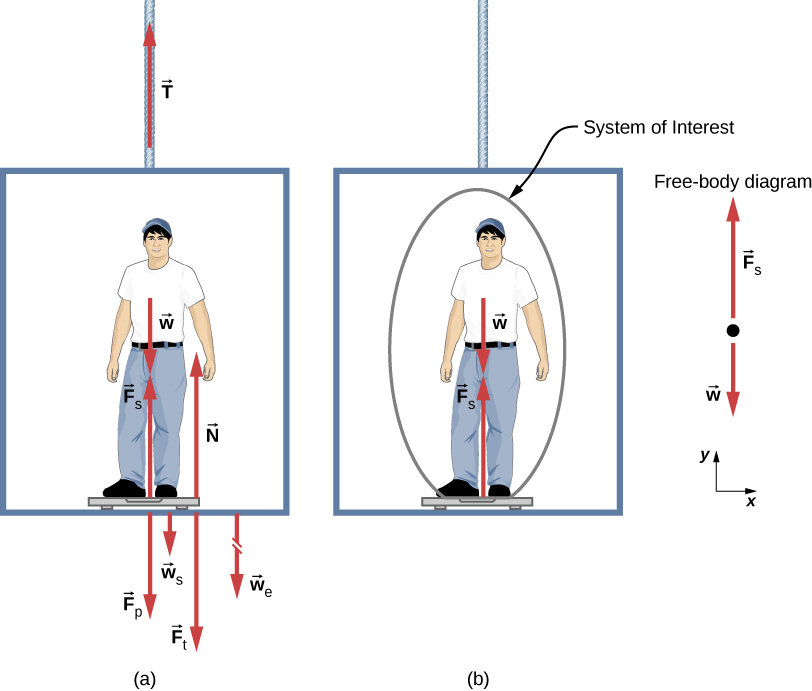
Figure 6.5 shows a 75.0-kg man (weight of about 165 lb.) standing on a bathroom scale in an elevator. Calculate the scale reading: (a) if the elevator accelerates upward at a rate of and (b) if the elevator moves upward at a constant speed of 1 m/s.
英語のヒント
図6.5では、質量75.0 kg、重さ約165 lbの男性が、エレベーター内の体重計に乗っている。(a) エレベーターが上向きにの加速度で加速するとき、(b) 毎秒1 mの一定の速さで上昇するとき、それぞれの体重計の読みを求めよ。
OpenStax / Rice University, University Physics Volume 1, CC BY 4.0. Source-book artwork retained. · CC BY 4.0 · Source出典

Figure 6.5図 6.5
(a) The various forces acting when a person stands on a bathroom scale in an elevator. The arrows are approximately correct for when the elevator is accelerating upward—broken arrows represent forces too large to be drawn to scale. is the tension in the supporting cable, is the weight of the person, is the weight of the scale, is the weight of the elevator, is the force of the scale on the person, is the force of the person on the scale, is the force of the scale on the floor of the elevator, and is the force of the floor upward on the scale. (b) The free-body diagram shows only the external forces acting on the designated system of interest—the person—and is the diagram we use for the solution of the problem.
英語のヒント
(a) エレベーター内で人が体重計に立つときに働くさまざまな力。矢印は、上向きに加速する場合におおむね対応する。途中を切った矢印は、縮尺どおりでは大きすぎる力を表す。は支持ケーブルの張力、は人の重さ、は体重計の重さ、はエレベーターの重さである。は体重計が人に及ぼす力、は人が体重計に及ぼす力、は体重計が床に及ぼす力、は床が体重計に及ぼす上向きの力である。(b) 着目する系として選んだ人に働く外力だけを示した力の図。この図を使って問題を解く。
Strategy方針
If the scale at rest is accurate, its reading equals , the magnitude of the force the person exerts downward on it. Figure 6.5(a) shows the numerous forces acting on the elevator, scale, and person. It makes this one-dimensional problem look much more formidable than if the person is chosen to be the system of interest and a free-body diagram is drawn, as in Figure 6.5(b). Analysis of the free-body diagram using Newton’s laws can produce answers to both Figure 6.5(a) and (b) of this example, as well as some other questions that might arise. The only forces acting on the person are his weight and the upward force of the scale According to Newton’s third law, and are equal in magnitude and opposite in direction, so that we need to find in order to find what the scale reads. We can do this, as usual, by applying Newton’s second law,
英語のヒント
From the free-body diagram, we see that so we have
英語のヒント
力の図からなので、次の式が成り立つ。
Solving for gives us an equation with only one unknown:
英語のヒント
について解くと、未知量が一つだけの式が得られる。
or, because simply
英語のヒント
なので、単に次のようにも書ける。
No assumptions were made about the acceleration, so this solution should be valid for a variety of accelerations in addition to those in this situation. (Note: We are considering the case when the elevator is accelerating upward. If the elevator is accelerating downward, Newton’s second law becomes )
英語のヒント
加速度には特別な仮定を置いていないので、この解は、この状況以外のさまざまな加速度でも成り立つはずである。注意:ここでは上向きに加速する場合を考えている。下向きに加速するならば、ニュートンの第2法則はとなる。
Solution解答
- We have so that
英語のヒント
なので、yielding英語のヒント
したがって、 - Now, what happens when the elevator reaches a constant upward velocity? Will the scale still read more than his weight? For any constant velocity—up, down, or stationary—acceleration is zero because and Thus,
英語のヒント
では、エレベーターが上向きの一定の速度に達するとどうなるか。体重計はまだ重さより大きな値を示すだろうか。上向き、下向き、静止のいずれでも、速度が一定ならば、およびなので加速度は0である。したがって、or英語のヒント
すなわち、which gives英語のヒント
これより、
Significance考察
The scale reading in Figure 6.5(a) is about 185 lb. What would the scale have read if he were stationary? Since his acceleration would be zero, the force of the scale would be equal to his weight:
英語のヒント
図6.5(a)の体重計の読みは約185 lbである。男性が静止していたならば、何を示しただろうか。加速度は0なので、体重計の力は重さに等しくなる。
Thus, the scale reading in the elevator is greater than his 735-N (165-lb.) weight. This means that the scale is pushing up on the person with a force greater than his weight, as it must in order to accelerate him upward. Clearly, the greater the acceleration of the elevator, the greater the scale reading, consistent with what you feel in rapidly accelerating versus slowly accelerating elevators. In Figure 6.5(b), the scale reading is 735 N, which equals the person’s weight. This is the case whenever the elevator has a constant velocity—moving up, moving down, or stationary.
英語のヒント
このように、エレベーター内の読みは、その人の重さ735 N(165 lb)より大きい。これは体重計が人を重さより大きな力で押し上げるということであり、人を上向きに加速するには必要なことである。エレベーターの加速度が大きいほど読みも大きくなる。急加速するエレベーターとゆっくり加速するものとで感じ方が違うことにも合っている。図6.5(b)の読みは735 Nで、人の重さに等しい。速度が一定ならば、上昇、下降、静止のどの場合もこうなる。