第6章ニュートンの法則の応用
Newton’s Laws of Motion and Kinematicsニュートンの運動の法則と運動学
Physics is most interesting and most powerful when applied to general situations that involve more than a narrow set of physical principles. Newton’s laws of motion can also be integrated with other concepts that have been discussed previously in this text to solve problems of motion. For example, forces produce accelerations, a topic of kinematics, and hence the relevance of earlier chapters.
英語のヒント
物理学が最も興味深く、力を発揮するのは、狭い範囲の原理だけにとどまらない一般的な状況に適用するときである。ニュートンの運動の法則も、本書で学んだ他の概念と組み合わせて、運動の問題を解くことができる。たとえば、力は加速度を生じさせる。加速度は運動学の対象なので、前の章の内容とも関わる。
When approaching problems that involve various types of forces, acceleration, velocity, and/or position, listing the givens and the quantities to be calculated will allow you to identify the principles involved. Then, you can refer to the chapters that deal with a particular topic and solve the problem using strategies outlined in the text. The following worked example illustrates how the problem-solving strategy given earlier in this chapter, as well as strategies presented in other chapters, is applied to an integrated concept problem.
英語のヒント
さまざまな力、加速度、速度、位置が関わる問題では、与えられた量と求める量を書き出すと、使う原理を特定できる。その後、その話題を扱う章を参照し、本書で示した方法で解けばよい。次の例では、この章の初めに示した問題解決の方針と、他の章の方針とを、複数の概念を組み合わせた問題にどう適用するかを示す。
Example 6.6例題 6.6
What Force Must a Soccer Player Exert to Reach Top Speed?サッカー選手が最高速度に達するために必要な力
A soccer player starts at rest and accelerates forward, reaching a velocity of 8.00 m/s in 2.50 s. (a) What is her average acceleration? (b) What average force does the ground exert forward on the runner so that she achieves this acceleration? The player’s mass is 70.0 kg, and air resistance is negligible.
英語のヒント
サッカー選手が静止状態から前向きに加速し、2.50 sで毎秒8.00 mに達する。(a) 平均加速度はいくらか。(b) この加速度を得るため、地面は走者に前向きに平均してどれだけの力を及ぼすか。選手の質量は70.0 kgで、空気抵抗は無視できる。
Strategy方針
To find the answers to this problem, we use the problem-solving strategy given earlier in this chapter. The solutions to each part of the example illustrate how to apply specific problem-solving steps. In this case, we do not need to use all of the steps. We simply identify the physical principles, and thus the knowns and unknowns; apply Newton’s second law; and check to see whether the answer is reasonable.
英語のヒント
この章で先に示した問題解決の手順を使う。各小問の解答では、具体的な手順の適用法を示す。この場合はすべての手順を使う必要はない。物理の原理と既知量・未知量を特定し、ニュートンの第2法則を適用して、答えが妥当かどうかを確かめればよい。
Solution解答
- We are given the initial and final velocities (zero and 8.00 m/s forward); thus, the change in velocity is . We are given the elapsed time, so The unknown is acceleration, which can be found from its definition:
英語のヒント
初速度と終速度は、0と前向きに毎秒8.00 mで与えられる。したがって速度の変化はである。経過時間も与えられており、となる。未知量は加速度で、定義から求められる。Substituting the known values yields英語のヒント
既知の値を代入すると、 - Here we are asked to find the average force the ground exerts on the runner to produce this acceleration. (Remember that we are dealing with the force or forces acting on the object of interest.) This is the reaction force to that exerted by the player backward against the ground, by Newton’s third law. Neglecting air resistance, this would be equal in magnitude to the net external force on the player, since this force causes her acceleration. Since we now know the player’s acceleration and are given her mass, we can use Newton’s second law to find the force exerted. That is,
英語のヒント
ここでは、この加速度を生じさせるため地面が走者に及ぼす平均の力を求める。扱うのは、着目する物体に働く力である。ニュートンの第3法則により、これは選手が地面へ後ろ向きに及ぼす力の反作用である。空気抵抗を無視すれば、この力が加速度を生じさせるので、その大きさは選手に働く外力の合力に等しい。加速度は求められており、質量も与えられているので、第2法則を使って力を求められる。すなわち、Substituting the known values of m and a gives英語のヒント
mとaの既知の値を代入すると、
This is a reasonable result: The acceleration is attainable for an athlete in good condition. The force is about 50 pounds, a reasonable average force.
英語のヒント
これは妥当な結果である。この加速度は、体調のよい選手なら達成できる。力は約50ポンドで、平均の力として妥当な値である。
Significance考察
This example illustrates how to apply problem-solving strategies to situations that include topics from different chapters. The first step is to identify the physical principles, the knowns, and the unknowns involved in the problem. The second step is to solve for the unknown, in this case using Newton’s second law. Finally, we check our answer to ensure it is reasonable. These techniques for integrated concept problems will be useful in applications of physics outside of a physics course, such as in your profession, in other science disciplines, and in everyday life.
英語のヒント
この例は、複数の章の内容を含む状況に、問題解決の手順をどう適用するかを示している。最初に、関わる物理の原理、既知量、未知量を特定する。次に未知量を求める。この場合はニュートンの第2法則を使った。最後に、答えの妥当性を確認する。このような複数の概念を組み合わせる問題の解き方は、物理の授業の外でも、自分の職業、他の科学分野、日常生活などで物理を使う際に役立つ。
Example 6.7例題 6.7
What Force Acts on a Model Helicopter?模型ヘリコプターに働く力
A 1.50-kg model helicopter has a velocity of at It is accelerated at a constant rate for two seconds (2.00 s) after which it has a velocity of What is the magnitude of the resultant force acting on the helicopter during this time interval?
英語のヒント
質量1.50 kgの模型ヘリコプターは、で速度をもつ。その後2.00 sの間、一定の加速度で加速し、速度はとなる。この時間に働いた合力の大きさを求めよ。
Strategy方針
We can easily set up a coordinate system in which the x-axis direction) is horizontal, and the y-axis direction) is vertical. We know that and From this, we can calculate the acceleration by the definition; we can then apply Newton’s second law.
英語のヒント
x軸方向)を水平、y軸方向)を鉛直に取ればよい。およびが分かっている。ここから加速度を定義によって計算し、ニュートンの第2法則を適用できる。
Solution解答
We have
英語のヒント
次の式が成り立つ。
The magnitude of the force is now easily found:
英語のヒント
これで力の大きさを簡単に求められる。
Significance考察
The original problem was stated in terms of vector components, so we used vector methods. Compare this example with the previous example.
英語のヒント
元の問題はのベクトル成分で与えられていたので、ベクトルを使って解いた。この例を前の例と比較しよう。
Example 6.8例題 6.8
Baggage Tractor手荷物牽引車
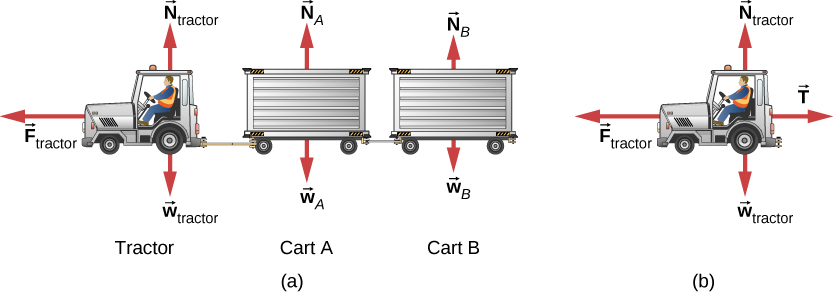
Figure 6.8(a) shows a baggage tractor pulling luggage carts from an airplane. The tractor has mass 650.0 kg, while cart A has mass 250.0 kg and cart B has mass 150.0 kg. The driving force acting for a brief period of time accelerates the system from rest and acts for 3.00 s. (a) If this driving force is given by find the speed after 3.00 seconds. (b) What is the horizontal force acting on the connecting cable between the tractor and cart A at this instant?
英語のヒント
図6.8(a)は、飛行機から手荷物用の台車を引いていく牽引車である。牽引車の質量は650.0 kg、台車Aは250.0 kg、台車Bは150.0 kgである。駆動力は短時間、3.00 sにわたって働き、静止していた系を加速する。(a) 駆動力がで与えられるとき、3.00 s後の速さを求めよ。(b) この瞬間、牽引車と台車Aをつなぐケーブルに働く水平な力はいくらか。
OpenStax / Rice University, University Physics Volume 1, CC BY 4.0. Source-book artwork retained. · CC BY 4.0 · Source出典

Figure 6.8図 6.8
(a) A free-body diagram is shown, which indicates all the external forces on the system consisting of the tractor and baggage carts for carrying airline luggage. (b) A free-body diagram of the tractor only is shown isolated in order to calculate the tension in the cable to the carts.
英語のヒント
(a) 航空手荷物を運ぶ牽引車と台車からなる系に働く、すべての外力を示した力の図。(b) 台車につながるケーブルの張力を求めるため、牽引車だけを取り出して描いた力の図。
Strategy方針
A free-body diagram shows the driving force of the tractor, which gives the system its acceleration. We only need to consider motion in the horizontal direction. The vertical forces balance each other and it is not necessary to consider them. For part b, we make use of a free-body diagram of the tractor alone to determine the force between it and cart A. This exposes the coupling force which is our objective.
英語のヒント
力の図には、系を加速する牽引車の駆動力が示される。考える必要があるのは水平方向の運動だけである。鉛直方向の力はつり合い、考慮する必要がない。(b)では牽引車だけの力の図を使い、牽引車と台車Aの間の力を求める。こうすると、求めたい連結力を表に出せる。
Solution解答
- and so
英語のヒント
およびなので、Since acceleration is a function of time, we can determine the velocity of the tractor by using with the initial condition that at We integrate from to英語のヒント
加速度は時間の関数なので、でという初期条件のもとでを使い、牽引車の速度を求められる。からまで積分する。 -
Significance考察
Since the force varies with time, we must use calculus to solve this problem. Notice how the total mass of the system was important in solving Figure 6.8(a), whereas only the mass of the truck (since it supplied the force) was of use in Figure 6.8(b).
英語のヒント
Recall that and . If acceleration is a function of time, we can use the calculus forms developed in Motion Along a Straight Line, as shown in this example. However, sometimes acceleration is a function of displacement. In this case, we can derive an important result from these calculus relations. Solving for dt in each, we have and Now, equating these expressions, we have We can rearrange this to obtain
英語のヒント
とを思い出そう。加速度が時間の関数ならば、この例のように「直線に沿う運動」で導いた微積分の形を使える。しかし加速度が変位の関数である場合もある。その場合には、これらの微積分の関係から重要な結果を導ける。それぞれをdtについて解くと、とを得る。両式を等しいと置けばとなり、変形するとを得る。
Example 6.9例題 6.9
Motion of a Projectile Fired Vertically鉛直に発射した投射体の運動
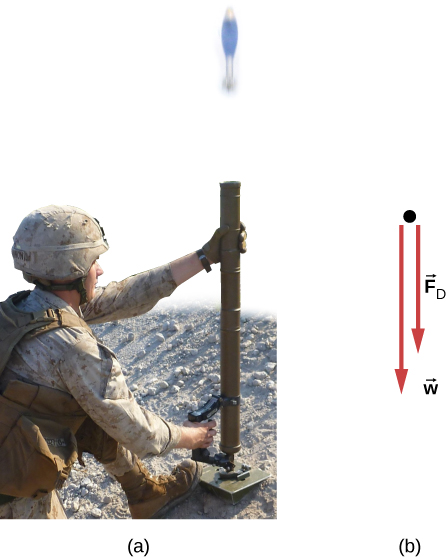
A 10.0-kg mortar shell is fired vertically upward from the ground, with an initial velocity of 50.0 m/s (see Figure 6.9). Determine the maximum height it will travel if atmospheric resistance is measured as where v is the speed at any instant.
英語のヒント
質量10.0 kgの迫撃砲弾を、地面から鉛直上向きに初速度50.0 m/sで発射する(図6.9)。大気の抵抗がと測定される場合、到達する最高点の高さを求めよ。vは各瞬間の速さである。
(credit a: modification of work by OS541/DoD; The appearance of U.S. Department of Defense (DoD) visual information does not imply or constitute DoD endorsement.) The appearance of U.S. Department of Defense visual information does not imply or constitute DoD endorsement. · US government public-domain visual information; OpenStax additions CC BY 4.0 · Source出典

Figure 6.9図 6.9
(a) The mortar fires a shell straight up; we consider the friction force provided by the air. (b) A free-body diagram is shown which indicates all the forces on the mortar shell. (credit a: modification of work by OS541/DoD; The appearance of U.S. Department of Defense (DoD) visual information does not imply or constitute DoD endorsement.)
英語のヒント
(a) 迫撃砲が砲弾を真上に発射する。空気による摩擦力を考慮する。(b) 砲弾に働くすべての力を示す力の図。(aの出典:OS541/DoDの作品を改変。米国国防総省の視覚資料を掲載していることは、同省による推奨を意味せず、その推奨に当たるものでもない。)
Strategy方針
The known force on the mortar shell can be related to its acceleration using the equations of motion. Kinematics can then be used to relate the mortar shell’s acceleration to its position.
英語のヒント
運動方程式を使えば、砲弾に働く既知の力を加速度に関係付けられる。次に運動学を使い、砲弾の加速度と位置を関係付ける。
Solution解答
Initially, and At the maximum height The free-body diagram shows to act downward, because it slows the upward motion of the mortar shell. Thus, we can write
英語のヒント
初めは、であり、最高点ではである。力の図では、上向きの運動を遅くするを下向きに描く。したがって、次のように書ける。
The acceleration depends on v and is therefore variable. Since we can relate a to v using the rearrangement described above,
英語のヒント
加速度はvに依存するので一定ではない。なので、先に説明した式変形によってaとvを関係付けられる。
We replace ds with dy because we are dealing with the vertical direction,
英語のヒント
鉛直方向を扱っているので、dsをdyに置き換える。
We now separate the variables (v’s and dv’s on one side; dy on the other):
英語のヒント
変数を分離する。vとdvを一方の辺に、dyをもう一方の辺に集める。
Thus,
英語のヒント
したがって、である。
Significance考察
Notice the need to apply calculus since the force is not constant, which also means that acceleration is not constant. To make matters worse, the force depends on v (not t), and so we must use the trick explained prior to the example. The answer for the height indicates a lower elevation if there were air resistance. We will deal with the effects of air resistance and other drag forces in greater detail in Drag Force and Terminal Speed.
英語のヒント
力が一定でないため、加速度も一定ではなく、微積分が必要になることに注目しよう。さらに厄介なことに、力はtではなくvに依存するので、この例の前で説明した工夫を使う必要がある。高さの答えは、空気抵抗があれば到達点が低くなることを示している。空気抵抗やその他の抗力の影響は、「抗力と終端速度」でさらに詳しく扱う。