第6章ニュートンの法則の応用
6.1 Solving Problems with Newton’s Laws6.1 ニュートンの法則による問題の解き方
Learning Objectives学習目標
Learning Objectives学習目標
By the end of this section, you will be able to:
英語のヒント
この節を終えると、次のことができるようになる。
- Apply problem-solving techniques to solve for quantities in more complex systems of forces
英語のヒント
問題を解く手順を使い、より複雑な力の系で物理量を求める。 - Use concepts from kinematics to solve problems using Newton’s laws of motion
英語のヒント
運動学の概念とニュートンの運動の法則を使って問題を解く。 - Solve more complex equilibrium problems
英語のヒント
より複雑なつり合いの問題を解く。 - Solve more complex acceleration problems
英語のヒント
より複雑な加速度の問題を解く。 - Apply calculus to more advanced dynamics problems
英語のヒント
より高度な動力学の問題に微積分を使う。
Success in problem solving is necessary to understand and apply physical principles. We developed a pattern of analyzing and setting up the solutions to problems involving Newton’s laws in Newton’s Laws of Motion; in this chapter, we continue to discuss these strategies and apply a step-by-step process.
英語のヒント
物理の原理を理解し適用するには、問題を解けることが必要である。「ニュートンの運動の法則」では、ニュートンの法則に関わる問題を分析し、解法を組み立てる方法を学んだ。この章では、その方針をさらに検討し、段階を追って適用する。
Problem-Solving Strategies問題解決の方針
We follow here the basics of problem solving presented earlier in this text, but we emphasize specific strategies that are useful in applying Newton’s laws of motion. Once you identify the physical principles involved in the problem and determine that they include Newton’s laws of motion, you can apply these steps to find a solution. These techniques also reinforce concepts that are useful in many other areas of physics. Many problem-solving strategies are stated outright in the worked examples, so the following techniques should reinforce skills you have already begun to develop.
英語のヒント
ここでは、本書で先に示した問題解決の基本に従いながら、ニュートンの運動の法則を適用するための具体的な方法を重視する。問題に関わる物理の原理を特定し、その中にニュートンの運動の法則があると判断したら、次の手順で解答を求められる。これらの方法は、物理学の他の多くの分野でも役立つ概念を強化する。解答付きの例では、問題解決の方針を明示していることが多いため、以下の方法によって、すでに身に付け始めた技能をさらに確かなものにできる。
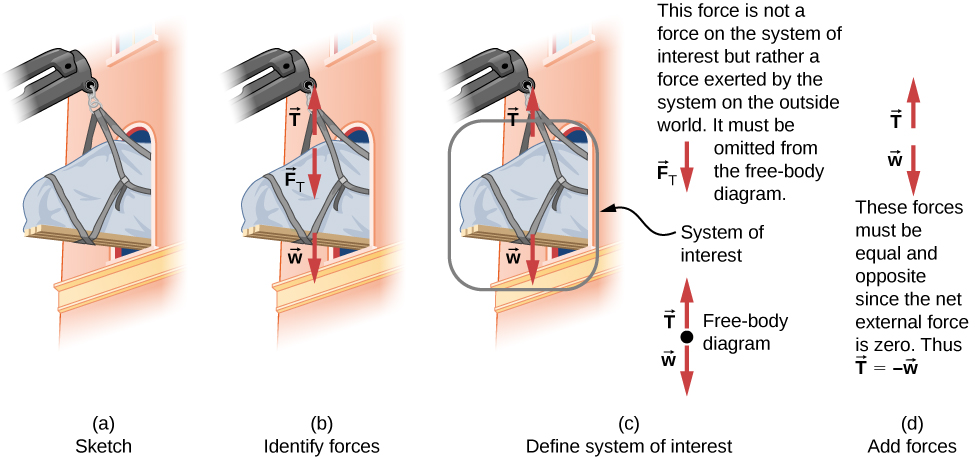
Let’s apply this problem-solving strategy to the challenge of lifting a grand piano into a second-story apartment. Once we have determined that Newton’s laws of motion are involved (if the problem involves forces), it is particularly important to draw a careful sketch of the situation. Such a sketch is shown in Figure 6.2(a). Then, as in Figure 6.2(b), we can represent all forces with arrows. Whenever sufficient information exists, it is best to label these arrows carefully and make the length and direction of each correspond to the represented force.
英語のヒント
OpenStax / Rice University, University Physics Volume 1, CC BY 4.0. Source-book artwork retained. · CC BY 4.0 · Source出典

Figure 6.2図 6.2
(a) A grand piano is being lifted to a second-story apartment. (b) Arrows are used to represent all forces: is the tension in the rope above the piano, is the force that the piano exerts on the rope, and is the weight of the piano. All other forces, such as the nudge of a breeze, are assumed to be negligible. (c) Suppose we are given the piano’s mass and asked to find the tension in the rope. We then define the system of interest as shown and draw a free-body diagram. Now is no longer shown, because it is not a force acting on the system of interest; rather, acts on the outside world. (d) Showing only the arrows, the head-to-tail method of addition is used. It is apparent that if the piano is stationary, .
英語のヒント
(a) グランドピアノを2階の部屋へつり上げる。(b) すべての力を矢印で表す。はピアノの上のロープの張力、はピアノがロープに及ぼす力、はピアノの重さである。そよ風に押される力など、他の力はすべて無視できると仮定する。(c) ピアノの質量が与えられ、ロープの張力を求めるとする。図のように系を定め、力の図を描く。は着目する系に働く力ではなく、が外部に及ぼす力なので、図には含めない。(d) 矢印だけを示し、矢印の先に次の矢印の尾をつなぐ方法で加える。ピアノが静止していれば、であることが分かる。
As with most problems, we next need to identify what needs to be determined and what is known or can be inferred from the problem as stated, that is, make a list of knowns and unknowns. It is particularly crucial to identify the system of interest, since Newton’s second law involves only external forces. We can then determine which forces are external and which are internal, a necessary step to employ Newton’s second law. (See Figure 6.2(c).) Newton’s third law may be used to identify whether forces are exerted between components of a system (internal) or between the system and something outside (external). As illustrated in Newton’s Laws of Motion, the system of interest depends on the question we need to answer. Only forces are shown in free-body diagrams, not acceleration or velocity. We have drawn several free-body diagrams in previous worked examples. Figure 6.2(c) shows a free-body diagram for the system of interest. Note that no internal forces are shown in a free-body diagram.
英語のヒント
多くの問題と同様に、次に、何を求めるべきか、何が既知か、問題文から何を推論できるかを特定し、既知量と未知量の一覧を作る。ニュートンの第2法則は外力だけを扱うので、着目する系を明確にすることがとくに重要である。そうすれば、どれが外力で、どれが内力かを判断できる。これは第2法則を使うために必要な手順である(図6.2(c))。ニュートンの第3法則を使うと、力が系の構成要素間に働く内力か、系と外部のものとの間に働く外力かを判断できる。「ニュートンの運動の法則」で示したように、着目する系は答えるべき問いによって決まる。力の図に描くのは力だけであり、加速度や速度は描かない。これまでの例でもいくつかの力の図を描いてきた。図6.2(c)は、着目する系の力の図である。内力が一つも描かれていないことに注意しよう。
Once a free-body diagram is drawn, we apply Newton’s second law. This is done in Figure 6.2(d) for a particular situation. In general, once external forces are clearly identified in free-body diagrams, it should be a straightforward task to put them into equation form and solve for the unknown, as done in all previous examples. If the problem is one-dimensional—that is, if all forces are parallel—then the forces can be handled algebraically. If the problem is two-dimensional, then it must be broken down into a pair of one-dimensional problems. We do this by projecting the force vectors onto a set of axes chosen for convenience. As seen in previous examples, the choice of axes can simplify the problem. For example, when an incline is involved, a set of axes with one axis parallel to the incline and one perpendicular to it is most convenient. It is almost always convenient to make one axis parallel to the direction of motion, if this is known. Generally, just write Newton’s second law in components along the different directions. Then, you have the following equations:
英語のヒント
力の図を描いたら、ニュートンの第2法則を適用する。図6.2(d)は一つの状況について、その操作を示している。一般に、外力を図中で明確に特定できれば、これまでの例のように式を立て、未知量を求めるのは容易になる。一次元の問題、すなわちすべての力が平行な場合は、代数的に扱える。二次元の問題ならば、二つの一次元の問題に分ける。そのために、都合よく選んだ座標軸へ力ベクトルを投影する。先の例のように、軸の選び方によって問題を簡単にできる。たとえば斜面を扱うときは、斜面に平行な軸と垂直な軸を使うと便利である。運動方向が分かっていれば、ほとんどの場合、一方の軸をそれに平行にするとよい。一般には、各方向の成分についてニュートンの第2法則を書けば、次の式が得られる。
(If, for example, the system is accelerating horizontally, then you can then set ) We need this information to determine unknown forces acting on a system.
英語のヒント
たとえば系が水平方向に加速しているならば、と置ける。系に働く未知の力を求めるには、この情報が必要である。
As always, we must check the solution. In some cases, it is easy to tell whether the solution is reasonable. For example, it is reasonable to find that friction causes an object to slide down an incline more slowly than when no friction exists. In practice, intuition develops gradually through problem solving; with experience, it becomes progressively easier to judge whether an answer is reasonable. Another way to check a solution is to check the units. If we are solving for force and end up with units of millimeters per second, then we have made a mistake.
英語のヒント
いつもどおり、解答を確かめる必要がある。妥当かどうかが容易に分かる場合もある。たとえば、斜面を滑り降りる物体が、摩擦のない場合よりゆっくり動くという結果は妥当である。実際には、問題を解くにつれて直感が少しずつ育ち、経験を積むほど答えの妥当性を判断しやすくなる。もう一つの確認法は単位を見ることである。力を求めているのに、最終的な単位がミリメートル毎秒ならば、どこかで誤っている。
There are many interesting applications of Newton’s laws of motion, a few more of which are presented in this section. These serve also to illustrate some further subtleties of physics and to help build problem-solving skills. We look first at problems involving particle equilibrium, which make use of Newton’s first law, and then consider particle acceleration, which involves Newton’s second law.
英語のヒント
ニュートンの運動の法則には多くの興味深い応用があり、この節でさらにいくつか紹介する。これらは、物理のより細かな点を示し、問題を解く力を養うのにも役立つ。まず第1法則を使う粒子のつり合いを扱い、次に第2法則を使う粒子の加速度を考える。