第6章ニュートンの法則の応用
The solution to the previous example also applies to an elevator accelerating downward, as mentioned. When an elevator accelerates downward, a is negative, and the scale reading is less than the weight of the person. If a constant downward velocity is reached, the scale reading again becomes equal to the person’s weight. If the elevator is in free fall and accelerating downward at g, then the scale reading is zero and the person appears to be weightless.
英語のヒント
先に述べたように、前の例の解は下向きの加速にも使える。このときaは負で、体重計の読みは人の重さより小さい。下向きの一定の速度に達すれば、読みは再び重さに等しくなる。自由落下し、下向きにgの加速度をもつならば、読みは0となり、人は無重量に見える。
Example 6.4例題 6.4
Two Attached Blocksつながれた二つの物体
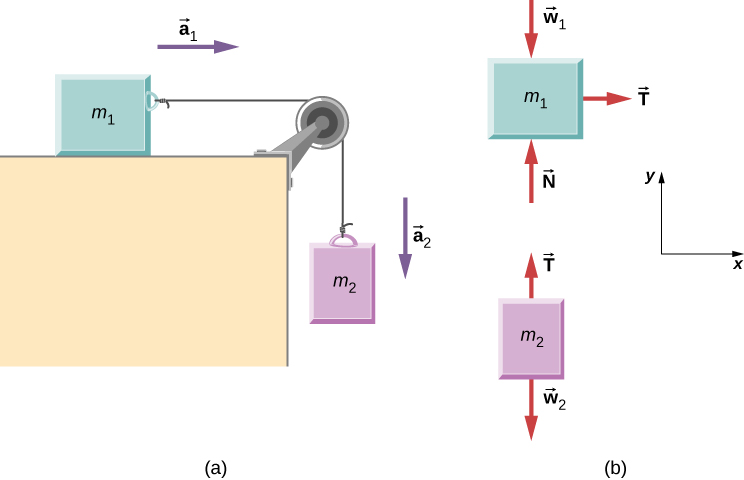
Figure 6.6 shows a block of mass on a frictionless, horizontal surface. It is pulled by a light string that passes over a frictionless and massless pulley. The other end of the string is connected to a block of mass Find the acceleration of the blocks and the tension in the string in terms of
英語のヒント
図6.6では、質量の物体が摩擦のない水平面上にある。物体は軽いひもで引かれ、ひもは摩擦も質量もない滑車を越えている。他端には質量の物体をつなぐ。を使って、二つの物体の加速度とひもの張力を求めよ。
OpenStax / Rice University, University Physics Volume 1, CC BY 4.0. Source-book artwork retained. · CC BY 4.0 · Source出典

Figure 6.6図 6.6
(a) Block 1 is connected by a light string to block 2. (b) The free-body diagrams of the blocks.
英語のヒント
(a) 軽いひもでつないだ物体1と2。(b) 各物体の力の図。
Strategy方針
We draw a free-body diagram for each mass separately, as shown in Figure 6.6. Then we analyze each one to find the required unknowns. The forces on block 1 are the gravitational force, the contact force of the surface, and the tension in the string. Block 2 is subjected to the gravitational force and the string tension. Newton’s second law applies to each, so we write two vector equations:
英語のヒント
図6.6のように、各物体について別々に力の図を描き、それぞれを分析して未知量を求める。物体1には重力、面からの接触力、ひもの張力が働く。物体2には重力と張力が働く。どちらにもニュートンの第2法則が当てはまるので、二つのベクトルの方程式を書く。
For block 1:
英語のヒント
物体1について、
For block 2:
英語のヒント
物体2について、
Notice that is the same for both blocks. Since the string and the pulley have negligible mass, and since there is no friction in the pulley, the tension is the same throughout the string. We can now write component equations for each block. All forces are either horizontal or vertical, so we can use the same horizontal/vertical coordinate system for both objects
英語のヒント
は両方の物体で同じである。ひもと滑車の質量は無視でき、滑車に摩擦もないので、ひも全体で張力が等しい。これで各物体の成分の式を書ける。すべての力は水平または鉛直なので、両方に同じ水平・鉛直の座標系を使える。
Solution解答
The component equations follow from the vector equations above. We see that block 1 has the vertical forces balanced, so we ignore them and write an equation relating the x-components. There are no horizontal forces on block 2, so only the y-equation is written. We obtain these results:
英語のヒント
成分の式は、先のベクトルの式から得られる。物体1の鉛直方向の力はつり合っているので省き、x成分の関係を書く。物体2には水平な力がないので、y方向の式だけを書く。こうして次の結果が得られる。
When block 1 moves to the right, block 2 travels an equal distance downward; thus, Writing the common acceleration of the blocks as we now have
英語のヒント
物体1が右へ動くと、物体2は同じ距離だけ下へ動くので、である。共通の加速度の大きさをと書くと、
and
英語のヒント
および
From these two equations, we can express a and T in terms of the masses
英語のヒント
これら二つの式から、aとTを質量で表せる。
and
英語のヒント
および
Significance考察
Notice that the tension in the string is less than the weight of the block hanging from the end of it. A common error in problems like this is to set You can see from the free-body diagram of block 2 that cannot be correct if the block is accelerating.
英語のヒント
ひもの張力は、端につり下がる物体の重さより小さい。この種類の問題でよくある間違いは、と置くことである。物体2の力の図から、加速している場合はそれが正しくないと分かる。
Example 6.5例題 6.5
Atwood Machineアトウッドの装置
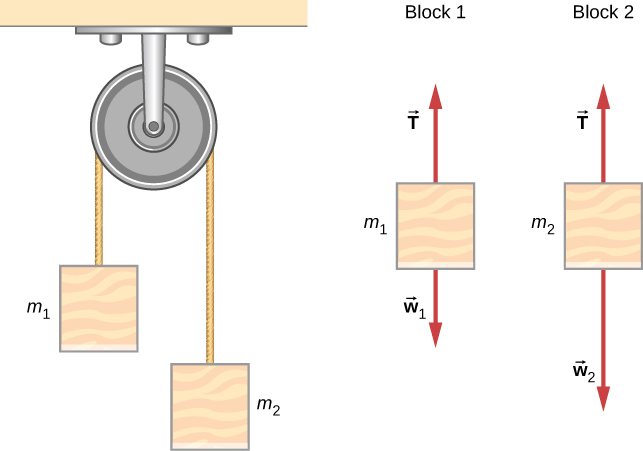
A classic problem in physics, similar to the one we just solved, is that of the Atwood machine, which consists of a rope running over a pulley, with two objects of different mass attached. It is particularly useful in understanding the connection between force and motion. In Figure 6.7, and Consider the pulley to be frictionless. (a) If is released, what will its acceleration be? (b) What is the tension in the string?
英語のヒント
今解いたものに似た物理学の古典的な問題に、アトウッドの装置がある。滑車を越えるロープの両端に、質量の異なる二つの物体をつないだ装置で、力と運動の関係を理解するのにとくに役立つ。図6.7では、、である。滑車に摩擦はないものとする。(a) を放すと、加速度はいくらか。(b) ひもの張力はいくらか。
OpenStax / Rice University, University Physics Volume 1, CC BY 4.0. Source-book artwork retained. · CC BY 4.0 · Source出典

Figure 6.7図 6.7
An Atwood machine and free-body diagrams for each of the two blocks.
英語のヒント
アトウッドの装置と、二つの物体それぞれの力の図。
Strategy方針
We draw a free-body diagram for each mass separately, as shown in the figure. Then we analyze each diagram to find the required unknowns. This may involve the solution of simultaneous equations. It is also important to note the similarity with the previous example. As block 2 accelerates with acceleration in the downward direction, block 1 accelerates upward with acceleration . Thus,
英語のヒント
図のように、各物体について別々に力の図を描き、未知量を求める。この際、連立方程式を解く必要が生じる場合がある。前の例との共通点にも注意しよう。物体2が下向きに加速度で加速すると、物体1は上向きに加速度で加速する。したがって、である。
Solution解答
- We have
英語のヒント
次の式が成り立つ。(The negative sign in front of indicates that accelerates downward; both blocks accelerate at the same rate, but in opposite directions.) Solve the two equations simultaneously (subtract them) and the result is英語のヒント
の前の負号は、が下向きに加速することを示す。両物体の加速度は大きさが等しく、向きが逆である。二つの方程式を連立して解く、つまり引き算すると、Solving for a:英語のヒント
aについて解くと、 - Observing the first block, we see that
英語のヒント
一つ目の物体に注目すると、
Significance考察
The result for the acceleration given in the solution can be interpreted as the ratio of the unbalanced force on the system, , to the total mass of the system, . We can also use the Atwood machine to measure local gravitational field strength.
英語のヒント
求めた加速度は、系のつり合っていない力と、全質量との比と解釈できる。アトウッドの装置は、その場所の重力場の強さを測ることにも使える。