第6章ニュートンの法則の応用
Inertial Forces and Noninertial (Accelerated) Frames: The Coriolis Force慣性力と非慣性(加速)基準系:コリオリの力
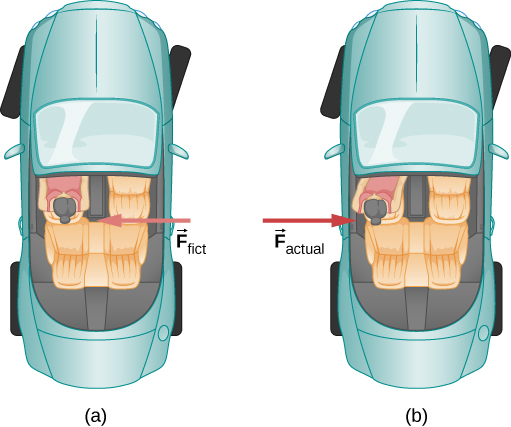
What do taking off in a jet airplane, turning a corner in a car, riding a merry-go-round, and the circular motion of a tropical cyclone have in common? Each exhibits inertial forces—fictitious forces that merely seem to arise from motion, because the observer’s frame of reference is accelerating or rotating. When taking off in a jet, most people would agree it feels as if you are being pushed back into the seat as the airplane accelerates down the runway. Yet a physicist would say that you tend to remain stationary while the seat pushes forward on you. An even more common experience occurs when you make a tight curve in your car—say, to the right (Figure 6.24). You feel as if you are thrown (that is, forced) toward the left relative to the car. Again, a physicist would say that you are going in a straight line (recall Newton’s first law) but the car moves to the right, not that you are experiencing a force from the left.
英語のヒント
ジェット機の離陸、車で角を曲がること、メリーゴーラウンドに乗ること、熱帯低気圧の円運動に共通するものは何だろうか。どれにも慣性力が現れる。これは、観測者の基準系が加速や回転をしているために、運動から生じるように見える見かけの力である。ジェット機が滑走路を加速して離陸するとき、座席に押し付けられるように感じることには、多くの人が同意するだろう。しかし物理学者は、体は静止し続けようとし、座席が体を前向きに押していると言うだろう。さらに身近なのは、車で急に、たとえば右へ曲がる経験である(図6.24)。車に対して左へ投げ出される、つまり力を受けるように感じる。ここでも物理学者は、体は直線上を進み続け(ニュートンの第1法則)、車が右へ動いているのであって、左から力を受けているのではない、と説明するだろう。
OpenStax / Rice University, University Physics Volume 1, CC BY 4.0. Source-book artwork retained. · CC BY 4.0 · Source出典

Figure 6.24図 6.24
(a) The car driver feels herself forced to the left relative to the car when she makes a right turn. This is a fictitious inertial force arising from the use of the car as a frame of reference. (b) In Earth’s frame of reference, the driver moves in a straight line, obeying Newton’s first law, and the car moves to the right. There is no force to the left on the driver relative to Earth. Instead, there is a force to the right on the car to make it turn.
英語のヒント
(a) 車で右へ曲がると、運転者は車に対して左へ力を受けるように感じる。これは車を基準系にしたために現れる見かけの慣性力である。(b) 地球の基準系では、運転者はニュートンの第1法則に従って直線上を進み、車が右へ動く。地球に対して運転者に左向きの力は働かない。代わりに、車を曲げる右向きの力が車に働く。
We can reconcile these points of view by examining the frames of reference used. Let us concentrate on people in a car. Passengers instinctively use the car as a frame of reference, whereas a physicist might use Earth. The physicist might make this choice because Earth is nearly an inertial frame of reference, in which all forces have an identifiable physical origin. In such a frame of reference, Newton’s laws of motion take the form given in Newton’s Laws of Motion. The car is a noninertial frame of reference because it is accelerated to the side. The force to the left sensed by car passengers is an inertial force having no physical origin (it is due purely to the inertia of the passenger, not to some physical cause such as tension, friction, or gravitation). The car, as well as the driver, is actually accelerating to the right.
英語のヒント
使っている基準系を調べれば、これらの見方を両立させられる。車内の人に注目しよう。乗客は本能的に車を基準系にするが、物理学者は地球を選ぶかもしれない。地球はほぼ慣性基準系であり、そこではすべての力の物理的な起源を特定できるからである。ニュートンの運動の法則は、そのような基準系で「ニュートンの運動の法則」の章に示した形を取る。車は横向きに加速しているので、非慣性基準系である。乗客が感じる左向きの力は、物理的な起源をもたない慣性力である。張力・摩擦・重力などの物理的な原因ではなく、乗客の慣性だけによる。実際には、車も運転者も右へ加速している。
A physicist will choose whatever reference frame is most convenient for the situation being analyzed. There is no problem to a physicist in including inertial forces and Newton’s second law, as usual, if that is more convenient, for example, on a merry-go-round or on a rotating planet. Noninertial (accelerated) frames of reference are used when it is useful to do so. Different frames of reference must be considered in discussing the motion of an astronaut in a spacecraft traveling at speeds near the speed of light, as you will appreciate in the study of the special theory of relativity.
英語のヒント
物理学者は、分析する状況に最も便利な基準系を選ぶ。メリーゴーラウンドや回転する惑星上などでそのほうが便利なら、慣性力を含めて、通常どおりニュートンの第2法則を使っても問題はない。非慣性、つまり加速する基準系も、役立つ場合には使う。光速に近い速さで進む宇宙船内の宇宙飛行士の運動を論じるときには、異なる基準系を考慮する必要がある。これは特殊相対性理論で理解することになる。
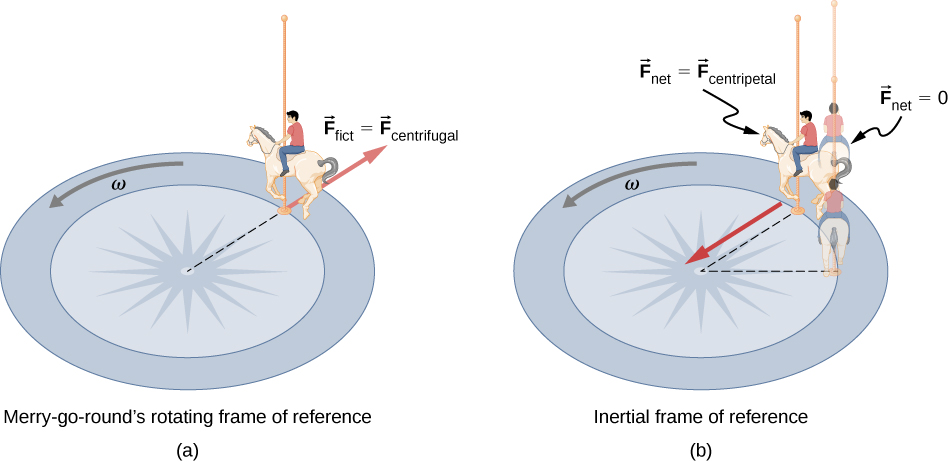
Let us now take a mental ride on a merry-go-round—specifically, a rapidly rotating playground merry-go-round (Figure 6.25). You take the merry-go-round to be your frame of reference because you rotate together. When rotating in that noninertial frame of reference, you feel an inertial force that tends to throw you off; this is often referred to as a centrifugal force (not to be confused with centripetal force). Centrifugal force is a commonly used term, but it does not actually exist. You must hang on tightly to counteract your inertia (which people often refer to as centrifugal force). In Earth’s frame of reference, there is no force trying to throw you off; we emphasize that centrifugal force is a fiction. You must hang on to make yourself go in a circle because otherwise you would go in a straight line, right off the merry-go-round, in keeping with Newton’s first law. But the force you exert acts toward the center of the circle.
英語のヒント
遊び場で高速に回転する回転遊具に、頭の中で乗ってみよう(図6.25)。一緒に回転するので、遊具を自分の基準系とする。その非慣性基準系で回ると、外へ投げ出そうとする慣性力を感じる。これは遠心力と呼ばれることが多い。向心力と混同しないようにしよう。遠心力はよく使われる言葉だが、実際に存在する力ではない。自分の慣性に対抗するには、しっかりつかまらなければならない。人はこの慣性を遠心力と呼ぶことが多い。地球の基準系では、外へ投げ出そうとする力はない。遠心力が見かけの力であることを強調しておく。つかまって自分を円運動させなければ、ニュートンの第1法則どおり直線に進み、遊具から飛び出してしまう。しかし、加える力は円の中心へ向かう。
OpenStax / Rice University, University Physics Volume 1, CC BY 4.0. Source-book artwork retained. · CC BY 4.0 · Source出典

Figure 6.25図 6.25
(a) A rider on a merry-go-round feels as if he is being thrown off. This inertial force is sometimes mistakenly called the centrifugal force in an effort to explain the rider’s motion in the rotating frame of reference. (b) In an inertial frame of reference and according to Newton’s laws, it is his inertia that carries him off (the unshaded rider has and heads in a straight line). A force, , is needed to cause a circular path.
英語のヒント
(a) メリーゴーラウンドの乗り手は、外へ投げ出されるように感じる。回転する基準系で運動を説明しようとして、この慣性力を誤って遠心力と呼ぶことがある。(b) 慣性基準系では、ニュートンの法則によれば、外へ運び去るのは慣性である。薄い色でない乗り手はで直線に進む。円軌道にするには力が必要である。
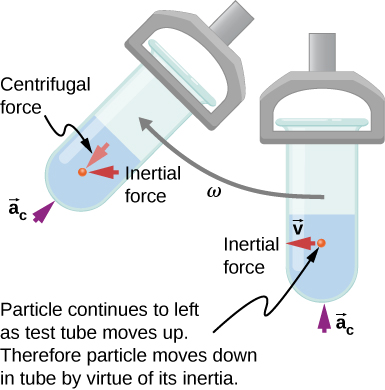
This inertial effect, carrying you away from the center of rotation if there is no centripetal force to cause circular motion, is put to good use in centrifuges (Figure 6.26). A centrifuge spins a sample very rapidly, as mentioned earlier in this chapter. Viewed from the rotating frame of reference, the inertial force throws particles outward, hastening their sedimentation. The greater the angular velocity, the greater the centrifugal force. But what really happens is that the inertia of the particles carries them along a line tangent to the circle while the test tube is forced in a circular path by a centripetal force.
英語のヒント
円運動を生む向心力がなければ回転中心から離れていく、という慣性の効果は、遠心分離機で有効に使われる(図6.26)。先に述べたように、遠心分離機は試料を高速で回す。回転する基準系から見ると、慣性力が粒子を外へ投げ出し、沈降を速める。角速度が大きいほど遠心力も大きい。実際には、粒子は慣性によって円の接線に沿って進む一方、試験管は向心力によって円軌道を動かされている。
OpenStax / Rice University, University Physics Volume 1, CC BY 4.0. Source-book artwork retained. · CC BY 4.0 · Source出典

Figure 6.26図 6.26
Centrifuges use inertia to perform their task. Particles in the fluid sediment settle out because their inertia carries them away from the center of rotation. The large angular velocity of the centrifuge quickens the sedimentation. Ultimately, the particles come into contact with the test tube walls, which then supply the centripetal force needed to make them move in a circle of constant radius.
英語のヒント
遠心分離機は慣性を利用する。液体中の粒子は、慣性によって回転中心から離れていくため沈降する。大きな角速度が沈降を速める。やがて粒子は試験管の壁に接触し、壁が、一定半径の円運動に必要な向心力を与える。
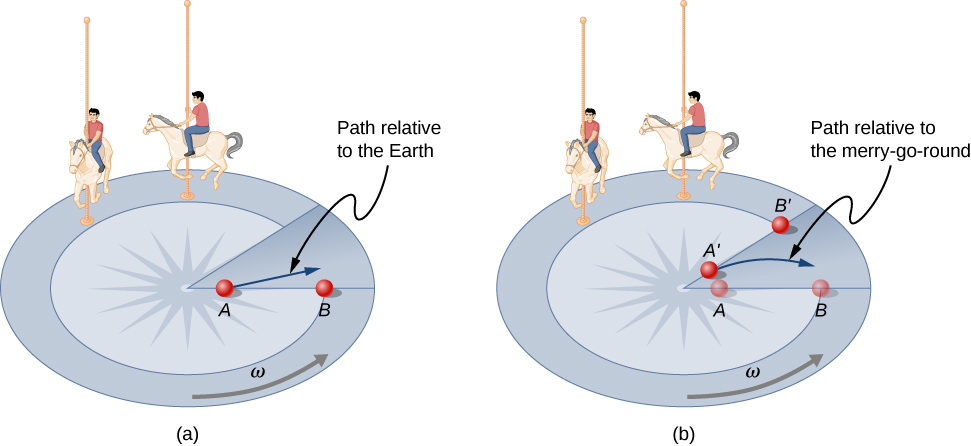
Let us now consider what happens if something moves in a rotating frame of reference. For example, what if you slide a ball directly away from the center of the merry-go-round, as shown in Figure 6.27? The ball follows a straight path relative to Earth (assuming negligible friction) and a path curved to the right on the merry-go-round’s surface. A person standing next to the merry-go-round sees the ball moving straight and the merry-go-round rotating underneath it. In the merry-go-round’s frame of reference, we explain the apparent curve to the right by using an inertial force, called the Coriolis force, which causes the ball to curve to the right. The Coriolis force can be used by anyone in that frame of reference to explain why objects follow curved paths and allows us to apply Newton’s laws in noninertial frames of reference.
英語のヒント
回転する基準系の中で物体が動くと、どうなるか考えよう。たとえば図6.27のように、回転台の中心からまっすぐ外向きに球を滑らせたらどうなるだろうか。摩擦を無視すれば、地球に対する球の軌道は直線だが、回転台の表面に対しては右へ曲がる。台の横に立つ人には、球がまっすぐ進み、その下で台が回っているように見える。回転台の基準系では、コリオリの力という慣性力を使い、右へ曲がって見える軌道を説明する。この基準系の人は誰でもコリオリの力を使って曲がる軌道を説明でき、非慣性基準系でもニュートンの法則を適用できる。
OpenStax / Rice University, University Physics Volume 1, CC BY 4.0. Source-book artwork retained. · CC BY 4.0 · Source出典

Figure 6.27図 6.27
Looking down on the counterclockwise rotation of a merry-go-round, we see that a ball slid straight toward the edge follows a path curved to the right. The person slides the ball toward point B, starting at point A. Both points rotate to the shaded positions (A’ and B’) shown in the time that the ball follows the curved path in the rotating frame and a straight path in Earth’s frame.
英語のヒント
反時計回りの回転台を上から見ると、縁へまっすぐ滑らせた球は右へ曲がる軌道をたどる。人は点Aから点Bへ向けて球を滑らせる。球が回転基準系では曲線、地球の基準系では直線を進む間に、両点は薄く示したA′とB′へ回る。
Up until now, we have considered Earth to be an inertial frame of reference with little or no worry about effects due to its rotation. Yet such effects do exist—in the rotation of weather systems, for example. Most consequences of Earth’s rotation can be qualitatively understood by analogy with the merry-go-round. Viewed from above the North Pole, Earth rotates counterclockwise, as does the merry-go-round in Figure 6.27. As on the merry-go-round, any motion in Earth’s Northern Hemisphere experiences a Coriolis force to the right. Just the opposite occurs in the Southern Hemisphere; there, the force is to the left. Because Earth’s angular velocity is small, the Coriolis force is usually negligible, but for large-scale motions, such as wind patterns, it has substantial effects.
英語のヒント
ここまでは、地球の自転の影響をほとんど、あるいはまったく気にせず、地球を慣性基準系とみなしてきた。しかし影響は確かに存在し、たとえば気象系の回転に現れる。自転の影響の多くは、回転台との類推によって定性的に理解できる。北極の上から見ると、地球は図6.27の回転台と同じく反時計回りに回る。回転台と同様、北半球の運動には右向きのコリオリの力が働く。南半球では逆に左向きになる。地球の角速度は小さく、通常はコリオリの力を無視できるが、風の流れなど大規模な運動には大きな影響をもつ。
The Coriolis force causes hurricanes in the Northern Hemisphere to rotate in the counterclockwise direction, whereas tropical cyclones in the Southern Hemisphere rotate in the clockwise direction. (The terms hurricane, typhoon, and tropical storm are regionally specific names for cyclones, which are storm systems characterized by low pressure centers, strong winds, and heavy rains.) Figure 6.28 helps show how these rotations take place. Air flows toward any region of low pressure, and tropical cyclones contain particularly low pressures. Thus winds flow toward the center of a tropical cyclone or a low-pressure weather system at the surface. In the Northern Hemisphere, these inward winds are deflected to the right, as shown in the figure, producing a counterclockwise circulation at the surface for low-pressure zones of any type. Low pressure at the surface is associated with rising air, which also produces cooling and cloud formation, making low-pressure patterns quite visible from space. Conversely, wind circulation around high-pressure zones is clockwise in the Southern Hemisphere but is less visible because high pressure is associated with sinking air, producing clear skies.
英語のヒント
コリオリの力により、北半球のハリケーンは反時計回り、南半球の熱帯低気圧は時計回りに回る。ハリケーン、台風、熱帯暴風雨は、中心の低い気圧、強風、大雨を特徴とする低気圧に付けられた、地域によって異なる名前である。図6.28は回転が生じる仕組みを示す。空気は気圧の低い領域へ流れ、熱帯低気圧の気圧は特に低い。そのため、地表付近の風は熱帯低気圧や低気圧系の中心へ流れる。北半球では、図のように内向きの風が右へ曲げられ、どの種類の低気圧でも地表で反時計回りの循環を生む。地表の低気圧には上昇気流が伴い、冷却と雲の形成も起こるので、宇宙から形がよく見える。逆に、高気圧の周囲の風は南半球では時計回りだが、高気圧は下降気流と晴天を伴うため、見えにくい。
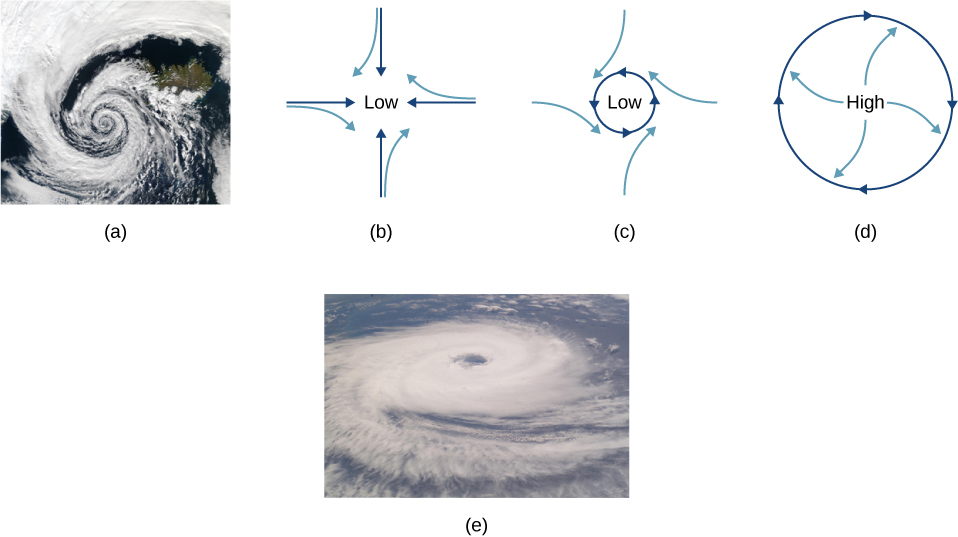
(credit a and credit e: modifications of work by NASA) NASA imagery used for educational publication; no NASA endorsement is implied. · NASA media use permission; OpenStax additions CC BY 4.0 · Source出典

Figure 6.28図 6.28
(a) The counterclockwise rotation of this Northern Hemisphere hurricane is a major consequence of the Coriolis force. (b) Without the Coriolis force, air would flow straight into a low-pressure zone, such as that found in tropical cyclones. (c) The Coriolis force deflects the winds to the right, producing a counterclockwise rotation. (d) Wind flowing away from a high-pressure zone is also deflected to the right, producing a clockwise rotation. (e) The opposite direction of rotation is produced by the Coriolis force in the Southern Hemisphere, leading to tropical cyclones. (credit a and credit e: modifications of work by NASA)
英語のヒント
(a) 北半球のハリケーンの反時計回りの回転は、コリオリの力の大きな結果の一つである。(b) コリオリの力がなければ、空気は熱帯低気圧のような低気圧域へまっすぐ流れ込む。(c) 右へ曲げられた風が反時計回りの回転を生む。(d) 高気圧域から流れ出す風も右へ曲げられ、時計回りに回る。(e) 南半球ではコリオリの力が逆向きの回転を生み、熱帯低気圧となる。(a、eの出典:NASAの作品を改変)