第6章ニュートンの法則の応用
6.3 Centripetal Force6.3 向心力
Learning Objectives学習目標
Learning Objectives学習目標
By the end of this section, you will be able to:
英語のヒント
この節を終えると、次のことができるようになる。
- Explain the equation for centripetal acceleration
英語のヒント
向心加速度の式を説明する。 - Apply Newton’s second law to develop the equation for centripetal force
英語のヒント
ニュートンの第2法則を適用し、向心力の式を導く。 - Use circular motion concepts in solving problems involving Newton’s laws of motion
英語のヒント
ニュートンの運動の法則を使う問題に、円運動の概念を応用する。
In Motion in Two and Three Dimensions, we examined the basic concepts of circular motion. An object undergoing circular motion, like one of the race cars shown at the beginning of this chapter, must be accelerating because it is changing the direction of its velocity. We proved that this centrally directed acceleration, called centripetal acceleration, is given by the formula
英語のヒント
「二次元と三次元の運動」で、円運動の基本概念を調べた。この章の冒頭のレースカーのように、円運動する物体は速度の向きを変えているので、必ず加速度をもつ。この中心向きの加速度を向心加速度と呼び、次の式で与えられることを証明した。
where v is the velocity of the object, directed along a tangent line to the curve at any instant. If we know the angular velocity , then we can use
英語のヒント
ここでvは物体の速度で、各瞬間に曲線の接線方向を向く。角速度が分かれば、次の式を使える。
Angular velocity gives the rate at which the object is turning through the curve, in units of rad/s. This acceleration acts along the radius of the curved path and is thus also referred to as a radial acceleration.
英語のヒント
角速度は、物体が曲線に沿って向きを変える割合をrad/sで表す。この加速度は曲がった軌道の半径に沿って働くため、半径方向加速度とも呼ばれる。
An acceleration must be produced by a force. Any force or combination of forces can cause a centripetal or radial acceleration. Just a few examples are the tension in the rope on a tether ball, the force of Earth’s gravity on the Moon, friction between roller skates and a rink floor, a banked roadway’s force on a car, and forces on the tube of a spinning centrifuge. Any net force causing uniform circular motion is called a centripetal force. The direction of a centripetal force is toward the center of curvature, the same as the direction of centripetal acceleration. According to Newton’s second law of motion, net force is mass times acceleration: For uniform circular motion, the acceleration is the centripetal acceleration:. Thus, the magnitude of centripetal force is
英語のヒント
加速度は力によって生じなければならない。どのような力でも、その組合せでも、向心加速度、つまり半径方向加速度を生み出せる。たとえば、テザーボールのロープの張力、月に働く地球の重力、ローラースケートとリンクの床の摩擦、傾斜した路面が車に及ぼす力、回転する遠心分離機の試験管に働く力がある。等速円運動を生む合力を向心力と呼ぶ。その向きは曲率中心に向かい、向心加速度と同じである。ニュートンの第2法則では、合力は質量と加速度の積である。等速円運動では、加速度は向心加速度.である。したがって、向心力の大きさは、
By substituting the expressions for centripetal acceleration we get two expressions for the centripetal force in terms of mass, velocity, angular velocity, and radius of curvature:
英語のヒント
向心加速度の式を代入すると、向心力を質量、速度、角速度、曲率半径で表す二つの式を得る。
You may use whichever expression for centripetal force is more convenient. Centripetal force is always perpendicular to the path and points to the center of curvature, because is perpendicular to the velocity and points to the center of curvature. Note that if you solve the first expression for r, you get
英語のヒント
向心力の式は、便利なほうを使ってよい。向心力は常に軌道に垂直で、曲率中心を向く。が速度に垂直で曲率中心を向くからである。最初の式をrについて解くと、
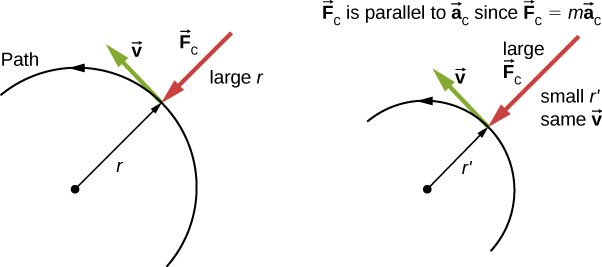
This implies that for a given mass and velocity, a large centripetal force causes a small radius of curvature—that is, a tight curve, as in Figure 6.20.
英語のヒント
つまり、質量と速度が決まっていれば、向心力が大きいほど曲率半径が小さくなり、図6.20のような急なカーブになる。
OpenStax / Rice University, University Physics Volume 1, CC BY 4.0. Source-book artwork retained. · CC BY 4.0 · Source出典

Figure 6.20図 6.20
The frictional force supplies the centripetal force and is numerically equal to it. Centripetal force is perpendicular to velocity and causes uniform circular motion. The larger the the smaller the radius of curvature r and the sharper the curve. The second curve has the same v, but a larger produces a smaller r′.
英語のヒント
摩擦力が向心力を与え、その大きさも等しい。向心力は速度に垂直で、等速円運動を生む。が大きいほど曲率半径rは小さく、カーブは急になる。二つ目のカーブでもvは同じだが、より大きいによって半径r′は小さくなる。
Example 6.15例題 6.15
What Coefficient of Friction Do Cars Need on a Flat Curve?平らなカーブを曲がる車に必要な摩擦係数は?
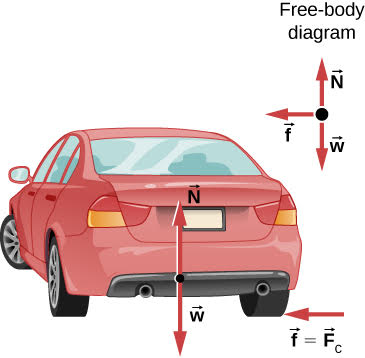
(a) Calculate the centripetal force exerted on a 900.0-kg car that negotiates a 500.0-m radius curve at 25.00 m/s. (b) Assuming an unbanked curve, find the minimum static coefficient of friction between the tires and the road, static friction being the reason that keeps the car from slipping (Figure 6.21).
英語のヒント
(a) 質量900.0 kgの車が半径500.0 mのカーブを25.00 m/sで曲がる。向心力を求めよ。(b) 路面に横方向の傾斜がないとして、タイヤと路面の間に必要な静止摩擦係数の最小値を求めよ。車が横滑りしないのは静止摩擦による(図6.21)。
OpenStax / Rice University, University Physics Volume 1, CC BY 4.0. Source-book artwork retained. · CC BY 4.0 · Source出典

Figure 6.21図 6.21
This car on level ground is moving away and turning to the left. The centripetal force causing the car to turn in a circular path is due to friction between the tires and the road. A minimum coefficient of friction is needed, or the car will move in a larger-radius curve and leave the roadway.
英語のヒント
平らな地面の車が、奥へ進みながら左へ曲がる。円軌道へ曲げる向心力はタイヤと路面の摩擦による。摩擦係数には必要な最小値があり、それより小さいと、車はより大きな半径のカーブを進んで道路を外れる。
Strategy方針
- We know that Thus,
英語のヒント
と分かっている。したがって、 - Figure 6.21 shows the forces acting on the car on an unbanked (level ground) curve. Friction is to the left, keeping the car from slipping, and because it is the only horizontal force acting on the car, the friction is the centripetal force in this case. We know that the maximum static friction (at which the tires roll but do not slip) is where is the static coefficient of friction and N is the normal force. The normal force equals the car’s weight on level ground, so Thus the centripetal force in this situation is
英語のヒント
図6.21は、傾斜のない水平なカーブで車に働く力を示す。摩擦は左向きで車の横滑りを防ぎ、車に働く唯一の水平な力なので、この場合の向心力である。タイヤが転がるが滑らないときの最大静止摩擦はである。は静止摩擦係数、Nは垂直抗力である。水平面では垂直抗力と車の重さが等しいので、となる。したがって、この状況の向心力は、Now we have a relationship between centripetal force and the coefficient of friction. Using the equation英語のヒント
向心力と摩擦係数の関係が得られた。次の式を使うと、we obtain英語のヒント
次を得る。We solve this for noting that mass cancels, and obtain英語のヒント
質量が消去されることに注意して、について解くと、Substituting the knowns,英語のヒント
既知の値を代入すると、(Because coefficients of friction are approximate, the answer is given to only two digits.)英語のヒント
摩擦係数は近似値なので、答えは2桁だけで示す。
Significance考察
The coefficient of friction found in Figure 6.21(b) is much smaller than is typically found between tires and roads. The car still negotiates the curve if the coefficient is greater than 0.13, because static friction is a responsive force, able to assume a value less than but no more than A higher coefficient would also allow the car to negotiate the curve at a higher speed, but if the coefficient of friction is less, the safe speed would be less than 25 m/s. Note that mass cancels, implying that, in this example, it does not matter how heavily loaded the car is to negotiate the turn. Mass cancels because friction is assumed proportional to the normal force, which in turn is proportional to mass. If the surface of the road were banked, the normal force would be greater, as discussed next.
英語のヒント
図6.21(b)で求めた摩擦係数は、通常のタイヤと路面の間の値よりはるかに小さい。係数が0.13を上回っていても、車はカーブを曲がれる。静止摩擦は外力に応じて変わり、以下の値を取れるからである。係数が大きければ、さらに速く曲がることも可能になる。逆に係数が小さければ、安全な速さは25 m/s未満になる。質量が消去されたことにも注目しよう。この例では、車がどれだけ重い荷物を積んでいるかは、曲がれるかどうかに影響しない。摩擦が垂直抗力に比例し、その垂直抗力が質量に比例すると仮定したためである。次に説明するように、路面に傾斜があれば垂直抗力は大きくなる。