第6章ニュートンの法則の応用
Terminal Velocity終端速度
Some interesting situations connected to Newton’s second law occur when considering the effects of drag forces upon a moving object. For instance, consider a skydiver falling through air under the influence of gravity. The two forces acting on him are the force of gravity and the drag force (ignoring the small buoyant force). The downward force of gravity remains constant regardless of the velocity at which the person is moving. However, as the person’s velocity increases, the magnitude of the drag force increases until the magnitude of the drag force is equal to the gravitational force, thus producing a net force of zero. A zero net force means that there is no acceleration, as shown by Newton’s second law. At this point, the person’s velocity remains constant and we say that the person has reached his terminal velocity Since is proportional to the speed squared, a heavier skydiver must go faster for to equal his weight. Let’s see how this works out more quantitatively.
英語のヒント
動く物体への抗力を考えると、ニュートンの第2法則に関わる興味深い状況が現れる。たとえば、重力で空気中を落下するスカイダイバーを考えよう。小さな浮力を無視すれば、働く力は重力と抗力の二つである。下向きの重力は、どの速さで動いても一定である。一方、速さが増すと抗力も増え、ついには重力と等しくなり、合力が0になる。第2法則より、合力が0なら加速度も0である。この時点から速度は一定となり、終端速度に達したという。は速さの2乗に比例するので、重いダイバーほど、が自分の重さと等しくなるために速く落ちる必要がある。定量的に調べよう。
At the terminal velocity,
英語のヒント
終端速度では、
Thus,
英語のヒント
したがって、
Using the equation for drag force, we have
英語のヒント
抗力の式を使うと、
Solving for the velocity, we obtain
英語のヒント
速度について解くと、
Assume the density of air is A 75-kg skydiver descending head first has a cross-sectional area of approximately and a drag coefficient of approximately . We find that
英語のヒント
空気の密度をとする。頭を下にして落下する質量75 kgのダイバーの断面積は約、抗力係数は約である。したがって、
This means a skydiver with a mass of 75 kg achieves a terminal velocity of about 350 km/h while traveling in a headfirst position, minimizing the area and his drag. In a spread-eagle position, that terminal velocity may decrease to about 200 km/h as the area increases. This terminal velocity becomes much smaller after the parachute opens.
英語のヒント
つまり、質量75 kgのダイバーが頭を下にし、面積と抗力を最小にすると、終端速度は約350 km/hになる。手足を大きく広げると面積が増し、約200 km/hまで下がることがある。パラシュートを開けば、終端速度はさらにずっと小さくなる。
Example 6.17例題 6.17
Terminal Velocity of a Skydiverスカイダイバーの終端速度
Find the terminal velocity of an 85-kg skydiver falling in a spread-eagle position. Assume that in the spread-eagle position, the diver has a cross-sectional area of .
英語のヒント
質量85 kgのスカイダイバーが、手足を大きく広げて落下するときの終端速度を求めよ。この姿勢での断面積をとする。
Strategy方針
At terminal velocity, Thus, the drag force on the skydiver must equal the force of gravity (the person’s weight). Using the equation of drag force, we find
英語のヒント
終端速度ではである。したがって、抗力は重力、つまり本人の重さと等しくなければならない。抗力の式を使うとを得る。
Solution解答
The terminal velocity can be written as
英語のヒント
終端速度は次のように書ける。
Significance考察
This result is consistent with the value for mentioned earlier. The 75-kg skydiver going feet first had a terminal velocity of He weighed less but had a smaller frontal area and so a smaller drag due to the air.
英語のヒント
この結果は先に述べたと一致する。足から先に落ちる質量75 kgのダイバーの終端速度はだった。体重は軽かったが、前面面積が小さいため、空気による抗力も小さかった。
The size of the object that is falling through air presents another interesting application of air drag. If you fall from a 5-m-high branch of a tree, you will likely get hurt—possibly fracturing a bone. However, a small squirrel does this all the time, without getting hurt. You do not reach a terminal velocity in such a short distance, but the squirrel does.
英語のヒント
空気中を落ちる物体の大きさも、抗力の興味深い応用につながる。高さ5 mの木の枝から人が落ちれば、けがをし、骨折するかもしれない。しかし小さなリスは、よくそうしてもけがをしない。人はそれほど短い距離では終端速度に達しないが、リスは達する。
The following interesting quote on animal size and terminal velocity is from a 1928 essay by a British biologist, J. B. S. Haldane, titled “On Being the Right Size.”
英語のヒント
動物の大きさと終端速度についての次の興味深い引用は、英国の生物学者J・B・S・ホールデンによる1928年の随筆「適切な大きさであることについて」からのものである。
“To the mouse and any smaller animal, [gravity] presents practically no dangers. You can drop a mouse down a thousand-yard mine shaft; and, on arriving at the bottom, it gets a slight shock and walks away, provided that the ground is fairly soft. A rat is killed, a man is broken, and a horse splashes. For the resistance presented to movement by the air is proportional to the surface of the moving object. Divide an animal’s length, breadth, and height each by ten; its weight is reduced to a thousandth, but its surface only to a hundredth. So the resistance to falling in the case of the small animal is relatively ten times greater than the driving force.”
英語のヒント
「ハツカネズミやそれより小さな動物にとって、[重力]はほとんど危険ではない。ハツカネズミを深さ1000ヤードの坑道に落としても、底がかなり柔らかければ、少し衝撃を受けるだけで歩き去る。ラットなら死に、人間なら体が壊れ、馬なら飛び散る。空気が運動に及ぼす抵抗は、動く物体の表面積に比例するからである。動物の長さ・幅・高さをそれぞれ10分の1にすると、重さは1000分の1になるが、表面積は100分の1にしかならない。したがって小さい動物では、落下への抵抗は、落下を引き起こす力に比べて相対的に10倍になる。」
The above quadratic dependence of air drag upon velocity does not hold if the object is very small, is going very slow, or is in a denser medium than air. Then we find that the drag force is proportional just to the velocity. This relationship is given by Stokes’ law.
英語のヒント
物体が非常に小さい、速さが非常に遅い、または空気より密な媒質中にある場合、先の抗力が速度の2乗に依存する関係は成り立たない。このとき抗力は、速度そのものに比例する。この関係をストークスの法則という。
Good examples of Stokes’ law are provided by microorganisms, pollen, and dust particles. Because each of these objects is so small, we find that many of these objects travel unaided only at a constant (terminal) velocity. Terminal velocities for bacteria (size about can be about To move at a greater speed, many bacteria swim using flagella (organelles shaped like little tails) that are powered by little motors embedded in the cell.
英語のヒント
微生物、花粉、ほこりの粒子は、ストークスの法則のよい例である。非常に小さいため、自力で泳ぐなどしなければ、多くは一定の終端速度でしか進まない。細菌(大きさ約の終端速度は、約にもなる。さらに速く進むため、多くの細菌は小さな尾のような細胞小器官である鞭毛を使って泳ぐ。鞭毛は、細胞に埋め込まれた小さなモーターで動く。
Sediment in a lake can move at a greater terminal velocity (about so it can take days for it to reach the bottom of the lake after being deposited on the surface.
英語のヒント
湖の堆積物は、より大きい終端速度(約で動ける。それでも水面に置かれてから湖底に着くまで、数日かかることがある。
If we compare animals living on land with those in water, you can see how drag has influenced evolution. Fish, dolphins, and even massive whales are streamlined in shape to reduce drag forces. Birds are streamlined and migratory species that fly large distances often have particular features such as long necks. Flocks of birds fly in the shape of a spearhead as the flock forms a streamlined pattern (Figure 6.32). In humans, one important example of streamlining is the shape of sperm, which need to be efficient in their use of energy.
英語のヒント
陸上の動物と水中の動物を比べると、抗力が進化に与えた影響が分かる。魚、イルカ、巨大なクジラも、抗力を減らす流線形をしている。鳥も流線形で、長距離を飛ぶ渡り鳥には、長い首のような特徴をもつものが多い。群れが槍の穂先のような形で飛ぶと、全体が流線形になる(図6.32)。人間での流線形の重要な例は精子である。精子はエネルギーを効率よく使う必要がある。
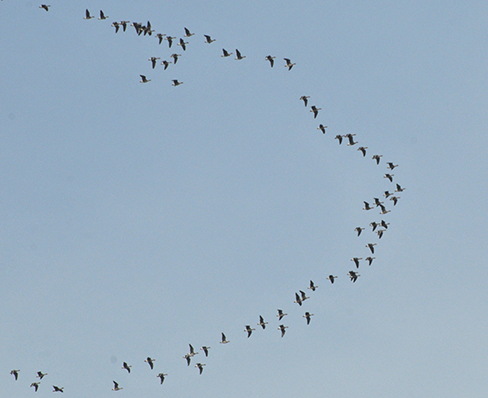
Julo. Public-domain photograph. Modified in OpenStax University Physics Volume 1. · Public Domain · Source出典

Figure 6.32図 6.32
Geese fly in a V formation during their long migratory travels. This shape reduces drag and energy consumption for individual birds, and also allows them a better way to communicate. (credit: modification of work by “Julo”/Wikimedia Commons)
英語のヒント
ガンは長い渡りの間、V字編隊で飛ぶ。この形は、各個体の抗力とエネルギー消費を減らし、互いの意思疎通もしやすくする。(出典:「Julo」/Wikimedia Commonsの作品を改変)