第6章ニュートンの法則の応用
6.2 Friction6.2 摩擦
Learning Objectives学習目標
Learning Objectives学習目標
By the end of this section, you will be able to:
英語のヒント
この節を終えると、次のことができるようになる。
- Describe the general characteristics of friction
英語のヒント
摩擦の一般的な特徴を説明する。 - List the various types of friction
英語のヒント
摩擦のさまざまな種類を挙げる。 - Calculate the magnitude of static and kinetic friction, and use these in problems involving Newton’s laws of motion
英語のヒント
静止摩擦と動摩擦の大きさを計算し、ニュートンの運動の法則を使う問題に応用する。
When a body is in motion, it has resistance because the body interacts with its surroundings. This resistance is a force of friction. Friction opposes relative motion between systems in contact but also allows us to move, a concept that becomes obvious if you try to walk on ice. Friction is a common yet complex force, and its behavior still not completely understood. Still, it is possible to understand the circumstances in which it behaves.
英語のヒント
物体が運動すると、周囲との相互作用によって抵抗を受ける。この抵抗が摩擦力である。摩擦は、接触する系どうしの相対運動を妨げるが、私たちが移動することも可能にする。氷の上を歩こうとすれば、そのことは明らかになる。摩擦は身近だが複雑な力で、その振る舞いは今も完全には理解されていない。それでも、どのような状況でどう働くかは理解できる。
Static and Kinetic Friction静止摩擦と動摩擦
The basic definition of friction is relatively simple to state.
英語のヒント
摩擦の基本的な定義は、比較的簡単に述べられる。
There are several forms of friction. One of the simpler characteristics of sliding friction is that it is parallel to the contact surfaces between systems and is always in a direction that opposes motion or attempted motion of the systems relative to each other. If two systems are in contact and moving relative to one another, then the friction between them is called kinetic friction. For example, friction slows a hockey puck sliding on ice. When objects are stationary, static friction can act between them; the static friction is usually greater than the kinetic friction between two objects.
英語のヒント
摩擦にはいくつかの形がある。滑り摩擦の比較的単純な特徴の一つは、接触面に平行で、二つの系の相対運動、または動き出そうとする向きと常に逆向きに働くことである。二つの系が接触し、互いに相対運動しているとき、その間の摩擦を動摩擦という。たとえば、氷の上を滑るホッケーのパックは摩擦によって遅くなる。物体が静止しているときには、間に静止摩擦が働くことがある。一般に、二つの物体間の静止摩擦は動摩擦より大きい。
Imagine, for example, trying to slide a heavy crate across a concrete floor—you might push very hard on the crate and not move it at all. This means that the static friction responds to what you do—it increases to be equal to and in the opposite direction of your push. If you finally push hard enough, the crate seems to slip suddenly and starts to move. Now static friction gives way to kinetic friction. Once in motion, it is easier to keep it in motion than it was to get it started, indicating that the kinetic frictional force is less than the static frictional force. If you add mass to the crate, say by placing a box on top of it, you need to push even harder to get it started and also to keep it moving. Furthermore, if you oiled the concrete you would find it easier to get the crate started and keep it going (as you might expect).
英語のヒント
たとえば、コンクリートの床で重い木箱を滑らせようとする場面を考えよう。強く押しても、木箱はまったく動かないかもしれない。つまり静止摩擦は、こちらの働きかけに応じて変わり、押す力と等しい大きさで逆向きになるまで増える。十分強く押すと、木箱は急に滑り出すように見える。ここで静止摩擦から動摩擦へ移る。いったん動けば、動き始めさせるときより、動かし続けるほうが容易である。これは、動摩擦力が静止摩擦力より小さいことを示す。上に別の箱を置くなどして質量を増やすと、動かし始めるにも動かし続けるにも、さらに強く押す必要がある。コンクリートに油を塗れば、予想どおり、そのどちらも容易になる。
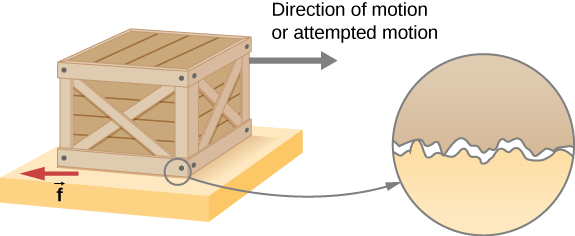
Figure 6.10 is a crude pictorial representation of how friction occurs at the interface between two objects. Close-up inspection of these surfaces shows them to be rough. Thus, when you push to get an object moving (in this case, a crate), you must raise the object until it can skip along with just the tips of the surface hitting, breaking off the points, or both. A considerable force can be resisted by friction with no apparent motion. The harder the surfaces are pushed together (such as if another box is placed on the crate), the more force is needed to move them. Part of the friction is due to adhesive forces between the surface molecules of the two objects, which explains the dependence of friction on the nature of the substances. For example, rubber-soled shoes slip less than those with leather soles. Adhesion varies with substances in contact and is a complicated aspect of surface physics. Once an object is moving, there are fewer points of contact (fewer molecules adhering), so less force is required to keep the object moving. At small but nonzero speeds, friction is nearly independent of speed.
英語のヒント
図6.10は、二つの物体の境界面で摩擦が生じる様子を簡略に描いたものである。接触面を拡大して調べると、表面に凹凸があることが分かる。物体(ここでは木箱)を押して動かすには、表面の先端どうしだけが触れながら進めるまで物体を持ち上げるか、先端を折るか、その両方が必要になる。目に見える運動がなくても、摩擦はかなり大きな力に抵抗できる。木箱の上に別の箱を載せる場合のように、面どうしを強く押し付けるほど、動かすために必要な力も大きい。摩擦の一部は二つの物体の表面分子間の付着力による。摩擦が物質の性質に依存するのも、そのためである。たとえばゴム底の靴は革底より滑りにくい。付着は接触する物質によって変わり、表面物理の複雑な側面の一つである。いったん物体が動くと、接触点、つまり付着している分子が減るため、動かし続けるのに必要な力は小さくなる。0ではない低い速さでは、摩擦は速さにほぼ依存しない。
OpenStax / Rice University, University Physics Volume 1, CC BY 4.0. Source-book artwork retained. · CC BY 4.0 · Source出典

Figure 6.10図 6.10
Frictional forces, such as always oppose motion or attempted motion between objects in contact. Friction arises in part because of the roughness of the surfaces in contact, as seen in the expanded view. For the object to move, it must rise to where the peaks of the top surface can skip along the bottom surface. Thus, a force is required just to set the object in motion. Some of the peaks will be broken off, also requiring a force to maintain motion. Much of the friction is actually due to attractive forces between molecules making up the two objects, so that even perfectly smooth surfaces are not friction-free. (In fact, perfectly smooth, clean surfaces of similar materials would adhere, forming a bond called a “cold weld.”)
英語のヒント
のような摩擦力は、接触する物体間の運動、または動こうとする向きと常に逆向きに働く。拡大図に見える接触面の凹凸は、摩擦の原因の一部である。物体が動くには、上側の物体の表面の突起が下側の面を乗り越えられる高さまで上がる必要がある。そのため、動き始めさせるだけでも力が要る。一部の突起は折れるので、動かし続けるにも力が要る。摩擦の多くは、実際には二つの物体を構成する分子間の引力による。そのため、完全に滑らかな面でも摩擦がなくなるわけではない。実際、似た材料の完全に滑らかで清浄な面どうしは付着し、「冷間圧接」と呼ばれる結合を作る。
The magnitude of the frictional force has two forms: one for static situations (static friction), the other for situations involving motion (kinetic friction). What follows is an approximate empirical (experimentally determined) model only. These equations for static and kinetic friction are not vector equations.
英語のヒント
摩擦力の大きさには、静止している場合の静止摩擦と、運動している場合の動摩擦の二つの形がある。以下に示すのは、あくまで実験で定めた近似的な経験モデルである。静止摩擦と動摩擦のこれらの式は、ベクトルの方程式ではない。
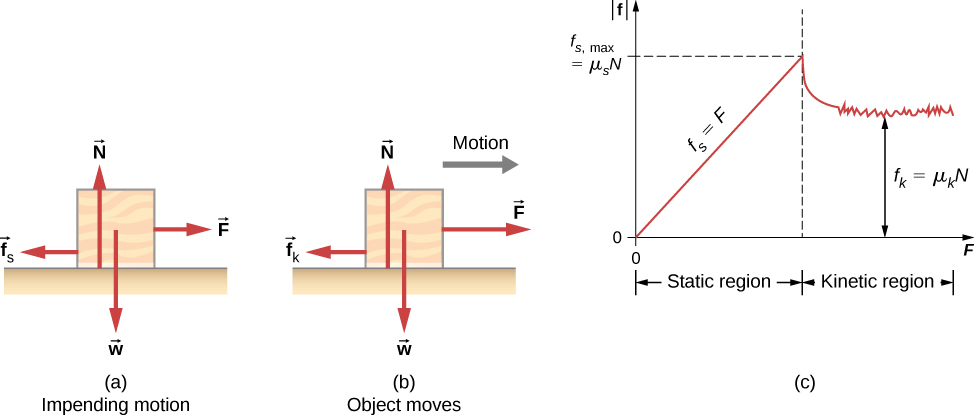
The symbol means less than or equal to, implying that static friction can have a maximum value of Static friction is a responsive force that increases to be equal and opposite to whatever force is exerted, up to its maximum limit. Once the applied force exceeds
英語のヒント
記号は「以下」を表し、静止摩擦の最大値がであることを示す。静止摩擦は外からの力に応じて変わり、上限に達するまでは、加えた力と大きさが等しく向きが逆になるまで増える。加えた力が次の値を超えると、
the object moves. Thus,
英語のヒント
、物体は動き出す。したがって、
A system in which is described as a system in which friction behaves simply. The transition from static friction to kinetic friction is illustrated in Figure 6.11.
英語のヒント
が成り立つ系では、摩擦が単純な振る舞いをすると表現する。静止摩擦から動摩擦への移行を図6.11に示す。
OpenStax / Rice University, University Physics Volume 1, CC BY 4.0. Source-book artwork retained. · CC BY 4.0 · Source出典

Figure 6.11図 6.11
(a) The force of friction between the block and the rough surface opposes the direction of the applied force The magnitude of the static friction balances that of the applied force. This is shown in the left side of the graph in (c). (b) At some point, the magnitude of the applied force is greater than the force of kinetic friction, and the block moves to the right. This is shown in the right side of the graph. (c) The graph of the frictional force versus the applied force; note that This means that
英語のヒント
(a) 物体と粗い面の間の摩擦力は、加えた力と逆向きである。静止摩擦の大きさは加えた力とつり合い、(c)のグラフの左側に対応する。(b) ある時点で、加えた力の大きさが動摩擦力を上回り、物体が右へ動く。これはグラフの右側に対応する。(c) 加えた力と摩擦力の関係。であることに注目しよう。これはを意味する。
As you can see in Table 6.1, the coefficients of kinetic friction are less than their static counterparts. The approximate values of are stated to only one or two digits to indicate the approximate description of friction given by the preceding two equations.
英語のヒント
表6.1のように、動摩擦係数は対応する静止摩擦係数より小さい。の近似値を1桁または2桁だけで示しているのは、先の二つの式による摩擦の記述が近似であることを表すためである。
System 系 |
Static Friction 静止摩擦 |
Kinetic Friction 動摩擦 |
|---|---|---|
Rubber on dry concrete 乾いたコンクリート上のゴム |
1.0 |
0.7 |
Rubber on wet concrete ぬれたコンクリート上のゴム |
0.5-0.7 |
0.3-0.5 |
Wood on wood 木材上の木材 |
0.5 |
0.3 |
Waxed wood on wet snow ぬれた雪上のワックスを塗った木材 |
0.14 |
0.1 |
Metal on wood 木材上の金属 |
0.5 |
0.3 |
Steel on steel (dry) 鋼上の鋼(乾燥) |
0.6 |
0.3 |
Steel on steel (oiled) 鋼上の鋼(油あり) |
0.05 |
0.03 |
Teflon on steel 鋼上のテフロン |
0.04 |
0.04 |
Bone lubricated by synovial fluid 滑液で潤滑された骨 |
0.016 |
0.015 |
Shoes on wood 木材上の靴 |
0.9 |
0.7 |
Shoes on ice 氷上の靴 |
0.1 |
0.05 |
Ice on ice 氷上の氷 |
0.1 |
0.03 |
Steel on ice 氷上の鋼 |
0.04 |
0.02 |
Equation 6.1 and Equation 6.2 include the dependence of friction on materials and the normal force. The direction of friction is always opposite that of motion, parallel to the surface between objects, and perpendicular to the normal force. For example, if the crate you try to push (with a force parallel to the floor) has a mass of 100 kg, then the normal force is equal to its weight,
英語のヒント
perpendicular to the floor. If the coefficient of static friction is 0.45, you would have to exert a force parallel to the floor greater than
英語のヒント
向きは床に垂直である。静止摩擦係数が0.45なら、木箱を動かすには床に平行に、次の値より大きな力を加えなければならない。
to move the crate. Once there is motion, friction is less and the coefficient of kinetic friction might be 0.30, so that a force of only
英語のヒント
こうして木箱を動かし始める。動き始めると摩擦は小さくなり、動摩擦係数が0.30であれば、次の力だけで、
keeps it moving at a constant speed. If the floor is lubricated, both coefficients are considerably less than they would be without lubrication. Coefficient of friction is a unitless quantity with a magnitude usually between 0 and 1.0. The actual value depends on the two surfaces that are in contact.
英語のヒント
一定の速さで動かし続けられる。床を潤滑すれば、両方の係数は潤滑しない場合よりかなり小さくなる。摩擦係数は単位のない量で、大きさは通常0から1.0の間にある。実際の値は、接触する二つの面によって決まる。
Many people have experienced the slipperiness of walking on ice. However, many parts of the body, especially the joints, have much smaller coefficients of friction—often three or four times less than ice. A joint is formed by the ends of two bones, which are connected by thick tissues. The knee joint is formed by the lower leg bone (the tibia) and the thighbone (the femur). The hip is a ball (at the end of the femur) and socket (part of the pelvis) joint. The ends of the bones in the joint are covered by cartilage, which provides a smooth, almost-glassy surface. The joints also produce a fluid (synovial fluid) that reduces friction and wear. A damaged or arthritic joint can be replaced by an artificial joint (Figure 6.12). These replacements can be made of metals (stainless steel or titanium) or plastic (polyethylene), also with very small coefficients of friction.
英語のヒント
多くの人は、氷の上を歩くと滑りやすいことを知っている。しかし身体の多くの部分、特に関節の摩擦係数はさらに小さく、氷の3分の1から4分の1ほどの場合もある。関節は、厚い組織でつながれた二つの骨の端からできている。膝関節は下腿の脛骨と大腿骨からなる。股関節は、大腿骨の端の球状部分と、骨盤の一部である受け皿からなる。関節内の骨の端は軟骨で覆われ、ガラスのように滑らかな面になる。関節は滑液という液体も作り、摩擦と摩耗を減らす。損傷した関節や関節炎のある関節は、人工関節に置き換えられる(図6.12)。人工関節は金属(ステンレス鋼やチタン)やプラスチック(ポリエチレン)で作られ、それらの摩擦係数も非常に小さい。
Image omitted because its reuse rights could not be verified.権利の確認ができないため画像を割愛。
Figure 6.12図 6.12
Artificial knee replacement is a procedure that has been performed for more than 20 years. These post-operative X-rays show a right knee joint replacement. (credit: modification of work by Mike Baird)
英語のヒント
人工膝関節への置換は、20年以上にわたって行われてきた処置である。術後のX線写真は右膝の人工関節を示す。(出典:Mike Bairdの作品を改変)