第6章ニュートンの法則の応用
The Calculus of Velocity-Dependent Frictional Forces速度に依存する摩擦力の微積分
When a body slides across a surface, the frictional force on it is approximately constant and given by Unfortunately, the frictional force on a body moving through a liquid or a gas does not behave so simply. This drag force is generally a complicated function of the body’s velocity. However, for a body moving in a straight line at moderate speeds through a liquid such as water, the frictional force can often be approximated by
英語のヒント
面に沿って滑る物体の摩擦力はほぼ一定で、で与えられる。残念ながら、液体や気体の中を動く物体の摩擦力はそれほど単純ではない。抗力は一般に、速度の複雑な関数である。ただし水のような液体中を中程度の速さでまっすぐ進む物体では、摩擦力を次の式で近似できる場合が多い。
where b is a constant whose value depends on the dimensions and shape of the body and the properties of the liquid, and v is the velocity of the body. Two situations for which the frictional force can be represented by this equation are a motorboat moving through water and a small object falling slowly through a liquid.
英語のヒント
ここでbは、物体の寸法や形、液体の性質によって値が決まる定数で、vは物体の速度である。この式で摩擦力を表せる二つの例は、水上を進むモーターボートと、液体中をゆっくり落ちる小さな物体である。
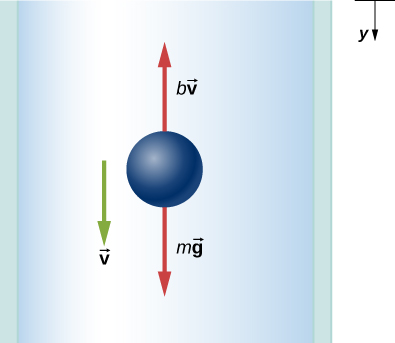
Let’s consider the object falling through a liquid. The free-body diagram of this object with the positive direction downward is shown in Figure 6.33. Newton’s second law in the vertical direction gives the differential equation
英語のヒント
液体中を落下する物体を考えよう。下向きを正に取った力の図を、図6.33に示す。鉛直方向のニュートンの第2法則から、次の微分方程式を得る。
where we have written the acceleration as As v increases, the frictional force –bv increases until it matches mg. At this point, there is no acceleration and the velocity remains constant at the terminal velocity From the previous equation,
英語のヒント
ここでは加速度をと書いた。vが増えると摩擦力−bvの大きさが増し、mgと一致する。この時点で加速度はなくなり、速度は終端速度で一定となる。先の式より、
so
英語のヒント
したがって、
OpenStax / Rice University, University Physics Volume 1, CC BY 4.0. Source-book artwork retained. · CC BY 4.0 · Source出典

Figure 6.33図 6.33
Free-body diagram of an object falling through a resistive medium.
英語のヒント
抵抗のある媒質中を落下する物体の力の図。
We can find the object’s velocity by integrating the differential equation for v. First, we rearrange terms in this equation to obtain
英語のヒント
vの微分方程式を積分すれば、物体の速度が求まる。まず式の項を整理すると、
Assuming that integration of this equation yields
英語のヒント
を仮定して積分すると、
or
英語のヒント
すなわち、
where are dummy variables of integration. With the limits given, we find
英語のヒント
ここでは積分のダミー変数である。与えた積分範囲から、
Since and we obtain
英語のヒント
およびなので、
and
英語のヒント
さらに、
Notice that as which is the terminal velocity.
英語のヒント
となり、終端速度に近づくことに注目しよう。
The position at any time may be found by integrating the equation for v. With
英語のヒント
vの式を積分すれば、任意の時刻の位置を求められる。なので、
Assuming
英語のヒント
と仮定すると、
which integrates to
英語のヒント
これを積分すると、
Example 6.18例題 6.18
Effect of the Resistive Force on a Motorboatモーターボートへの抵抗力の影響
A motorboat is moving across a lake at a speed when its motor suddenly freezes up and stops. The boat then slows down under the frictional force (a) What are the velocity and position of the boat as functions of time? (b) If the boat slows down from 4.0 to 1.0 m/s in 10 s, how far does it travel before stopping?
英語のヒント
モーターボートが湖を速さで進んでいると、突然モーターが動かなくなり、停止した。ボートは摩擦力で減速する。(a) 速度と位置を時間の関数として求めよ。(b) 10 sで4.0 m/sから1.0 m/sへ減速するなら、停止するまでにどれだけ進むか。
Solution解答
- With the motor stopped, the only horizontal force on the boat is so from Newton’s second law,
英語のヒント
モーターが止まると、ボートに働く水平な力はだけなので、ニュートンの第2法則より、which we can write as英語のヒント
これは次のように書ける。Integrating this equation between the time zero when the velocity is and the time t when the velocity is , we have英語のヒント
速度がの時刻0から、速度がの時刻tまで、この式を積分すると、Thus,英語のヒント
したがって、which, since we can write this as英語のヒント
なので、この式は次のように書ける。Now from the definition of velocity,英語のヒント
次に、速度の定義から、so we have英語のヒント
したがって、With the initial position zero, we have英語のヒント
初期位置を0とすると、and英語のヒント
さらに、As time increases, and the position of the boat approaches a limiting value英語のヒント
時間が増すととなり、ボートの位置は次の極限値に近づく。Although this tells us that the boat takes an infinite amount of time to reach the boat effectively stops after a reasonable time. For example, at we have英語のヒント
これによれば、に達するには無限の時間がかかる。それでも実際上は、妥当な長さの時間で停止する。たとえばでは、whereas we also have英語のヒント
一方、次も成り立つ。Therefore, the boat’s velocity and position have essentially reached their final values.英語のヒント
したがって、ボートの速度と位置は、実質的に最終値に達している。 - With and we have so
英語のヒント
、ではなので、and英語のヒント
さらに、Now the boat’s limiting position is英語のヒント
よって、ボートの位置の極限値は、
Significance考察
In the both of the previous examples, we found “limiting” values. The terminal velocity is the same as the limiting velocity, which is the velocity of the falling object after a (relatively) long time has passed. Similarly, the limiting distance of the boat is the distance the boat will travel after a long amount of time has passed. Due to the properties of exponential decay, the time involved to reach either of these values is actually not too long (certainly not an infinite amount of time!) but they are quickly found by taking the limit to infinity.
英語のヒント
前の二つの例では、どちらも「極限」の値を求めた。終端速度は速度の極限値と同じで、比較的長い時間が過ぎた後の落下物の速度である。同様に、ボートの距離の極限値は、長時間後までにボートが進む距離である。指数関数的減衰の性質により、実際にこれらの値へ達する時間はそれほど長くない。もちろん無限の時間ではない。それでも、時間を無限大へ近づける極限を取れば、値はすぐに求められる。