第6章ニュートンの法則の応用
6.4 Drag Force and Terminal Speed6.4 抗力と終端速度
Learning Objectives学習目標
Learning Objectives学習目標
By the end of this section, you will be able to:
英語のヒント
この節を終えると、次のことができるようになる。
- Express the drag force mathematically
英語のヒント
抗力を数式で表す。 - Describe applications of the drag force
英語のヒント
抗力の応用を説明する。 - Define terminal velocity
英語のヒント
終端速度を定義する。 - Determine an object’s terminal velocity given its mass
英語のヒント
質量が与えられた物体の終端速度を求める。
Another interesting force in everyday life is the force of drag on an object when it is moving in a fluid (either a gas or a liquid). You feel the drag force when you move your hand through water. You might also feel it if you move your hand during a strong wind. The faster you move your hand, the harder it is to move. You feel a smaller drag force when you tilt your hand so only the side goes through the air—you have decreased the area of your hand that faces the direction of motion.
英語のヒント
日常生活にあるもう一つの興味深い力が、気体や液体などの流体中を動く物体に働く抗力である。水中で手を動かすと抗力を感じる。強風の中で手を動かしても感じるかもしれない。手を速く動かすほど、動かすのは難しくなる。手を傾けて側面だけが空気を切るようにすると、抗力は小さくなる。運動方向を向く手の面積を小さくしたからである。
Drag Forces抗力
Like friction, the drag force always opposes the motion of an object. Unlike simple friction, the drag force is proportional to some function of the velocity of the object in that fluid. This functionality is complicated and depends upon the shape of the object, its size, its velocity, and the fluid it is in. For most large objects such as cyclists, cars, and baseballs not moving too slowly, the magnitude of the drag force is proportional to the square of the speed of the object. We can write this relationship mathematically as When taking into account other factors, this relationship becomes
英語のヒント
抗力は摩擦と同じく、常に物体の運動と逆向きに働く。しかし単純な摩擦とは異なり、流体中の物体の速度の何らかの関数に比例する。その関係は複雑で、物体の形、大きさ、速度、周囲の流体によって決まる。自転車に乗る人、自動車、野球のボールなど、大きめの物体が遅すぎない速さで動く場合、抗力の大きさは速さの2乗に比例する。数式ではと書ける。ほかの要因も入れると、次の関係になる。
where C is the drag coefficient, A is the area of the object facing the fluid, and is the density of the fluid. (Recall that density is mass per unit volume.) This equation can also be written in a more generalized fashion as where b is a constant equivalent to We have set the exponent n for these equations as 2 because when an object is moving at high velocity through air, the magnitude of the drag force is proportional to the square of the speed. As we shall see in Fluid Mechanics, for small particles moving at low speeds in a fluid, the exponent n is equal to 1.
英語のヒント
ここでCは抗力係数、Aは流体に向かい合う物体の面積、は流体の密度である。密度は単位体積当たりの質量だった。この式は、より一般的にとも書ける。bはに等しい定数である。空気中を高速で動く物体の抗力は速さの2乗に比例するので、これらの式では指数nを2にした。「流体力学」で見るように、流体中を低速で動く小さな粒子では、指数nは1になる。
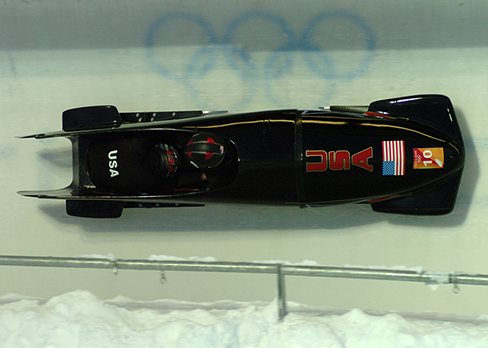
Athletes as well as car designers seek to reduce the drag force to lower their race times (Figure 6.29). Aerodynamic shaping of an automobile can reduce the drag force and thus increase a car’s gas mileage.
英語のヒント
競技者も自動車設計者も、競技時間を縮めるために抗力を減らそうとする(図6.29)。空気力学を考えた車体形状は抗力を減らし、燃費も改善できる。
(credit: “U.S. Army”/Wikimedia Commons) The appearance of U.S. Department of Defense visual information does not imply or constitute DoD endorsement. · US government public-domain visual information; OpenStax additions CC BY 4.0 · Source出典

Figure 6.29図 6.29
From racing cars to bobsled racers, aerodynamic shaping is crucial to achieving top speeds. Bobsleds are designed for speed and are shaped like a bullet with tapered fins. (credit: “U.S. Army”/Wikimedia Commons)
英語のヒント
レーシングカーからボブスレーまで、最高速度を得るには空気力学的な形状が重要になる。速さのために設計されたボブスレーは、先細りのひれを付けた弾丸のような形をしている。(出典:「U.S. Army」/Wikimedia Commons)
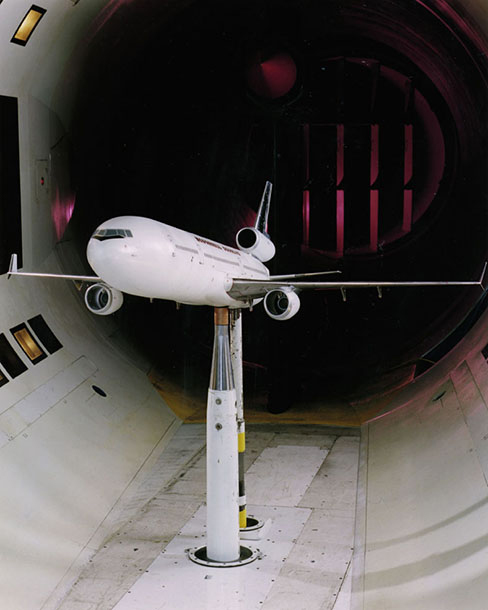
The value of the drag coefficient C is determined empirically, usually with the use of a wind tunnel (Figure 6.30).
英語のヒント
抗力係数Cの値は、通常、風洞を使って実験的に求める(図6.30)。
(credit: NASA/Ames) NASA imagery used for educational publication; no NASA endorsement is implied. · NASA media use permission; OpenStax additions CC BY 4.0 · Source出典

Figure 6.30図 6.30
NASA researchers test a model plane in a wind tunnel. (credit: NASA/Ames)
英語のヒント
NASAの研究者が風洞で模型飛行機を試験する。(出典:NASA/Ames)
The drag coefficient can depend upon velocity, but we assume that it is a constant here. Table 6.2 lists some typical drag coefficients for a variety of objects. Notice that the drag coefficient is a dimensionless quantity. At highway speeds, over of the power of a car is used to overcome air drag. The most fuel-efficient cruising speed is about 70–80 km/h (about 45–50 mi/h). For this reason, during the 1970s oil crisis in the United States, maximum speeds on highways were set at about 90 km/h (55 mi/h).
英語のヒント
抗力係数は速度に依存することもあるが、ここでは一定とする。表6.2に、さまざまな物体の代表的な抗力係数を示す。この係数は無次元量である。高速道路で走る速さでは、車の出力の以上が空気抵抗に打ち勝つために使われる。最も燃費のよい巡航速度は約70〜80 km/h(45〜50 mi/h)である。このため、1970年代の米国の石油危機では、高速道路の最高速度が約90 km/h(55 mi/h)に設定された。
Object 物体 |
C |
|---|---|
Airfoil 翼形 |
0.05 |
Toyota Camry トヨタ・カムリ |
0.28 |
Ford Focus フォード・フォーカス |
0.32 |
Honda Civic ホンダ・シビック |
0.36 |
Ferrari Testarossa フェラーリ・テスタロッサ |
0.37 |
Dodge Ram Pickup ダッジ・ラム・ピックアップ |
0.43 |
Sphere 球 |
0.45 |
Hummer H2 SUV ハマーH2 SUV |
0.64 |
Skydiver (feet first) スカイダイバー(足を下にした姿勢) |
0.70 |
Bicycle 自転車 |
0.90 |
Skydiver (horizontal) スカイダイバー(水平姿勢) |
1.0 |
Circular flat plate 円形平板 |
1.12 |
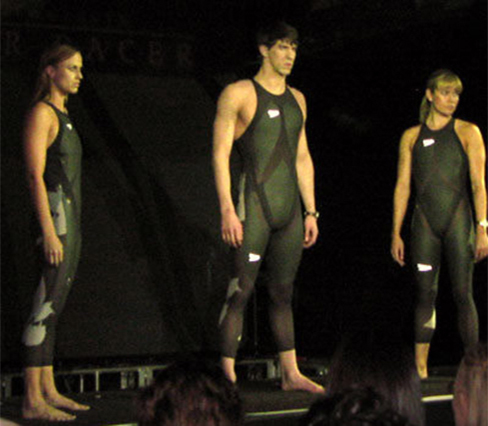
Substantial research is under way in the sporting world to minimize drag. The dimples on golf balls are being redesigned, as are the clothes that athletes wear. Bicycle racers and some swimmers and runners wear full bodysuits. Australian Cathy Freeman wore a full body suit in the 2000 Sydney Olympics and won a gold medal in the 400-m race. Many swimmers in the 2008 Beijing Olympics wore (Speedo) body suits; it might have made a difference in breaking many world records (Figure 6.31). Most elite swimmers (and cyclists) shave their body hair. Such innovations can have the effect of slicing away milliseconds in a race, sometimes making the difference between a gold and a silver medal. One consequence is that careful and precise guidelines must be continuously developed to maintain the integrity of the sport.
英語のヒント
スポーツ界では、抗力を最小化する研究が盛んに進められている。ゴルフボールのくぼみも、競技者の服も、設計が見直されている。自転車選手や一部の水泳・陸上選手は全身スーツを着る。オーストラリアのキャシー・フリーマンは、2000年シドニー五輪で全身スーツを着て400 mの金メダルを獲得した。2008年北京五輪では多くの水泳選手がSpeedoのスーツを着用し、多数の世界記録更新に影響した可能性がある(図6.31)。一流の水泳選手や自転車選手の多くは体毛をそる。こうした工夫で競技時間を数ミリ秒削り、それが金と銀の差になることもある。その結果、競技の公正さを維持するため、注意深く正確な指針を継続的に整える必要が生じる。
(credit: NASA/Kathy Barnstorff) NASA imagery used for educational publication; no NASA endorsement is implied. · NASA media use permission; OpenStax additions CC BY 4.0 · Source出典

Figure 6.31図 6.31
Body suits, such as this LZR Racer Suit, have been credited with aiding in many world records after their release in 2008. Smoother “skin” and more compression forces on a swimmer’s body provide at least less drag. (credit: NASA/Kathy Barnstorff)
英語のヒント
このLZR Racer Suitのような全身スーツは、2008年の登場後、多くの世界記録に貢献したとされる。より滑らかな「皮膚」と、体をより強く圧縮する力によって、抗力を少なくとも減らす。(出典:NASA/Kathy Barnstorff)