第6章ニュートンの法則の応用
Natural lubricants include saliva produced in our mouths to aid in the swallowing process, and the slippery mucus found between organs in the body, allowing them to move freely past each other during heartbeats, during breathing, and when a person moves. Hospitals and doctor’s clinics commonly use artificial lubricants, such as gels, to reduce friction.
英語のヒント
天然の潤滑物質には、飲み込みを助ける口の中の唾液や、体内の臓器の間にある滑らかな粘液がある。粘液により、心臓の拍動、呼吸、身体の動きの際に、臓器は互いの間で滑らかに動ける。病院や診療所では、摩擦を減らすためにジェルなどの人工的な潤滑剤もよく使う。
The equations given for static and kinetic friction are empirical laws that describe the behavior of the forces of friction. While these formulas are very useful for practical purposes, they do not have the status of mathematical statements that represent general principles (e.g., Newton’s second law). In fact, there are cases for which these equations are not even good approximations. For instance, neither formula is accurate for lubricated surfaces or for two surfaces sliding across each other at high speeds. Unless specified, we will not be concerned with these exceptions.
英語のヒント
静止摩擦と動摩擦について示した式は、摩擦力の振る舞いを記述する経験則である。実用上は非常に役立つが、ニュートンの第2法則のように、一般原理を表す数学的記述と同じ地位にあるわけではない。実際、これらの式がよい近似にすらならない場合もある。たとえば、潤滑された面や高速で互いに滑る面では、どちらの式も正確ではない。特に指定がない限り、ここではこうした例外を扱わない。
Example 6.10例題 6.10
Static and Kinetic Friction静止摩擦と動摩擦
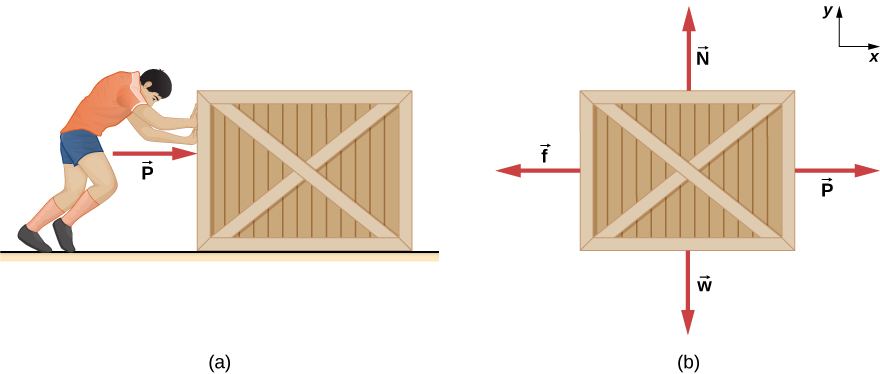
A 20.0-kg crate is at rest on a floor as shown in Figure 6.13. The coefficient of static friction between the crate and floor is 0.700 and the coefficient of kinetic friction is 0.600. A horizontal force is applied to the crate. Find the force of friction if (a) (b) (c) and (d)
英語のヒント
質量20.0 kgの木箱が、図6.13のように床の上で静止している。木箱と床の静止摩擦係数は0.700、動摩擦係数は0.600である。水平な力を木箱に加える。(a) 、(b) 、(c) 、(d) のそれぞれで摩擦力を求めよ。
OpenStax / Rice University, University Physics Volume 1, CC BY 4.0. Source-book artwork retained. · CC BY 4.0 · Source出典

Figure 6.13図 6.13
(a) A crate on a horizontal surface is pushed with a force (b) The forces on the crate. Here, may represent either the static or the kinetic frictional force.
英語のヒント
(a) 水平面上の木箱を力で押す。(b) 木箱に働く力。ここでは、静止摩擦力か動摩擦力のどちらかを表す。
Strategy方針
The free-body diagram of the crate is shown in Figure 6.13(b). We apply Newton’s second law in the horizontal and vertical directions, including the friction force in opposition to the direction of motion of the box.
英語のヒント
木箱の力の図を図6.13(b)に示す。箱の運動と逆向きの摩擦力も含めて、水平・鉛直方向にニュートンの第2法則を適用する。
Solution解答
Newton’s second law GIVES
英語のヒント
ニュートンの第2法則より、
Here we are using the symbol f to represent the frictional force since we have not yet determined whether the crate is subject to station friction or kinetic friction. We do this whenever we are unsure what type of friction is acting. Now the weight of the crate is
英語のヒント
まだ静止摩擦か動摩擦かを決めていないので、摩擦力を記号fで表す。どちらの摩擦が働くか不明な場合には、いつもこう表す。木箱の重さは、
which is also equal to N. The maximum force of static friction is therefore As long as is less than 137 N, the force of static friction keeps the crate stationary and Thus, (a) (b) and (c)
英語のヒント
であり、Nもこれに等しい。したがって、最大静止摩擦力はである。が137 N未満である限り、静止摩擦力が木箱を静止させ、となる。したがって、(a) 、(b) 、(c) である。
(d) If the applied force is greater than the maximum force of static friction (137 N), so the crate can no longer remain at rest. Once the crate is in motion, kinetic friction acts. Then
英語のヒント
(d) ならば、加えた力が最大静止摩擦力137 Nを上回り、木箱は静止していられなくなる。動き始めると動摩擦が働く。このとき、
and the acceleration is
英語のヒント
加速度は次のようになる。
Significance考察
This example illustrates how we consider friction in a dynamics problem. Notice that static friction has a value that matches the applied force, until we reach the maximum value of static friction. Also, no motion can occur until the applied force equals the force of static friction, but the force of kinetic friction will then become smaller.
英語のヒント
この例は、動力学の問題で摩擦をどう扱うかを示す。静止摩擦は最大値に達するまで、加えた力に合わせた値を取る。また、加えた力が静止摩擦力に達するまでは動き出せないが、その後の動摩擦力は小さくなることに注目しよう。
Friction and the Inclined Plane摩擦と斜面
One situation where friction plays an obvious role is that of an object on a slope. It might be a crate being pushed up a ramp to a loading dock or a skateboarder coasting down a mountain, but the basic physics is the same. We usually generalize the sloping surface and call it an inclined plane but then pretend that the surface is flat. Let’s look at an example of analyzing motion on an inclined plane with friction.
英語のヒント
摩擦の役割がはっきり現れる状況の一つは、斜面上の物体である。荷積み場へ木箱を押し上げる場合も、スケートボードで山を滑り降りる場合も、基本の物理は同じである。傾いた面を一般化して斜面と呼び、その表面は平らだとみなすことが多い。摩擦のある斜面上の運動を分析する例を見よう。
Example 6.11例題 6.11
Downhill Skier斜面を滑り降りるスキーヤー
A skier with a mass of 62 kg is sliding down a snowy slope at a constant acceleration. Find the coefficient of kinetic friction for the skier if friction is known to be 45.0 N.
英語のヒント
質量62 kgのスキーヤーが、雪の斜面を一定の加速度で滑り降りる。摩擦力が45.0 Nと分かっているとき、動摩擦係数を求めよ。
Strategy方針
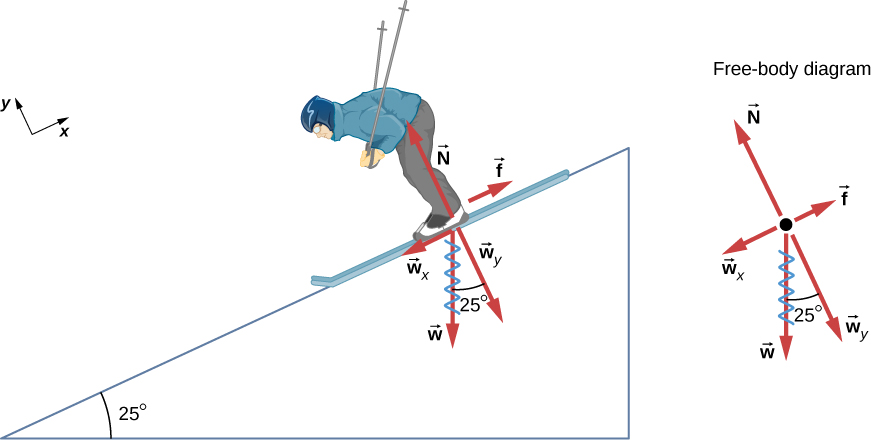
The magnitude of kinetic friction is given as 45.0 N. Kinetic friction is related to the normal force by ; thus, we can find the coefficient of kinetic friction if we can find the normal force on the skier. The normal force is always perpendicular to the surface, and since there is no motion perpendicular to the surface, the normal force should equal the component of the skier’s weight perpendicular to the slope. (See Figure 6.14, which repeats a figure from the chapter on Newton’s laws of motion.)
英語のヒント
動摩擦力の大きさは45.0 Nである。動摩擦力と垂直抗力はで関係付けられるので、垂直抗力が分かれば動摩擦係数を求められる。垂直抗力は常に面に垂直である。面に垂直な運動はないので、垂直抗力はスキーヤーの重さの斜面に垂直な成分と等しいはずである。図6.14は、ニュートンの運動の法則の章の図を再掲したものである。
OpenStax / Rice University, University Physics Volume 1, CC BY 4.0. Source-book artwork retained. · CC BY 4.0 · Source出典

Figure 6.14図 6.14
The motion of the skier and friction are parallel to the slope, so it is most convenient to project all forces onto a coordinate system where one axis is parallel to the slope and the other is perpendicular (axes shown to left of skier). The normal force is perpendicular to the slope, and friction is parallel to the slope, but the skier’s weight has components along both axes, namely and The normal force is equal in magnitude to so there is no motion perpendicular to the slope.
英語のヒント
スキーヤーの運動と摩擦は斜面に平行なので、一方の軸を斜面に平行、もう一方を垂直に取った座標系に力を分解するのが最も便利である(スキーヤーの左側の軸)。垂直抗力は斜面に垂直、摩擦は平行だが、重さは両軸方向に成分とをもつ。垂直抗力はと大きさが等しく、斜面に垂直な運動は生じない。
We have
英語のヒント
次の式が成り立つ。
Substituting this into our expression for kinetic friction, we obtain
英語のヒント
これを動摩擦の式に代入すると、
which can now be solved for the coefficient of kinetic friction
英語のヒント
となる。この式を動摩擦係数について解けばよい。
Solution解答
Solving for gives
英語のヒント
について解くと、
Substituting known values on the right-hand side of the equation,
英語のヒント
式の右辺に既知の値を代入すると、
Significance考察
This result is a little smaller than the coefficient listed in Table 6.1 for waxed wood on snow, but it is still reasonable since values of the coefficients of friction can vary greatly. In situations like this, where an object of mass m slides down a slope that makes an angle with the horizontal, friction is given by All objects slide down a slope with constant acceleration under these circumstances.
英語のヒント
この結果は、表6.1の雪上のワックスを塗った木材の係数より少し小さい。それでも、摩擦係数の値は大きく変わりうるので妥当である。このように質量mの物体が、水平との角をなす斜面を滑り降りる場合、摩擦はで与えられる。この条件では、どの物体も一定の加速度で滑り降りる。
We have discussed that when an object rests on a horizontal surface, the normal force supporting it is equal in magnitude to its weight. Furthermore, simple friction is always proportional to the normal force. When an object is not on a horizontal surface, as with the inclined plane, we must find the force acting on the object that is directed perpendicular to the surface; it is a component of the weight.
英語のヒント
水平面上で静止する物体では、支える垂直抗力と重さの大きさが等しいことを説明した。また、単純な摩擦は常に垂直抗力に比例する。斜面の場合のように水平面上でないときには、物体に働く力のうち、面に垂直なものを求めなければならない。それは重さの一成分である。
We now derive a useful relationship for calculating coefficient of friction on an inclined plane. Notice that the result applies only for situations in which the object slides at constant speed down the ramp.
英語のヒント
斜面での摩擦係数を計算するための便利な関係を導こう。この結果は、物体が一定の速さで斜面を滑り降りる場合だけに使える。
An object slides down an inclined plane at a constant velocity if the net force on the object is zero. We can use this fact to measure the coefficient of kinetic friction between two objects. As shown in Example 6.11, the kinetic friction on a slope is . The component of the weight down the slope is equal to (see the free-body diagram in Figure 6.14). These forces act in opposite directions, so when they have equal magnitude, the acceleration is zero. Writing these out,
英語のヒント
Solving for we find that
英語のヒント
について解くと、
Put a coin on a book and tilt it until the coin slides at a constant velocity down the book. You might need to tap the book lightly to get the coin to move. Measure the angle of tilt relative to the horizontal and find Note that the coin does not start to slide at all until an angle greater than is attained, since the coefficient of static friction is larger than the coefficient of kinetic friction. Think about how this may affect the value for and its uncertainty.
英語のヒント
本の上に硬貨を置き、硬貨が一定の速度で滑り降りるまで本を傾けよう。動き出させるには、本を軽くたたく必要があるかもしれない。水平からの傾斜角を測り、を求めよう。静止摩擦係数は動摩擦係数より大きいため、硬貨はより大きい角度に達するまで、まったく滑り始めない。このことがの値と不確かさにどう影響するか考えよう。