第6章ニュートンの法則の応用
Atomic-Scale Explanations of Friction原子の尺度で摩擦を説明する
The simpler aspects of friction dealt with so far are its macroscopic (large-scale) characteristics. Great strides have been made in the atomic-scale explanation of friction during the past several decades. Researchers are finding that the atomic nature of friction seems to have several fundamental characteristics. These characteristics not only explain some of the simpler aspects of friction—they also hold the potential for the development of nearly friction-free environments that could save hundreds of billions of dollars in energy which is currently being converted (unnecessarily) into heat.
英語のヒント
ここまで扱った比較的単純な摩擦の側面は、巨視的、つまり大きな尺度での特徴である。過去数十年で、原子の尺度による摩擦の説明は大きく進歩した。研究者は、摩擦の原子的な性質にいくつかの基本的特徴があると見いだしつつある。これらの特徴は摩擦の単純な側面を説明するだけでなく、ほとんど摩擦のない環境の開発につながる可能性もある。そのような環境では、今は不必要に熱へ変わっている、数千億ドル相当のエネルギーを節約できるかもしれない。
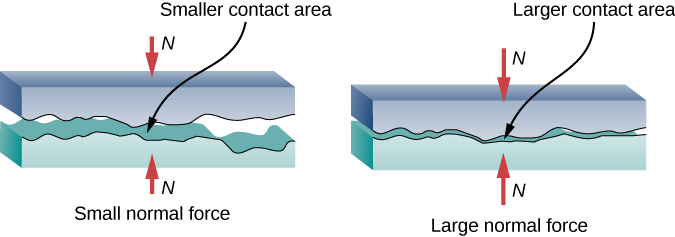
Figure 6.15 illustrates one macroscopic characteristic of friction that is explained by microscopic (small-scale) research. We have noted that friction is proportional to the normal force, but not to the amount of area in contact, a somewhat counterintuitive notion. When two rough surfaces are in contact, the actual contact area is a tiny fraction of the total area because only high spots touch. When a greater normal force is exerted, the actual contact area increases, and we find that the friction is proportional to this area.
英語のヒント
図6.15は、微視的、つまり小さな尺度の研究によって説明できる、摩擦の巨視的な特徴を示す。先に、摩擦は垂直抗力に比例するが接触面積には比例しないと述べた。これはやや直感に反する。二つの粗い面が接するとき、実際には高い部分だけが触れるので、接触面積は全体のごく一部である。垂直抗力が増えると、実際の接触面積も増える。摩擦は、この面積に比例すると分かる。
OpenStax / Rice University, University Physics Volume 1, CC BY 4.0. Source-book artwork retained. · CC BY 4.0 · Source出典

Figure 6.15図 6.15
Two rough surfaces in contact have a much smaller area of actual contact than their total area. When the normal force is larger as a result of a larger applied force, the area of actual contact increases, as does friction.
英語のヒント
粗い二つの面が接触するとき、実際に接触する面積は全体の面積よりはるかに小さい。加える力が増して垂直抗力が大きくなると、実際の接触面積が増え、摩擦も増える。
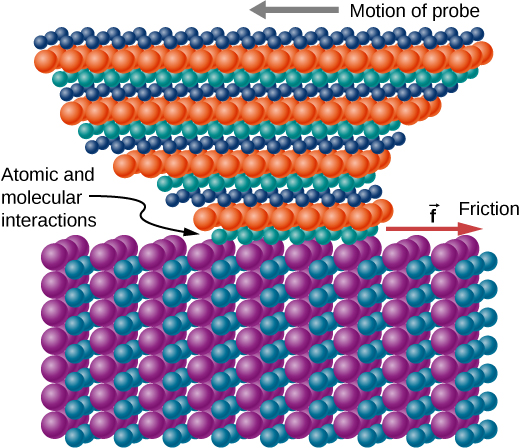
However, the atomic-scale view promises to explain far more than the simpler features of friction. The mechanism for how heat is generated is now being determined. In other words, why do surfaces get warmer when rubbed? Essentially, atoms are linked with one another to form lattices. When surfaces rub, the surface atoms adhere and cause atomic lattices to vibrate—essentially creating sound waves that penetrate the material. The sound waves diminish with distance, and their energy is converted into heat. Chemical reactions that are related to frictional wear can also occur between atoms and molecules on the surfaces. Figure 6.16 shows how the tip of a probe drawn across another material is deformed by atomic-scale friction. The force needed to drag the tip can be measured and is found to be related to shear stress, which is discussed in Static Equilibrium and Elasticity. The variation in shear stress is remarkable (more than a factor of ) and difficult to predict theoretically, but shear stress is yielding a fundamental understanding of a large-scale phenomenon known since ancient times—friction.
英語のヒント
原子の尺度で見る方法は、摩擦の単純な特徴だけでなく、さらに多くを説明すると期待される。熱が生じる仕組みも明らかになりつつある。言い換えると、こすると表面が温かくなるのはなぜだろうか。原子は互いにつながり、格子を作っている。面をこすり合わせると、表面の原子が付着して原子格子を振動させる。これは、材料内へ伝わる音波を生むことに相当する。音波は距離とともに弱まり、そのエネルギーが熱に変わる。摩耗に関係する化学反応が、表面の原子や分子の間で起こることもある。図6.16は、別の材料上を引かれる探針の先が、原子の尺度の摩擦によって変形する様子を示す。先端を引くために必要な力は測定でき、「静的つり合いと弾性」で扱うせん断応力に関係すると分かっている。せん断応力の変動は非常に大きく、倍以上にもなり、理論的な予測は難しい。それでも、せん断応力の研究により、古代から知られてきた巨視的現象である摩擦の基礎的な理解が進んでいる。
OpenStax / Rice University, University Physics Volume 1, CC BY 4.0. Source-book artwork retained. · CC BY 4.0 · Source出典

Figure 6.16図 6.16
The tip of a probe is deformed sideways by frictional force as the probe is dragged across a surface. Measurements of how the force varies for different materials are yielding fundamental insights into the atomic nature of friction.
英語のヒント
探針を表面に沿って引くと、摩擦力で先端が横へ変形する。材料によって力がどう変わるかを測ることで、摩擦の原子的な性質について基礎的な知見が得られる。
Additional Resources追加教材
Example 6.12例題 6.12
Sliding Blocks滑る二つの物体
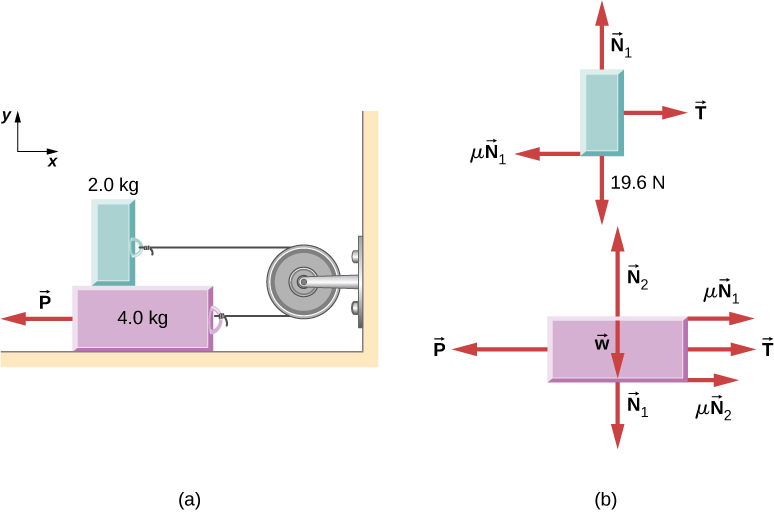
The two blocks of Figure 6.17 are attached to each other by a massless string that is wrapped around a frictionless pulley. When the bottom 4.00-kg block is pulled to the left by the constant force the top 2.00-kg block slides across it to the right. Find the magnitude of the force necessary to move the blocks at constant speed. Assume that the coefficient of kinetic friction between all surfaces is 0.400.
英語のヒント
図6.17の二つの物体は、摩擦のない滑車に巻き掛けた、質量のないひもでつながれている。下の4.00 kgの物体を一定の力で左へ引くと、上の2.00 kgの物体はその上を右へ滑る。両方を一定の速さで動かすために必要な力の大きさを求めよ。すべての接触面の動摩擦係数を0.400とする。
OpenStax / Rice University, University Physics Volume 1, CC BY 4.0. Source-book artwork retained. · CC BY 4.0 · Source出典

Figure 6.17図 6.17
(a) Each block moves at constant velocity. (b) Free-body diagrams for the blocks.
英語のヒント
(a) 各物体は一定の速度で動く。(b) 各物体の力の図。
Strategy方針
We analyze the motions of the two blocks separately. The top block is subjected to a contact force exerted by the bottom block. The components of this force are the normal force and the frictional force Other forces on the top block are the tension in the string and the weight of the top block itself, 19.6 N. The bottom block is subjected to contact forces due to the top block and due to the floor. The first contact force has components and which are simply reaction forces to the contact forces that the bottom block exerts on the top block. The components of the contact force of the floor are and Other forces on this block are the tension and the weight –39.2 N.
英語のヒント
二つの物体の運動を別々に分析する。上の物体は、下の物体から接触力を受ける。その成分は垂直抗力と摩擦力である。そのほかに、ひもの張力と、上の物体自身の重さ19.6 Nが働く。下の物体は、上の物体と床から接触力を受ける。上の物体からの接触力の成分はとであり、下の物体が上の物体に及ぼす接触力の反作用である。床からの接触力の成分はとである。そのほかに、張力、重さ−39.2 Nが働く。
Solution解答
Since the top block is moving horizontally to the right at constant velocity, its acceleration is zero in both the horizontal and the vertical directions. From Newton’s second law,
英語のヒント
上の物体は水平方向に右へ一定の速度で動くため、水平・鉛直のどちらの加速度も0である。ニュートンの第2法則より、
Solving for the two unknowns, we obtain and The bottom block is also not accelerating, so the application of Newton’s second law to this block gives
英語のヒント
二つの未知量について解くと、とを得る。下の物体も加速していないので、ニュートンの第2法則を適用すると、
The values of and T were found with the first set of equations. When these values are substituted into the second set of equations, we can determine and P. They are
英語のヒント
とTは最初の連立方程式から求めた。これらを次の連立方程式に代入すると、とPが求まる。その値は、
Significance考察
Understanding what direction in which to draw the friction force is often troublesome. Notice that each friction force labeled in Figure 6.17 acts in the direction opposite the motion of its corresponding block.
英語のヒント
摩擦力をどの向きに描くべきかの判断は、しばしば難しい。図6.17の各摩擦力が、対応する物体の運動と逆向きに働いていることに注目しよう。
Example 6.13例題 6.13
A Crate on an Accelerating Truck加速するトラックの荷台の木箱
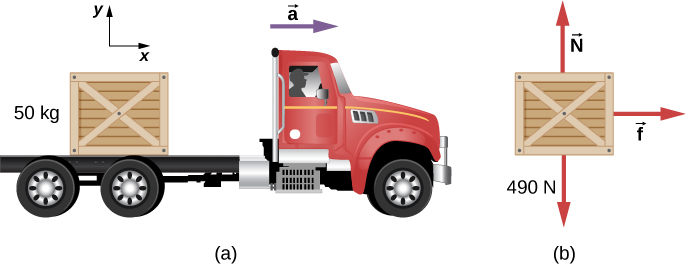
A 50.0-kg crate rests on the bed of a truck as shown in Figure 6.18. The coefficients of friction between the surfaces are and Find the frictional force on the crate when the truck is accelerating forward relative to the ground at (a) 2.00 m/s2, and (b) 5.00 m/s2.
英語のヒント
図6.18のように、質量50.0 kgの木箱がトラックの荷台上に置かれている。接触面の摩擦係数はとである。トラックが地面に対して前向きに、(a) 2.00 m/s2、(b) 5.00 m/s2の加速度で加速するとき、木箱に働く摩擦力を求めよ。
OpenStax / Rice University, University Physics Volume 1, CC BY 4.0. Source-book artwork retained. · CC BY 4.0 · Source出典

Figure 6.18図 6.18
(a) A crate rests on the bed of the truck that is accelerating forward. (b) The free-body diagram of the crate.
英語のヒント
(a) 前向きに加速するトラックの荷台に木箱が載っている。(b) 木箱の力の図。
Strategy方針
The forces on the crate are its weight and the normal and frictional forces due to contact with the truck bed. We start by assuming that the crate is not slipping. In this case, the static frictional force acts on the crate. Furthermore, the accelerations of the crate and the truck are equal.
英語のヒント
木箱に働くのは重さと、荷台との接触による垂直抗力・摩擦力である。まず木箱は滑っていないと仮定する。この場合、木箱には静止摩擦力が働く。また木箱とトラックの加速度は等しい。
Solution解答
- Application of Newton’s second law to the crate, using the reference frame attached to the ground, yields
英語のヒント
地面に固定した基準系を使って、木箱にニュートンの第2法則を適用すると、We can now check the validity of our no-slip assumption. The maximum value of the force of static friction is英語のヒント
ここで、滑らないという仮定が妥当かどうかを確認できる。静止摩擦力の最大値は、whereas the actual force of static friction that acts when the truck accelerates forward at is only Thus, the assumption of no slipping is valid.英語のヒント
である。それに対し、トラックが前向きにで加速するときに実際に働く静止摩擦力は、にすぎない。したがって、滑らないという仮定は妥当である。 - If the crate is to move with the truck when it accelerates at the force of static friction must be
英語のヒント
トラックがで加速するとき、木箱が一緒に動くには、静止摩擦力は次の値でなければならない。Since this exceeds the maximum of 196 N, the crate must slip. The frictional force is therefore kinetic and is英語のヒント
これは最大値196 Nを超えるので、木箱は滑る。そのため摩擦は動摩擦となり、The horizontal acceleration of the crate relative to the ground is now found from英語のヒント
地面に対する木箱の水平方向の加速度は、次の式から求まる。
Significance考察
Relative to the ground, the truck is accelerating forward at and the crate is accelerating forward at . Hence the crate is sliding backward relative to the bed of the truck with an acceleration
英語のヒント
地面に対して、トラックは前向きに、木箱は前向きにの加速度で加速する。したがって木箱は、荷台に対して後ろ向きに、加速度で滑る。
Example 6.14例題 6.14
Snowboardingスノーボード
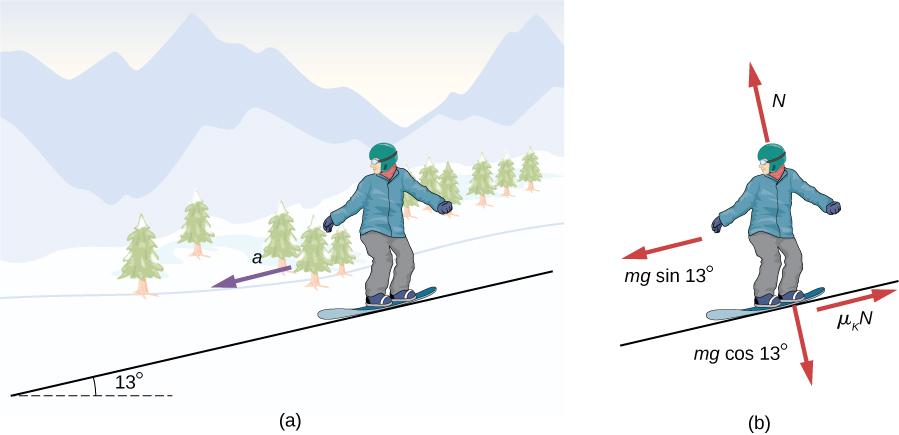
Earlier, we analyzed the situation of a downhill skier moving at constant velocity to determine the coefficient of kinetic friction. Now let’s do a similar analysis to determine acceleration. The snowboarder of Figure 6.19 glides down a slope that is inclined at 13° to the horizontal. The coefficient of kinetic friction between the board and the snow is What is the acceleration of the snowboarder?
英語のヒント
先ほどは、斜面を一定の速度で滑るスキーヤーから動摩擦係数を求めた。今度は、同様の分析で加速度を求めよう。図6.19のスノーボーダーが、水平に対して13°傾いた斜面を滑り降りる。板と雪の動摩擦係数はである。加速度はいくらか。
OpenStax / Rice University, University Physics Volume 1, CC BY 4.0. Source-book artwork retained. · CC BY 4.0 · Source出典

Figure 6.19図 6.19
(a) A snowboarder glides down a slope inclined at 13° to the horizontal. (b) The free-body diagram of the snowboarder.
英語のヒント
(a) スノーボーダーが水平に対して13°傾いた斜面を滑り降りる。(b) スノーボーダーの力の図。
Strategy方針
The forces acting on the snowboarder are her weight and the contact force of the slope, which has a component normal to the incline and a component along the incline (force of kinetic friction). Because she moves along the slope, the most convenient reference frame for analyzing her motion is one with the x-axis along and the y-axis perpendicular to the incline. In this frame, both the normal and the frictional forces lie along coordinate axes, the components of the weight are , and the only acceleration is along the x-axis
英語のヒント
スノーボーダーに働くのは重さと斜面からの接触力である。接触力には、斜面に垂直な成分と、斜面に沿う動摩擦力の成分がある。斜面に沿って動くので、x軸を斜面に沿わせ、y軸を斜面に垂直にする基準系が、分析には最も便利である。この基準系では垂直抗力も摩擦力も座標軸に沿い、重さの成分は、加速度はx軸方向のだけである。
Solution解答
We can now apply Newton’s second law to the snowboarder:
英語のヒント
ニュートンの第2法則をスノーボーダーに適用する。
From the second equation, Upon substituting this into the first equation, we find
英語のヒント
第2式からを得る。これを第1式に代入すると、
Significance考察
Notice from this equation that if is small enough or is large enough, is negative, that is, the snowboarder slows down.
英語のヒント
この式から、が十分小さいか、が十分大きいと、が負になり、スノーボーダーは減速すると分かる。