第6章ニュートンの法則の応用
Summaryまとめ
- Newton’s laws of motion can be applied in numerous situations to solve motion problems.
英語のヒント
ニュートンの運動の法則は、さまざまな状況の運動問題に適用できる。 - Some problems contain multiple force vectors acting in different directions on an object. Be sure to draw diagrams, resolve all force vectors into horizontal and vertical components, and draw a free-body diagram. Always analyze the direction in which an object accelerates so that you can determine whether or
英語のヒント
物体に異なる向きの力のベクトルが複数働く問題もある。必ず図を描き、すべての力を水平・鉛直の成分に分解して、力の図を描こう。かかを判断できるよう、物体がどの向きに加速するかを常に分析する。 - The normal force on an object is not always equal in magnitude to the weight of the object. If an object is accelerating vertically, the normal force is less than or greater than the weight of the object. Also, if the object is on an inclined plane, the normal force is always less than the full weight of the object.
英語のヒント
垂直抗力の大きさは、必ずしも物体の重さに等しくない。物体が鉛直方向に加速していれば、垂直抗力は重さより小さいか大きい。また斜面上では、垂直抗力は物体の重さ全体より常に小さい。 - Some problems contain several physical quantities, such as forces, acceleration, velocity, or position. You can apply concepts from kinematics and dynamics to solve these problems.
英語のヒント
力、加速度、速度、位置など、複数の物理量が関わる問題もある。運動学と動力学の概念を使って解くことができる。
Conceptual Questions概念に関する問題
Exercises 1練習問題 1
Exercise 1問題 1
To simulate the apparent weightlessness of space orbit, astronauts are trained in the hold of a cargo aircraft that is accelerating downward at g. Why do they appear to be weightless, as measured by standing on a bathroom scale, in this accelerated frame of reference? Is there any difference between their apparent weightlessness in orbit and in the aircraft?
英語のヒント
宇宙の軌道上での見かけの無重量状態を再現するため、宇宙飛行士は、下向きにgの加速度で加速する貨物機の貨物室で訓練する。この加速する基準系内では、体重計に乗って測ると、なぜ無重量に見えるのか。軌道上と機内での見かけの無重量状態に違いはあるか。
Solution解き方
The scale is in free fall along with the astronauts, so the reading on the scale would be 0. There is no difference in the apparent weightlessness; in the aircraft and in orbit, free fall is occurring.
英語のヒント
体重計は宇宙飛行士とともに自由落下するので、読みは0になる。機内でも軌道上でも自由落下が起きており、見かけの無重量状態に違いはない。
Problems問題
Exercises 2–22練習問題 2–22
Exercise 2問題 2
A 30.0-kg girl in a swing is pushed to one side and held at rest by a horizontal force so that the swing ropes are with respect to the vertical. (a) Calculate the tension in each of the two ropes supporting the swing under these conditions. (b) Calculate the magnitude of
英語のヒント
ブランコに乗る質量30.0 kgの少女を横へ押し、水平な力で静止させる。ブランコのロープは鉛直との角をなす。(a) この状態で、ブランコを支える2本のロープそれぞれの張力を求めよ。(b) の大きさを求めよ。
Solution解き方
a. 170 N; b. 170 N
a. 170 N、b. 170 N
Exercise 3問題 3
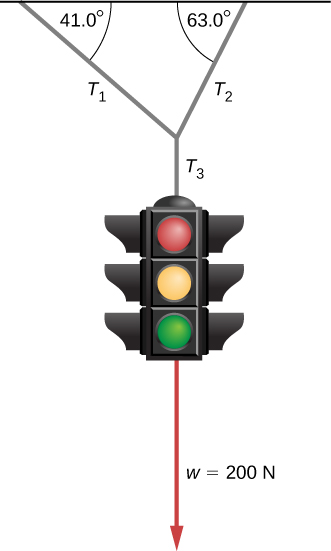
Exercise 4問題 4
Three forces act on an object, considered to be a particle, which moves with constant velocity Two of the forces are and Find the third force.
英語のヒント
質点とみなす物体に三つの力が働き、物体は一定の速度で動く。そのうち二つの力はとである。残る一つの力を求めよ。
Solution解き方
Exercise 5問題 5
A flea jumps by exerting a force of straight down on the ground. A breeze blowing on the flea parallel to the ground exerts a force of on the flea while the flea is still in contact with the ground. Find the direction and magnitude of the acceleration of the flea if its mass is . Do not neglect the gravitational force.
英語のヒント
ノミが地面に真下向きの力を加えて跳ぶ。まだノミが地面に接している間、地面に平行なそよ風がノミにの力を及ぼす。ノミの質量がのとき、加速度の向きと大きさを求めよ。重力を無視してはならない。
Exercise 6問題 6
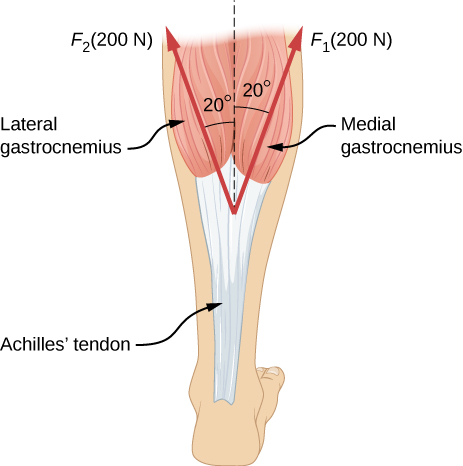
Two muscles in the back of the leg pull upward on the Achilles tendon, as shown below. (These muscles are called the medial and lateral heads of the gastrocnemius muscle.) Find the magnitude and direction of the total force on the Achilles tendon. What type of movement could be caused by this force?
英語のヒント
図のように、脚の後ろ側にある二つの筋肉がアキレス腱を上向きに引く。この二つは腓腹筋の内側頭と外側頭という。アキレス腱に働く合力の大きさと向きを求めよ。この力によって、どのような動きが生じるだろうか。
Solution解き方
376 N pointing up (along the dashed line in the figure); the force is used to raise the heel of the foot.
英語のヒント
図の破線に沿って上向きに376 N。この力は、かかとを上げるのに使われる。
Exercise 7問題 7
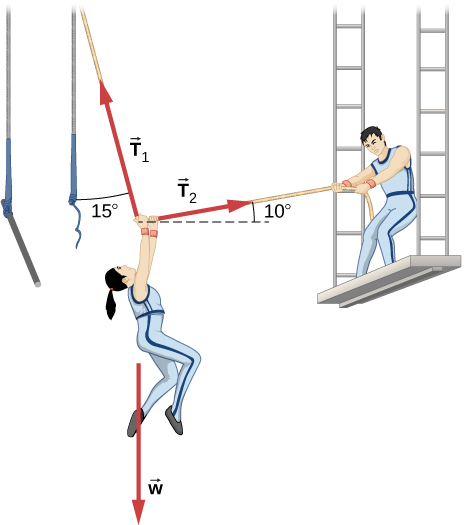
After a mishap, a 76.0-kg circus performer clings to a trapeze, which is being pulled to the side by another circus artist, as shown here. Calculate the tension in the two ropes if the person is momentarily motionless. Include a free-body diagram in your solution.
英語のヒント
思わぬ事故の後、質量76.0 kgのサーカスの演者が空中ブランコにつかまり、別の演者が図のように横へ引いている。本人が一瞬静止しているときの、2本のロープの張力を求めよ。解答には力の図も含めよ。
Exercise 8問題 8
A 35.0-kg dolphin accelerates opposite to the motion from 12.0 to 7.50 m/s in 2.30 s to join another dolphin in play. What average force was exerted to slow the first dolphin if it was moving horizontally? (The gravitational force is balanced by the buoyant force of the water.)
英語のヒント
質量35.0 kgのイルカが仲間との遊びに加わるため、運動と逆向きに加速し、2.30 sの間に12.0 m/sから7.50 m/sへ減速する。水平方向に動いていたとき、減速させた平均の力はいくらか。重力と水の浮力はつり合っている。
Solution解き方
−68.5 N
Exercise 9問題 9
When starting a foot race, a 70.0-kg sprinter exerts an average force of 650 N backward on the ground for 0.800 s. (a) What is their final speed? (b) How far do they travel?
英語のヒント
徒競走のスタートで、質量70.0 kgの短距離走者が0.800 sの間、平均650 Nの力で地面を後ろに押す。(a) 最後の速さはいくらか。(b) どれだけの距離を進むか。
Exercise 10問題 10
A large rocket has a mass of at takeoff, and its engines produce a thrust of (a) Find its initial acceleration if it takes off vertically. (b) How long does it take to reach a velocity of 120 km/h straight up, assuming constant mass and thrust?
英語のヒント
大型ロケットの離陸時の質量はで、エンジンの推力はである。(a) 鉛直に離陸するときの初期加速度を求めよ。(b) 質量と推力を一定として、真上向きに120 km/hの速度に達するまでの時間を求めよ。
Solution解き方
a. ; b. 4.33 s
a. 、b. 4.33 s
Exercise 11問題 11
A basketball player jumps straight up for a ball. To do this, he lowers his body 0.300 m and then accelerates through this distance by forcefully straightening his legs. This player leaves the floor with a vertical velocity sufficient to carry him 0.900 m above the floor. (a) Calculate his velocity when he leaves the floor. (b) Calculate his acceleration while he is straightening his legs. He goes from zero to the velocity found in (a) in a distance of 0.300 m. (c) Calculate the force he exerts on the floor to do this, given that his mass is 110.0 kg.
英語のヒント
バスケットボールの選手が、ボールを取ろうと真上に跳ぶ。体を0.300 m下げ、脚を力強く伸ばして、その距離を加速する。床を離れるときの鉛直速度は、床の0.900 m上まで上がるのに十分である。(a) 床を離れるときの速度を求めよ。(b) 脚を伸ばしている間の加速度を求めよ。0.300 mの距離で、速度は0から(a)で求めた値になる。(c) 質量が110.0 kgのとき、この跳躍のために床に及ぼす力を求めよ。
Exercise 12問題 12
A 2.50-kg fireworks shell is fired straight up from a mortar and reaches a height of 110.0 m. (a) Neglecting air resistance (a poor assumption, but we will make it for this example), calculate the shell’s velocity when it leaves the mortar. (b) The mortar itself is a tube 0.450 m long. Calculate the average acceleration of the shell in the tube as it goes from zero to the velocity found in (a). (c) What is the average force on the shell in the mortar? Express your answer in newtons and as a ratio to the weight of the shell.
英語のヒント
質量2.50 kgの花火玉を発射筒から真上に打ち上げると、高さ110.0 mに達する。(a) 空気抵抗を無視して、筒を出るときの速度を求めよ。妥当性の低い仮定だが、この例ではそう仮定する。(b) 発射筒の長さは0.450 mである。筒内で速度が0から(a)の値になる間の平均加速度を求めよ。(c) 筒内で花火玉に働く平均の力はいくらか。N単位と、花火玉の重さに対する比の両方で答えよ。
Solution解き方
a. 46.4 m/s; b. c. 5.99 × 10³ N; ratio of 245
英語のヒント
a. 46.4 m/s、b. 、c. 5.99 × 10³ N、比は245。
Exercise 13問題 13
A 0.500-kg potato is fired at an angle of above the horizontal from a PVC pipe used as a “potato gun” and reaches a height of 110.0 m. (a) Neglecting air resistance, calculate the potato’s velocity when it leaves the gun. (b) The gun itself is a tube 0.450 m long. Calculate the average acceleration of the potato in the tube as it goes from zero to the velocity found in (a). (c) What is the average force on the potato in the gun? Express your answer in newtons and as a ratio to the weight of the potato.
英語のヒント
「ポテトガン」として使う塩化ビニル管から、質量0.500 kgのジャガイモを水平より上向きに発射すると、高さ110.0 mに達する。(a) 空気抵抗を無視して、管を出るときの速度を求めよ。(b) 管の長さは0.450 mである。管内で速度が0から(a)の値になる間の平均加速度を求めよ。(c) 管内でジャガイモに働く平均の力はいくらか。N単位と、ジャガイモの重さに対する比の両方で答えよ。
Exercise 14問題 14
An elevator filled with passengers has a mass of . (a) The elevator accelerates upward from rest at a rate of for 1.50 s. Calculate the tension in the cable supporting the elevator. (b) The elevator continues upward at constant velocity for 8.50 s. What is the tension in the cable during this time? (c) The elevator accelerates opposite to the motion at a rate of for 3.00 s. What is the tension in the cable during acceleration opposite to the motion? (d) How high has the elevator moved above its original starting point, and what is its final velocity?
英語のヒント
乗客でいっぱいのエレベーターの質量はである。(a) 静止から上向きにの加速度で1.50 s加速する。支えるケーブルの張力を求めよ。(b) その後8.50 s、一定の速度で上昇する。この間の張力はいくらか。(c) 次に、運動と逆向きにの加速度で3.00 s加速する。この間の張力はいくらか。(d) 最初の位置からどれだけ高く上がったか。また最終速度はいくらか。
Solution解き方
a. b. c. d. 19.4 m, 0 m/s
a. 、b. 、c. 、d. 19.4 m、0 m/s
Exercise 15問題 15
A 20.0-g ball hangs from the roof of a freight car by a string. When the freight car begins to move, the string makes an angle of with the vertical. (a) What is the acceleration of the freight car? (b) What is the tension in the string?
英語のヒント
質量20.0 gの球を、貨車の天井からひもでつるす。貨車が動き始めると、ひもは鉛直との角をなす。(a) 貨車の加速度はいくらか。(b) ひもの張力はいくらか。
Exercise 16問題 16
A student’s backpack, full of textbooks, is hung from a spring scale attached to the ceiling of an elevator. When the elevator is accelerating downward at , the scale reads 60 N. (a) What is the mass of the backpack? (b) What does the scale read if the elevator moves upward while speeding up at a rate ? (c) What does the scale read if the elevator moves upward at constant velocity? (d) If the elevator had no brakes and the cable supporting it were to break loose so that the elevator could fall freely, what would the spring scale read?
英語のヒント
教科書の詰まった学生のリュックサックを、エレベーターの天井に取り付けたばねばかりにつるす。エレベーターが下向きにの加速度で加速すると、はかりは60 Nを示す。(a) リュックの質量はいくらか。(b) 上昇しながらの割合で速さを増している場合、はかりは何を示すか。(c) 一定の速度で上昇する場合はどうか。(d) ブレーキがなく、支えるケーブルが切れて自由落下するとしたら、ばねばかりは何を示すか。
Solution解き方
a. 10 kg; b. 140 N; c. 98 N; d. 0
a. 10 kg、b. 140 N、c. 98 N、d. 0
Exercise 17問題 17
A service elevator takes a load of garbage, mass 10.0 kg, from a floor of a skyscraper under construction, down to ground level, accelerating downward at a rate of . Find the magnitude of the force the garbage exerts on the floor of the service elevator?
英語のヒント
建設中の高層ビルのある階から地上へ、業務用エレベーターで質量10.0 kgのごみを運ぶ。下向きの加速度がであるとき、ごみがエレベーターの床に及ぼす力の大きさを求めよ。
Exercise 18問題 18
A roller coaster car starts from rest at the top of a track 30.0 m long and inclined at to the horizontal. Assume that friction can be ignored. (a) What is the acceleration of the car? (b) How much time elapses before it reaches the bottom of the track?
英語のヒント
ジェットコースターの車両が、長さ30.0 m、水平との角がの軌道の頂上から静止状態で出発する。摩擦は無視できるとする。(a) 車両の加速度はいくらか。(b) 軌道の一番下に着くまで何秒かかるか。
Solution解き方
a. ; b. 4.2 s
a. 、b. 4.2 s
Exercise 19問題 19
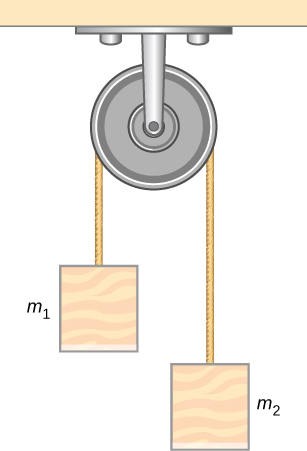
The device shown below is the Atwood’s machine considered in Example 6.5. Assuming that the masses of the string and the frictionless pulley are negligible, (a) find an equation for the acceleration of the two blocks; (b) find an equation for the tension in the string; and (c) find both the acceleration and tension when block 1 has mass 2.00 kg and block 2 has mass 4.00 kg.
英語のヒント
下図は、例題6.5で扱ったアトウッドの装置である。ひもと摩擦のない滑車の質量は無視できるとする。(a) 二つの物体の加速度の式を求めよ。(b) ひもの張力の式を求めよ。(c) 物体1の質量が2.00 kg、物体2が4.00 kgの場合の加速度と張力を求めよ。
Exercise 20問題 20
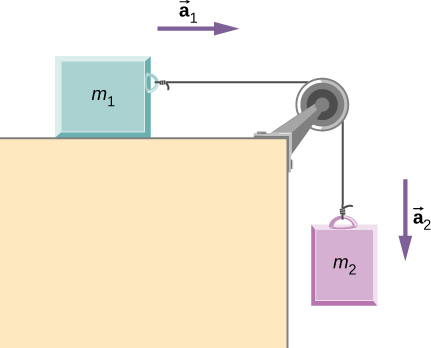
Two blocks are connected by a massless rope as shown below. The mass of the block on the table is 4.0 kg and the hanging mass is 1.0 kg. The table and the pulley are frictionless. (a) Find the acceleration of the system. (b) Find the tension in the rope. (c) Find the speed with which the hanging mass hits the floor if it starts from rest and is initially located 1.0 m from the floor.
英語のヒント
下図のように、質量を無視できるロープで二つの物体をつなぐ。テーブル上の物体は4.0 kg、つり下げた物体は1.0 kgである。テーブルと滑車には摩擦がない。(a) 系の加速度を求めよ。(b) ロープの張力を求めよ。(c) つり下げた物体を、床から1.0 mの位置で静止状態から放す場合、床に当たるときの速さを求めよ。
Solution解き方
a. b. 7.8 N; c. 2.0 m/s
a. 、b. 7.8 N、c. 2.0 m/s
Exercise 21問題 21
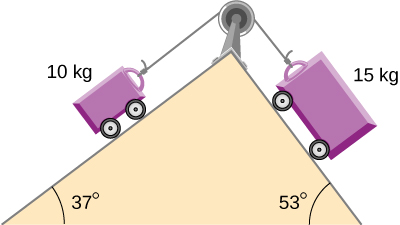
Shown below are two carts connected by a cord that passes over a small frictionless pulley. Each cart rolls freely with negligible friction. Calculate the acceleration of the carts and the tension in the cord.
英語のヒント
下図の2台の台車は、小さな摩擦のない滑車を越えるひもでつながれている。どちらも摩擦を無視でき、自由に転がる。台車の加速度とひもの張力を求めよ。
Exercise 22問題 22
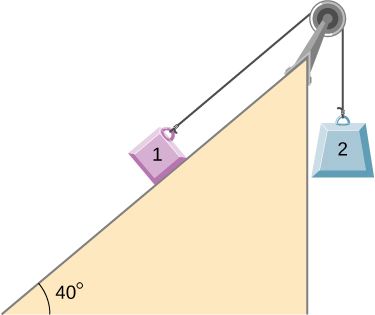
A 2.00 kg block (mass 1) and a 4.00 kg block (mass 2) are connected by a light string as shown; the inclination of the ramp is . Friction is negligible. What is (a) the acceleration of each block and (b) the tension in the string?
英語のヒント
質量2.00 kgの物体1と4.00 kgの物体2を、図のように軽いひもでつなぐ。斜面の傾斜角はで、摩擦は無視できる。(a) 各物体の加速度と、(b) ひもの張力を求めよ。


Solution解き方
a. (mass 1 accelerates up the ramp as mass 2 falls with the same acceleration); b. 21.5 N
英語のヒント
a. 。物体2が落ちると、物体1は同じ加速度で斜面を上る。b. 21.5 N