第3章直線上の運動
Solving for Final Position with Constant Acceleration等加速度運動の最終位置を求める
We can combine the previous equations to find a third equation that allows us to calculate the final position of an object experiencing constant acceleration. We start with
英語のヒント
これまでの式を組み合わせれば、一定の加速度を受ける物体の最終位置を計算できる、三つ目の式を求められる。次の式から出発する。
Adding to each side of this equation and dividing by 2 gives
英語のヒント
この式の両辺にを加えて2で割ると、次のようになる。
Since for constant acceleration, we have
英語のヒント
等加速度運動ではなので、次の式を得る。
Now we substitute this expression for into the equation for displacement, , yielding
英語のヒント
ここでの式を変位の式へ代入すると、次のようになる。
Example 3.8例題 3.8
Calculating Displacement of an Accelerating Object加速する物体の変位を求める
Dragsters can achieve an average acceleration of 26.0 m/s2. Suppose a dragster accelerates from rest at this rate for 5.56 s (Figure 3.20). How far does it travel in this time?
英語のヒント
ドラッグレーサーは26.0 m/s2の平均加速度を実現できる。静止状態から、この加速度で5.56 s加速するとする(図3.20)。この間にどれだけ進むか。
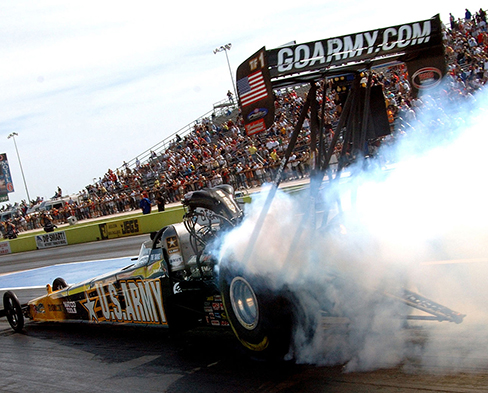
(credit: Lt. Col. William Thurmond. Photo Courtesy of U.S. Army.) The appearance of U.S. Department of Defense visual information does not imply or constitute DoD endorsement. · US government public-domain visual information; OpenStax additions CC BY 4.0 · Source出典

Figure 3.20図 3.20
U.S. Army Top Fuel pilot Tony “The Sarge” Schumacher begins a race with a controlled burnout. (credit: Lt. Col. William Thurmond. Photo Courtesy of U.S. Army.)
英語のヒント
米国陸軍トップフューエルのドライバー、トニー・「ザ・サージ」・シューマッハが、制御したバーンアウトでレースを始める。(出典:William Thurmond中佐。写真提供:米国陸軍)
Strategy方針
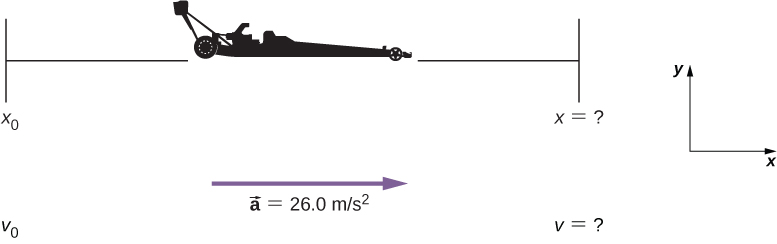
First, let’s draw a sketch (Figure 3.21). We are asked to find displacement, which is x if we take to be zero. (Think about as the starting line of a race. It can be anywhere, but we call it zero and measure all other positions relative to it.) We can use the equation when we identify , , and t from the statement of the problem.
英語のヒント
まず略図を描こう(図3.21)。求めるのは変位であり、を0に取ればxに等しい。(をレースのスタートラインと考えよう。どこに置いてもよいが、そこを0として、ほかのすべての位置をそこから測る。)問題文から、、tを確認すれば、式を使える。
OpenStax / Rice University, University Physics Volume 1, CC BY 4.0. Source-book artwork retained. · CC BY 4.0 · Source出典

Figure 3.21図 3.21
Sketch of an accelerating dragster.
英語のヒント
加速するドラッグレーサーの略図。
Solution解答
First, we need to identify the knowns. Starting from rest means that , a is given as 26.0 m/s2 and t is given as 5.56 s.
英語のヒント
まず既知量を確認する。静止状態から出発するのでである。aは26.0 m/s2、tは5.56 sと与えられている。
Second, we substitute the known values into the equation to solve for the unknown:
英語のヒント
次に、既知の値を式へ代入し、未知量を求める。
Since the initial position and velocity are both zero, this equation simplifies to
英語のヒント
初期位置も初速度も0なので、この式は次のように簡単になる。
Substituting the identified values of a and t gives
英語のヒント
確認したaとtの値を代入すると、次のようになる。
Significance意味の検討
If we convert 402 m to miles, we find that the distance covered is very close to one-quarter of a mile, the standard distance for drag racing. So, our answer is reasonable. This is an impressive displacement to cover in only 5.56 s, but top-notch dragsters can do a quarter mile in even less time than this. If the dragster were given an initial velocity, this would add another term to the distance equation. If the same acceleration and time are used in the equation, the distance covered would be much greater.
英語のヒント
402 mをマイルへ換算すると、移動距離はドラッグレースの標準距離である4分の1マイルに非常に近い。したがって、答えは合理的である。わずか5.56 sでこれだけ移動するのは驚くべきことだが、最高水準のドラッグレーサーは、これよりさらに短い時間で4分の1マイルを走れる。ドラッグレーサーに初速度が与えられていれば、距離の式にもう一つ項が加わる。同じ加速度と時間を式に用いた場合、移動距離はずっと大きくなる。
What else can we learn by examining the equation We can see the following relationships:
英語のヒント
式を調べると、ほかに何が分かるだろうか。次の関係が分かる。
- Displacement depends on the square of the elapsed time when acceleration is not zero. In Example 3.8, the dragster covers only one-fourth of the total distance in the first half of the elapsed time.
英語のヒント
加速度が0でないとき、変位は経過時間の2乗に依存する。例題3.8では、経過時間の前半にドラッグレーサーが進むのは、総距離の4分の1にすぎない。 - If acceleration is zero, then initial velocity equals average velocity , and
英語のヒント
加速度が0なら、初速度は平均速度に等しく、となる。
Solving for Final Velocity from Distance and Acceleration距離と加速度から最終速度を求める
A fourth useful equation can be obtained from another algebraic manipulation of previous equations. If we solve for t, we get
英語のヒント
これまでの式をさらに代数的に変形すると、四つ目の便利な式が得られる。をtについて解くと、次のようになる。
Substituting this and into , we get
英語のヒント
これとをへ代入すると、次の式を得る。
Example 3.9例題 3.9
Calculating Final Velocity最終速度の計算
Calculate the final velocity of the dragster in Example 3.8 without using information about time.
英語のヒント
時間についての情報を使わずに、例題3.8のドラッグレーサーの最終速度を求めよ。
Strategy方針
The equation is ideally suited to this task because it relates velocities, acceleration, and displacement, and no time information is required.
英語のヒント
式は、速度、加速度、変位を関連づけ、時間の情報を必要としないので、この問題に最も適している。
Solution解答
First, we identify the known values. We know that v0 = 0, since the dragster starts from rest. We also know that x − x0 = 402 m (this was the answer in Example 3.8). The average acceleration was given by a = 26.0 m/s2.
英語のヒント
まず既知の値を確認する。ドラッグレーサーは静止状態から出発するので、v0 = 0である。また、x − x0 = 402 mであることも分かっている(例題3.8の答え)。平均加速度はa = 26.0 m/s2と与えられている。
Second, we substitute the knowns into the equation and solve for v:
英語のヒント
次に既知量を式へ代入し、vについて解く。
Thus,
英語のヒント
したがって、
Significance意味の検討
A velocity of 145 m/s is about 522 km/h, or about 324 mi/h, but even this breakneck speed is short of the record for the quarter mile. Also, note that a square root has two values; we took the positive value to indicate a velocity in the same direction as the acceleration.
英語のヒント
145 m/sという速度は約522 km/h、または約324 mi/hだが、この猛烈な速さでも4分の1マイルの記録には及ばない。また、平方根には二つの値があることにも注意しよう。ここでは加速度と同じ向きの速度を表すため、正の値を選んだ。
An examination of the equation can produce additional insights into the general relationships among physical quantities:
英語のヒント
式を調べると、物理量どうしの一般的な関係について、さらに理解が深まる。
- The final velocity depends on how large the acceleration is and the distance over which it acts.
英語のヒント
最終速度は、加速度がどれほど大きいかと、それがどれだけの距離にわたって働くかに依存する。 - For a fixed acceleration, a car that is going twice as fast doesn’t simply stop in twice the distance. It takes much farther to stop. (This is why we have reduced speed zones near schools.)
英語のヒント
加速度が一定の場合、2倍の速さで進む自動車は、単に2倍の距離で止まれるわけではない。停止するには、さらに長い距離が必要になる。(学校の近くに速度制限を低くした区域があるのは、このためである。)