第16章波動
Transverse and Longitudinal Waves横波と縦波
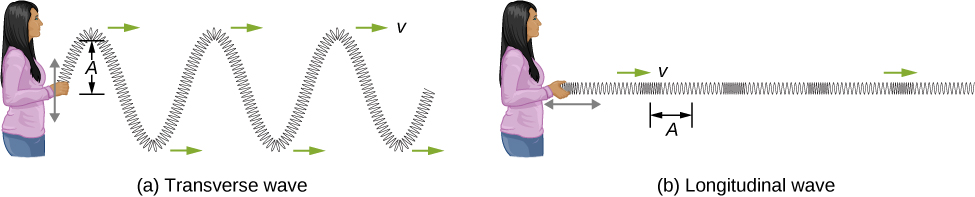
We have seen that a simple mechanical wave consists of a periodic disturbance that propagates from one place to another through a medium. In Figure 16.4(a), the wave propagates in the horizontal direction, whereas the medium is disturbed in the vertical direction. Such a wave is called a transverse wave. In a transverse wave, the wave may propagate in any direction, but the disturbance of the medium is perpendicular to the direction of propagation. In contrast, in a longitudinal wave or compressional wave, the disturbance is parallel to the direction of propagation. Figure 16.4(b) shows an example of a longitudinal wave. The size of the disturbance is its amplitude A and is completely independent of the speed of propagation v.
英語のヒント
OpenStax / Rice University, University Physics Volume 1, CC BY 4.0. Source-book artwork retained. · CC BY 4.0 · Source出典

Figure 16.4図 16.4
(a) In a transverse wave, the medium oscillates perpendicular to the wave velocity. Here, the spring moves vertically up and down, while the wave propagates horizontally to the right. (b) In a longitudinal wave, the medium oscillates parallel to the propagation of the wave. In this case, the spring oscillates back and forth, while the wave propagates to the right.
英語のヒント
(a) 横波では、媒質は波の速度に垂直な方向へ振動する。ここでは、ばねが上下に動く一方、波は水平に右へ進む。(b) 縦波では、媒質は波の進行方向と平行に振動する。この場合、ばねは前後に振動し、波は右へ進む。
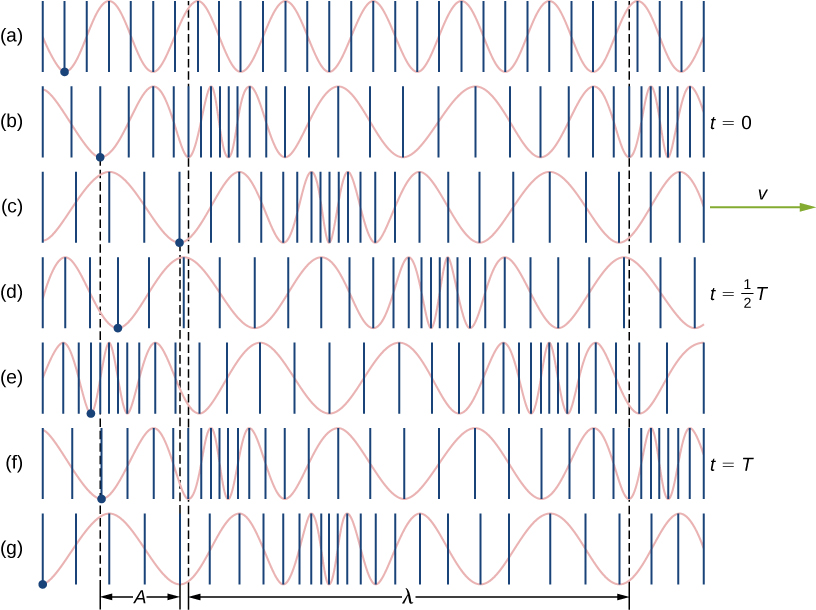
A simple graphical representation of a section of the spring shown in Figure 16.4(b) is shown in Figure 16.5. Figure 16.5(a) shows the equilibrium position of the spring before any waves move down it. A point on the spring is marked with a blue dot. Figure 16.5(b) through (g) show snapshots of the spring taken one-quarter of a period apart, sometime after the end of` the spring is oscillated back and forth in the x-direction at a constant frequency. The disturbance of the wave is seen as the compressions and the expansions of the spring. Note that the blue dot oscillates around its equilibrium position a distance A, as the longitudinal wave moves in the positive x-direction with a constant speed. The distance A is the amplitude of the wave. The y-position of the dot does not change as the wave moves through the spring. The wavelength of the wave is measured in part (d). The wavelength depends on the speed of the wave and the frequency of the driving force.
英語のヒント
OpenStax / Rice University, University Physics Volume 1, CC BY 4.0. Source-book artwork retained. · CC BY 4.0 · Source出典

Figure 16.5図 16.5
(a) This is a simple, graphical representation of a section of the stretched spring shown in Figure 16.4(b), representing the spring’s equilibrium position before any waves are induced on the spring. A point on the spring is marked by a blue dot. (b–g) Longitudinal waves are created by oscillating the end of the spring (not shown) back and forth along the x-axis. The longitudinal wave, with a wavelength , moves along the spring in the +x-direction with a wave speed v. For convenience, the wavelength is measured in (d). Note that the point on the spring that was marked with the blue dot moves back and forth a distance A from the equilibrium position, oscillating around the equilibrium position of the point.
英語のヒント
(a) 図16.4(b)の伸ばしたばねの一部を、波を起こす前のつり合いの状態として簡単に示す。一点を青く記している。(b)–(g) 図にはないばねの端をx軸に沿って前後へ動かし、縦波を作る。波長の縦波は、速さvで+x方向へ進む。便宜上、(d)で波長を測っている。青い点は、その点自身のつり合いの位置から距離Aだけ前後に動き、つり合いの周りを振動する。
Waves may be transverse, longitudinal, or a combination of the two. Examples of transverse waves are the waves on stringed instruments or surface waves on water, such as ripples moving on a pond. Sound waves in air and water are longitudinal. With sound waves, the disturbances are periodic variations in pressure that are transmitted in fluids. Fluids do not have appreciable shear strength, and for this reason, the sound waves in them are longitudinal waves. Sound in solids can have both longitudinal and transverse components, such as those in a seismic wave. Earthquakes generate seismic waves under Earth’s surface with both longitudinal and transverse components (called compressional or P-waves and shear or S-waves, respectively). The components of seismic waves have important individual characteristics—they propagate at different speeds, for example. Earthquakes also have surface waves that are similar to surface waves on water. Ocean waves also have both transverse and longitudinal components.
英語のヒント
波には、横波、縦波、両者を組み合わせたものがある。弦楽器の弦の波や、池のさざ波のような水面波は横波の例である。空気や水の中の音波は縦波である。音波の乱れは、流体を伝わる周期的な圧力変化である。流体には無視できないほどのせん断強度がないため、その中の音波は縦波となる。固体中の音は、地震波のように縦成分と横成分の両方を持ち得る。地震は地中に、縦成分である圧縮波・P波と、横成分であるせん断波・S波を生む。それぞれに重要な性質があり、たとえば伝わる速さが違う。地震には、水面波に似た表面波もある。海の波にも、横成分と縦成分の両方がある。
Example 16.1例題 16.1
Wave on a String糸を伝わる波
A student takes a 30.00-m-long string and attaches one end to the wall in the physics lab. The student then holds the free end of the rope, keeping the tension constant in the rope. The student then begins to send waves down the string by moving the end of the string up and down with a frequency of 2.00 Hz. The maximum displacement of the end of the string is 20.00 cm. The first wave hits the lab wall 6.00 s after it was created. (a) What is the speed of the wave? (b) What is the period of the wave? (c) What is the wavelength of the wave?
英語のヒント
学生が長さ30.00 mの糸の一端を物理実験室の壁に固定する。自由端を持ち、張力を一定に保ちながら、振動数2.00 Hzで上下させて波を送り出す。端の最大変位は20.00 cmである。最初の波は発生から6.00 s後に壁へ届いた。(a) 波の速さはいくらか。(b) 周期はいくらか。(c) 波長はいくらか。
Strategy方針
- The speed of the wave can be derived by dividing the distance traveled by the time.
英語のヒント
波が進んだ距離を時間で割れば、速さが求められる。 - The period of the wave is the inverse of the frequency of the driving force.
英語のヒント
周期は、駆動力の振動数の逆数である。 - The wavelength can be found from the speed and the period
英語のヒント
波長は、速さと周期からによって求められる。
Solution解答
- The first wave traveled 30.00 m in 6.00 s:
英語のヒント
最初の波は6.00 sで30.00 m進んだ。 - The period is equal to the inverse of the frequency:
英語のヒント
周期は振動数の逆数に等しい。 - The wavelength is equal to the velocity times the period:
英語のヒント
波長は、速度と周期の積に等しい。
Significance考察
The frequency of the wave produced by an oscillating driving force is equal to the frequency of the driving force.
英語のヒント
振動する駆動力で作られる波の振動数は、その駆動力の振動数に等しい。
Example 16.2例題 16.2
Characteristics of a Wave波の性質
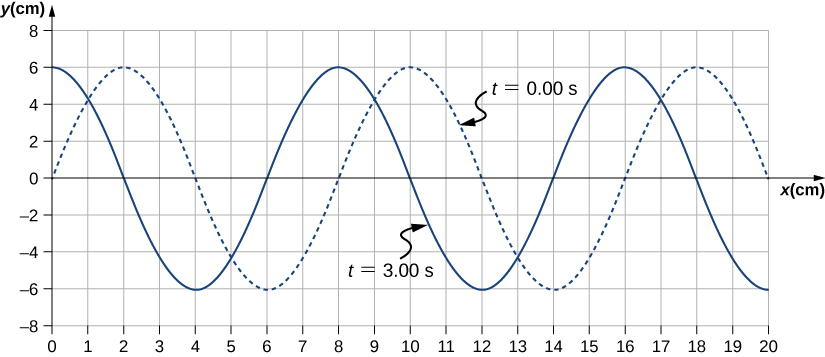
A transverse mechanical wave propagates in the positive x-direction through a spring (as shown in Figure 16.4(a)) with a constant wave speed, and the medium oscillates between and around an equilibrium position. The graph in Figure 16.6 shows the height of the spring (y) versus the position (x), where the x-axis points in the direction of propagation. The figure shows the height of the spring versus the x-position at as a dotted line and the wave at as a solid line. Assume the wave has not traveled more than 1 wavelength in this time. (a) Determine the wavelength and amplitude of the wave. (b) Find the propagation velocity of the wave. (c) Calculate the period and frequency of the wave.
英語のヒント
OpenStax / Rice University, University Physics Volume 1, CC BY 4.0. Source-book artwork retained. · CC BY 4.0 · Source出典

Figure 16.6図 16.6
A transverse wave shown at two instants of time.
英語のヒント
二つの時刻での横波。
Strategy方針
- The amplitude and wavelength can be determined from the graph.
英語のヒント
振幅と波長はグラフから求められる。 - Since the velocity is constant, the velocity of the wave can be found by dividing the distance traveled by the wave by the time it took the wave to travel the distance.
英語のヒント
速度は一定なので、波が進んだ距離を、その距離を進むのにかかった時間で割れば、波の速度が求められる。 - The period can be found from and the frequency from
英語のヒント
周期は、振動数はから求める。
Solution解答
- Read the wavelength from the graph, looking at the purple arrow in Figure 16.7. Read the amplitude by looking at the green arrow. The wavelength is and the amplitude is
英語のヒント
図16.7の紫の矢印から波長を読み、緑の矢印から振幅を読む。波長は、振幅はである。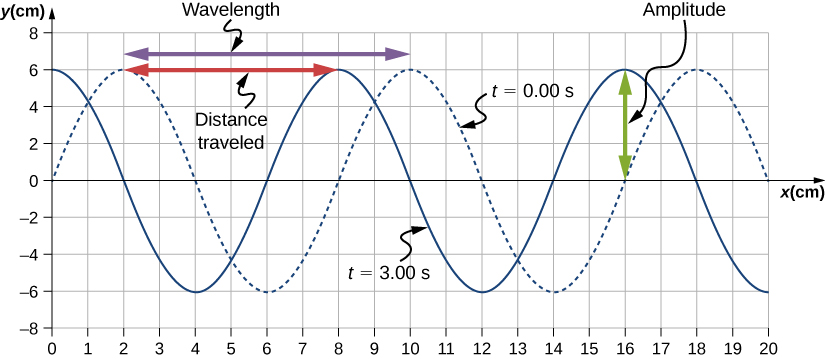
OpenStax / Rice University, University Physics Volume 1, CC BY 4.0. Source-book artwork retained. · CC BY 4.0 · Source出典
Figure 16.7図 16.7Characteristics of the wave marked on a graph of its displacement.英語のヒント
変位のグラフに記した波の性質。 - The distance the wave traveled from time to time can be seen in the graph. Consider the red arrow, which shows the distance the crest has moved in 3 s. The distance is The velocity is
英語のヒント
時刻からまでに波が進んだ距離をグラフから読み取る。赤矢印は、山が3秒間に動いた距離を表し、その値はである。速度は次のようになる。 - The period is and the frequency is
英語のヒント
周期は、振動数はである。

Significance考察
Note that the wavelength can be found using any two successive identical points that repeat, having the same height and slope. You should choose two points that are most convenient. The displacement can also be found using any convenient point.
英語のヒント
波長は、高さと傾きが同じで、繰り返し現れる隣り合った二点なら、どれを使っても求められる。最も測りやすい二点を選べばよい。波の移動距離も、都合のよい点を使って求められる。