第16章波動
Challenge Problems発展問題
Exercises 144–149練習問題 144–149
Exercise 144問題 144
A copper wire has a radius of and a length of 5.0 m. The wire is placed under a tension of 3000 N and the wire stretches by a small amount. The wire is plucked and a pulse travels down the wire. What is the propagation speed of the pulse? (Assume the temperature does not change:
英語のヒント
半径、長さ5.0 mの銅線に3000 Nの張力をかけると、銅線は少し伸びる。銅線をはじくとパルスが伝わる。その伝播の速さはいくらか。(温度は変わらないとする。)
Exercise 145問題 145
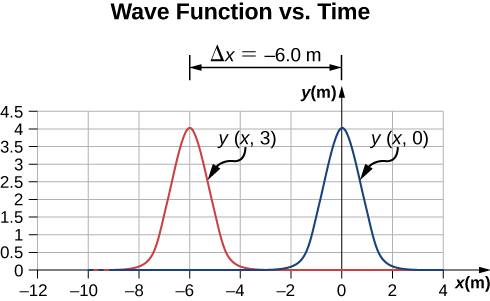
A pulse moving along the x axis can be modeled as the wave function (a)What are the direction and propagation speed of the pulse? (b) How far has the wave moved in 3.00 s? (c) Plot the pulse using a spreadsheet at time and to verify your answer in part (b).
英語のヒント
x軸に沿って進むパルスを波動関数で表す。(a) パルスの進行方向と伝播の速さは何か。(b) 3.00 sでどれだけ移動するか。(c) 表計算ソフトで時刻とのパルスを描き、(b)の答えを確かめよ。
Exercise 146問題 146
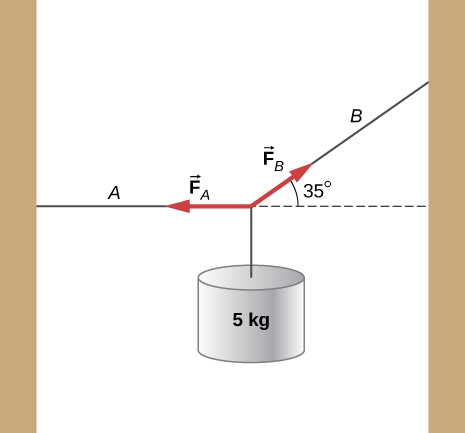
A string with a linear mass density of is fixed at both ends. A 5.0-kg mass is hung from the string, as shown below. If a pulse is sent along section A, what is the wave speed in section A and the wave speed in section B?
英語のヒント
線密度の糸の両端を固定し、下図のように5.0 kgのおもりをつるす。区間Aに沿ってパルスを送るとき、区間Aと区間Bの波の速さはいくらか。
Exercise 147問題 147
Consider two wave functions and . What is the wave function resulting from the interference of the two wave? (Hint: and .)
英語のヒント
二つの波動関数、を考える。干渉による合成波の波動関数は何か。(ヒント:および。)
Solution解き方
Exercise 148問題 148
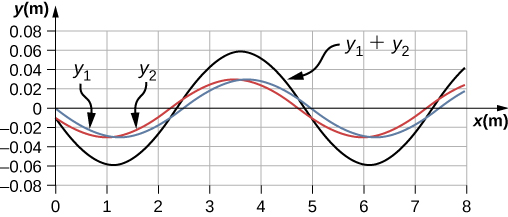
The wave function that models a standing wave is given as . What are two wave functions that interfere to form this wave function? Plot the two wave functions and the sum of the sum of the two wave functions at to verify your answer.
英語のヒント
定常波を表す波動関数はである。干渉によってこの波動関数を作る二つの波動関数は何か。における二つの波動関数とその和を描き、答えを確かめよ。
Exercise 149問題 149
Consider two wave functions and . The resultant wave form when you add the two functions is Consider the case where , and . (a) Where are the first three nodes of the standing wave function starting at zero and moving in the positive x direction? (b) Using a spreadsheet, plot the two wave functions and the resulting function at time to verify your answer.
英語のヒント
二つの波動関数、を考える。和を取った合成波はである。、、、の場合を考える。(a) ゼロからx軸の正の向きへ進んだとき、定常波の最初の三つの節はどこにあるか。(b) 表計算ソフトで時刻の二つの波動関数と合成関数を描き、答えを確かめよ。


antinode
腹
location of maximum amplitude in standing waves
英語のヒント
定常波で振幅が最大となる位置
fundamental frequency
基本振動数
lowest frequency that will produce a standing wave
英語のヒント
定常波を作る最も低い振動数
node
節
point where the string does not move; more generally, nodes are where the wave disturbance is zero in a standing wave
英語のヒント
糸が動かない点。より一般には、定常波において波による乱れがゼロになる点。
normal mode
固有モード
possible standing wave pattern for a standing wave on a string
英語のヒント
糸の定常波が取り得る振動の形
overtone
上音
frequency that produces standing waves and is higher than the fundamental frequency
英語のヒント
定常波を作る、基本振動数より高い振動数
standing wave
定常波
wave that can bounce back and forth through a particular region, effectively becoming stationary
英語のヒント
ある領域を往復して、実質的に静止した状態になる波