第16章波動
Superposition of Sinusoidal Waves that Differ by a Phase Shift位相のずれだけ異なる正弦波の重ね合わせ
Many examples in physics consist of two sinusoidal waves that are identical in amplitude, wave number, and angular frequency, but differ by a phase shift:
英語のヒント
物理学の多くの例は、振幅、波数、角振動数が同じで、位相のずれだけが異なる二つの正弦波からなる。
When these two waves exist in the same medium, the resultant wave resulting from the superposition of the two individual waves is the sum of the two individual waves:
英語のヒント
この二つの波が同じ媒質にあるとき、重ね合わせによる合成波は、個々の波の和となる。
The resultant wave can be better understood by using the trigonometric identity:
英語のヒント
次の三角関数の恒等式を使うと、合成波をよりよく理解できる。
where and . The resulting wave becomes
英語のヒント
ここで、とする。合成波は次のようになる。
This equation is usually written as
英語のヒント
通常、この式は次のように書く。
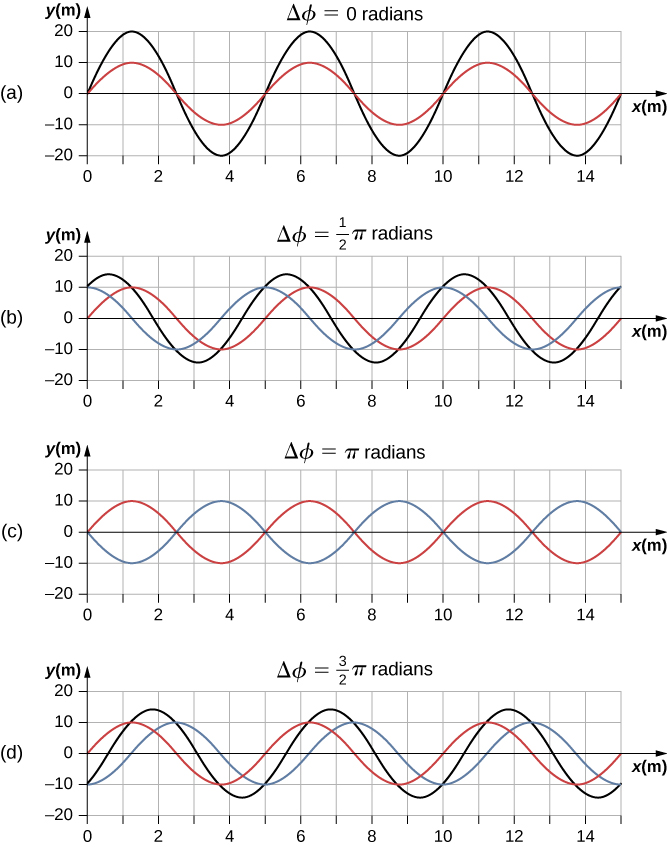
The resultant wave has the same wave number and angular frequency, an amplitude of and a phase shift equal to half the original phase shift. Examples of waves that differ only in a phase shift are shown in Figure 16.24. The red and blue waves each have the same amplitude, wave number, and angular frequency, and differ only in a phase shift. They therefore have the same period, wavelength, and frequency. The green wave is the result of the superposition of the two waves. When the two waves have a phase difference of zero, the waves are in phase, and the resultant wave has the same wave number and angular frequency, and an amplitude equal to twice the individual amplitudes (part (a)). This is constructive interference. If the phase difference is the waves interfere in destructive interference (part (c)). The resultant wave has an amplitude of zero. Any other phase difference results in a wave with the same wave number and angular frequency as the two incident waves but with a phase shift of and an amplitude equal to Examples are shown in parts (b) and (d).
英語のヒント
合成波の波数と角振動数は同じで、振幅は、位相のずれは元の半分となる。図16.24に、位相だけが異なる波の例を示す。赤と青の波は振幅、波数、角振動数が同じで、位相だけが異なる。したがって周期、波長、振動数も同じである。緑の波はその重ね合わせの結果である。二つの波の位相差がゼロなら同位相であり、合成波の波数と角振動数は同じ、振幅は各々の2倍となる((a))。これが強め合う干渉である。位相差がなら弱め合う干渉が起こり((c))、合成振幅はゼロになる。それ以外の位相差では、波数と角振動数は二つの入射波と同じで、位相のずれが、振幅がの波になる。(b)、(d)に例を示す。
OpenStax / Rice University, University Physics Volume 1, CC BY 4.0. Source-book artwork retained. · CC BY 4.0 · Source出典
Figure 16.24図 16.24
Superposition of two waves with identical amplitudes, wavelengths, and frequency, but that differ in a phase shift. The red wave is defined by the wave function and the blue wave is defined by the wave function . The black line shows the result of adding the two waves. The phase difference between the two waves are (a) (b) (c) and (d) .
英語のヒント
振幅、波長、振動数が同じで、位相だけがずれた二つの波の重ね合わせ。赤の波は波動関数、青の波はで定義する。黒い線は二つの波を加えた結果を示す。位相差は(a) 、(b) 、(c) 、(d) である。
Summaryまとめ
- Superposition is the combination of two waves at the same location.
英語のヒント
重ね合わせとは、同じ場所で二つの波を組み合わせることである。 - Constructive interference occurs from the superposition of two identical waves that are in phase.
英語のヒント
同位相の同一の二つの波を重ね合わせると、強め合う干渉が起こる。 - Destructive interference occurs from the superposition of two identical waves that are out of phase.
英語のヒント
位相がずれた同一の二つの波を重ね合わせると、弱め合う干渉が起こる。 - The wave that results from the superposition of two sine waves that differ only by a phase shift is a wave with an amplitude that depends on the value of the phase difference.
英語のヒント
位相のずれだけが異なる二つの正弦波を重ね合わせると、位相差の値によって振幅が決まる波ができる。
Conceptual Questions概念に関する問題
Exercises 80–84練習問題 80–84
Exercise 80問題 80
An incident sinusoidal wave is sent along a string that is fixed to the wall with a wave speed of v. The wave reflects off the end of the string. Describe the reflected wave.
英語のヒント
壁に固定した糸に、速さvの正弦波を入射させる。波は糸の端で反射する。反射波を説明せよ。
Exercise 81問題 81
A string of a length of 2.00 m with a linear mass density of is attached to the end of a 2.00-m-long string with a linear mass density of The free end of the higher-density string is fixed to the wall, and a student holds the free end of the low-density string, keeping the tension constant in both strings. The student sends a pulse down the string. Describe what happens at the interface between the two strings.
英語のヒント
長さ2.00 m、線密度の糸を、長さ2.00 m、線密度の糸の端へつなぐ。高密度の糸の他端を壁へ固定し、学生が低密度の糸の他端を持って、両方の張力を一定に保つ。学生が糸へパルスを送り出す。二つの糸の境界で何が起こるかを説明せよ。
Solution解き方
At the interface, the incident pulse produces a reflected pulse and a transmitted pulse. The reflected pulse would be out of phase with respect to the incident pulse, and would move at the same propagation speed as the incident pulse, but would move in the opposite direction. The transmitted pulse would travel in the same direction as the incident pulse, but at half the speed. The transmitted pulse would be in phase with the incident pulse. Both the reflected pulse and the transmitted pulse would have amplitudes less than the amplitude of the incident pulse.
英語のヒント
境界では、入射パルスが反射パルスと透過パルスを作る。反射パルスは入射パルスに対して位相がずれ、同じ伝播の速さで反対向きへ進む。透過パルスは入射パルスと同じ向きへ、半分の速さで進み、入射パルスと同位相になる。反射パルスも透過パルスも、入射パルスより振幅が小さい。
Exercise 82問題 82
A long, tight spring is held by two students, one student holding each end. Each student gives the end a flip sending one wavelength of a sinusoidal wave down the spring in opposite directions. When the waves meet in the middle, what does the wave look like?
英語のヒント
長く張ったばねの両端を、二人の学生が一端ずつ持つ。それぞれが端をさっと動かし、反対向きへ1波長分の正弦波を送り出す。中央で出会ったとき、波はどのように見えるか。
Exercise 83問題 83
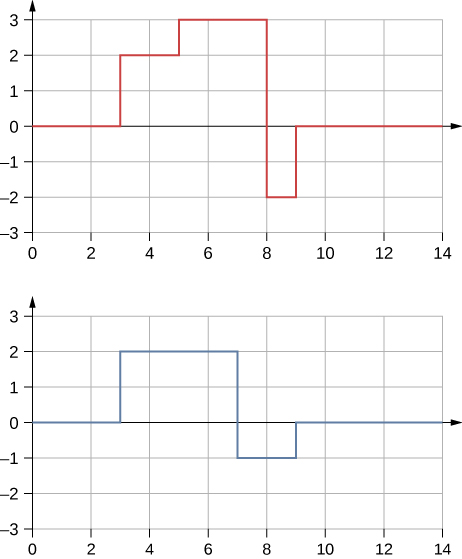
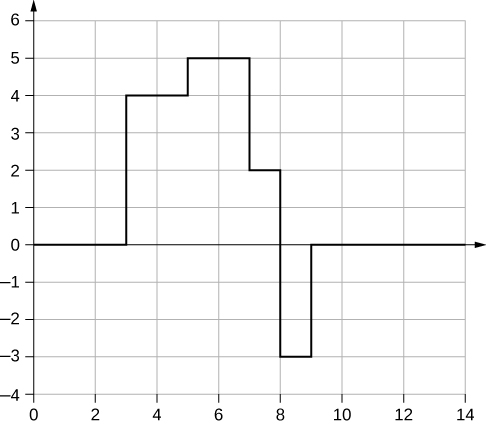
Many of the topics discussed in this chapter are useful beyond the topics of mechanical waves. It is hard to conceive of a mechanical wave with sharp corners, but you could encounter such a wave form in your digital electronics class, as shown below. This could be a signal from a device known as an analog to digital converter, in which a continuous voltage signal is converted into a discrete signal or a digital recording of sound. What is the result of the superposition of the two signals?
英語のヒント
この章の多くの内容は、力学的な波以外にも役立つ。鋭い角を持つ力学的な波は想像しにくいが、デジタル電子工学の授業では、下図のような波形に出会うことがある。例えば、連続的な電圧信号を離散的な信号へ変換するアナログ・デジタル変換器の信号や、音のデジタル録音である。この二つの信号を重ね合わせると、どうなるか。


Exercise 84問題 84
A string of a constant linear mass density is held taut by two students, each holding one end. The tension in the string is constant. The students each send waves down the string by wiggling the string. (a) Is it possible for the waves to have different wave speeds? (b) Is it possible for the waves to have different frequencies? (c) Is it possible for the waves to have different wavelengths?
英語のヒント
線密度が一定の糸の両端を二人の学生が一端ずつ持ち、張った状態に保つ。糸の張力は一定である。それぞれが糸を揺らして波を送り出す。(a) 二つの波の速さが異なることはあるか。(b) 振動数が異なることはあるか。(c) 波長が異なることはあるか。