第16章波動
16.6 Standing Waves and Resonance16.6 定常波と共振
Learning Objectives学習目標
Learning Objectives学習目標
By the end of this section, you will be able to:
英語のヒント
この節を終えると、次のことができるようになる。
- Describe standing waves and explain how they are produced
英語のヒント
定常波を説明し、その作られ方を述べる。 - Describe the modes of a standing wave on a string
英語のヒント
糸の定常波の各モードを説明する。 - Provide examples of standing waves beyond the waves on a string
英語のヒント
糸の波以外の定常波の例を挙げる。
Throughout this chapter, we have been studying traveling waves, or waves that transport energy from one place to another. Under certain conditions, waves can bounce back and forth through a particular region, effectively becoming stationary. These are called standing waves.
英語のヒント
この章では、ある場所から別の場所へエネルギーを運ぶ進行波を学んできた。ある条件の下では、波が特定の領域を往復して、実質的に静止した状態になる。この波を定常波という。
Another related effect is known as resonance. In Oscillations, we defined resonance as a phenomenon in which a small-amplitude driving force could produce large-amplitude motion. Think of a child on a swing, which can be modeled as a physical pendulum. Relatively small-amplitude pushes by a parent can produce large-amplitude swings. Sometimes this resonance is good—for example, when producing music with a stringed instrument. At other times, the effects can be devastating, such as the collapse of a building during an earthquake. In the case of standing waves, the relatively large amplitude standing waves are produced by the superposition of smaller amplitude component waves.
英語のヒント
これに関連する現象が共振である。「振動」では、小さな振幅の駆動力が大きな振幅の運動を生み得る現象として共振を定義した。実体振り子で表せる、ぶらんこに乗った子どもを考えよう。親が比較的小さく押しても、大きな振れを作れる。弦楽器で音楽を奏でる場合のように、共振が役立つこともある。地震で建物が倒壊する場合のように、壊滅的な結果を招くこともある。定常波では、振幅の小さい成分波の重ね合わせによって、比較的振幅の大きい定常波ができる。
Standing Waves定常波
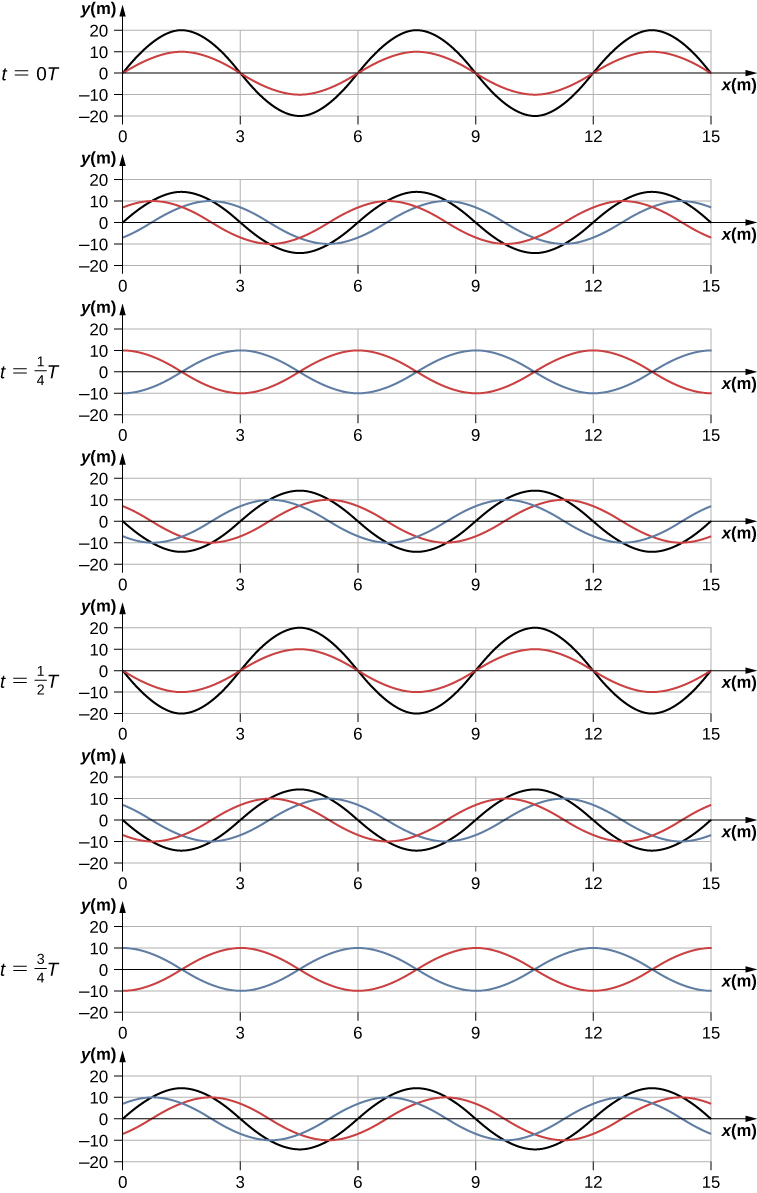
Sometimes waves do not seem to move; rather, they just vibrate in place. You can see unmoving waves on the surface of a glass of milk in a refrigerator, for example. Vibrations from the refrigerator motor create waves on the milk that oscillate up and down but do not seem to move across the surface. Figure 16.25 shows an experiment you can try at home. Take a bowl of milk and place it on a common box fan. Vibrations from the fan will produce circular standing waves in the milk. The waves are visible in the photo due to the reflection from a lamp. These waves are formed by the superposition of two or more traveling waves, such as illustrated in Figure 16.26 for two identical waves moving in opposite directions. The waves move through each other with their disturbances adding as they go by. If the two waves have the same amplitude and wavelength, then they alternate between constructive and destructive interference. The resultant looks like a wave standing in place and, thus, is called a standing wave.
英語のヒント
波が進まず、その場で振動するだけに見えることがある。例えば冷蔵庫の中のコップに入った牛乳の表面には、動かない波が見える。モーターの振動が牛乳に波を作り、上下には振動するが表面を横切っては進まないように見える。図16.25は家庭で試せる実験である。牛乳を入れたボウルを普通の箱形扇風機に載せると、扇風機の振動によって円形の定常波ができる。写真で波が見えるのは、ランプの光が反射しているためである。このような波は、二つ以上の進行波の重ね合わせでできる。図16.26は、反対向きへ進む同一の二つの波を示す。通り過ぎる間に乱れを加え合わせながら、互いを通り抜ける。振幅と波長が等しければ、強め合う干渉と弱め合う干渉を交互に起こす。合成波はその場に立ち止まって見えるので、定常波と呼ぶ。
Image omitted because its reuse rights could not be verified.権利の確認ができないため画像を割愛。
Figure 16.25図 16.25
Standing waves are formed on the surface of a bowl of milk sitting on a box fan. The vibrations from the fan causes the surface of the milk to oscillate. The waves are visible due to the reflection of light from a lamp. (credit: David Chelton)
英語のヒント
箱形扇風機に載せたボウルの牛乳の表面に定常波ができる。扇風機の振動が牛乳の表面を振動させ、ランプの光の反射によって波が見える。(提供:David Chelton)
OpenStax / Rice University, University Physics Volume 1, CC BY 4.0. Source-book artwork retained. · CC BY 4.0 · Source出典

Figure 16.26図 16.26
Time snapshots of two sine waves. The red wave is moving in the −x-direction and the blue wave is moving in the +x-direction. The resulting wave is shown in black. Consider the resultant wave at the points and notice that the resultant wave always equals zero at these points, no matter what the time is. These points are known as fixed points (nodes). In between each two nodes is an antinode, a place where the medium oscillates with an amplitude equal to the sum of the amplitudes of the individual waves.
英語のヒント
二つの正弦波の各時刻の様子。赤は−x方向、青は+x方向へ進み、合成波を黒で示す。点での合成波を見ると、どの時刻でも常にゼロとなる。これらの点を固定点、すなわち節という。隣り合う節の間には腹があり、媒質は個々の波の振幅の和に等しい振幅で振動する。
Consider two identical waves that move in opposite directions. The first wave has a wave function of and the second wave has a wave function . The waves interfere and form a resultant wave
英語のヒント
反対向きへ進む同一の二つの波を考える。一つ目の波動関数を、二つ目をとする。二つは干渉し、次の合成波を作る。
This can be simplified using the trigonometric identity
英語のヒント
次の三角関数の恒等式を用いて簡単にできる。
where and , giving us
英語のヒント
ここで、とすると、次式を得る。
which simplifies to
英語のヒント
整理すると次のようになる。
Notice that the resultant wave is a sine wave that is a function only of position, multiplied by a cosine function that is a function only of time. Graphs of y(x,t) as a function of x for various times are shown in Figure 16.26. The red wave moves in the negative x-direction, the blue wave moves in the positive x-direction, and the black wave is the sum of the two waves. As the red and blue waves move through each other, they move in and out of constructive interference and destructive interference.
英語のヒント
合成波は、位置だけの関数である正弦波に、時間だけの関数である余弦関数を掛けたものになっている。図16.26には、さまざまな時刻でのy(x,t)をxの関数として示す。赤はx軸の負の向き、青は正の向きへ進み、黒は二つの波の和である。赤と青が互いを通り抜けるとき、強め合う干渉と弱め合う干渉を行き来する。
Initially, at time the two waves are in phase, and the result is a wave that is twice the amplitude of the individual waves. The waves are also in phase at the time In fact, the waves are in phase at any integer multiple of half of a period:
英語のヒント
初めの時刻では二つの波は同位相で、合成振幅は個々の2倍になる。時刻でも同位相である。実際、半周期の任意の整数倍の時刻で同位相となる。
At other times, the two waves are out of phase, and the resulting wave is equal to zero. This happens at
英語のヒント
別の時刻には、二つの波の位相がずれ、合成波はゼロとなる。それは次の時刻である。
Notice that some x-positions of the resultant wave are always zero no matter what the phase relationship is. These positions are called nodes. Where do the nodes occur? Consider the solution to the sum of the two waves
英語のヒント
合成波には、位相関係によらず常にゼロとなるxの位置がある。この位置を節という。節はどこにできるだろうか。二つの波の和として得た解を考えよう。
Finding the positions where the sine function equals zero provides the positions of the nodes.
英語のヒント
正弦関数がゼロとなる位置を求めれば、節の位置が得られる。
There are also positions where y oscillates between . These are the antinodes. We can find them by considering which values of x result in .
英語のヒント
yがの間で振動する位置もある。これが腹である。となるxの値を考えれば求められる。
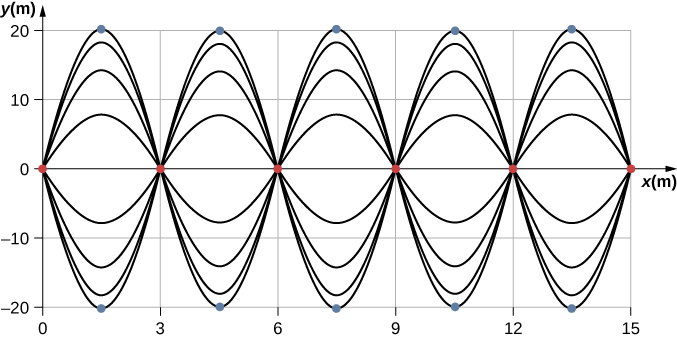
What results is a standing wave as shown in Figure 16.27, which shows snapshots of the resulting wave of two identical waves moving in opposite directions. The resulting wave appears to be a sine wave with nodes at integer multiples of half wavelengths. The antinodes oscillate between due to the cosine term, , which oscillates between .
英語のヒント
こうして図16.27のような定常波ができる。図は、反対向きへ進む同一の二つの波の合成波を、各時刻で示す。合成波は、半波長の整数倍の位置に節がある正弦波に見える。の間で振動する余弦の項によって、腹はの間で振動する。
The resultant wave appears to be standing still, with no apparent movement in the x-direction, although it is composed of one wave function moving in the positive, whereas the second wave is moving in the negative x-direction. Figure 16.27 shows various snapshots of the resulting wave. The nodes are marked with red dots while the antinodes are marked with blue dots.
英語のヒント
一つ目の波動関数はx軸の正の向き、二つ目は負の向きへ進んでいるが、合成波はx方向の見かけの移動がなく、その場に静止しているように見える。図16.27は、合成波のさまざまな時刻の様子を示す。節を赤い点、腹を青い点で示す。
OpenStax / Rice University, University Physics Volume 1, CC BY 4.0. Source-book artwork retained. · CC BY 4.0 · Source出典

Figure 16.27図 16.27
When two identical waves are moving in opposite directions, the resultant wave is a standing wave. Nodes appear at integer multiples of half wavelengths. Antinodes appear at odd multiples of quarter wavelengths, where they oscillate between The nodes are marked with red dots and the antinodes are marked with blue dots.
英語のヒント
同一の二つの波が反対向きへ進むと、合成波は定常波となる。節は半波長の整数倍の位置にできる。腹は4分の1波長の奇数倍の位置にでき、の間で振動する。節を赤い点、腹を青い点で示す。
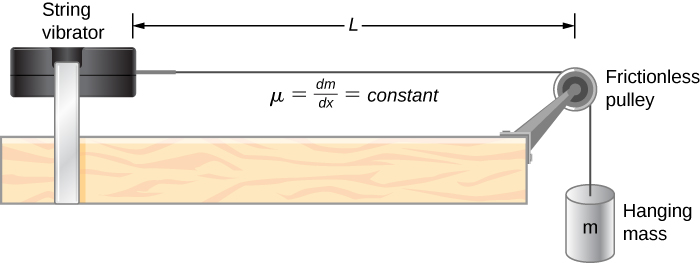
A common example of standing waves are the waves produced by stringed musical instruments. When the string is plucked, pulses travel along the string in opposite directions. The ends of the strings are fixed in place, so nodes appear at the ends of the strings—the boundary conditions of the system, regulating the resonant frequencies in the strings. The resonance produced on a string instrument can be modeled in a physics lab using the apparatus shown in Figure 16.28.
英語のヒント
定常波の身近な例は、弦楽器にできる波である。弦をはじくと、パルスが弦に沿って反対向きへ進む。両端は固定されているので節となり、これが弦の共振振動数を決める系の境界条件になる。図16.28の装置を使うと、弦楽器の共振を物理実験室で再現できる。
OpenStax / Rice University, University Physics Volume 1, CC BY 4.0. Source-book artwork retained. · CC BY 4.0 · Source出典

Figure 16.28図 16.28
A lab setup for creating standing waves on a string. The string has a node on each end and a constant linear density. The length between the fixed boundary conditions is L. The hanging mass provides the tension in the string, and the speed of the waves on the string is proportional to the square root of the tension divided by the linear mass density.
英語のヒント
糸に定常波を作る実験装置。糸は両端が節で、線密度は一定である。固定端の条件に挟まれた長さをLとする。つるしたおもりが糸に張力を与え、波の速さは、張力を線密度で割った値の平方根に比例する。
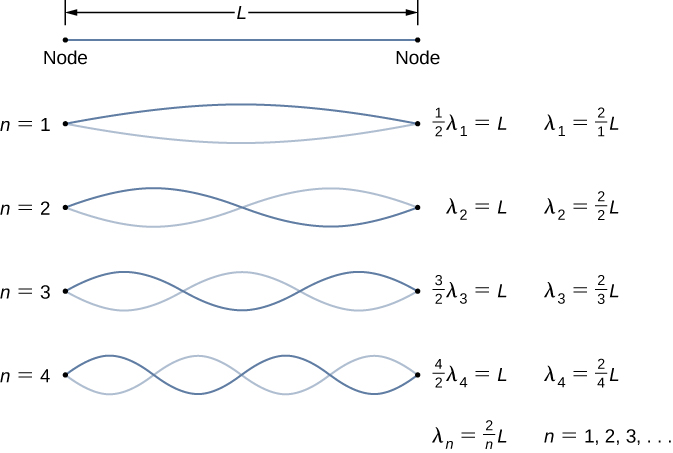
The lab setup shows a string attached to a string vibrator, which oscillates the string with an adjustable frequency f. The other end of the string passes over a frictionless pulley and is tied to a hanging mass. The magnitude of the tension in the string is equal to the weight of the hanging mass. The string has a constant linear density (mass per length) and the speed at which a wave travels down the string equals Equation 16.7. The symmetrical boundary conditions (a node at each end) dictate the possible frequencies that can excite standing waves. Starting from a frequency of zero and slowly increasing the frequency, the first mode appears as shown in Figure 16.29. The first mode, also called the fundamental mode or the first harmonic, shows half of a wavelength has formed, so the wavelength is equal to twice the length between the nodes . The fundamental frequency, or first harmonic frequency, that drives this mode is
英語のヒント
where the speed of the wave is Keeping the tension constant and increasing the frequency leads to the second harmonic or the mode. This mode is a full wavelength and the frequency is twice the fundamental frequency:
英語のヒント
ここで波の速さはである。張力を一定に保って振動数を上げると、第2高調波、すなわちのモードになる。このモードには1波長が収まり、振動数は基本振動数の2倍となる。
OpenStax / Rice University, University Physics Volume 1, CC BY 4.0. Source-book artwork retained. · CC BY 4.0 · Source出典

Figure 16.29図 16.29
Standing waves created on a string of length L. A node occurs at each end of the string. The nodes are boundary conditions that limit the possible frequencies that excite standing waves. (Note that the amplitudes of the oscillations have been kept constant for visualization. The standing wave patterns possible on the string are known as the normal modes. Conducting this experiment in the lab would result in a decrease in amplitude as the frequency increases.)
英語のヒント
長さLの糸にできる定常波。両端に節があり、この境界条件が定常波を励起できる振動数を制限する。(見やすくするため、振動の振幅は一定に描いている。糸に生じ得る定常波の形を固有モードという。実験室でこの実験を行うと、振動数が増すにつれて振幅は減少する。)