第16章波動
16.3 Wave Speed on a Stretched String16.3 伸ばした糸を伝わる波の速さ
Learning Objectives学習目標
Learning Objectives学習目標
By the end of this section, you will be able to:
英語のヒント
この節を終えると、次のことができるようになる。
- Determine the factors that affect the speed of a wave on a string
英語のヒント
糸の波の速さに影響する要因を求める。 - Write a mathematical expression for the speed of a wave on a string and generalize these concepts for other media
英語のヒント
糸の波の速さを数式で表し、その概念をほかの媒質へ一般化する。
The speed of a wave depends on the characteristics of the medium. For example, in the case of a guitar, the strings vibrate to produce the sound. The speed of the waves on the strings, and the wavelength, determine the frequency of the sound produced. The strings on a guitar have different thickness but may be made of similar material. They have different linear densities, where the linear density is defined as the mass per length,
英語のヒント
波の速さは媒質の性質に依存する。たとえばギターでは、弦の振動が音を生む。弦を伝わる波の速さと波長が、音の振動数を決める。ギターの弦は、似た材料でできていても太さが違うため、線密度が異なる。線密度は、単位長さ当たりの質量として定義する。
In this chapter, we consider only strings with a constant linear density. If the linear density is constant, then the mass of a small length of string is For example, if the string has a length of 2.00 m and a mass of 0.06 kg, then the linear density is If a 1.00-mm section is cut from the string, the mass of the 1.00-mm length is The guitar also has a method to change the tension of the strings. The tension of the strings is adjusted by turning spindles, called the tuning pegs, around which the strings are wrapped. For the guitar, the linear density of the string and the tension in the string determine the speed of the waves in the string and the frequency of the sound produced is proportional to the wave speed.
英語のヒント
この章では、線密度が一定の糸だけを考える。その場合、長さの小部分の質量は、となる。たとえば長さ2.00 m、質量0.06 kgの糸なら、線密度はである。そこから長さ1.00 mmを切り取ると、その質量はとなる。ギターには弦の張力を変える仕組みもある。弦を巻き付けた、糸巻きと呼ぶ軸を回して張力を調節する。弦の線密度と張力が波の速さを決め、出る音の振動数はその速さに比例する。
Wave Speed on a String under Tension張力をかけた糸の波の速さ
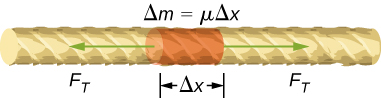
To see how the speed of a wave on a string depends on the tension and the linear density, consider a pulse sent down a taut string (Figure 16.13). When the taut string is at rest at the equilibrium position, the tension in the string is constant. Consider a small element of the string with a mass equal to The mass element is at rest and in equilibrium and the force of tension of either side of the mass element is equal and opposite.
英語のヒント
糸の波の速さが張力と線密度にどう依存するかを見るため、張った糸へ送ったパルスを考える(図16.13)。糸がつり合いの位置で静止するとき、張力は一定である。質量の小さな部分を考えよう。この質量要素は静止してつり合っており、両側の張力は大きさが等しく、向きが反対である。
OpenStax / Rice University, University Physics Volume 1, CC BY 4.0. Source-book artwork retained. · CC BY 4.0 · Source出典

Figure 16.13図 16.13
Mass element of a string kept taut with a tension . The mass element is in static equilibrium, and the force of tension acting on either side of the mass element is equal in magnitude and opposite in direction.
英語のヒント
張力で張った糸の質量要素。静的につり合っており、両側に働く張力は大きさが等しく、向きが反対である。
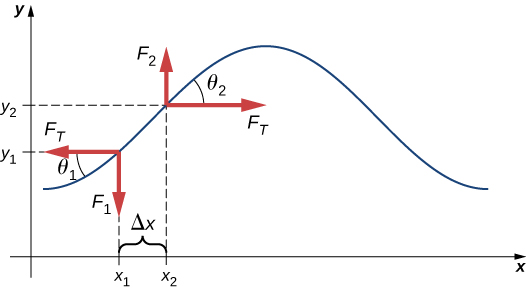
If you pluck a string under tension, a transverse wave moves in the positive x-direction, as shown in Figure 16.14. The mass element is small but is enlarged in the figure to make it visible. The small mass element oscillates perpendicular to the wave motion as a result of the restoring force provided by the string and does not move in the x-direction. The tension in the string, which acts in the positive and negative x-direction, is approximately constant and is independent of position and time.
英語のヒント
張力をかけた糸をはじくと、図16.14のように横波がxの正方向へ進む。質量要素は小さいが、見えるよう図では拡大している。糸の復元力により、この要素は波の進行方向に垂直に振動し、x方向には動かない。xの正負方向に働く張力は、ほぼ一定で、位置と時間によらない。
OpenStax / Rice University, University Physics Volume 1, CC BY 4.0. Source-book artwork retained. · CC BY 4.0 · Source出典

Figure 16.14図 16.14
A string under tension is plucked, causing a pulse to move along the string in the positive x-direction.
英語のヒント
張力をかけた糸をはじくと、糸に沿ってxの正方向へパルスが進む。
Assume that the inclination of the displaced string with respect to the horizontal axis is small. The net force on the element of the string, acting parallel to the string, is the sum of the tension in the string and the restoring force. The x-components of the force of tension cancel, so the net force is equal to the sum of the y-components of the force. The magnitude of the x-component of the force is equal to the horizontal force of tension of the string as shown in Figure 16.14. To obtain the y-components of the force, note that and The is equal to the slope of a function at a point, which is equal to the partial derivative of y with respect to x at that point. Therefore, is equal to the negative slope of the string at and is equal to the slope of the string at
英語のヒント
変位した糸が水平軸となす傾きは小さいとする。糸の要素に働く、糸に平行な合力は、張力と復元力の和である。張力のx成分は打ち消し合うので、合力はy成分の和に等しい。図16.14のように、x成分の大きさは糸の水平な張力に等しい。y成分を求めるには、とを使う。はその点での関数の傾き、すなわちyのxに関する偏微分である。したがって、はでの傾きの符号を逆にしたもの、はでの傾きに等しい。
The net force on the small mass element can be written as
英語のヒント
微小な質量要素への合力は、次のように書ける。
Using Newton’s second law, the net force is equal to the mass times the acceleration. The linear density of the string is the mass per length of the string, and the mass of the portion of the string is ,
英語のヒント
ニュートンの第2法則から、合力は質量と加速度の積に等しい。線密度は糸の単位長さ当たりの質量なので、小部分の質量はとなる。
Dividing by and taking the limit as approaches zero,
英語のヒント
で割り、をゼロへ近づける極限を取る。
Recall that the linear wave equation is
英語のヒント
線形波動方程式は、次の形だった。
Therefore,
英語のヒント
したがって、
Solving for v, we see that the speed of the wave on a string depends on the tension and the linear density.
英語のヒント
vについて解くと、糸の波の速さは張力と線密度に依存することが分かる。
Example 16.5例題 16.5
The Wave Speed of a Guitar Stringギターの弦を伝わる波の速さ
On a six-string guitar, the high E string has a linear density of and the low E string has a linear density of (a) If the high E string is plucked, producing a wave in the string, what is the speed of the wave if the tension of the string is 56.40 N? (b) The linear density of the low E string is approximately 20 times greater than that of the high E string. For waves to travel through the low E string at the same wave speed as the high E, would the tension need to be larger or smaller than the high E string? What would be the approximate tension? (c) Calculate the tension of the low E string needed for the same wave speed.
英語のヒント
6弦ギターの高いEの弦の線密度は、低いEの弦はである。(a) 高いEの弦をはじいて波を作り、張力が56.40 Nの場合、波の速さはいくらか。(b) 低いEの弦の線密度は、高いEの弦の約20倍である。両方を同じ波の速さにするには、低いEの弦の張力を高いEより大きくするか、小さくするか。およそいくら必要か。(c) 同じ速さにするために必要な低いEの弦の張力を計算せよ。
Strategy方針
- The speed of the wave can be found from the linear density and the tension
英語のヒント
波の速さは、線密度と張力からで求められる。 - From the equation if the linear density is increased by a factor of almost 20, the tension would need to be increased by a factor of 20.
英語のヒント
式から、線密度が約20倍になるなら、張力も20倍にする必要がある。 - Knowing the velocity and the linear density, the velocity equation can be solved for the force of tension
英語のヒント
速度と線密度が分かっているので、速度の式を張力について解いてを得る。
Solution解答
- Use the velocity equation to find the speed:
英語のヒント
速度の式を使い、速さを求める。 - The tension would need to be increased by a factor of approximately 20. The tension would be slightly less than 1128 N.
英語のヒント
張力をおよそ20倍にする必要がある。1128 Nより少し小さい値になる。 - Use the velocity equation to find the actual tension:
英語のヒント
速度の式で、実際の張力を求める。This solution is within of the approximation.英語のヒント
この解と見積もりとの差は、以内である。
Significance考察
The standard notes of the six string (high E, B, G, D, A, low E) are tuned to vibrate at the fundamental frequencies (329.63 Hz, 246.94Hz, 196.00Hz, 146.83Hz, 110.00Hz, and 82.41Hz) when plucked. The frequencies depend on the speed of the waves on the string and the wavelength of the waves. The six strings have different linear densities and are “tuned” by changing the tensions in the strings. We will see in Interference of Waves that the wavelength depends on the length of the strings and the boundary conditions. To play notes other than the fundamental notes, the lengths of the strings are changed by pressing down on the strings.
英語のヒント
6本の弦の標準の音、高いE、B、G、D、A、低いEは、はじいたときの基本振動数がそれぞれ329.63、246.94、196.00、146.83、110.00、82.41 Hzになるよう調律される。振動数は弦の波の速さと波長で決まる。6本は線密度が異なり、張力を変えて調律する。「波の干渉」で見るように、波長は弦の長さと境界条件で決まる。基本の音以外を弾くには、指で弦を押さえて長さを変える。