第16章波動
Speed of Compression Waves in a Fluid流体中の圧縮波の速さ
The speed of a wave on a string depends on the square root of the tension divided by the mass per length, the linear density. In general, the speed of a wave through a medium depends on the elastic property of the medium and the inertial property of the medium.
英語のヒント
糸の波の速さは、張力を単位長さ当たりの質量、すなわち線密度で割った値の平方根に依存する。一般に、媒質中の波の速さは、媒質の弾性に関する性質と慣性に関する性質によって決まる。
The elastic property describes the tendency of the particles of the medium to return to their initial position when perturbed. The inertial property describes the tendency of the particle to resist changes in velocity.
英語のヒント
弾性に関する性質は、媒質の粒子をずらしたときに元の位置へ戻ろうとする傾向を表す。慣性に関する性質は、速度の変化に抵抗する傾向を表す。
The speed of a longitudinal wave through a liquid or gas depends on the density of the fluid and the bulk modulus of the fluid,
英語のヒント
液体や気体を伝わる縦波の速さは、流体の密度と体積弾性率に依存する。
Here the bulk modulus is defined as where is the change in the pressure and the denominator is the ratio of the change in volume to the initial volume, and is the mass per unit volume. For example, sound is a mechanical wave that travels through a fluid or a solid. The speed of sound in air with an atmospheric pressure of and a temperature of is Because the density depends on temperature, the speed of sound in air depends on the temperature of the air. This will be discussed in detail in Sound.
英語のヒント
体積弾性率はと定義する。は圧力変化、分母は体積変化を初期体積で割った比で、は単位体積当たりの質量である。たとえば音は、流体や固体を伝わる力学的波である。大気圧、温度の空気中での音速はである。密度が温度に依存するため、空気中の音速も温度による。詳細は「音」で扱う。
Summaryまとめ
- The speed of a wave on a string depends on the linear density of the string and the tension in the string. The linear density is mass per unit length of the string.
英語のヒント
糸の波の速さは、糸の線密度と張力で決まる。線密度は単位長さ当たりの質量である。 - In general, the speed of a wave depends on the square root of the ratio of the elastic property to the inertial property of the medium.
英語のヒント
一般に、波の速さは、媒質の弾性に関する性質と慣性に関する性質の比の平方根によって決まる。 - The speed of a wave through a fluid is equal to the square root of the ratio of the bulk modulus of the fluid to the density of the fluid.
英語のヒント
流体中の波の速さは、体積弾性率を密度で割った比の平方根に等しい。 - The speed of sound through air at is approximately
英語のヒント
の空気中の音速は、約である。
Conceptual Questions概念に関する問題
Exercises 39–44練習問題 39–44
Exercise 39問題 39
If the tension in a string were increased by a factor of four, by what factor would the wave speed of a wave on the string increase?
英語のヒント
糸の張力を4倍にすると、糸の波の速さは何倍になるか。
Solution解き方
The wave speed is proportional to the square root of the tension, so the speed is doubled.
英語のヒント
波の速さは張力の平方根に比例するので、2倍になる。
Exercise 40問題 40
Does a sound wave move faster in seawater or fresh water, if both the sea water and fresh water are at the same temperature and the sound wave moves near the surface?
英語のヒント
海水と淡水が同じ温度で、音波が水面付近を進む場合、音はどちらで速く進むか。
Exercise 41問題 41
Guitars have strings of different linear mass density. If the lowest density string and the highest density string are under the same tension, which string would support waves with the higher wave speed?
英語のヒント
ギターの弦は線密度が異なる。線密度が最小の弦と最大の弦に同じ張力をかけたとき、波が速く進むのはどちらか。
Solution解き方
Since the speed of a wave on a string is inversely proportional to the square root of the linear mass density, the speed would be higher in the low linear mass density of the string.
英語のヒント
糸の波の速さは線密度の平方根に反比例するので、線密度が小さい弦で速くなる。
Exercise 42問題 42
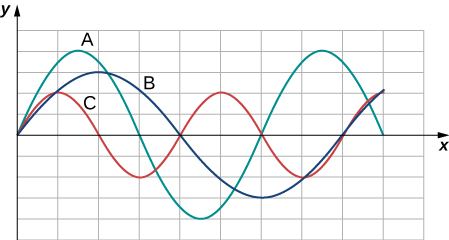
Shown below are three waves that were sent down a string at different times. The tension in the string remains constant. (a) Rank the waves from the smallest wavelength to the largest wavelength. (b) Rank the waves from the lowest frequency to the highest frequency.
英語のヒント
下図は、同じ糸へ異なる時刻に送った三つの波である。糸の張力は一定に保つ。(a) 波長の短い順に並べよ。(b) 振動数の低い順に並べよ。

Exercise 43問題 43
Electrical power lines connected by two utility poles are sometimes heard to hum when driven into oscillation by the wind. The speed of the waves on the power lines depend on the tension. What provides the tension in the power lines?
英語のヒント
2本の電柱の間の送電線が、風で振動してうなり音を出すことがある。送電線の波の速さは張力に依存する。この張力は何によって生じるか。
Solution解き方
The tension in the wire is due to the weight of the electrical power cable.
英語のヒント
送電線自身の重さが、張力を生む。
Exercise 44問題 44
Two strings, one with a low mass density and one with a high linear density are spliced together. The higher density end is tied to a lab post and a student holds the free end of the low-mass density string. The student gives the string a flip and sends a pulse down the strings. If the tension is the same in both strings, does the pulse travel at the same wave velocity in both strings? If not, where does it travel faster, in the low density string or the high density string?
英語のヒント
線密度が小さい糸と大きい糸をつなぎ合わせる。密度の大きい側の端を実験用の支柱へ固定し、学生が密度の小さい側の自由端を持つ。手首で端をさっと振り、パルスを送る。両方の張力が同じなら、パルスの速度も両方で同じか。同じでなければ、密度の小さい糸と大きい糸のどちらが速いか。