第16章波動
16.2 Mathematics of Waves16.2 波を表す数学
Learning Objectives学習目標
Learning Objectives学習目標
By the end of this section, you will be able to:
英語のヒント
この節を終えると、次のことができるようになる。
- Model a wave, moving with a constant wave velocity, with a mathematical expression
英語のヒント
一定の速度で進む波を数式で表す。 - Calculate the velocity and acceleration of the medium
英語のヒント
媒質の速度と加速度を計算する。 - Show how the velocity of the medium differs from the wave velocity (propagation velocity)
英語のヒント
媒質の速度と波の速度、すなわち伝播速度の違いを示す。
In the previous section, we described periodic waves by their characteristics of wavelength, period, amplitude, and wave speed of the wave. Waves can also be described by the motion of the particles of the medium through which the waves move. The position of particles of the medium can be mathematically modeled as wave functions, which can be used to find the position, velocity, and acceleration of the particles of the medium of the wave at any time.
英語のヒント
前節では、波長、周期、振幅、波の速さによって周期的な波を説明した。波は、媒質を構成する粒子の運動によっても表せる。粒子の位置を波動関数として数学的に表すと、任意の時刻の粒子の位置、速度、加速度を求められる。
Pulsesパルス波
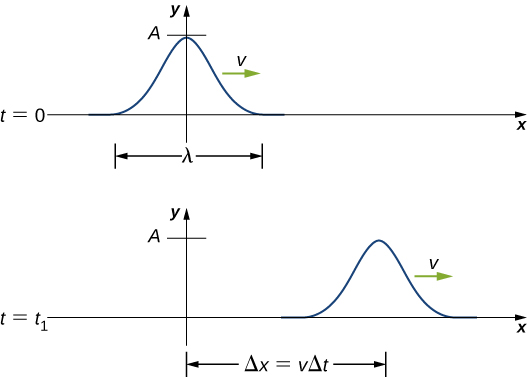
A pulse can be described as wave consisting of a single disturbance that moves through the medium with a constant amplitude. The pulse moves as a pattern that maintains its shape as it propagates with a constant wave speed. Because the wave speed is constant, the distance the pulse moves in a time is equal to (Figure 16.8).
英語のヒント
パルス波は、一定の振幅で媒質を伝わる単一の乱れからなる波といえる。一定の波の速さで伝わりながら、形を保つ模様として移動する。速さが一定なので、時間に進む距離はに等しい(図16.8)。
OpenStax / Rice University, University Physics Volume 1, CC BY 4.0. Source-book artwork retained. · CC BY 4.0 · Source出典

Figure 16.8図 16.8
The pulse at time is centered on with amplitude A. The pulse moves as a pattern with a constant shape, with a constant maximum value A. The velocity is constant and the pulse moves a distance in a time The distance traveled is measured with any convenient point on the pulse. In this figure, the crest is used.
英語のヒント
時刻のパルスはを中心とし、振幅はAである。形と最大値Aを保ちながら移動する。速度は一定で、時間に距離だけ進む。移動距離は、パルス上の都合のよい点で測れ、この図では山を使っている。
Modeling a One-Dimensional Sinusoidal Wave using a Wave Function波動関数で1次元の正弦波を表す
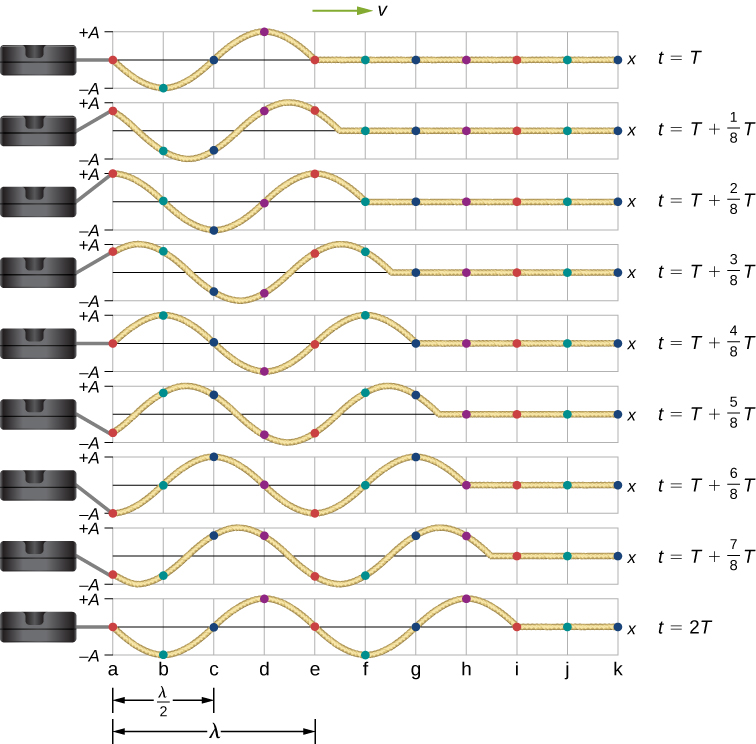
Consider a string kept at a constant tension where one end is fixed and the free end is oscillated between and by a mechanical device at a constant frequency. Figure 16.9 shows snapshots of the wave at an interval of an eighth of a period, beginning after one period
英語のヒント
張力を一定に保った糸を考える。一端を固定し、機械装置によって自由端をとの間で、一定の振動数で動かす。図16.9は、1周期後から、8分の1周期ごとに波の様子を示す。
OpenStax / Rice University, University Physics Volume 1, CC BY 4.0. Source-book artwork retained. · CC BY 4.0 · Source出典

Figure 16.9図 16.9
Snapshots of a transverse wave moving through a string under tension, beginning at time and taken at intervals of Colored dots are used to highlight points on the string. Points that are a wavelength apart in the x-direction are highlighted with the same color dots.
英語のヒント
張力をかけた糸を進む横波を、時刻から間隔で描いた図。糸の各点を色付きの点で強調し、x方向に1波長離れた点を同じ色で示す。
Notice that each select point on the string (marked by colored dots) oscillates up and down in simple harmonic motion, between and with a period T. The wave on the string is sinusoidal and is translating in the positive x-direction as time progresses.
英語のヒント
色付きの点で示した糸の各点は、との間を、周期Tで上下に単振動する。糸の波形は正弦波で、時間が進むにつれてxの正方向へ平行移動する。
At this point, it is useful to recall from your study of algebra that if f(x) is some function, then is the same function translated in the positive x-direction by a distance d. The function is the same function translated in the negative x-direction by a distance d. We want to define a wave function that will give the y-position of each segment of the string for every position x along the string for every time t.
英語のヒント
ここで、代数で学んだ関数の移動を思い出すと役立つ。f(x)という関数があるとき、はそれをxの正方向へ距離dだけ平行移動したもの、は負方向へ距離dだけ移したものである。糸に沿ったすべての位置x、すべての時刻tについて、各部分のy座標を与える波動関数を定義したい。
Looking at the first snapshot in Figure 16.9, the y-position of the string between and can be modeled as a sine function. This wave propagates down the string one wavelength in one period, as seen in the last snapshot. The wave therefore moves with a constant wave speed of
英語のヒント
図16.9の最初の図では、からの間の糸のy座標を、正弦関数で表せる。最後の図に見られるように、波は1周期で1波長だけ糸を進む。したがって、一定の波の速さで移動する。
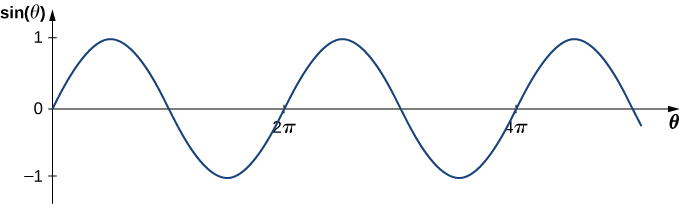
Recall that a sine function is a function of the angle , oscillating between and , and repeating every radians (Figure 16.10). However, the y-position of the medium, or the wave function, oscillates between and , and repeats every wavelength .
英語のヒント
正弦関数は角度の関数で、との間を振動し、ラジアンごとに繰り返すことを思い出そう(図16.10)。一方、媒質のy座標を表す波動関数は、との間を振動し、波長ごとに繰り返す。
OpenStax / Rice University, University Physics Volume 1, CC BY 4.0. Source-book artwork retained. · CC BY 4.0 · Source出典

Figure 16.10図 16.10
A sine function oscillates between and every radians.
英語のヒント
正弦関数は、ラジアンごとにとの間を振動する。
To construct our model of the wave using a periodic function, consider the ratio of the angle and the position,
英語のヒント
周期関数を使って波のモデルを作るため、角度と位置の比を考える。
Using and multiplying the sine function by the amplitude A, we can now model the y-position of the string as a function of the position x:
英語のヒント
を使い、正弦関数に振幅Aを掛けると、糸のy座標を位置xの関数として表せる。
The wave on the string travels in the positive x-direction with a constant velocity v, and moves a distance vt in a time t. The wave function can now be defined by
英語のヒント
糸の波はxの正方向へ一定の速度vで進み、時間tに距離vtだけ移動する。したがって、波動関数は次のように定義できる。
It is often convenient to rewrite this wave function in a more compact form. Multiplying through by the ratio leads to the equation
英語のヒント
この波動関数は、より簡潔な形に書き直すと便利なことが多い。比を括弧の各項へ掛けると、次の式になる。
The value is defined as the wave number. The symbol for the wave number is k and has units of inverse meters,
英語のヒント
値を波数と定義する。波数の記号はkで、単位はメートルの逆数である。
Recall from Oscillations that the angular frequency is defined as The second term of the wave function becomes
英語のヒント
「振動」で、角振動数をと定義したことを思い出そう。波動関数の第2項は次のようになる。
The wave function for a simple harmonic wave on a string reduces to
英語のヒント
糸の正弦波の波動関数は、次の形に簡約される。
where A is the amplitude, is the wave number, is the angular frequency, the minus sign is for waves moving in the positive x-direction, and the plus sign is for waves moving in the negative x-direction. The velocity of the wave is equal to
英語のヒント
Aは振幅、は波数、は角振動数である。負の符号はxの正方向へ進む波、正の符号はxの負方向へ進む波に使う。波の速度は次の値に等しい。
Think back to our discussion of a mass on a spring, when the position of the mass was modeled as The angle is a phase shift, added to allow for the fact that the mass may have initial conditions other than and For similar reasons, the initial phase is added to the wave function. The wave function modeling a sinusoidal wave, allowing for an initial phase shift is
英語のヒント
ばねにつながれた質点の位置をで表したことを思い出そう。角度は位相のずれで、初期条件がおよびとは異なる場合も表せるように加えた。同じ理由で、波動関数にも初期位相を加える。初期位相を含む正弦波の波動関数は、次のようになる。
The value
英語のヒント
次の量を、
is known as the phase of the wave, where is the initial phase of the wave function. Whether the temporal term is negative or positive depends on the direction of the wave. First consider the minus sign for a wave with an initial phase equal to zero The phase of the wave would be Consider following a point on a wave, such as a crest. A crest will occur when , that is, when for any integral value of n. For instance, one particular crest occurs at As the wave moves, time increases and x must also increase to keep the phase equal to Therefore, the minus sign is for a wave moving in the positive x-direction. Using the plus sign, As time increases, x must decrease to keep the phase equal to The plus sign is used for waves moving in the negative x-direction. In summary, models a wave moving in the positive x-direction and models a wave moving in the negative x-direction.
英語のヒント
波の位相と呼ぶ。は波動関数の初期位相である。時間の項が負か正かは、波の進行方向で決まる。まず、初期位相がゼロの波について負の符号を考える。この場合の位相はである。山など、波形上の一点を追ってみよう。山は、すなわち整数nに対してのときに現れる。たとえば、ある山はにある。波が進んで時間が増すと、位相をに保つためにはxも増さなければならない。したがって、負の符号はxの正方向へ進む波に対応する。正の符号ならであり、時間が増すにつれて、位相をに保つにはxを減らす必要がある。よって、正の符号はxの負方向へ進む波に使う。まとめると、は正方向へ、は負方向へ進む波を表す。
Equation 16.4 is known as a simple harmonic wave function. A wave function is any function such that Later in this chapter, we will see that it is a solution to the linear wave equation. Note that works equally well because it corresponds to a different phase shift
英語のヒント
この式を正弦波の波動関数と呼ぶ。波動関数は、という形を持つ関数である。この章の後半で、線形波動方程式の解となることを確かめる。も、別の位相のずれに対応するので、同じように使える。
Example 16.3例題 16.3
Characteristics of a Traveling Wave on a String糸を伝わる進行波の性質
A transverse wave on a taut string is modeled with the wave function
英語のヒント
張った糸の横波を、次の波動関数で表す。
Find the amplitude, wavelength, period, and speed of the wave.
英語のヒント
波の振幅、波長、周期、速さを求めよ。
Strategy方針
All these characteristics of the wave can be found from the constants included in the equation or from simple combinations of these constants.
英語のヒント
これらの性質はすべて、式の定数、またはそれらの簡単な組み合わせから求められる。
Solution解答
- The amplitude, wave number, and angular frequency can be read directly from the wave equation:
英語のヒント
振幅、波数、角振動数を、波の式から直接読み取る。 - The wave number can be used to find the wavelength:
英語のヒント
波数を使って波長を求める。 - The period of the wave can be found using the angular frequency:
英語のヒント
角振動数を使って周期を求める。 - The speed of the wave can be found using the wave number and the angular frequency. The direction of the wave can be determined by considering the sign of : A negative sign suggests that the wave is moving in the positive x-direction:
英語のヒント
波数と角振動数から波の速さを求める。進行方向はの符号から判断できる。負の符号なら、波はxの正方向へ進む。
Significance考察
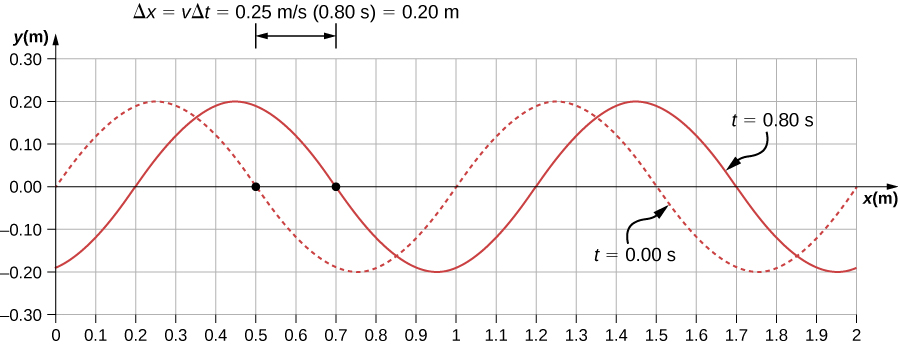
All of the characteristics of the wave are contained in the wave function. Note that the wave speed is the speed of the wave in the direction parallel to the motion of the wave. Plotting the height of the medium y versus the position x for two times and can provide a graphical visualization of the wave (Figure 16.11).
英語のヒント
波の性質はすべて波動関数に含まれる。波の速さは、波が進む方向に沿った速さであることに注意しよう。時刻とで、媒質の高さyを位置xに対して描くと、波を図として見られる(図16.11)。
OpenStax / Rice University, University Physics Volume 1, CC BY 4.0. Source-book artwork retained. · CC BY 4.0 · Source出典

Figure 16.11図 16.11
A graph of height of the wave y as a function of position x for snapshots of the wave at two times. The dotted line represents the wave at time and the solid line represents the wave at Since the wave velocity is constant, the distance the wave travels is the wave velocity times the time interval. The black dots indicate the points used to measure the displacement of the wave. The medium moves up and down, whereas the wave moves to the right.
英語のヒント
二つの時刻について、波の高さyを位置xの関数として描いたグラフ。点線は時刻、実線はの波を表す。波の速度が一定なので、進む距離は速度と時間間隔の積となる。黒点は、波の移動距離を測るために選んだ点である。媒質は上下に動き、波は右へ進む。
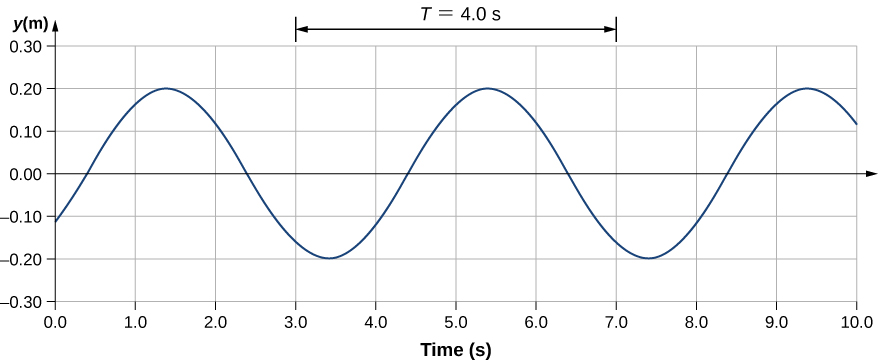
There is a second velocity to the motion. In this example, the wave is transverse, moving horizontally as the medium oscillates up and down perpendicular to the direction of motion. The graph in Figure 16.12 shows the motion of the medium at point as a function of time. Notice that the medium of the wave oscillates up and down between and every period of 4.0 seconds.
英語のヒント
この運動には、もう一つの速度がある。この例の波は横波で、波が水平に進む一方、媒質はそれに垂直な方向へ上下する。図16.12は、位置の媒質の運動を時間の関数として示す。媒質は4.0秒の周期ごとに、との間を上下する。
OpenStax / Rice University, University Physics Volume 1, CC BY 4.0. Source-book artwork retained. · CC BY 4.0 · Source出典

Figure 16.12図 16.12
A graph of height of the wave y as a function of time t for the position The medium oscillates between and every period. The period represented picks two convenient points in the oscillations to measure the period. The period can be measured between any two adjacent points with the same amplitude and the same velocity, The velocity can be found by looking at the slope tangent to the point on a y-versus-t plot. Notice that at times and the heights and the velocities are the same and the period of the oscillation is 4.00 s.
英語のヒント
位置での波の高さyを、時間tの関数として示す。媒質は各周期でとの間を振動する。図では測りやすい二点を選んで周期を示している。周期は、高さと速度が同じになる隣り合う二点の間で測れ、である。速度は、yとtのグラフ上の点に接する接線の傾きから求められる。時刻とでは高さも速度も同じで、周期は4.00 sとなる。