第16章波動
Superposition and Interference重ね合わせと干渉
Most waves do not look very simple. Complex waves are more interesting, even beautiful, but they look formidable. Most interesting mechanical waves consist of a combination of two or more traveling waves propagating in the same medium. The principle of superposition can be used to analyze the combination of waves.
英語のヒント
たいていの波は、それほど単純には見えない。複雑な波は面白く、美しくさえあるが、手ごわく見える。興味深い力学的な波の多くは、同じ媒質を伝わる二つ以上の進行波の組合せからなる。波の組合せは、重ね合わせの原理を用いて解析できる。
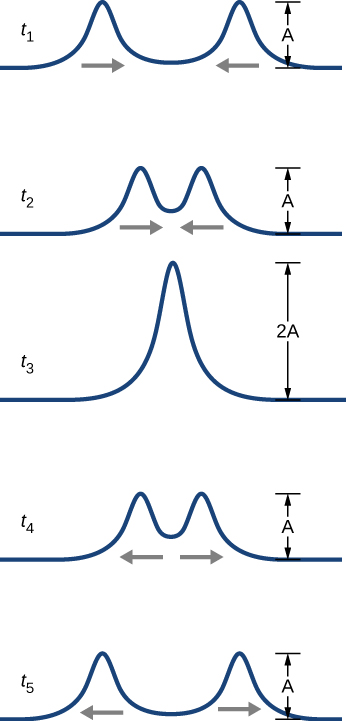
Consider two simple pulses of the same amplitude moving toward one another in the same medium, as shown in Figure 16.19. Eventually, the waves overlap, producing a wave that has twice the amplitude, and then continue on unaffected by the encounter. The pulses are said to interfere, and this phenomenon is known as interference.
英語のヒント
図16.19のように、同じ媒質の中を互いに向かって進む、振幅の等しい二つの単純なパルスを考える。やがて重なって振幅が2倍の波を作り、その後は出会いの影響を受けずに進み続ける。パルスは干渉するといい、この現象を干渉と呼ぶ。
OpenStax / Rice University, University Physics Volume 1, CC BY 4.0. Source-book artwork retained. · CC BY 4.0 · Source出典

Figure 16.19図 16.19
Two pulses moving toward one another experience interference. The term interference refers to what happens when two waves overlap.
英語のヒント
互いへ向かう二つのパルスは干渉する。「干渉」は、二つの波が重なったときに起こることを表す。
To analyze the interference of two or more waves, we use the principle of superposition. For mechanical waves, the principle of superposition states that if two or more traveling waves combine at the same point, the resulting position of the mass element of the medium, at that point, is the algebraic sum of the position due to the individual waves. This property is exhibited by many waves observed, such as waves on a string, sound waves, and surface water waves. Electromagnetic waves also obey the superposition principle, but the electric and magnetic fields of the combined wave are added instead of the displacement of the medium. Waves that obey the superposition principle are linear waves; waves that do not obey the superposition principle are said to be nonlinear waves. In this chapter, we deal with linear waves, in particular, sinusoidal waves.
英語のヒント
二つ以上の波の干渉を解析するには、重ね合わせの原理を使う。力学的な波では、二つ以上の進行波が同じ点で合わさると、その点の媒質の質量要素の位置は、それぞれの波による位置の代数和になる、という原理である。糸の波、音波、水面波など、観測される多くの波がこの性質を示す。電磁波も重ね合わせの原理に従うが、媒質の変位ではなく、合成波の電場と磁場を加える。重ね合わせの原理に従う波を線形波、従わない波を非線形波という。この章では線形波、特に正弦波を扱う。
The superposition principle can be understood by considering the linear wave equation. In Mathematics of a Wave, we defined a linear wave as a wave whose mathematical representation obeys the linear wave equation. For a transverse wave on a string with an elastic restoring force, the linear wave equation is
英語のヒント
線形波動方程式を考えると、重ね合わせの原理を理解できる。「波の数学」では、数学的な表現が線形波動方程式に従う波を線形波と定義した。弾性的な復元力が働く糸の横波では、線形波動方程式は次のとおりである。
Any wave function where the argument of the function is linear is a solution to the linear wave equation and is a linear wave function. If wave functions and are solutions to the linear wave equation, the sum of the two functions is also a solution to the linear wave equation. Mechanical waves that obey superposition are normally restricted to waves with amplitudes that are small with respect to their wavelengths. If the amplitude is too large, the medium is distorted past the region where the restoring force of the medium is linear.
英語のヒント
関数の引数が線形である任意の波動関数は、線形波動方程式の解であり、線形な波動関数である。波動関数とが線形波動方程式の解なら、その和も解となる。重ね合わせに従う力学的な波は通常、波長に対して振幅が小さいものに限られる。振幅が大きすぎると、媒質の変形は、その復元力が線形である範囲を超える。
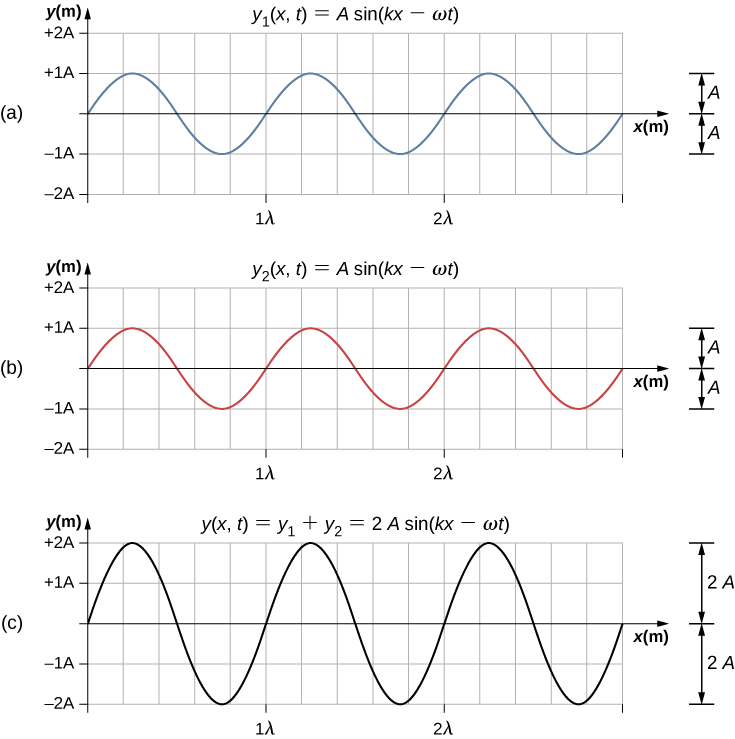
Waves can interfere constructively or destructively. Figure 16.20 shows two identical sinusoidal waves that arrive at the same point exactly in phase. Figure 16.20(a) and (b) show the two individual waves, Figure 16.20(c) shows the resultant wave that results from the algebraic sum of the two linear waves. The crests of the two waves are precisely aligned, as are the troughs. This superposition produces constructive interference. Because the disturbances add, constructive interference produces a wave that has twice the amplitude of the individual waves, but has the same wavelength.
英語のヒント
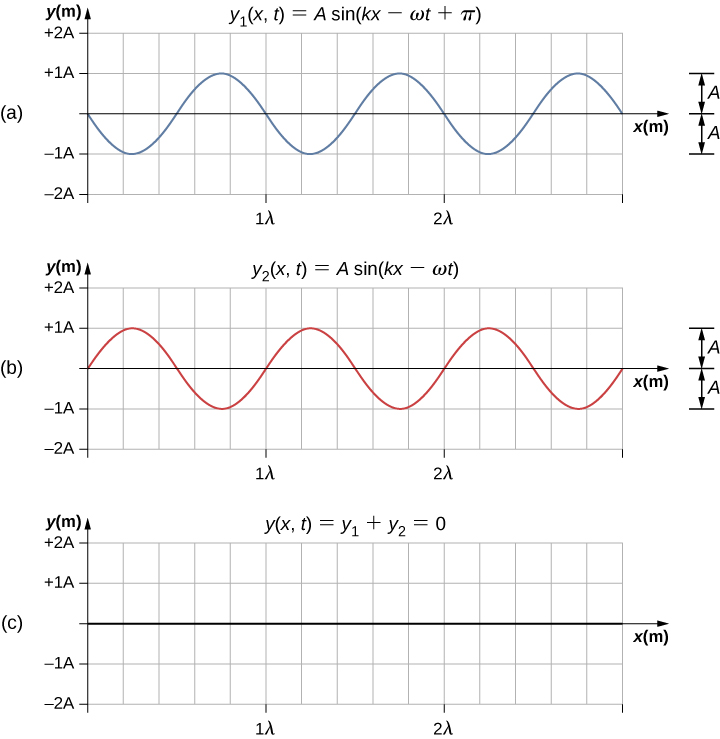
Figure 16.21 shows two identical waves that arrive exactly out of phase, producing destructive interference. Figure 16.21(a) and (b) show the individual waves, and Figure 16.21(c) shows the superposition of the two waves. Because the troughs of one wave add the crest of the other wave, the resulting amplitude is zero for destructive interference—the waves completely cancel.
英語のヒント
OpenStax / Rice University, University Physics Volume 1, CC BY 4.0. Source-book artwork retained. · CC BY 4.0 · Source出典

Figure 16.20図 16.20
Constructive interference of two identical waves produces a wave with twice the amplitude, but the same wavelength.
英語のヒント
同一の二つの波が強め合うと、振幅は2倍、波長は同じ波ができる。
OpenStax / Rice University, University Physics Volume 1, CC BY 4.0. Source-book artwork retained. · CC BY 4.0 · Source出典

Figure 16.21図 16.21
Destructive interference of two identical waves, one with a phase shift of , produces zero amplitude, or complete cancellation.
英語のヒント
一方の位相がずれた同一の二つの波は、弱め合う干渉によって振幅ゼロとなり、完全に打ち消し合う。
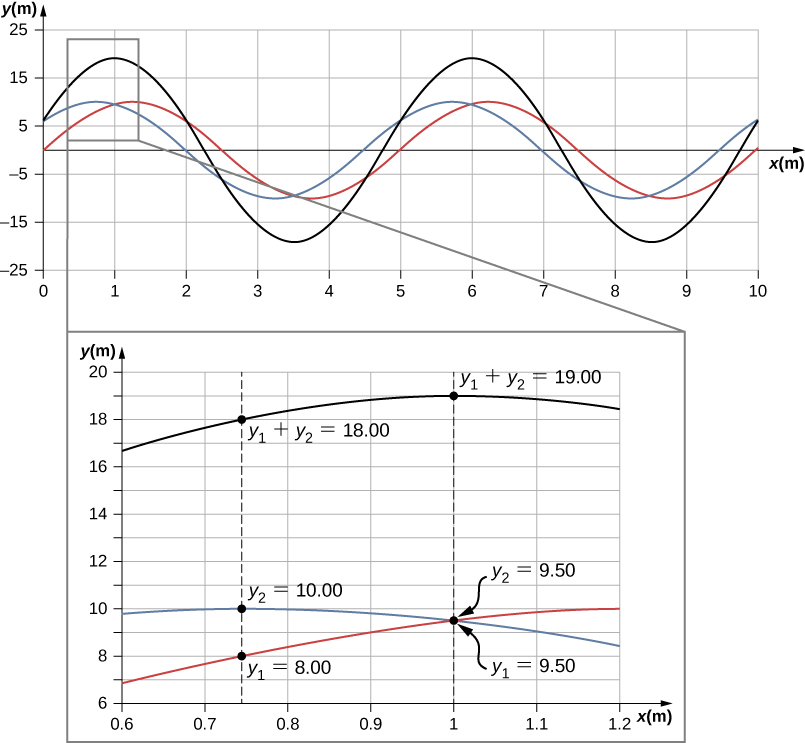
When linear waves interfere, the resultant wave is just the algebraic sum of the individual waves as stated in the principle of superposition. Figure 16.22 shows two waves (red and blue) and the resultant wave (black). The resultant wave is the algebraic sum of the two individual waves.
英語のヒント
線形波が干渉するとき、合成波は重ね合わせの原理が述べるとおり、個々の波の代数和になる。図16.22は、二つの波を赤と青、合成波を黒で示す。合成波は、個々の二つの波の代数和である。
OpenStax / Rice University, University Physics Volume 1, CC BY 4.0. Source-book artwork retained. · CC BY 4.0 · Source出典

Figure 16.22図 16.22
When two linear waves in the same medium interfere, the height of resulting wave is the sum of the heights of the individual waves, taken point by point. This plot shows two waves (red and blue) added together, along with the resulting wave (black). These graphs represent the height of the wave at each point. The waves may be any linear wave, including ripples on a pond, disturbances on a string, sound, or electromagnetic waves.
英語のヒント
同じ媒質の二つの線形波が干渉すると、合成波の高さは各点で個々の波の高さを足したものになる。赤と青の二つの波と、その和である黒い合成波を示す。グラフは各点での波の高さを表す。池の波紋、糸の乱れ、音、電磁波など、どのような線形波でもよい。
The superposition of most waves produces a combination of constructive and destructive interference, and can vary from place to place and time to time. Sound from a stereo, for example, can be loud in one spot and quiet in another. Varying loudness means the sound waves add partially constructively and partially destructively at different locations. A stereo has at least two speakers creating sound waves, and waves can reflect from walls. All these waves interfere, and the resulting wave is the superposition of the waves.
英語のヒント
大部分の波の重ね合わせでは、強め合う干渉と弱め合う干渉が組み合わさり、その状態は場所や時刻によって変わり得る。例えばステレオの音は、ある場所では大きく、別の場所では小さくなる。音量が変わるのは、場所によって音波が部分的に強め合ったり弱め合ったりするためである。ステレオには少なくとも二つのスピーカーがあり、そこから音波が出て、壁でも反射する。これらすべての波が干渉し、合成波はその重ね合わせとなる。
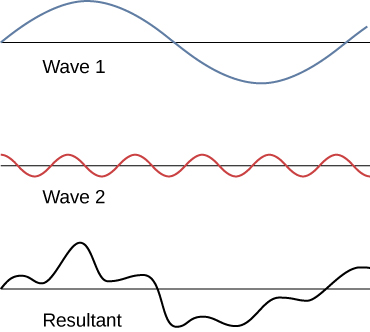
We have shown several examples of the superposition of waves that are similar. Figure 16.23 illustrates an example of the superposition of two dissimilar waves. Here again, the disturbances add, producing a resultant wave.
英語のヒント
これまでは似た波の重ね合わせをいくつか示した。図16.23は、異なる二つの波の重ね合わせの例である。ここでも乱れが加わり、合成波を作る。
OpenStax / Rice University, University Physics Volume 1, CC BY 4.0. Source-book artwork retained. · CC BY 4.0 · Source出典

Figure 16.23図 16.23
Superposition of nonidentical waves exhibits both constructive and destructive interference.
英語のヒント
異なる波の重ね合わせには、強め合う干渉と弱め合う干渉の両方が現れる。
At times, when two or more mechanical waves interfere, the pattern produced by the resulting wave can be rich in complexity, some without any readily discernable patterns. For example, plotting the sound wave of your favorite music can look quite complex and is the superposition of the individual sound waves from many instruments; it is the complexity that makes the music interesting and worth listening to. At other times, waves can interfere and produce interesting phenomena, which are complex in their appearance and yet beautiful in simplicity of the physical principle of superposition, which formed the resulting wave. One example is the phenomenon known as standing waves, produced by two identical waves moving in different directions. We will look more closely at this phenomenon in the next section.
英語のヒント
二つ以上の力学的な波が干渉すると、合成波の模様は非常に複雑になり、容易に見分けられる模様がないこともある。例えば好きな音楽の音波をグラフにすると、とても複雑に見える場合がある。それは多数の楽器から出る個々の音波の重ね合わせであり、この複雑さこそが音楽を面白く、聴く価値のあるものにする。波の干渉は、見た目は複雑でも、合成波を作る重ね合わせという物理原理の単純さが美しい、興味深い現象を生むこともある。その一例が、異なる向きへ進む同一の二つの波による定常波である。次の節で、この現象を詳しく見る。