第16章波動
16.1 Traveling Waves16.1 進行波
Learning Objectives学習目標
Learning Objectives学習目標
By the end of this section, you will be able to:
英語のヒント
この節を終えると、次のことができるようになる。
- Describe the basic characteristics of wave motion
英語のヒント
波動の基本的な性質を説明する。 - Define the terms wavelength, amplitude, period, frequency, and wave speed
英語のヒント
波長、振幅、周期、振動数、波の速さを定義する。 - Explain the difference between longitudinal and transverse waves, and give examples of each type
英語のヒント
縦波と横波の違いを説明し、それぞれの例を挙げる。 - List the different types of waves
英語のヒント
波のさまざまな種類を挙げる。
We saw in Oscillations that oscillatory motion is an important type of behavior that can be used to model a wide range of physical phenomena. Oscillatory motion is also important because oscillations can generate waves, which are of fundamental importance in physics. Many of the terms and equations we studied in the chapter on oscillations apply equally well to wave motion (Figure 16.2).
英語のヒント
Image omitted because its reuse rights could not be verified.権利の確認ができないため画像を割愛。
Figure 16.2図 16.2
An ocean wave is probably the first picture that comes to mind when you hear the word “wave.” Although this breaking wave, and ocean waves in general, have apparent similarities to the basic wave characteristics we will discuss, the mechanisms driving ocean waves are highly complex and beyond the scope of this chapter. It may seem natural, and even advantageous, to apply the concepts in this chapter to ocean waves, but ocean waves are nonlinear, and the simple models presented in this chapter do not fully explain them. (credit: Steve Jurvetson)
英語のヒント
「波」と聞いて最初に思い浮かべるのは、おそらく海の波だろう。この砕ける波や海の波全般には、これから学ぶ基本的な波の性質と明らかな類似点がある。しかし、海の波を生む仕組みは非常に複雑で、この章の範囲を超える。本章の概念を海の波へ当てはめることは自然で、有利にさえ思えるが、海の波は非線形であり、ここで示す単純なモデルだけでは十分に説明できない。(クレジット:Steve Jurvetson)
Types of Waves波の種類
A wave is a disturbance that propagates, or moves from the place it was created. There are three basic types of waves: mechanical waves, electromagnetic waves, and matter waves.
英語のヒント
波とは、発生した場所から伝わる、すなわち移動する乱れである。基本的な種類には、力学的な波、電磁波、物質波の三つがある。
Basic mechanical waves are governed by Newton’s laws and require a medium. A medium is the substance mechanical waves propagate through, and the medium produces an elastic restoring force when it is deformed. Mechanical waves transfer energy and momentum, without transferring mass. Some examples of mechanical waves are water waves, sound waves, and seismic waves. The medium for water waves is water; for sound waves, the medium is usually air. (Sound waves can travel in other media as well; we will look at that in more detail in Sound.) For surface water waves, the disturbance occurs on the surface of the water, perhaps created by a rock thrown into a pond or by a swimmer splashing the surface repeatedly. For sound waves, the disturbance is a change in air pressure, perhaps created by the oscillating cone inside a speaker or a vibrating tuning fork. In both cases, the disturbance is the oscillation of the molecules of the fluid. In mechanical waves, energy and momentum transfer with the motion of the wave, whereas the mass oscillates around an equilibrium point. (We discuss this in Energy and Power of a Wave.) Earthquakes generate seismic waves from several types of disturbances, including the disturbance of Earth’s surface and pressure disturbances under the surface. Seismic waves travel through the solids and liquids that form Earth. In this chapter, we focus on mechanical waves.
英語のヒント
基本的な力学的波はニュートンの法則に従い、媒質を必要とする。媒質とは力学的波が伝わる物質であり、変形すると弾性的な復元力を生む。力学的波は質量を運ばず、エネルギーと運動量を運ぶ。例には、水の波、音波、地震波がある。水の波の媒質は水で、音波では普通は空気である。音波はほかの媒質も伝わり、その詳細は「音」で扱う。水面波では、水面に乱れが生じる。たとえば池へ石を投げたり、泳ぐ人が繰り返し水面をはね上げたりして作られる。音波の乱れは気圧の変化で、スピーカー内の円錐形の振動板や、振動する音叉などから生じる。どちらも流体分子の振動が乱れの正体である。力学的波では、波の移動とともにエネルギーと運動量が伝わるが、質量を持つ媒質はつり合いの点の周りを振動する。これは「波のエネルギーと仕事率」で扱う。地震は、地表の変動や地中の圧力の乱れなど、いくつかの種類の乱れから地震波を生む。地震波は地球を構成する固体や液体を通る。この章では力学的な波に焦点を当てる。
Electromagnetic waves are associated with oscillations in electric and magnetic fields and do not require a medium. Examples include gamma rays, X-rays, ultraviolet waves, visible light, infrared waves, microwaves, and radio waves. Electromagnetic waves can travel through a vacuum at the speed of light, For example, light from distant stars travels through the vacuum of space and reaches Earth. Electromagnetic waves have some characteristics that are similar to mechanical waves; they are covered in more detail in Electromagnetic Waves.
英語のヒント
電磁波は電場と磁場の振動に関係し、媒質を必要としない。ガンマ線、X線、紫外線、可視光、赤外線、マイクロ波、電波などが含まれる。真空中を光速で伝わることができる。たとえば、遠い星の光は宇宙の真空を進んで地球へ届く。電磁波には力学的波と共通する性質もあり、詳しくは「電磁波」で扱う。
Matter waves are a central part of the branch of physics known as quantum mechanics. These waves are associated with protons, electrons, neutrons, and other fundamental particles found in nature. The theory that all types of matter have wave-like properties was first proposed by Louis de Broglie in 1924. Matter waves are discussed in Photons and Matter Waves.
英語のヒント
物質波は、量子力学という物理学の分野の中心的な要素である。陽子、電子、中性子など、自然界の基本的な粒子に関わる波である。あらゆる物質が波のような性質を持つという理論は、1924年にルイ・ド・ブロイが初めて提案した。物質波は「光子と物質波」で扱う。
Mechanical Waves力学的な波
Mechanical waves exhibit characteristics common to all waves, such as amplitude, wavelength, period, frequency, and energy. All wave characteristics can be described by a small set of underlying principles.
英語のヒント
力学的な波には、振幅、波長、周期、振動数、エネルギーなど、あらゆる波に共通する性質がある。波の性質はすべて、少数の基礎原理で説明できる。
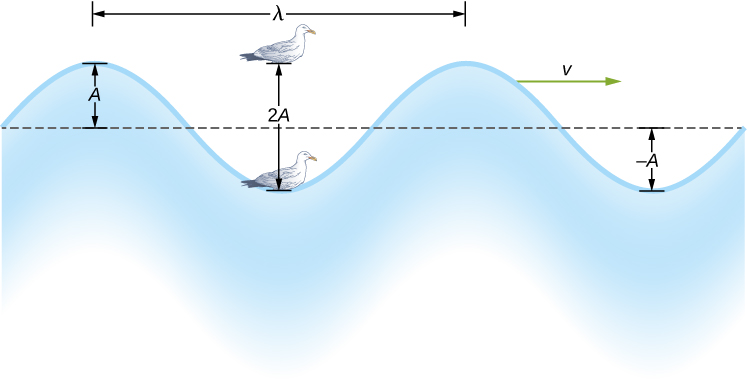
The simplest mechanical waves repeat themselves for several cycles and are associated with simple harmonic motion. These simple harmonic waves can be modeled using some combination of sine and cosine functions. For example, consider the simplified surface water wave that moves across the surface of water as illustrated in Figure 16.3. Unlike complex ocean waves, in surface water waves, the medium, in this case water, moves vertically, oscillating up and down, whereas the disturbance of the wave moves horizontally through the medium. In Figure 16.3, the waves causes a seagull to move up and down in simple harmonic motion as the wave crests and troughs (peaks and valleys) pass under the bird. The crest is the highest point of the wave, and the trough is the lowest part of the wave. The time for one complete oscillation of the up-and-down motion is the wave’s period T. The wave’s frequency is the number of waves that pass through a point per unit time and is equal to The period can be expressed using any convenient unit of time but is usually measured in seconds; frequency is usually measured in hertz (Hz), where
英語のヒント
最も単純な力学的波は、単振動に関係し、同じ形を何周期も繰り返す。このような正弦波は、正弦関数と余弦関数の組み合わせで表せる。たとえば図16.3のように水面を進む、単純化した水面波を考えよう。複雑な海の波と異なり、この水面波では媒質の水が鉛直に上下振動する一方、波の乱れは媒質の中を水平に進む。図16.3では、波の山と谷がカモメの下を通ると、カモメは上下に単振動する。山は波の最も高い部分、谷は最も低い部分である。上下運動が完全に1回振動する時間を、波の周期Tという。振動数は単位時間にある点を通る波の数で、に等しい。周期は適当な時間単位で表せるが、通常は秒を使う。振動数は通常ヘルツ(Hz)で表し、である。
The length of the wave is called the wavelength and is represented by the Greek letter lambda , which is measured in any convenient unit of length, such as a centimeter or meter. The wavelength can be measured between any two similar points along the medium that have the same height and the same slope. In Figure 16.3, the wavelength is shown measured between two crests. As stated above, the period of the wave is equal to the time for one oscillation, but it is also equal to the time for one wavelength to pass through a point along the wave’s path.
英語のヒント
波の長さを波長と呼び、ギリシャ文字ラムダで表す。単位にはcmやmなど、適当な長さの単位を使う。波長は、媒質に沿って同じ高さと同じ傾きを持つ、対応する二点の間で測れる。図16.3では、二つの山の間で測っている。前述のとおり、周期は1回の振動にかかる時間だが、波の進路上のある点を1波長分が通過する時間にも等しい。
The amplitude of the wave (A) is a measure of the maximum displacement of the medium from its equilibrium position. In the figure, the equilibrium position is indicated by the dotted line, which is the height of the water if there were no waves moving through it. In this case, the wave is symmetrical, the crest of the wave is a distance above the equilibrium position, and the trough is a distance below the equilibrium position. The units for the amplitude can be centimeters or meters, or any convenient unit of distance.
英語のヒント
波の振幅Aは、媒質のつり合いの位置からの最大変位を表す。図の点線がつり合いの位置であり、波が通っていない場合の水面の高さである。この波は対称で、山はつり合いよりだけ上、谷はだけ下にある。振幅の単位にはcm、mなど、適当な距離の単位を使える。
OpenStax / Rice University, University Physics Volume 1, CC BY 4.0. Source-book artwork retained. · CC BY 4.0 · Source出典

Figure 16.3図 16.3
An idealized surface water wave passes under a seagull that bobs up and down in simple harmonic motion. The wave has a wavelength , which is the distance between adjacent identical parts of the wave. The amplitude A of the wave is the maximum displacement of the wave from the equilibrium position, which is indicated by the dotted line. In this example, the medium moves up and down, whereas the disturbance of the surface propagates parallel to the surface at a speed v.
英語のヒント
理想化した水面波が、上下に単振動するカモメの下を通る。波長は、隣り合う同じ形の部分の間の距離である。振幅Aは、点線で示したつり合いの位置からの最大変位である。この例では媒質は上下に動くが、水面の乱れは速さvで水面に平行に進む。
The water wave in the figure moves through the medium with a propagation velocity The magnitude of the wave velocity is the distance the wave travels in a given time, which is one wavelength in the time of one period, and the wave speed is the magnitude of wave velocity. In equation form, this is
英語のヒント
図の水の波は、媒質中を伝播速度で進む。その速度の大きさは、単位時間に波が進む距離である。1周期の間に1波長だけ進むので、波の速さ、すなわち波の速度の大きさは、次の式になる。
This fundamental relationship holds for all types of waves. For water waves, v is the speed of a surface wave; for sound, v is the speed of sound; and for visible light, v is the speed of light.
英語のヒント
この基本関係は、すべての種類の波に成り立つ。水の波ではvは水面波の速さ、音では音速、可視光では光速である。