第16章波動
16.5 Interference of Waves16.5 波の干渉
Learning Objectives学習目標
Learning Objectives学習目標
By the end of this section, you will be able to:
英語のヒント
この節を終えると、次のことができるようになる。
- Explain how mechanical waves are reflected and transmitted at the boundaries of a medium
英語のヒント
力学的な波が媒質の境界でどのように反射・透過するかを説明する。 - Define the terms interference and superposition
英語のヒント
干渉と重ね合わせという用語を定義する。 - Find the resultant wave of two identical sinusoidal waves that differ only by a phase shift
英語のヒント
位相のずれだけが異なる同一の二つの正弦波について、合成波を求める。
Up to now, we have been studying mechanical waves that propagate continuously through a medium, but we have not discussed what happens when waves encounter the boundary of the medium or what happens when a wave encounters another wave propagating through the same medium. Waves do interact with boundaries of the medium, and all or part of the wave can be reflected. For example, when you stand some distance from a rigid cliff face and yell, you can hear the sound waves reflect off the rigid surface as an echo. Waves can also interact with other waves propagating in the same medium. If you throw two rocks into a pond some distance from one another, the circular ripples that result from the two stones seem to pass through one another as they propagate out from where the stones entered the water. This phenomenon is known as interference. In this section, we examine what happens to waves encountering a boundary of a medium or another wave propagating in the same medium. We will see that their behavior is quite different from the behavior of particles and rigid bodies. Later, when we study modern physics, we will see that only at the scale of atoms do we see similarities in the properties of waves and particles.
英語のヒント
ここまでは、媒質を連続的に伝わる力学的な波を調べてきた。しかし、波が媒質の境界に出会ったときや、同じ媒質を伝わる別の波に出会ったときに何が起こるかは、まだ扱っていない。波は媒質の境界と相互作用し、その全部または一部が反射される。例えば、硬い崖から少し離れて叫ぶと、硬い表面で反射した音波がこだまとして聞こえる。波は同じ媒質を伝わる他の波とも相互作用する。池の少し離れた2か所へ石を投げると、それぞれの石が作った円形の波紋は、水に入った場所から広がりながら互いを通り抜けていくように見える。この現象を干渉という。この節では、波が媒質の境界や同じ媒質を伝わる別の波に出会うと何が起こるかを調べる。その振る舞いは、粒子や剛体の振る舞いとは大きく異なることが分かる。後に現代物理学を学ぶと、原子の尺度になって初めて、波と粒子の性質に類似が見られることが分かる。
Reflection and Transmission反射と透過
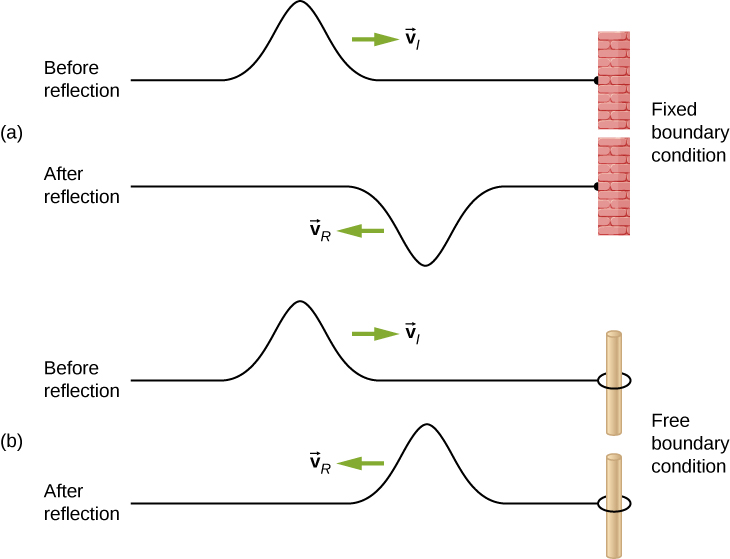
When a wave propagates through a medium, it reflects when it encounters the boundary of the medium. The wave before hitting the boundary is known as the incident wave. The wave after encountering the boundary is known as the reflected wave. How the wave is reflected at the boundary of the medium depends on the boundary conditions; waves will react differently if the boundary of the medium is fixed in place or free to move (Figure 16.17). A fixed boundary condition exists when the medium at a boundary is fixed in place so it cannot move. A free boundary condition exists when the medium at the boundary is free to move.
英語のヒント
媒質を伝わる波は、その媒質の境界に出会うと反射する。境界へ当たる前の波を入射波、境界に出会った後の波を反射波という。境界でどのように反射するかは境界条件で決まる。媒質の境界がその場に固定されているか、自由に動けるかによって、波の反応は異なる(図16.17)。境界にある媒質が固定されて動けない場合は固定端の条件であり、自由に動ける場合は自由端の条件である。
OpenStax / Rice University, University Physics Volume 1, CC BY 4.0. Source-book artwork retained. · CC BY 4.0 · Source出典

Figure 16.17図 16.17
(a) One end of a string is fixed so that it cannot move. A wave propagating on the string, encountering this fixed boundary condition, is reflected out of phase with respect to the incident wave. (b) One end of a string is tied to a solid ring of negligible mass on a frictionless lab pole, where the ring is free to move. A wave propagating on the string, encountering this free boundary condition, is reflected in phase with respect to the wave.
英語のヒント
(a) 糸の一端を動けないように固定する。糸を伝わる波がこの固定端の条件に出会うと、入射波に対して位相がずれて反射する。(b) 糸の一端を、摩擦のない実験用の棒に通した質量を無視できる硬い環へ結び、環が自由に動けるようにする。糸を伝わる波がこの自由端の条件に出会うと、入射波と同位相で反射する。
Part (a) of the Figure 16.17 shows a fixed boundary condition. Here, one end of the string is fixed to a wall so the end of the string is fixed in place and the medium (the string) at the boundary cannot move. When the wave is reflected, the amplitude of the reflected wave is exactly the same as the amplitude of the incident wave, but the reflected wave is reflected out of phase with respect to the incident wave. The phase change can be explained using Newton’s third law: Recall that Newton’s third law states that when object A exerts a force on object B, then object B exerts an equal and opposite force on object A. As the incident wave encounters the wall, the string exerts an upward force on the wall and the wall reacts by exerting an equal and opposite force on the string. The reflection at a fixed boundary is inverted. Note that the figure shows a crest of the incident wave reflected as a trough. If the incident wave were a trough, the reflected wave would be a crest.
英語のヒント
図16.17(a)は固定端の条件を示す。ここでは糸の一端を壁に固定するので、糸の端は動かず、境界の媒質である糸も動けない。反射波の振幅は入射波とまったく同じだが、位相は入射波に対してずれる。位相の変化はニュートンの第3法則で説明できる。物体Aが物体Bへ力を及ぼすと、物体Bは物体Aへ大きさが等しく向きが反対の力を及ぼす、という法則を思い出そう。入射波が壁に出会うと、糸は壁へ上向きの力を及ぼし、壁は糸へ同じ大きさの反対向きの力を及ぼす。固定端での反射は上下が反転する。図では入射波の山が谷として反射している。入射波が谷なら、反射波は山になる。
Part (b) of the figure shows a free boundary condition. Here, one end of the string is tied to a solid ring of negligible mass on a frictionless pole, so the end of the string is free to move up and down. As the incident wave encounters the boundary of the medium, it is also reflected. In the case of a free boundary condition, the reflected wave is in phase with respect to the incident wave. In this case, the wave encounters the free boundary applying an upward force on the ring, accelerating the ring up. The ring travels up to the maximum height equal to the amplitude of the wave and then accelerates down towards the equilibrium position due to the tension in the string. The figure shows the crest of an incident wave being reflected in phase with respect to the incident wave as a crest. If the incident wave were a trough, the reflected wave would also be a trough. The amplitude of the reflected wave would be equal to the amplitude of the incident wave.
英語のヒント
図(b)は自由端の条件を示す。ここでは糸の一端を、摩擦のない棒に通した質量を無視できる硬い環につなぐため、糸の端は自由に上下できる。入射波が媒質の境界に出会うと、やはり反射する。自由端の条件では反射波は入射波と同位相になる。この場合、波は自由端に出会って環へ上向きの力を加え、環を上方へ加速する。環は波の振幅に等しい最大の高さまで上がり、その後は糸の張力によってつり合いの位置へ向けて下方へ加速する。図では入射波の山が、同位相の山として反射する。入射波が谷なら反射波も谷となる。反射波の振幅は入射波の振幅に等しい。
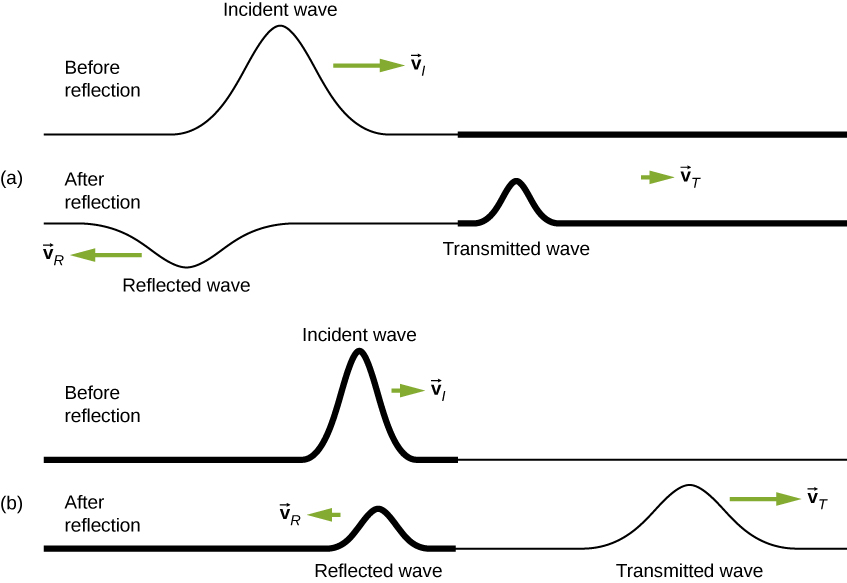
In some situations, the boundary of the medium is neither fixed nor free. Consider Figure 16.18(a), where a low-linear mass density string is attached to a string of a higher linear mass density. In this case, the reflected wave is out of phase with respect to the incident wave. There is also a transmitted wave that is in phase with respect to the incident wave. Both the transmitted and the reflected waves have amplitudes less than the amplitude of the incident wave. If the tension is the same in both strings, the wave speed is higher in the string with the lower linear mass density.
英語のヒント
媒質の境界が固定端でも自由端でもない場合もある。図16.18(a)では、線密度の小さい糸を線密度の大きい糸へつないでいる。この場合、反射波は入射波に対して位相がずれる。入射波と同位相の透過波も生じる。透過波と反射波の振幅は、いずれも入射波より小さい。両方の糸の張力が等しければ、線密度の小さい糸のほうが波の速さは大きい。
OpenStax / Rice University, University Physics Volume 1, CC BY 4.0. Source-book artwork retained. · CC BY 4.0 · Source出典

Figure 16.18図 16.18
Waves traveling along two types of strings: a thick string with a high linear density and a thin string with a low linear density. Both strings are under the same tension, so a wave moves faster on the low-density string than on the high-density string. (a) A wave moving from a low-density to a high-density medium results in a reflected wave that is out of phase with respect to the incident pulse (or wave) and a transmitted wave that is in phase with the incident wave. (b) When a wave moves from a high-density medium to a low-density medium, both the reflected and transmitted wave are in phase with respect to the incident wave.
英語のヒント
線密度の大きい太い糸と、小さい細い糸という2種類の糸を伝わる波。張力は等しいので、低密度の糸のほうが波は速い。(a) 低密度から高密度の媒質へ進む波は、入射パルスまたは入射波に対して位相がずれた反射波と、入射波と同位相の透過波を生じる。(b) 高密度から低密度の媒質へ進む場合、反射波も透過波も入射波と同位相になる。
Part (b) of the figure shows a high-linear mass density string is attached to a string of a lower linear density. In this case, the reflected wave is in phase with respect to the incident wave. There is also a transmitted wave that is in phase with respect to the incident wave. Both the incident and the reflected waves have amplitudes less than the amplitude of the incident wave. Here you may notice that if the tension is the same in both strings, the wave speed is higher in the string with the lower linear mass density.
英語のヒント
図(b)では、線密度の大きい糸を線密度の小さい糸へつなぐ。この場合、反射波は入射波と同位相になる。入射波と同位相の透過波もある。入射波と反射波は、どちらも入射波より振幅が小さい。ここでも、両方の糸の張力が等しければ、線密度の小さい糸のほうが波の速さは大きいことに気づくだろう。