第16章波動
Summaryまとめ
- A standing wave is the superposition of two waves which produces a wave that varies in amplitude but does not propagate.
英語のヒント
定常波は、二つの波の重ね合わせによってでき、振幅は変わるが伝播しない波である。 - Nodes are points of no motion in standing waves.
英語のヒント
節は、定常波で動かない点である。 - An antinode is the location of maximum amplitude of a standing wave.
英語のヒント
腹は、定常波の振幅が最大になる位置である。 - Normal modes of a wave on a string are the possible standing wave patterns. The lowest frequency that will produce a standing wave is known as the fundamental frequency. The higher frequencies which produce standing waves are called overtones.
英語のヒント
糸の波の固有モードとは、生じ得る定常波の形である。定常波を作る最も低い振動数を基本振動数という。定常波を作るそれより高い振動数を上音という。
Key Equations重要な式
Wave speed 波の速さ |
|
Linear mass density 線密度 |
|
Speed of a wave or pulse on a string under tension 英語のヒント張力が働く糸の波またはパルスの速さ |
|
Speed of a compression wave in a fluid 英語のヒント流体中の圧縮波の速さ |
|
Resultant wave from superposition of two sinusoidal waves that are identical except for a phase shift 英語のヒント位相のずれ以外は同一の二つの正弦波を重ね合わせた合成波 |
|
Wave number 波数 |
|
Wave speed 波の速さ |
|
A periodic wave 周期的な波 |
|
Phase of a wave 波の位相 |
|
The linear wave equation 線形波動方程式 |
|
Power averaged over a wavelength 英語のヒント1波長にわたって平均した仕事率 |
|
Intensity 強度 |
|
Intensity for a spherical wave 球面波の強度 |
|
Equation of a standing wave 定常波の方程式 |
|
Wavelength for symmetric boundary conditions 英語のヒント対称な境界条件での波長 |
|
Frequency for symmetric boundary conditions 英語のヒント対称な境界条件での振動数 |
Conceptual Questions概念に関する問題
Exercises 97–101練習問題 97–101
Exercise 97問題 97
A truck manufacturer finds that a strut in the engine is failing prematurely. A sound engineer determines that the strut resonates at the frequency of the engine and suspects that this could be the problem. What are two possible characteristics of the strut can be modified to correct the problem?
英語のヒント
トラックメーカーが、エンジンの支柱が早期に壊れることを発見した。音響技術者は支柱がエンジンの振動数で共振していると判断し、これが原因かもしれないと考えた。問題を解消するため、支柱のどの二つの性質を変えられるか。
Solution解き方
It may be as easy as changing the length and/or the density a small amount so that the parts do not resonate at the frequency of the motor.
英語のヒント
長さや密度、またはその両方を少し変えて、部品がモーターの振動数で共振しないようにするだけで済むかもしれない。
Exercise 98問題 98
Why do roofs of gymnasiums and churches seem to fail more than family homes when an earthquake occurs?
英語のヒント
地震が起こると、体育館や教会の屋根は一般住宅より壊れやすく見えるのはなぜか。
Exercise 99問題 99
Wine glasses can be set into resonance by moistening your finger and rubbing it around the rim of the glass. Why?
英語のヒント
指を湿らせてワイングラスの縁をこすると、グラスを共振させられる。なぜか。
Solution解き方
Energy is supplied to the glass by the work done by the force of your finger on the glass. When supplied at the right frequency, standing waves form. The glass resonates and the vibrations produce sound.
英語のヒント
指がグラスに及ぼす力の仕事によって、グラスへエネルギーが供給される。適切な振動数で供給すると定常波ができる。グラスが共振し、その振動が音を作る。
Exercise 100問題 100
Air conditioning units are sometimes placed on the roof of homes in the city. Occasionally, the air conditioners cause an undesirable hum throughout the upper floors of the homes. Why does this happen? What can be done to reduce the hum?
英語のヒント
都市では、住宅の屋根に空調機を置くことがある。空調機によって、住宅の上の階全体に不快なうなり音が生じる場合がある。なぜ起こるのか。音を減らすにはどうすればよいか。
Exercise 101問題 101
Consider a standing wave modeled as Is there a node or an antinode at What about a standing wave modeled as Is there a node or an antinode at the position?
英語のヒント
で表される定常波を考える。には節と腹のどちらがあるか。で表される定常波ではどうか。の位置には節と腹のどちらがあるか。
Solution解き方
For the equation there is a node because when , so for all time. For the equation there is an antinode because when , , so oscillates between +A and −A as the cosine term oscillates between +1 and -1.
英語のヒント
式では節がある。のときなので、すべての時刻でとなる。式では腹がある。のときなので、余弦の項が+1から−1まで振動するにつれて、は+Aから−Aまで振動する。
Problems問題
Exercises 102–116練習問題 102–116
Exercise 102問題 102
A wave traveling on a Slinky® that is stretched to 4 m takes 2.4 s to travel the length of the Slinky and back again. (a) What is the speed of the wave? (b) Using the same Slinky stretched to the same length, a standing wave is created which consists of three antinodes and four nodes. At what frequency must the Slinky be oscillating?
英語のヒント
4 mに伸ばしたスリンキー®を波が端まで進んで戻るのに2.4 sかかる。(a) 波の速さはいくらか。(b) 同じスリンキーを同じ長さに伸ばし、腹が3個、節が4個の定常波を作る。どの振動数で振動させる必要があるか。
Exercise 103問題 103
A 2-m long string is stretched between two supports with a tension that produces a wave speed equal to What are the wavelength and frequency of the first three modes that resonate on the string?
英語のヒント
長さ2 mの糸を二つの支持具の間に張り、波の速さがとなる張力をかける。共振する最初の三つのモードの波長と振動数はいくらか。
Solution解き方
Exercise 104問題 104
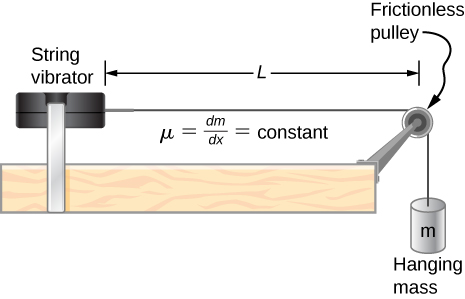
Consider the experimental setup shown below. The length of the string between the string vibrator and the pulley is The linear density of the string is The string vibrator can oscillate at any frequency. The hanging mass is 2.00 kg. (a)What are the wavelength and frequency of mode? (b) The string oscillates the air around the string. What is the wavelength of the sound if the speed of the sound is
英語のヒント
下の実験装置を考える。弦振動器と滑車の間の糸の長さは、線密度はである。振動器は任意の振動数で振動でき、つるした質量は2.00 kgである。(a) のモードの波長と振動数はいくらか。(b) 糸は周囲の空気を振動させる。音速がなら、その音の波長はいくらか。
Exercise 105問題 105
A cable with a linear density of is hung from telephone poles. The tension in the cable is 500.00 N. The distance between poles is 20 meters. The wind blows across the line, causing the cable resonate. A standing waves pattern is produced that has 4.5 wavelengths between the two poles. The speed of sound at the current temperature is . What are the frequency and wavelength of the hum?
英語のヒント
線密度のケーブルを電柱間につるす。張力は500.00 N、電柱間の距離は20 mである。風が横切るとケーブルが共振し、電柱間に4.5波長を含む定常波ができる。現在の気温での音速はである。うなり音の振動数と波長はいくらか。
Solution解き方
Exercise 106問題 106
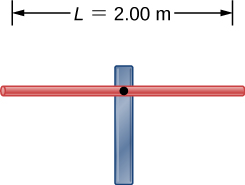
Consider a rod of length L, mounted in the center to a support. A node must exist where the rod is mounted on a support, as shown below. Draw the first two normal modes of the rod as it is driven into resonance. Label the wavelength and the frequency required to drive the rod into resonance.
英語のヒント
長さLの棒を中央で支持具へ固定する。下図のように、支持具への固定点には節が必要である。共振させたときの最初の二つの固有モードを描き、それぞれの波長と、共振に必要な振動数を書け。


Exercise 107問題 107
Consider two wave functions and . Write a wave function for the resulting standing wave.
英語のヒント
二つの波動関数、を考える。合成された定常波の波動関数を書け。
Solution解き方
Exercise 108問題 108
A 2.40-m wire has a mass of 7.50 g and is under a tension of 160 N. The wire is held rigidly at both ends and set into oscillation. (a) What is the speed of waves on the wire? The string is driven into resonance by a frequency that produces a standing wave with a wavelength equal to 1.20 m. (b) What is the frequency used to drive the string into resonance?
英語のヒント
長さ2.40 m、質量7.50 gの針金に160 Nの張力をかける。両端をしっかり固定して振動させる。(a) 針金の波の速さはいくらか。波長1.20 mの定常波を作る振動数で共振させる。(b) 共振を起こすために使う振動数はいくらか。
Exercise 109問題 109
A string with a linear mass density of 0.0062 kg/m and a length of 3.00 m is set into the mode of resonance. The tension in the string is 20.00 N. What is the wavelength and frequency of the wave?
英語のヒント
線密度0.0062 kg/m、長さ3.00 mの糸を、のモードで共振させる。糸の張力は20.00 Nである。波長と振動数はいくらか。
Solution解き方
Exercise 110問題 110
A string with a linear mass density of 0.0075 kg/m and a length of 6.00 m is set into the mode of resonance by driving with a frequency of 100.00 Hz. What is the tension in the string?
英語のヒント
線密度0.0075 kg/m、長さ6.00 mの糸を100.00 Hzで駆動し、のモードで共振させる。糸の張力はいくらか。
Exercise 111問題 111
Two sinusoidal waves with identical wavelengths and amplitudes travel in opposite directions along a string producing a standing wave. The linear mass density of the string is and the tension in the string is The time interval between instances of total destructive interference is What is the wavelength of the waves?
英語のヒント
波長と振幅が等しい二つの正弦波が、糸を反対向きへ進み、定常波を作る。糸の線密度は、張力はである。完全に打ち消し合う干渉が起こる時刻の間隔はである。波長はいくらか。
Solution解き方
Exercise 112問題 112
A string, fixed on both ends, is 5.00 m long and has a mass of 0.15 kg. The tension if the string is 90 N. The string is vibrating to produce a standing wave at the fundamental frequency of the string. (a) What is the speed of the waves on the string? (b) What is the wavelength of the standing wave produced? (c) What is the period of the standing wave?
英語のヒント
両端を固定した糸は長さ5.00 m、質量0.15 kg、張力90 Nである。糸の基本振動数で振動させて定常波を作る。(a) 波の速さはいくらか。(b) 定常波の波長はいくらか。(c) 定常波の周期はいくらか。
Exercise 113問題 113
A string is fixed at both end. The mass of the string is 0.0090 kg and the length is 3.00 m. The string is under a tension of 200.00 N. The string is driven by a variable frequency source to produce standing waves on the string. Find the wavelengths and frequency of the first four modes of standing waves.
英語のヒント
両端を固定した糸の質量は0.0090 kg、長さは3.00 m、張力は200.00 Nである。振動数可変の振動源で駆動して定常波を作る。最初の四つのモードの波長と振動数を求めよ。
Solution解き方
Exercise 114問題 114
The frequencies of two successive modes of standing waves on a string are 258.36 Hz and 301.42 Hz. What is the next frequency above 100.00 Hz that would produce a standing wave?
英語のヒント
糸の定常波の連続する二つのモードの振動数は258.36 Hzと301.42 Hzである。100.00 Hzより上で、最初に定常波を作る振動数はいくらか。
Exercise 115問題 115
A string is fixed at both ends to supports 3.50 m apart and has a linear mass density of The string is under a tension of 90.00 N. A standing wave is produced on the string with six nodes and five antinodes. What are the wave speed, wavelength, frequency, and period of the standing wave?
英語のヒント
線密度の糸の両端を、3.50 m離れた支持具へ固定する。張力は90.00 Nである。節が6個、腹が5個の定常波を作る。波の速さ、波長、振動数、周期はいくらか。
Solution解き方
Exercise 116問題 116
Sine waves are sent down a 1.5-m-long string fixed at both ends. The waves reflect back in the opposite direction. The amplitude of the wave is 4.00 cm. The propagation velocity of the waves is 175 m/s. The resonance mode of the string is produced. Write an equation for the resulting standing wave.
英語のヒント
両端を固定した長さ1.5 mの糸へ正弦波を送る。波は反射して反対向きへ戻る。振幅は4.00 cm、伝播速度は175 m/sである。糸にの共振モードを作る。できる定常波の式を書け。