第16章波動
The next two modes, or the third and fourth harmonics, have wavelengths of and driven by frequencies of and All frequencies above the frequency are known as the overtones. The equations for the wavelength and the frequency can be summarized as:
英語のヒント
次の二つのモード、すなわち第3、第4高調波の波長は、で、駆動する振動数は、である。振動数より高いものをすべて上音という。波長と振動数の式は次のようにまとめられる。
The standing wave patterns that are possible for a string, the first four of which are shown in Figure 16.29, are known as the normal modes, with frequencies known as the normal frequencies. In summary, the first frequency to produce a normal mode is called the fundamental frequency (or first harmonic). Any frequencies above the fundamental frequency are overtones. The second frequency of the normal mode of the string is the first overtone (or second harmonic). The frequency of the normal mode is the second overtone (or third harmonic) and so on.
英語のヒント
糸に生じ得る定常波の形を固有モードといい、その振動数を固有振動数という。最初の四つを図16.29に示す。まとめると、固有モードを生む最初の振動数が基本振動数、または第1高調波であり、それより高い振動数が上音である。糸のの固有モードにあたる第2の振動数は第1上音、または第2高調波である。の固有モードの振動数は第2上音、または第3高調波となり、以下同様である。
The solutions shown as Equation 16.15 and Equation 16.16 are for a string with the boundary condition of a node on each end. When the boundary condition on either side is the same, the system is said to have symmetric boundary conditions. Equation 16.15 and Equation 16.16 are good for any symmetric boundary conditions, that is, nodes at both ends or antinodes at both ends.
英語のヒント
Example 16.7例題 16.7
Standing Waves on a String糸の定常波
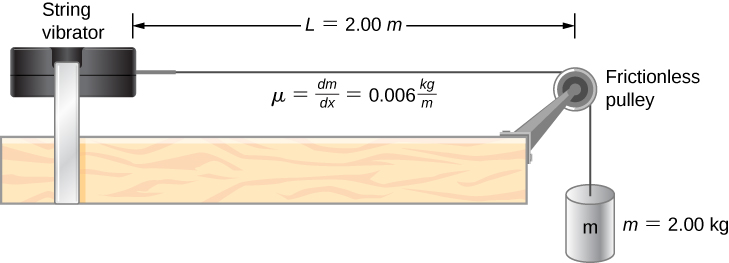
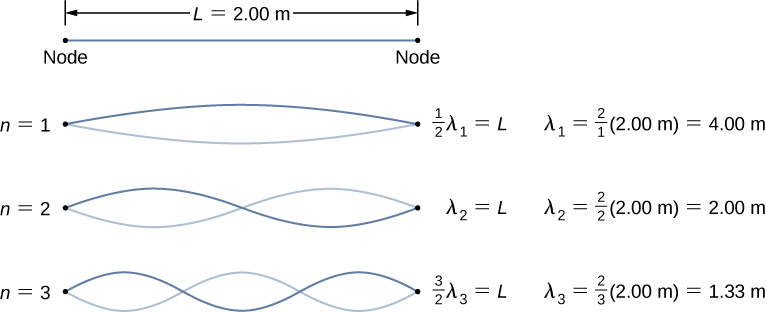
Consider a string of attached to an adjustable-frequency string vibrator as shown in Figure 16.30. The waves produced by the vibrator travel down the string and are reflected by the fixed boundary condition at the pulley. The string, which has a linear mass density of is passed over a frictionless pulley of a negligible mass, and the tension is provided by a 2.00-kg hanging mass. (a) What is the velocity of the waves on the string? (b) Draw a sketch of the first three normal modes of the standing waves that can be produced on the string and label each with the wavelength. (c) List the frequencies that the string vibrator must be tuned to in order to produce the first three normal modes of the standing waves.
英語のヒント
図16.30のように、長さの糸を振動数可変の弦振動器につなぐ。振動器が作る波は糸を伝わり、滑車での固定端の条件によって反射する。線密度の糸を、摩擦がなく質量を無視できる滑車にかけ、2.00 kgのおもりで張力を与える。(a) 糸の波の速度はいくらか。(b) 糸にできる定常波の最初の三つの固有モードを略図に描き、それぞれに波長を書け。(c) これら三つのモードを作るために、振動器をどの振動数へ調節すればよいか列挙せよ。
OpenStax / Rice University, University Physics Volume 1, CC BY 4.0. Source-book artwork retained. · CC BY 4.0 · Source出典
Figure 16.30図 16.30
A string attached to an adjustable-frequency string vibrator.
英語のヒント
振動数可変の弦振動器につないだ糸。
Strategy方針
- The velocity of the wave can be found using The tension is provided by the weight of the hanging mass.
英語のヒント
波の速度はで求められる。張力は、つるしたおもりの重さによって与えられる。 - The standing waves will depend on the boundary conditions. There must be a node at each end. The first mode will be one half of a wave. The second can be found by adding a half wavelength. That is the shortest length that will result in a node at the boundaries. For example, adding one quarter of a wavelength will result in an antinode at the boundary and is not a mode which would satisfy the boundary conditions. This is shown in Figure 16.31.
英語のヒント
定常波は境界条件によって決まる。両端に節が必要なので、最初のモードは半波長となる。さらに半波長を加えると第2モードが得られる。これは境界を節にできる最短の追加の長さである。例えば4分の1波長を加えると境界が腹となり、境界条件を満たすモードにならない。図16.31に示す。 - Since the wave speed velocity is the wavelength times the frequency, the frequency is wave speed divided by the wavelength.
英語のヒント
波の速さは波長と振動数の積なので、振動数は速さを波長で割った値である。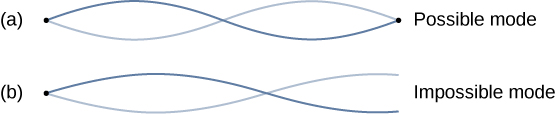
OpenStax / Rice University, University Physics Volume 1, CC BY 4.0. Source-book artwork retained. · CC BY 4.0 · Source出典
Figure 16.31図 16.31(a) The figure represents the second mode of the string that satisfies the boundary conditions of a node at each end of the string. (b)This figure could not possibly be a normal mode on the string because it does not satisfy the boundary conditions. There is a node on one end, but an antinode on the other.英語のヒント
(a) 糸の両端が節という境界条件を満たす第2モード。(b) 境界条件を満たさないので、この図は糸の固有モードにはなり得ない。一端は節だが、他端が腹になっている。
Solution解答
- Begin with the velocity of a wave on a string. The tension is equal to the weight of the hanging mass. The linear mass density and mass of the hanging mass are given:
英語のヒント
糸の波の速度から始める。張力は、つるしたおもりの重さに等しい。線密度とおもりの質量は与えられている。 - The first normal mode that has a node on each end is a half wavelength. The next two modes are found by adding a half of a wavelength.
英語のヒント
両端が節になる最初の固有モードは半波長である。半波長ずつ加えると、次の二つのモードが得られる。 - The frequencies of the first three modes are found by using
英語のヒント
最初の三つのモードの振動数は、を使って求める。


Significance考察
The three standing modes in this example were produced by maintaining the tension in the string and adjusting the driving frequency. Keeping the tension in the string constant results in a constant velocity. The same modes could have been produced by keeping the frequency constant and adjusting the speed of the wave in the string (by changing the hanging mass.)
英語のヒント
この例では、糸の張力を保ったまま駆動振動数を調節して、三つの定常モードを作った。張力が一定なので、速度も一定になる。振動数を一定に保ち、つるす質量を変えて糸の波の速さを調節しても、同じモードを作れたはずである。
Additional Resources追加教材
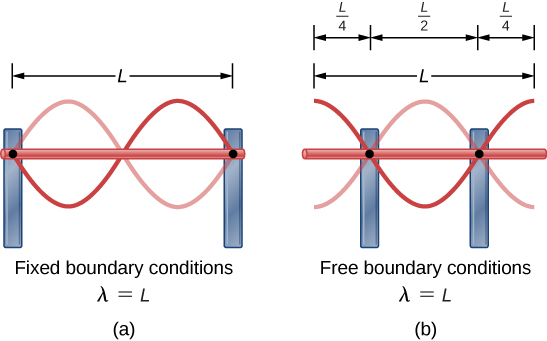
The free boundary conditions shown in the last Check Your Understanding may seem hard to visualize. How can there be a system that is free to oscillate on each end? In Figure 16.32 are shown two possible configuration of a metallic rods (shown in red) attached to two supports (shown in blue). In part (a), the rod is supported at the ends, and there are fixed boundary conditions at both ends. Given the proper frequency, the rod can be driven into resonance with a wavelength equal to length of the rod, with nodes at each end. In part (b), the rod is supported at positions one quarter of the length from each end of the rod, and there are free boundary conditions at both ends. Given the proper frequency, this rod can also be driven into resonance with a wavelength equal to the length of the rod, but there are antinodes at each end. If you are having trouble visualizing the wavelength in this figure, remember that the wavelength may be measured between any two nearest identical points and consider Figure 16.33.
英語のヒント
OpenStax / Rice University, University Physics Volume 1, CC BY 4.0. Source-book artwork retained. · CC BY 4.0 · Source出典

Figure 16.32図 16.32
(a) A metallic rod of length L (red) supported by two supports (blue) on each end. When driven at the proper frequency, the rod can resonate with a wavelength equal to the length of the rod with a node on each end. (b) The same metallic rod of length L (red) supported by two supports (blue) at a position a quarter of the length of the rod from each end. When driven at the proper frequency, the rod can resonate with a wavelength equal to the length of the rod with an antinode on each end.
英語のヒント
(a) 長さLの赤い金属棒を、両端の青い支持具で支える。適切な振動数で駆動すると、棒の長さに等しい波長で、両端に節を持つ共振が起こる。(b) 同じ長さLの赤い金属棒を、両端から長さの4分の1の位置で青い支持具によって支える。適切な振動数で駆動すると、棒の長さに等しい波長で、両端に腹を持つ共振が起こる。
OpenStax / Rice University, University Physics Volume 1, CC BY 4.0. Source-book artwork retained. · CC BY 4.0 · Source出典

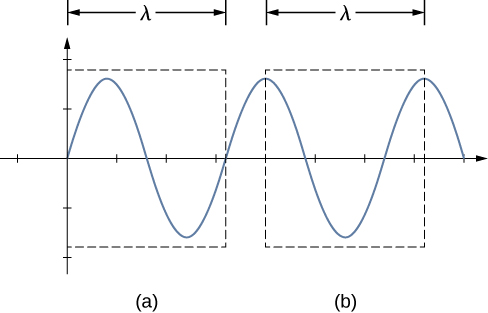
Figure 16.33図 16.33
A wavelength may be measure between the nearest two repeating points. On the wave on a string, this means the same height and slope. (a) The wavelength is measured between the two nearest points where the height is zero and the slope is maximum and positive. (b) The wavelength is measured between two identical points where the height is maximum and the slope is zero.
英語のヒント
波長は、同じ状態を繰り返す最も近い2点の間で測れる。糸の波では、高さと傾きが同じということである。(a) 高さがゼロ、傾きが正で最大になる最も近い2点の間で測る。(b) 高さが最大、傾きがゼロになる同じ状態の2点の間で測る。
Note that the study of standing waves can become quite complex. In Figure 16.32(a), the mode of the standing wave is shown, and it results in a wavelength equal to L. In this configuration, the mode would also have been possible with a standing wave equal to 2L. Is it possible to get the mode for the configuration shown in part (b)? The answer is no. In this configuration, there are additional conditions set beyond the boundary conditions. Since the rod is mounted at a point one quarter of the length from each side, a node must exist there, and this limits the possible modes of standing waves that can be created. We leave it as an exercise for the reader to consider if other modes of standing waves are possible. It should be noted that when a system is driven at a frequency that does not cause the system to resonate, vibrations may still occur, but the amplitude of the vibrations will be much smaller than the amplitude at resonance.
英語のヒント
定常波の研究は、かなり複雑になり得る。図16.32(a)はのモードで、波長はLに等しい。この配置なら、波長2Lの定常波であるのモードも可能である。(b)の配置でのモードを作れるだろうか。答えは否である。この配置には、境界条件のほかにも条件が加わっている。棒は両端から長さの4分の1の位置で固定されるので、その位置には節が必要となり、作れる定常波のモードが制限される。他のモードも可能かどうかは、読者の演習とする。系を共振させない振動数で駆動しても振動は起こり得るが、その振幅は共振時よりはるかに小さいことに注意しよう。
A field of mechanical engineering uses the sound produced by the vibrating parts of complex mechanical systems to troubleshoot problems with the systems. Suppose a part in an automobile is resonating at the frequency of the car’s engine, causing unwanted vibrations in the automobile. This may cause the engine to fail prematurely. The engineers use microphones to record the sound produced by the engine, then use a technique called Fourier analysis to find frequencies of sound produced with large amplitudes and then look at the parts list of the automobile to find a part that would resonate at that frequency. The solution may be as simple as changing the composition of the material used or changing the length of the part in question.
英語のヒント
機械工学のある分野では、複雑な機械系の振動する部品が出す音を使って、系の不具合を調べる。自動車のある部品がエンジンの振動数で共振し、望ましくない振動を車に起こすとしよう。そのためにエンジンが早期に故障することがある。技術者はマイクでエンジンの音を録音し、フーリエ解析という手法で振幅の大きい音の振動数を見つけ、部品一覧からその振動数で共振する部品を探す。解決策は、使う材料の組成や問題の部品の長さを変えるだけという簡単なものかもしれない。
There are other numerous examples of resonance in standing waves in the physical world. The air in a tube, such as found in a musical instrument like a flute, can be forced into resonance and produce a pleasant sound, as we discuss in Sound.
英語のヒント
自然界には、定常波の共振の例がほかにも多数ある。「音」で扱うように、フルートなどの楽器の管内にある空気を共振させると、心地よい音を作れる。
At other times, resonance can cause serious problems. A closer look at earthquakes provides evidence for conditions appropriate for resonance, standing waves, and constructive and destructive interference. A building may vibrate for several seconds with a driving frequency matching that of the natural frequency of vibration of the building—producing a resonance resulting in one building collapsing while neighboring buildings do not. Often, buildings of a certain height are devastated while other taller buildings remain intact. The building height matches the condition for setting up a standing wave for that particular height. The span of the roof is also important. Often it is seen that gymnasiums, supermarkets, and churches suffer damage when individual homes suffer far less damage. The roofs with large surface areas supported only at the edges resonate at the frequencies of the earthquakes, causing them to collapse. As the earthquake waves travel along the surface of Earth and reflect off denser rocks, constructive interference occurs at certain points. Often areas closer to the epicenter are not damaged, while areas farther away are damaged.
英語のヒント
共振が深刻な問題を引き起こす場合もある。地震を詳しく見ると、共振、定常波、強め合う干渉や弱め合う干渉の条件がそろう証拠が見つかる。建物の固有振動数に一致する駆動振動数で数秒間揺れると共振し、隣の建物は倒れないのに、その建物だけが倒壊することがある。ある高さの建物が壊滅する一方、さらに高い建物は無傷で残ることも多い。建物の高さが、その高さに定常波を作る条件に一致するのである。屋根の支点間の距離も重要である。一般住宅の被害はずっと小さいのに、体育館、スーパーマーケット、教会が被害を受けることがよくある。縁だけで支えられた大面積の屋根が地震の振動数で共振し、崩落する。地震波が地表を伝わって密度の大きい岩で反射すると、ある地点で強め合う干渉が起こる。震央に近い地域は被害を受けず、遠い地域が被害を受けることも多い。