第16章波動
16.4 Energy and Power of a Wave16.4 波のエネルギーと仕事率
Learning Objectives学習目標
Learning Objectives学習目標
By the end of this section, you will be able to:
英語のヒント
この節を終えると、次のことができるようになる。
- Explain how energy travels with a pulse or wave
英語のヒント
パルスや波とともにエネルギーがどう伝わるかを説明する。 - Describe, using a mathematical expression, how the energy in a wave depends on the amplitude of the wave
英語のヒント
波のエネルギーが波の振幅にどう依存するかを、数式で説明する。
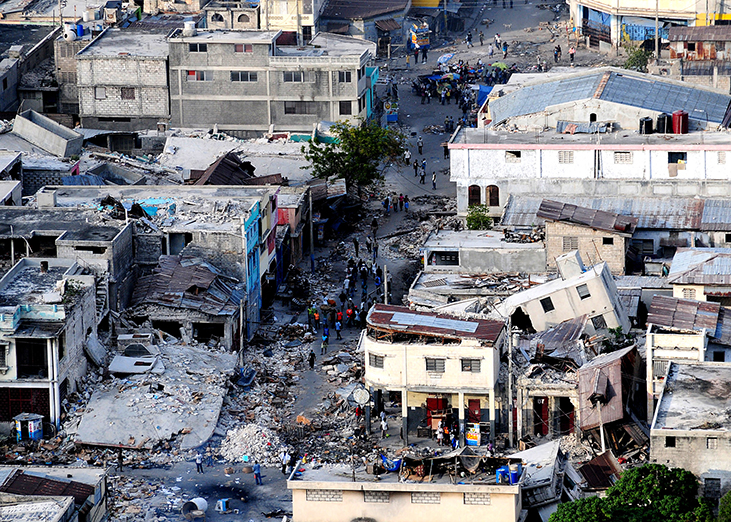
All waves carry energy, and sometimes this can be directly observed. Earthquakes can shake whole cities to the ground, performing the work of thousands of wrecking balls (Figure 16.15). Loud sounds can pulverize nerve cells in the inner ear, causing permanent hearing loss. Ultrasound is used for deep-heat treatment of muscle strains. A laser beam can burn away a malignancy. Water waves chew up beaches.
英語のヒント
すべての波はエネルギーを運び、それが直接観察できる場合もある。地震は都市全体を倒壊させ、何千もの解体用鉄球に相当する仕事をする(図16.15)。大音響は内耳の神経細胞を破壊し、永久的な聴力低下を起こすことがある。超音波は筋肉の損傷の深部温熱療法に使われる。レーザーは悪性腫瘍を焼き切れる。水の波は海岸を削る。
OpenStax / Rice University, University Physics Volume 1, CC BY 4.0. Source-book artwork retained. · CC BY 4.0 · Source出典

Figure 16.15図 16.15
The destructive effect of an earthquake is observable evidence of the energy carried in these waves. The Richter scale rating of earthquakes is a logarithmic scale related to both their amplitude and the energy they carry.
英語のヒント
地震の破壊的な効果は、波が運ぶエネルギーを目に見える形で示す。リヒターの地震規模の尺度は対数尺度で、波の振幅と運ぶエネルギーの両方に関係する。
In this section, we examine the quantitative expression of energy in waves. This will be of fundamental importance in later discussions of waves, from sound to light to quantum mechanics.
英語のヒント
この節では、波のエネルギーを定量的に表す式を調べる。これは、音、光、量子力学へと続く波の議論の基礎となる。
Energy in Waves波のエネルギー
The amount of energy in a wave is related to its amplitude and its frequency. Large-amplitude earthquakes produce large ground displacements. Loud sounds have high-pressure amplitudes and come from larger-amplitude source vibrations than soft sounds. Large ocean breakers churn up the shore more than small ones. Consider the example of the seagull and the water wave earlier in the chapter (Figure 16.3). Work is done on the seagull by the wave as the seagull is moved up, changing its potential energy. The larger the amplitude, the higher the seagull is lifted by the wave and the larger the change in potential energy.
英語のヒント
波のエネルギー量は、振幅と振動数に関係する。大振幅の地震は地面を大きく動かす。大きな音は圧力振幅が大きく、小さな音よりも音源が大きく振動している。大きな砕け波は、小さなものより海岸を激しくかき回す。この章の初めの、水面波とカモメの例を考えよう(図16.3)。波はカモメを持ち上げることで仕事をし、位置エネルギーを変える。振幅が大きいほど高く持ち上げられ、位置エネルギーの変化も大きくなる。
The energy of the wave depends on both the amplitude and the frequency. If the energy of each wavelength is considered to be a discrete packet of energy, a high-frequency wave will deliver more of these packets per unit time than a low-frequency wave. We will see that the average rate of energy transfer in mechanical waves is proportional to both the square of the amplitude and the square of the frequency. If two mechanical waves have equal amplitudes, but one wave has a frequency equal to twice the frequency of the other, the higher-frequency wave will have a rate of energy transfer a factor of four times as great as the rate of energy transfer of the lower-frequency wave. It should be noted that although the rate of energy transport is proportional to both the square of the amplitude and square of the frequency in mechanical waves, the rate of energy transfer in electromagnetic waves is proportional to the square of the amplitude, but independent of the frequency.
英語のヒント
波のエネルギーは、振幅と振動数の両方に依存する。1波長分のエネルギーを一つの独立した包みとみなすと、高周波の波は低周波より、単位時間に多くの包みを届ける。これから見るように、力学的波の平均エネルギー伝達率は、振幅の2乗と振動数の2乗の両方に比例する。振幅が同じで、一方の振動数が他方の2倍なら、高周波側のエネルギー伝達率は低周波側の4倍となる。ただし、力学的波の伝達率が振幅と振動数の両方の2乗に比例するのに対し、電磁波の伝達率は振幅の2乗に比例し、振動数には依存しない。
Power in Waves波の仕事率
Consider a sinusoidal wave on a string that is produced by a string vibrator, as shown in Figure 16.16. The string vibrator is a device that vibrates a rod up and down. A string of uniform linear mass density is attached to the rod, and the rod oscillates the string, producing a sinusoidal wave. The rod does work on the string, producing energy that propagates along the string. Consider a mass element of the string with a mass , as seen in Figure 16.16. As the energy propagates along the string, each mass element of the string is driven up and down at the same frequency as the wave. Each mass element of the string can be modeled as a simple harmonic oscillator. Since the string has a constant linear density each mass element of the string has the mass
英語のヒント

OpenStax / Rice University, University Physics Volume 1, CC BY 4.0. Source-book artwork retained. · CC BY 4.0 · Source出典

Figure 16.16図 16.16
A string vibrator is a device that vibrates a rod. A string is attached to the rod, and the rod does work on the string, driving the string up and down. This produces a sinusoidal wave in the string, which moves with a wave velocity v. The wave speed depends on the tension in the string and the linear mass density of the string. A section of the string with mass oscillates at the same frequency as the wave.
英語のヒント
糸用振動装置は棒を振動させる装置である。棒につないだ糸へ仕事を加えて上下に動かすと、速度vで進む正弦波ができる。波の速さは、糸の張力と線密度に依存する。質量の小部分は、波と同じ振動数で振動する。
The total mechanical energy of the wave is the sum of its kinetic energy and potential energy. The kinetic energy of each mass element of the string of length is as the mass element oscillates perpendicular to the direction of the motion of the wave. Using the constant linear mass density, the kinetic energy of each mass element of the string with length is
英語のヒント
波の全力学的エネルギーは、運動エネルギーと位置エネルギーの和である。長さの各質量要素が、波の進行方向に垂直に振動すると、その運動エネルギーはとなる。一定の線密度を使えば、長さの各要素の運動エネルギーは次のようになる。
A differential equation can be formed by letting the length of the mass element of the string approach zero,
英語のヒント
質量要素の長さをゼロへ近づけると、微分形の式が得られる。
Since the wave is a sinusoidal wave with an angular frequency the position of each mass element may be modeled as Each mass element of the string oscillates with a velocity The kinetic energy of each mass element of the string becomes
英語のヒント
波は角振動数の正弦波なので、各要素の位置をで表せる。各要素は速度で振動する。運動エネルギーは次のようになる。
The wave can be very long, consisting of many wavelengths. To standardize the energy, consider the kinetic energy associated with a wavelength of the wave. This kinetic energy can be integrated over the wavelength to find the energy associated with each wavelength of the wave:
英語のヒント
波は、多数の波長を含む非常に長いものにもなり得る。エネルギーを共通の単位で比べるため、1波長分の運動エネルギーを考えよう。微小部分の運動エネルギーを1波長にわたって積分すると、各波長に対応するエネルギーを得る。
There is also potential energy associated with the wave. Much like the mass oscillating on a spring, there is a conservative restoring force that, when the mass element is displaced from the equilibrium position, drives the mass element back to the equilibrium position. The potential energy of the mass element can be found by considering the linear restoring force of the string, In Oscillations, we saw that the potential energy stored in a spring with a linear restoring force is equal to where the equilibrium position is defined as When a mass attached to the spring oscillates in simple harmonic motion, the angular frequency is equal to As each mass element oscillates in simple harmonic motion, the spring constant is equal to The potential energy of the mass element is equal to
英語のヒント
波には位置エネルギーもある。ばねにつながれた質点のように、要素をつり合いからずらすと、そこへ戻す保存的な復元力が働く。糸の線形な復元力を考えれば、要素の位置エネルギーを求められる。「振動」で見たように、線形な復元力を持つばねに蓄えられる位置エネルギーはで、つり合いの位置をとする。ばねにつながれた質点が単振動するとき、角振動数はである。各要素も単振動するので、ばね定数はとなる。要素の位置エネルギーは次のとおりである。
Note that is the spring constant and not the wave number This equation can be used to find the energy over a wavelength. Integrating over the wavelength, we can compute the potential energy over a wavelength:
英語のヒント
はばね定数であり、波数ではないことに注意しよう。この式を1波長にわたって積分すると、1波長分の位置エネルギーが求められる。
The potential energy associated with a wavelength of the wave is equal to the kinetic energy associated with a wavelength.
英語のヒント
1波長分の位置エネルギーは、1波長分の運動エネルギーに等しい。
The total energy associated with a wavelength is the sum of the potential energy and the kinetic energy:
英語のヒント
1波長分の全エネルギーは、位置エネルギーと運動エネルギーの和である。
The time-averaged power of a sinusoidal mechanical wave, which is the average rate of energy transfer associated with a wave as it passes a point, can be found by taking the total energy associated with the wave divided by the time it takes to transfer the energy. If the velocity of the sinusoidal wave is constant, the time for one wavelength to pass by a point is equal to the period of the wave, which is also constant. For a sinusoidal mechanical wave, the time-averaged power is therefore the energy associated with a wavelength divided by the period of the wave. The wavelength of the wave divided by the period is equal to the velocity of the wave,
英語のヒント
正弦波の力学的な波の時間平均の仕事率は、波がある点を通過する際の平均のエネルギー伝達率である。波の全エネルギーを、そのエネルギーの伝達にかかる時間で割ると求められる。波の速度が一定なら、1波長がある点を通過する時間は波の周期に等しく、これも一定である。したがって、正弦波の力学的な波の時間平均の仕事率は、1波長分のエネルギーを波の周期で割った値となる。波長を周期で割った値は波の速度に等しい。
Note that this equation for the time-averaged power of a sinusoidal mechanical wave shows that the power is proportional to the square of the amplitude of the wave and to the square of the angular frequency of the wave. Recall that the angular frequency is equal to , so the power of a mechanical wave is equal to the square of the amplitude and the square of the frequency of the wave.
英語のヒント
正弦波の力学的な波の時間平均の仕事率を表すこの式から、仕事率は波の振幅の2乗と角振動数の2乗に比例することが分かる。角振動数はなので、力学的な波の仕事率は、波の振幅の2乗と振動数の2乗に等しい。
Example 16.6例題 16.6
Power Supplied by a String Vibrator弦振動器が供給する仕事率
Consider a two-meter-long string with a mass of 70.00 g attached to a string vibrator as illustrated in Figure 16.16. The tension in the string is 90.0 N. When the string vibrator is turned on, it oscillates with a frequency of 60 Hz and produces a sinusoidal wave on the string with an amplitude of 4.00 cm and a constant wave speed. What is the time-averaged power supplied to the wave by the string vibrator?
英語のヒント
図16.16のように、長さ2 m、質量70.00 gの糸を弦振動器につなぐ。糸の張力は90.0 Nである。振動器を作動させると60 Hzで振動し、振幅4.00 cm、波の速さ一定の正弦波を糸に作る。振動器が波へ供給する時間平均の仕事率はいくらか。
Strategy方針
The power supplied to the wave should equal the time-averaged power of the wave on the string. We know the mass of the string , the length of the string , and the tension in the string. The speed of the wave on the string can be derived from the linear mass density and the tension. The string oscillates with the same frequency as the string vibrator, from which we can find the angular frequency.
英語のヒント
波へ供給される仕事率は、糸の波の時間平均の仕事率に等しいはずである。糸の質量、長さ、張力が分かっている。波の速さは線密度と張力から求められる。糸は振動器と同じ振動数で振動するので、それを使って角振動数を求められる。
Solution解答
- Begin with the equation of the time-averaged power of a sinusoidal wave on a string:
英語のヒント
糸の正弦波の時間平均の仕事率の式から始める。The amplitude is given, so we need to calculate the linear mass density of the string, the angular frequency of the wave on the string, and the speed of the wave on the string.英語のヒント
振幅は与えられているので、糸の線密度、波の角振動数、波の速さを計算する必要がある。 - We need to calculate the linear density to find the wave speed:
英語のヒント
波の速さを求めるには、線密度を計算する必要がある。 - The wave speed can be found using the linear mass density and the tension of the string:
英語のヒント
波の速さは、糸の線密度と張力から求められる。 - The angular frequency can be found from the frequency:
英語のヒント
角振動数は、振動数から求められる。 - Calculate the time-averaged power:
英語のヒント
時間平均の仕事率を計算する。
Significance考察
The time-averaged power of a sinusoidal wave is proportional to the square of the amplitude of the wave and the square of the angular frequency of the wave. This is true for most mechanical waves. If either the angular frequency or the amplitude of the wave were doubled, the power would increase by a factor of four. The time-averaged power of the wave on a string is also proportional to the speed of the sinusoidal wave on the string. If the speed were doubled, by increasing the tension by a factor of four, the power would also be doubled.
英語のヒント
正弦波の時間平均の仕事率は、波の振幅の2乗と角振動数の2乗に比例する。大部分の力学的な波にこれが成り立つ。角振動数または振幅を2倍にすると、仕事率は4倍になる。糸の波の時間平均の仕事率は、糸を伝わる正弦波の速さにも比例する。張力を4倍にして速さを2倍にすると、仕事率も2倍になる。