第7章因数分解
Factor Differences of Squares平方の差を因数分解する
The other special product you saw in the previous chapter was the Product of Conjugates pattern. You used this to multiply two binomials that were conjugates. Here’s an example:
英語のヒント
前の章で見たもう1つの特別な積は、共役な式の積の公式だった。共役な2つの二項式を掛けるために、この公式を使った。例を示そう:
Remember, when you multiply conjugate binomials, the middle terms of the product add to 0. All you have left is a binomial, the difference of squares.
英語のヒント
共役な二項式を掛けると、積の真ん中の項どうしの和が0になることを思い出そう。残るのは、平方の差という二項式だけである。
Multiplying conjugates is the only way to get a binomial from the product of two binomials.
英語のヒント
2つの二項式の積から二項式を得る唯一の方法は、共役な式どうしを掛けることである。
To factor, we will use the product pattern “in reverse” to factor the difference of squares. A difference of squares factors to a product of conjugates.
英語のヒント
平方の差を因数分解するには、積の公式を「逆向き」に使う。平方の差は、共役な式の積に因数分解される。
Remember, “difference” refers to subtraction. So, to use this pattern you must make sure you have a binomial in which two squares are being subtracted.
英語のヒント
「差」は引き算を指すことを思い出そう。この公式を使うには、2つの平方を引いた二項式になっていることを確かめなければならない。
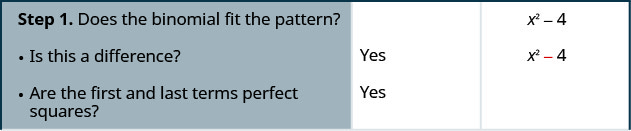
Example 7.47例題 7.47
How to Factor Differences of Squares平方の差を因数分解する方法
Factor: .
英語のヒント
因数分解せよ:。
Solution解答



Try It (2)確認問題(2題)
It is important to remember that sums of squares do not factor into a product of binomials. There are no binomial factors that multiply together to get a sum of squares. After removing any GCF, the expression is prime!
英語のヒント
平方の和は、二項式の積に因数分解できないことを覚えておくのが大切である。掛けて平方の和になる二項式の因数は存在しない。最大公約因子を取り除いた後の式は既約である。
Don’t forget that 1 is a perfect square. We’ll need to use that fact in the next example.
英語のヒント
1も完全平方であることを忘れないようにしよう。次の例では、このことを使う。
Example 7.48例題 7.48
Factor: .
英語のヒント
因数分解せよ:。
Solution解答
Solution解答
 |
|
Is this a difference? Yes. これは差か。そうである。 |
 |
Are the first and last terms perfect squares? 最初と最後の項は完全平方か。 |
|
Yes - write them as squares. そうである。それらを平方で表す。 |
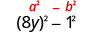 |
Factor as the product of conjugates. 共役な式の積に因数分解する。 |
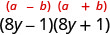 |
Check by multiplying. 掛け算して確認する。 |
|
Try It (2)確認問題(2題)
Example 7.49例題 7.49
Factor: .
英語のヒント
因数分解せよ:。
Solution解答
Try It (2)確認問題(2題)
The binomial in the next example may look “backwards,” but it’s still the difference of squares.
英語のヒント
次の例の二項式は「逆向き」に見えるかもしれないが、それでも平方の差である。
Example 7.50例題 7.50
Factor: .
英語のヒント
因数分解せよ:。
Solution解答
Is this a difference of squares? Yes. これは平方の差か。そうである。 |
|
Factor as the product of conjugates. 共役な式の積に因数分解する。 |
|
Check by multiplying. 掛け算して確認する。 |
|
Be careful not to rewrite the original expression as . 元の式をに書き換えてしまわないよう注意する。 |
|
Factor on your own and then notice how the result differs from .
英語のヒント
自分でを因数分解し、その結果がとどのように異なるかに注目しよう。
Try It (2)確認問題(2題)
To completely factor the binomial in the next example, we’ll factor a difference of squares twice!
英語のヒント
次の例の二項式を完全に因数分解するには、平方の差を2回因数分解する。
Example 7.51例題 7.51
Factor: .
英語のヒント
因数分解せよ:。
Solution解答
Is this a difference of squares? Yes. これは平方の差か。そうである。 |
|
Factor it as the product of conjugates. 共役な式の積に因数分解する。 |
|
Notice the first binomial is also a difference of squares! 最初の二項式も平方の差であることに注目する。 |
|
Factor it as the product of conjugates. The last factor, the sum of squares, cannot be factored. 共役な式の積に因数分解する。最後の因数は平方の和なので、因数分解できない。 |
|
Check by multiplying. 掛け算して確認する。 |
Try It (2)確認問題(2題)
As always, you should look for a common factor first whenever you have an expression to factor. Sometimes a common factor may “disguise” the difference of squares and you won’t recognize the perfect squares until you factor the GCF.
英語のヒント
いつものように、式を因数分解するときは、最初に共通因子を探そう。共通因子が平方の差を「隠して」いて、最大公約因子をくくり出すまで完全平方に気付かないことがある。
Example 7.52例題 7.52
Factor: .
英語のヒント
因数分解せよ:。
Solution解答
Is there a GCF? Yes, 2y—factor it out! 最大公約因子はあるか。ある。2yをくくり出す。 |
|
Is the binomial a difference of squares? Yes. この二項式は平方の差か。そうである。 |
|
Factor as a product of conjugates. 共役な式の積に因数分解する。 |
|
Check by multiplying. 掛け算して確認する。 |
Try It (2)確認問題(2題)
Example 7.53例題 7.53
Factor: .
英語のヒント
因数分解せよ:。
Solution解答
Is there a GCF? Yes, 6—factor it out! 最大公約因子はあるか。ある。6をくくり出す。 |
|
Is the binomial a difference of squares? No, it is a sum of squares. Sums of squares do not factor! この二項式は平方の差か。違う。平方の和である。平方の和は因数分解できない。 |
|
Check by multiplying. 掛け算して確認する。 |
Try It (2)確認問題(2題)
Factor Sums and Differences of Cubes立方の和と差を因数分解する
There is another special pattern for factoring, one that we did not use when we multiplied polynomials. This is the pattern for the sum and difference of cubes. We will write these formulas first and then check them by multiplication.
英語のヒント
因数分解には、多項式の掛け算では使わなかった別の特別な公式がある。立方の和と差の公式である。まず公式を書き、次に掛け算して確かめる。
We’ll check the first pattern and leave the second to you.
英語のヒント
最初の公式を確認し、2番目は読者自身で確かめてもらうことにする。
 |
|
Distribute. 分配法則を使う。 |
 |
Multiply. 掛ける。 |
|
Combine like terms. 同類項をまとめる。 |
The two patterns look very similar, don’t they? But notice the signs in the factors. The sign of the binomial factor matches the sign in the original binomial. And the sign of the middle term of the trinomial factor is the opposite of the sign in the original binomial. If you recognize the pattern of the signs, it may help you memorize the patterns.
英語のヒント
2つの公式はよく似ているだろう。だが、因数の符号に注目しよう。二項式の因数の符号は、元の二項式の符号と一致する。そして、三項式の因数の真ん中の項の符号は、元の二項式の符号と逆になる。この符号の規則を見分けると、公式を覚える助けになる。
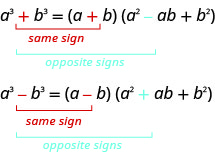
The trinomial factor in the sum and difference of cubes pattern cannot be factored.
英語のヒント
立方の和と差の公式にある三項式の因数は、それ以上因数分解できない。
It can be very helpful if you learn to recognize the cubes of the integers from 1 to 10, just like you have learned to recognize squares. We have listed the cubes of the integers from 1 to 10 in Table 7.2.
英語のヒント
平方を見分けられるようになったのと同様に、1から10までの整数の3乗も見分けられるようになると、とても役立つ。1から10までの整数の3乗を表7.2に示す。
n |
1 |
2 |
3 |
4 |
5 |
6 |
7 |
8 |
9 |
10 |
|---|---|---|---|---|---|---|---|---|---|---|
1 |
8 |
27 |
64 |
125 |
216 |
343 |
512 |
729 |
1000 |
Example 7.54例題 7.54
How to Factor the Sum or Difference of Cubes立方の和または差を因数分解する方法
Factor: .
英語のヒント
因数分解せよ:。
Solution解答
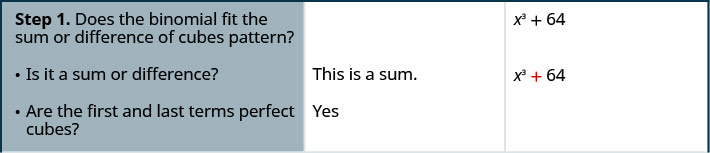



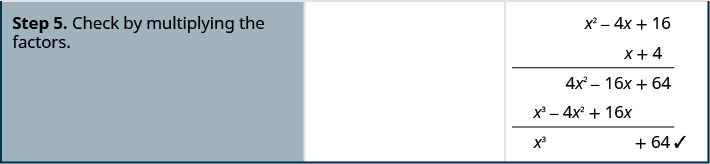
Try It (2)確認問題(2題)
Example 7.55例題 7.55
Factor: .
英語のヒント
因数分解せよ:。
Solution解答
 |
|
This binomial is a difference. The first and last terms are perfect cubes. この二項式は差である。最初と最後の項は完全立方である。 |
|
Write the terms as cubes. 各項を3乗で表す。 |
 |
Use the difference of cubes pattern. 立方の差の公式を使う。 |
 |
Simplify. 簡単にする。 |
 |
Check by multiplying. 掛け算して確認する。 |
|
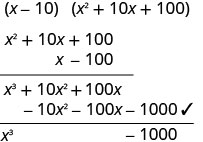 |
Try It (2)確認問題(2題)
Be careful to use the correct signs in the factors of the sum and difference of cubes.
英語のヒント
立方の和と差の因数では、正しい符号を使うように注意しよう。
Example 7.56例題 7.56
Factor: .
英語のヒント
因数分解せよ:。
Solution解答
 |
|
This binomial is a difference. The first and last terms are perfect cubes. この二項式は差である。最初と最後の項は完全立方である。 |
|
Write the terms as cubes. 各項を3乗で表す。 |
 |
Use the difference of cubes pattern. 立方の差の公式を使う。 |
 |
Simplify. 簡単にする。 |
 |
Check by multiplying. 掛け算して確認する。 |
We'll leave the check to you. 確認は読者自身で行おう。 |
Try It (2)確認問題(2題)
Example 7.57例題 7.57
Factor: .
英語のヒント
因数分解せよ:。
Solution解答
Solution解答
 |
|
This binomial is a difference. The first and last terms are perfect cubes. この二項式は差である。最初と最後の項は完全立方である。 |
|
Write the terms as cubes. 各項を3乗で表す。 |
 |
Use the difference of cubes pattern. 立方の差の公式を使う。 |
 |
Simplify. 簡単にする。 |
 |
Check by multiplying. 掛け算して確認する。 |
We'll leave the check to you. 確認は読者自身で行おう。 |
Try It (2)確認問題(2題)
In the next example, we first factor out the GCF. Then we can recognize the sum of cubes.
英語のヒント
次の例では、最初に最大公約因子をくくり出す。すると、立方の和を見分けられる。
Example 7.58例題 7.58
Factor: .
英語のヒント
因数分解せよ:。
Solution解答
 |
|
Factor the common factor. 共通因子をくくり出す。 |
 |
This binomial is a sum. The first and last terms are perfect cubes. この二項式は和である。最初と最後の項は完全立方である。 |
|
Write the terms as cubes. 各項を3乗で表す。 |
 |
Use the sum of cubes pattern. 立方の和の公式を使う。 |
 |
Simplify. 簡単にする。 |
 |
Check. To check, you may find it easier to multiply the sum of cubes factors first, then multiply that product by 5. We’ll leave the multiplication for you.
英語のヒント
確認するには、まず立方の和を因数分解した因数どうしを掛け、その積に5を掛ける方が簡単かもしれない。この掛け算は読者自身で行おう。