第7章因数分解
Key Concepts重要な概念
- How to Factor Polynomials
英語のヒント
多項式を因数分解する方法- Is there a greatest common factor? Factor it out.
英語のヒント
最大公約因子はあるか。あれば、くくり出す。 - Is the polynomial a binomial, trinomial, or are there more than three terms?
英語のヒント
多項式は二項式か、三項式か、それとも4項以上あるか。- If it is a binomial:
Is it a sum?英語のヒント
二項式の場合:和か。- Of squares? Sums of squares do not factor.
英語のヒント
平方の和か。平方の和は因数分解できない。 - Of cubes? Use the sum of cubes pattern.
英語のヒント
立方の和か。立方の和の公式を使う。
Is it a difference?英語のヒント
差か。- Of squares? Factor as the product of conjugates.
英語のヒント
平方の差か。共役な式の積に因数分解する。 - Of cubes? Use the difference of cubes pattern.
英語のヒント
立方の差か。立方の差の公式を使う。
- If it is a trinomial:
Is it of the form ? Undo FOIL.
Is it of the form ?英語のヒント
三項式の場合:の形か。FOIL法を逆向きに行う。の形か。- If ‘a’ and ‘c’ are squares, check if it fits the trinomial square pattern.
英語のヒント
aとcが平方なら、完全平方式の三項式の形に当てはまるかを確かめる。 - Use the trial and error or ‘ac’ method.
英語のヒント
試行錯誤またはac法を使う。
- If it has more than three terms:
Use the grouping method.英語のヒント
4項以上ある場合:項をグループに分ける方法を使う。
- Check. Is it factored completely? Do the factors multiply back to the original polynomial?
英語のヒント
確認する。完全に因数分解されているか。因数を掛けると、元の多項式に戻るか。
Practice Makes Perfect練習問題
Exercises 279–310練習問題 279–310
Recognize and Use the Appropriate Method to Factor a Polynomial Completely
英語のヒント
多項式を完全に因数分解する適切な方法を見分け、使う
In the following exercises, factor completely.
英語のヒント
以下の問題では、完全に因数分解せよ。
Exercise 279問題 279
Solution解き方
Exercise 280問題 280
Exercise 281問題 281
Solution解き方
Exercise 282問題 282
Exercise 283問題 283
Solution解き方
Exercise 284問題 284
Exercise 285問題 285
Solution解き方
Exercise 286問題 286
Exercise 287問題 287
Solution解き方
Exercise 288問題 288
Exercise 289問題 289
Solution解き方
Exercise 290問題 290
Exercise 291問題 291
Solution解き方
Exercise 292問題 292
Exercise 293問題 293
Solution解き方
Exercise 294問題 294
Exercise 295問題 295
Solution解き方
Exercise 296問題 296
Exercise 297問題 297
Solution解き方
Exercise 298問題 298
Exercise 299問題 299
Solution解き方
Exercise 300問題 300
Exercise 301問題 301
Solution解き方
Exercise 302問題 302
Exercise 303問題 303
Solution解き方
Exercise 304問題 304
Exercise 305問題 305
Solution解き方
Exercise 306問題 306
Exercise 307問題 307
Solution解き方
prime
英語のヒント
素数
Exercise 308問題 308
Exercise 309問題 309
Solution解き方
Exercise 310問題 310
Everyday Math日常生活の数学
Exercises 311–312練習問題 311–312
Exercise 311問題 311
Watermelon drop A springtime tradition at the University of California San Diego is the Watermelon Drop, where a watermelon is dropped from the seventh story of Urey Hall.
英語のヒント
スイカ落とし カリフォルニア大学サンディエゴ校の春の恒例行事に、ユーリー・ホールの7階からスイカを落とす「スイカ落とし」がある。
- ⓐ The binomial gives the height of the watermelon seconds after it is dropped. Factor the greatest common factor from this binomial.
英語のヒント
ⓐ 二項式は、落としてから秒後のスイカの高さを表す。この二項式から最大公約因子をくくり出せ。 - ⓑ If the watermelon is thrown down with initial velocity 8 feet per second, its height after seconds is given by the trinomial . Completely factor this trinomial.
英語のヒント
ⓑ スイカを初速度毎秒8フィートで下向きに投げた場合、秒後の高さは三項式で表される。この三項式を完全に因数分解せよ。
Solution解き方
ⓐ ⓑ
Exercise 312問題 312
Pumpkin drop A fall tradition at the University of California San Diego is the Pumpkin Drop, where a pumpkin is dropped from the eleventh story of Tioga Hall.
英語のヒント
カボチャ落とし カリフォルニア大学サンディエゴ校の秋の恒例行事に、タイオガ・ホールの11階からカボチャを落とす「カボチャ落とし」がある。
- ⓐ The binomial gives the height of the pumpkin t seconds after it is dropped. Factor the greatest common factor from this binomial.
英語のヒント
ⓐ 二項式は、落としてからt秒後のカボチャの高さを表す。この二項式から最大公約因子をくくり出せ。 - ⓑ If the pumpkin is thrown down with initial velocity 32 feet per second, its height after seconds is given by the trinomial . Completely factor this trinomial.
英語のヒント
ⓑ カボチャを初速度毎秒32フィートで下向きに投げた場合、秒後の高さは三項式で表される。この三項式を完全に因数分解せよ。
Writing Exercises記述問題
Exercises 313–314練習問題 313–314
Exercise 313問題 313
The difference of squares can be factored as . But it is not completely factored. What more must be done to completely factor it?
英語のヒント
平方の差は、と因数分解できる。しかし、まだ完全には因数分解されていない。完全に因数分解するためには、さらに何をする必要があるか。
Solution解き方
Answer may vary.
英語のヒント
解答はさまざまである。
Exercise 314問題 314
Of all the factoring methods covered in this chapter (GCF, grouping, undo FOIL, ‘ac’ method, special products) which is the easiest for you? Which is the hardest? Explain your answers.
英語のヒント
この章で扱った因数分解の方法(最大公約因子、グループ分け、FOIL法の逆、ac法、特別な積)のうち、あなたにとって最も簡単なのはどれか。最も難しいのはどれか。理由も説明せよ。
Self Check自己チェック
ⓐ After completing the exercises, use this checklist to evaluate your mastery of the objectives of this section.
英語のヒント
ⓐ 練習問題を終えたら、このチェックリストを使って、この節の学習目標をどれだけ達成できたかを評価する。
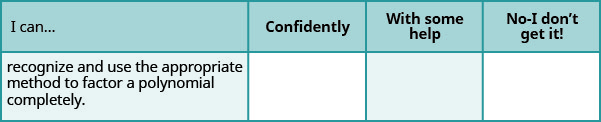
ⓑ Overall, after looking at the checklist, do you think you are well-prepared for the next section? Why or why not?
英語のヒント
ⓑ チェックリストを見て、全体として次の節に進む準備は十分にできていると思うか。その理由、またはできていないと思う理由を述べよ。