第7章因数分解
7.3 Factor Trinomials of the Form ax2+bx+c7.3 ax2+bx+cの形の三項式を因数分解する
Learning Objectives学習目標
Learning Objectives学習目標
By the end of this section, you will be able to:
英語のヒント
この節を終えると、次のことができるようになる。
- Recognize a preliminary strategy to factor polynomials completely
英語のヒント
多項式を完全に因数分解するために最初に行う方針を理解する - Factor trinomials of the form with a GCF
英語のヒント
最大公約因子を持つの形の三項式を因数分解する - Factor trinomials using trial and error
英語のヒント
試行錯誤によって三項式を因数分解する - Factor trinomials using the ‘ac’ method
英語のヒント
「ac法」で三項式を因数分解する
Before You Begin (3)準備問題(3題)
Recognize a Preliminary Strategy for Factoring因数分解で最初に行う方針を理解する
Let’s summarize where we are so far with factoring polynomials. In the first two sections of this chapter, we used three methods of factoring: factoring the GCF, factoring by grouping, and factoring a trinomial by “undoing” FOIL. More methods will follow as you continue in this chapter, as well as later in your studies of algebra.
英語のヒント
多項式の因数分解について、ここまでの内容をまとめよう。この章の最初の2節では、最大公約因子をくくり出す、項をグループに分ける、FOIL法を「逆向き」にして三項式を因数分解するという3つの方法を使った。この章の先の部分や、今後の代数の学習で、さらに多くの方法を学ぶ。
How will you know when to use each factoring method? As you learn more methods of factoring, how will you know when to apply each method and not get them confused? It will help to organize the factoring methods into a strategy that can guide you to use the correct method.
英語のヒント
それぞれの因数分解の方法をいつ使えばよいと判断するのだろうか。さらに多くの方法を学んだとき、混同せずにそれぞれを適用する場面を見分けるにはどうすればよいだろうか。正しい方法を選ぶ道筋となるように、因数分解の方法を整理すると役立つ。
As you start to factor a polynomial, always ask first, “Is there a greatest common factor?” If there is, factor it first.
英語のヒント
多項式の因数分解を始めるときは、必ず最初に「最大公約因子はあるか」と考える。あるなら、それを最初にくくり出す。
The next thing to consider is the type of polynomial. How many terms does it have? Is it a binomial? A trinomial? Or does it have more than three terms?
英語のヒント
次に考えるのは、多項式の種類である。項はいくつあるだろうか。二項式か、三項式か、それとも4項以上あるだろうか。
If it is a trinomial where the leading coefficient is one, , use the “undo FOIL” method.
英語のヒント
最高次の係数が1の三項式なら、FOIL法を逆向きにする方法を使う。
If it has more than three terms, try the grouping method. This is the only method to use for polynomials of more than three terms.
英語のヒント
4項以上ある場合は、項をグループに分ける方法を試す。4項以上の多項式で使うのは、この方法だけである。
Some polynomials cannot be factored. They are called “prime.”
英語のヒント
因数分解できない多項式もある。そのような多項式を「既約」という。
Below we summarize the methods we have so far. These are detailed in Choose a strategy to factor polynomials completely.
英語のヒント
ここまでに学んだ方法を以下にまとめる。詳しくは「多項式を完全に因数分解する方針を選ぶ」を参照しよう。
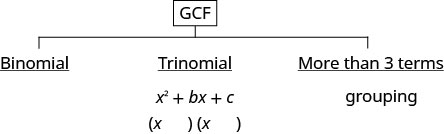
Use the preliminary strategy to completely factor a polynomial. A polynomial is factored completely if, other than monomials, all of its factors are prime.
英語のヒント
最初に行う方針に従って、多項式を完全に因数分解する。単項式以外のすべての因数が既約であれば、多項式は完全に因数分解されている。
Example 7.29例題 7.29
Identify the best method to use to factor each polynomial.
英語のヒント
各多項式を因数分解する最適な方法を示せ。
- ⓐ
- ⓑ
- ⓒ
Solution解答
ⓐ
Is there a greatest common factor? 最大公約数となる共通因子はあるか。 |
Yes, 6. ある。6である。 |
Factor out the 6. 6をくくり出す。 |
|
Is it a binomial, trinomial, or are there more than 3 terms? 二項式か、三項式か、それとも4項以上あるか。 |
Binomial, we have no method to factor binomials yet. 二項式である。二項式を因数分解する方法はまだ学んでいない。 |
ⓑ
Is there a greatest common factor? 最大公約数となる共通因子はあるか。 |
No, there is no common factor. ない。共通因子はない。 |
Is it a binomial, trinomial, or are there more than three terms? 二項式か、三項式か、それとも4項以上あるか。 |
Trinomial, with leading coefficient 1, so “undo” FOIL. 最高次の係数が1の三項式なので、FOIL法を逆向きに行う。 |
ⓒ
Is there a greatest common factor? 最大公約数となる共通因子はあるか。 |
No, there is no common factor. ない。共通因子はない。 |
Is it a binomial, trinomial, or are there more than three terms? 二項式か、三項式か、それとも4項以上あるか。 |
More than three terms, so factor using grouping. 4項以上あるので、項をグループに分けて因数分解する。 |
Try It (2)確認問題(2題)
Factor Trinomials of the form ax2 + bx + c with a GCF最大公約因子を持つax2 + bx + cの形の三項式を因数分解する
Now that we have organized what we’ve covered so far, we are ready to factor trinomials whose leading coefficient is not 1, trinomials of the form .
英語のヒント
ここまでの内容を整理したので、最高次の係数が1ではない、の形の三項式を因数分解する準備ができた。
Remember to always check for a GCF first! Sometimes, after you factor the GCF, the leading coefficient of the trinomial becomes 1 and you can factor it by the methods in the last section. Let’s do a few examples to see how this works.
英語のヒント
必ず最初に最大公約因子を確認することを忘れないようにしよう。最大公約因子をくくり出すと、三項式の最高次の係数が1になり、前の節の方法で因数分解できる場合がある。いくつかの例を通して、その仕組みを見てみよう。
Watch out for the signs in the next two examples.
英語のヒント
次の2つの例では、符号に注意しよう。
Example 7.30例題 7.30
Factor completely: .
英語のヒント
完全に因数分解せよ:。
Solution解答
Use the preliminary strategy.
英語のヒント
最初に行う方針に従う。
Is there a greatest common factor? 最大公約数となる共通因子はあるか。 |
|
Yes, GCF = 2. Factor it out. ある。最大公約因子は2である。これをくくり出す。 |
Inside the parentheses, is it a binomial, trinomial, or are there more than three terms?
英語のヒント
括弧の中は二項式か、三項式か、それとも4項以上あるか。
It is a trinomial whose coefficient is 1, so undo FOIL. 係数が1の三項式なので、FOIL法を逆向きに行う。 |
|
Use 3 and −7 as the last terms of the binomials. 二項式の最後の項に3と−7を使う。 |
Factors of の因数 |
Sum of factors 因数の和 |
|---|---|
Check.
英語のヒント
確かめる。
Try It (2)確認問題(2題)
Example 7.31例題 7.31
Factor completely: .
英語のヒント
完全に因数分解せよ:。
Solution解答
Solution解答
Use the preliminary strategy.
英語のヒント
最初に行う方針に従う。
Is there a greatest common factor? 最大公約数となる共通因子はあるか。 |
|
Yes, GCF = 4. Factor it. ある。最大公約因子は4である。これをくくり出す。 |
|
Inside the parentheses, is it a binomial, trinomial, or are there more than three terms? 括弧の中は二項式か、三項式か、それとも4項以上あるか。 |
|
It is a trinomial whose coefficient is 1. So undo FOIL. 係数が1の三項式である。したがって、FOIL法を逆向きに行う。 |
|
Use a table like the one below to find two numbers that multiply to 14 and add to −9. 下のような表を使って、掛けると14、足すと−9になる2つの数を求める。 |
|
Both factors of 14 must be negative. 14の2つの因数は、両方とも負でなければならない。 |
Factors of の因数 |
Sum of factors 因数の和 |
|---|---|
Check.
英語のヒント
確かめる。
Try It (2)確認問題(2題)
In the next example the GCF will include a variable.
英語のヒント
次の例では、最大公約因子に変数が含まれる。
Example 7.32例題 7.32
Factor completely: .
英語のヒント
完全に因数分解せよ:。
Solution解答
Use the preliminary strategy.
英語のヒント
最初に行う方針に従う。
Is there a greatest common factor? 最大公約数となる共通因子はあるか。 |
|
Yes, GCF = 4u. Factor it. ある。最大公約因子は4uである。これをくくり出す。 |
|
Binomial, trinomial, or more than three terms? 二項式か、三項式か、それとも4項以上あるか。 |
|
It is a trinomial. So “undo FOIL.” 三項式なので、FOIL法を逆向きに行う。 |
|
Use a table like the table below to find two numbers that multiply to −5 and add to 4. 下のような表を使って、掛けると−5、足すと4になる2つの数を求める。 |
Factors of の因数 |
Sum of factors 因数の和 |
|---|---|
Check.
英語のヒント
確かめる。