第7章因数分解
7.4 Factor Special Products7.4 特別な積を因数分解する
Learning Objectives学習目標
Learning Objectives学習目標
By the end of this section, you will be able to:
英語のヒント
この節を終えると、次のことができるようになる。
- Factor perfect square trinomials
英語のヒント
完全平方式の三項式を因数分解する - Factor differences of squares
英語のヒント
平方の差を因数分解する - Factor sums and differences of cubes
英語のヒント
立方の和と差を因数分解する - Choose method to factor a polynomial completely
英語のヒント
多項式を完全に因数分解する方法を選ぶ
Before You Begin (4)準備問題(4題)
The strategy for factoring we developed in the last section will guide you as you factor most binomials, trinomials, and polynomials with more than three terms. We have seen that some binomials and trinomials result from special products—squaring binomials and multiplying conjugates. If you learn to recognize these kinds of polynomials, you can use the special products patterns to factor them much more quickly.
英語のヒント
前の節で組み立てた因数分解の方針は、多くの二項式、三項式、4項以上の多項式を因数分解するときの道筋となる。二項式や三項式の中には、二項式の2乗や共役な式の掛け算という、特別な積からできるものがあることを学んだ。このような多項式を見分けられるようになると、特別な積の公式を使って、はるかに速く因数分解できる。
Factor Perfect Square Trinomials完全平方式の三項式を因数分解する
Some trinomials are perfect squares. They result from multiplying a binomial times itself. You can square a binomial by using FOIL, but using the Binomial Squares pattern you saw in a previous chapter saves you a step. Let’s review the Binomial Squares pattern by squaring a binomial using FOIL.
英語のヒント
三項式には完全平方式となるものがある。これは二項式に同じ二項式を掛けてできる。二項式の2乗はFOIL法でも求められるが、前の章で見た二項式の平方の公式を使えば、手順を1つ省ける。FOIL法で二項式を2乗し、二項式の平方の公式を復習しよう。
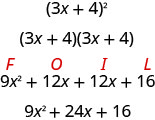
The first term is the square of the first term of the binomial and the last term is the square of the last. The middle term is twice the product of the two terms of the binomial.
英語のヒント
最初の項は二項式の最初の項の2乗で、最後の項は最後の項の2乗である。真ん中の項は、二項式の2つの項の積を2倍したものである。
The trinomial 9x2 + 24 +16 is called a perfect square trinomial. It is the square of the binomial 3x+4.
英語のヒント
三項式9x2 + 24 + 16は、完全平方式の三項式と呼ばれる。これは二項式3x + 4の2乗である。
We’ll repeat the Binomial Squares Pattern here to use as a reference in factoring.
英語のヒント
因数分解の際に参照できるよう、二項式の平方の公式をもう一度示す。
When you square a binomial, the product is a perfect square trinomial. In this chapter, you are learning to factor—now, you will start with a perfect square trinomial and factor it into its prime factors.
英語のヒント
二項式を2乗すると、積は完全平方式の三項式になる。この章では因数分解を学んでいる。今度は完全平方式の三項式から始め、既約な因数に分解する。
You could factor this trinomial using the methods described in the last section, since it is of the form ax2 + bx + c. But if you recognize that the first and last terms are squares and the trinomial fits the perfect square trinomials pattern, you will save yourself a lot of work.
英語のヒント
この三項式はax2 + bx + cの形なので、前の節で説明した方法でも因数分解できる。だが、最初と最後の項が平方で、完全平方式の三項式の形に当てはまると気付けば、多くの手間を省ける。
Here is the pattern—the reverse of the binomial squares pattern.
英語のヒント
その公式を示そう。二項式の平方の公式を逆向きにしたものである。
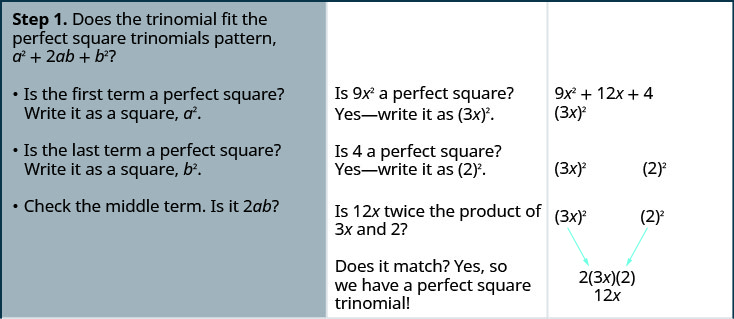
To make use of this pattern, you have to recognize that a given trinomial fits it. Check first to see if the leading coefficient is a perfect square, . Next check that the last term is a perfect square, . Then check the middle term—is it twice the product, 2ab? If everything checks, you can easily write the factors.
英語のヒント
この公式を使うには、与えられた三項式がこの形に当てはまることを見抜く必要がある。まず最高次の係数が完全平方かどうかを確認する。次に、最後の項が完全平方かどうかを確認する。そして真ん中の項を確認する。それは積の2倍、2abだろうか。すべてが当てはまれば、因数は簡単に書ける。
Example 7.42例題 7.42
How to Factor Perfect Square Trinomials完全平方式の三項式を因数分解する方法
Factor: .
英語のヒント
因数分解せよ:。
Solution解答


Try It (2)確認問題(2題)
The sign of the middle term determines which pattern we will use. When the middle term is negative, we use the pattern , which factors to .
英語のヒント
どちらの公式を使うかは、真ん中の項の符号で決まる。真ん中の項が負のときはの形を使い、に因数分解する。
The steps are summarized here.
英語のヒント
手順をここにまとめる。
We’ll work one now where the middle term is negative.
英語のヒント
今度は、真ん中の項が負の例に取り組もう。
Example 7.43例題 7.43
Factor: .
英語のヒント
因数分解せよ:。
Solution解答
The first and last terms are squares. See if the middle term fits the pattern of a perfect square trinomial. The middle term is negative, so the binomial square would be .
英語のヒント
最初と最後の項は平方である。真ん中の項が完全平方式の三項式の形に当てはまるかを調べる。真ん中の項が負なので、二項式の平方はになるはずである。
 |
|
Are the first and last terms perfect squares? 最初と最後の項は完全平方か。 |
 |
Check the middle term. 真ん中の項を確認する。 |
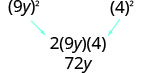 |
Does is match ? Yes. の形に当てはまるか。当てはまる。 |
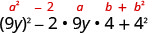 |
Write the square of a binomial. 二項式の2乗を書く。 |
 |
Check by mulitplying. 掛け算して確認する。 |
|
Try It (2)確認問題(2題)
The next example will be a perfect square trinomial with two variables.
英語のヒント
次の例は、2つの変数を持つ完全平方式の三項式である。
Example 7.44例題 7.44
Factor: .
英語のヒント
因数分解せよ:。
Solution解答
 |
|
Test each term to verify the pattern. 各項を調べ、公式の形に当てはまることを確かめる。 |
 |
Factor. 因数分解する。 |
 |
Check by mulitplying. 掛け算して確認する。 |
|
Try It (2)確認問題(2題)
Example 7.45例題 7.45
Factor: .
英語のヒント
因数分解せよ:。
Solution解答
Are the first and last terms perfect squares? 最初と最後の項は完全平方か。 |
|
Check the middle term—is it 真ん中の項を確認する。 |
|
No! 違う。 |
This does not fit the pattern! この式は公式の形に当てはまらない。 |
Factor using the “ac” method. ac法を使って因数分解する。 |
|
Split the middle term. Factor by grouping. 真ん中の項を分ける。項をグループに分けて因数分解する。 |
|
Check. 確認する。 |
Try It (2)確認問題(2題)
Remember the very first step in our Strategy for Factoring Polynomials? It was to ask “is there a greatest common factor?” and, if there was, you factor the GCF before going any further. Perfect square trinomials may have a GCF in all three terms and it should be factored out first. And, sometimes, once the GCF has been factored, you will recognize a perfect square trinomial.
英語のヒント
多項式の因数分解の方針で、いちばん最初の手順を覚えているだろうか。「最大公約因子はあるか」と問い、あれば先へ進む前にくくり出すことだった。完全平方式の三項式でも、3つの項すべてに最大公約因子がある場合は、最初にくくり出す。そして、最大公約因子をくくり出して初めて、完全平方式の三項式だと気付くこともある。
Example 7.46例題 7.46
Factor: .
英語のヒント
因数分解せよ:。
Solution解答
Is there a GCF? Yes, 4y, so factor it out. 最大公約因子はあるか。ある。4yなので、これをくくり出す。 |
|
Is this a perfect square trinomial? これは完全平方式の三項式か。 |
|
Verify the pattern. 公式の形に当てはまることを確かめる。 |
 |
Factor. 因数分解する。 |
|
Remember: Keep the factor 4y in the final product. 最後の積にも因子4yを残すことを忘れない。 |
|
Check. 確かめる。 |
|