第1章単位と測定
1.2 Units and Standards1.2 単位と標準
Learning Objectives学習目標
Learning Objectives学習目標
By the end of this section, you will be able to:
英語のヒント
この節を学び終えると、次のことができるようになる。
- Describe how SI base units are defined.
英語のヒント
SI基本単位の定義の仕方を説明する。 - Describe how derived units are created from base units.
英語のヒント
基本単位から組立単位を作る方法を説明する。 - Express quantities given in SI units using metric prefixes.
英語のヒント
SI単位で与えられた量を、接頭語を使って表す。
As we saw previously, the range of objects and phenomena studied in physics is immense. From the incredibly short lifetime of a nucleus to the age of Earth, from the tiny sizes of subnuclear particles to the vast distance to the edges of the known universe, from the force exerted by a jumping flea to the force between Earth and the Sun, there are enough factors of 10 to challenge the imagination of even the most experienced scientist. Giving numerical values for physical quantities and equations for physical principles allows us to understand nature much more deeply than qualitative descriptions alone. To comprehend these vast ranges, we must also have accepted units in which to express them. We shall find that even in the potentially mundane discussion of meters, kilograms, and seconds, a profound simplicity of nature appears: all physical quantities can be expressed as combinations of only seven base physical units.
英語のヒント
前に見たように、物理学が研究する物体と現象の範囲は非常に広い。原子核の信じがたいほど短い寿命から地球の年齢まで、原子核より小さな粒子の微小な大きさから既知の宇宙の端までの膨大な距離まで、跳ぶノミが及ぼす力から地球と太陽の間の力まで、その違いを表す10の累乗は、最も経験豊かな科学者の想像力をも試すほどである。物理量に数値を与え、物理原理を方程式で表すと、定性的な説明だけの場合より、自然をはるかに深く理解できる。この広大な範囲を理解するには、それらを表すために認められた単位も必要である。メートル、キログラム、秒についての、平凡に思えるかもしれない議論の中にさえ、自然の奥深い単純さが現れることが分かるだろう。あらゆる物理量は、わずか七つの基本的な物理単位の組合せで表せるのである。
We define a physical quantity either by specifying how it is measured or by stating how it is calculated from other measurements. For example, we might define distance and time by specifying methods for measuring them, such as using a meter stick and a stopwatch. Then, we could define average speed by stating that it is calculated as the total distance traveled divided by time of travel.
英語のヒント
物理量は、それをどのように測るかを指定するか、ほかの測定値からどのように計算するかを述べるかの、いずれかによって定義する。例えば、距離と時間は、1 mの物差しやストップウォッチを使うといった測定方法を指定して定義できる。そのうえで平均の速さは、移動した総距離を移動時間で割って計算するものとして定義できる。
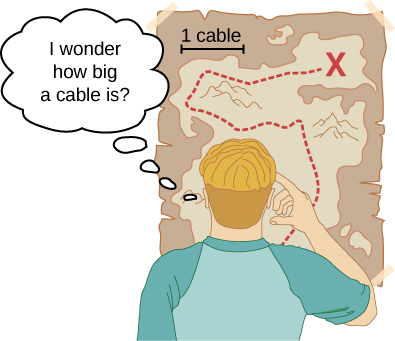
Measurements of physical quantities are expressed in terms of units, which are standardized values. For example, the length of a race, which is a physical quantity, can be expressed in units of meters (for sprinters) or kilometers (for distance runners). Without standardized units, it would be extremely difficult for scientists to express and compare measured values in a meaningful way (Figure 1.7).
英語のヒント
物理量の測定値は、標準化された値である単位を用いて表す。例えば、競走の距離は物理量であり、短距離走ではメートル、長距離走ではキロメートルという単位で表せる。標準化された単位がなければ、科学者が測定値を意味のある形で表現し、比較することは極めて難しいだろう(図1.7)。
OpenStax / Rice University, University Physics Volume 1, CC BY 4.0. Source-book artwork retained. · CC BY 4.0 · Source出典

Figure 1.7図 1.7
Distances given in unknown units are maddeningly useless.
英語のヒント
知らない単位で示された距離は、腹立たしいほど役に立たない。
Two major systems of units are used in the world: SI units (for the French Système International d’Unités), also known as the metric system, and English units (also known as the customary or imperial system). English units were historically used in nations once ruled by the British Empire and are still widely used in the United States. English units may also be referred to as the foot–pound–second (fps) system, as opposed to the centimeter–gram–second (cgs) system. You may also encounter the term SAE units, named after the Society of Automotive Engineers. Products such as fasteners and automotive tools (for example, wrenches) that are measured in inches rather than metric units are referred to as SAE fasteners or SAE wrenches.
英語のヒント
世界では二つの主要な単位系が使われている。メートル法とも呼ばれるSI単位系(フランス語Système International d’Unitésの略)と、慣用単位系または帝国単位系とも呼ばれる英米単位系である。英米単位は、かつて大英帝国の統治下にあった国々で歴史的に用いられ、現在も米国で広く使われている。英米単位系は、センチメートル・グラム・秒(cgs)単位系に対して、フィート・ポンド・秒(fps)単位系と呼ばれることもある。また、米国自動車技術会(Society of Automotive Engineers)に由来する、SAE単位という語に出会うこともある。締結部品や自動車用工具、例えばレンチなどのうち、メートル法の単位ではなくインチで寸法を測る製品は、SAE締結部品やSAEレンチと呼ばれる。
Virtually every other country in the world (except the United States) now uses SI units as the standard. The metric system is also the standard system agreed on by scientists and mathematicians.
英語のヒント
現在、米国以外の世界のほぼすべての国が、SI単位を標準として使っている。メートル法は、科学者や数学者が使用することで合意している標準の単位系でもある。
SI Units: Base and Derived UnitsSI単位:基本単位と組立単位
In any system of units, the units for some physical quantities must be defined through a measurement process. These are called the base quantities for that system and their units are the system’s base units. All other physical quantities can then be expressed as algebraic combinations of the base quantities. Each of these physical quantities is then known as a derived quantity and each unit is called a derived unit. The choice of base quantities is somewhat arbitrary, as long as they are independent of each other and all other quantities can be derived from them. Typically, the goal is to choose physical quantities that can be measured accurately to a high precision as the base quantities. The reason for this is simple. Since the derived units can be expressed as algebraic combinations of the base units, they can only be as accurate and precise as the base units from which they are derived.
英語のヒント
どんな単位系でも、いくつかの物理量の単位は、測定の過程を通じて定義しなければならない。これらの物理量を、その単位系の基本量といい、その単位を基本単位という。すると、ほかのすべての物理量は、基本量の代数的な組合せで表せる。こうした物理量のそれぞれを組立量、その単位を組立単位という。基本量の選び方には、ある程度の任意性がある。互いに独立であり、ほかのすべての量をそれらから導ければよい。通常は、高い正確さと精密さで測定できる物理量を、基本量として選ぶことを目指す。理由は単純である。組立単位は基本単位の代数的な組合せで表せるため、その正確さと精密さは、もとになる基本単位の正確さと精密さを超えることができないからである。
Based on such considerations, the International Standards Organization recommends using seven base quantities, which form the International System of Quantities (ISQ). These are the base quantities used to define the SI base units. Table 1.1 lists these seven ISQ base quantities and the corresponding SI base units.
英語のヒント
このような考慮に基づき、国際標準化機構は、国際量体系(ISQ)を構成する七つの基本量を用いることを推奨している。これらが、SI基本単位を定義するために使う基本量である。表1.1に、七つのISQ基本量と、それぞれに対応するSI基本単位を示す。
ISQ Base Quantity ISQ基本量 |
SI Base Unit SI基本単位 |
|---|---|
Length 長さ |
meter (m) メートル(m) |
Mass 質量 |
kilogram (kg) キログラム(kg) |
Time 時間 |
second (s) 秒(s) |
Electrical current 電流 |
ampere (A) アンペア(A) |
Thermodynamic temperature 熱力学温度 |
kelvin (K) ケルビン(K) |
Amount of substance 物質量 |
mole (mol) モル(mol) |
Luminous intensity 光度 |
candela (cd) カンデラ(cd) |
You are probably already familiar with some derived quantities that can be formed from the base quantities in Table 1.1. For example, the geometric concept of area is always calculated as the product of two lengths. Thus, area is a derived quantity that can be expressed in terms of SI base units using square meters Similarly, volume is a derived quantity that can be expressed in cubic meters Speed is length per time; so in terms of SI base units, we could measure it in meters per second (m/s). Volume mass density (or just density) is mass per volume, which is expressed in terms of SI base units such as kilograms per cubic meter (kg/m3). Angles can also be thought of as derived quantities because they can be defined as the ratio of the arc length subtended by two radii of a circle to the radius of the circle. This is how the radian is defined. Depending on your background and interests, you may be able to come up with other derived quantities, such as the mass flow rate (kg/s) or volume flow rate (m3/s) of a fluid, electric charge mass flux density and so on. We will see many more examples throughout this text. For now, the point is that every physical quantity can be derived from the seven base quantities in Table 1.1, and the units of every physical quantity can be derived from the seven SI base units.
英語のヒント
表1.1の基本量から作れる組立量のいくつかは、すでによく知っているだろう。例えば、幾何学の概念である面積は、常に二つの長さの積として計算する。したがって面積は組立量であり、SI基本単位では平方メートルを使って表せる。同様に、体積は立方メートルで表せる組立量である。速さは時間あたりの長さなので、SI基本単位ではメートル毎秒(m/s)で測れる。体積質量密度、あるいは単に密度は、体積あたりの質量であり、SI基本単位ではキログラム毎立方メートル(kg/m3)などで表す。角度も組立量と考えられる。円の二つの半径が挟む弧の長さと、その円の半径との比として定義できるからである。ラジアンはこのように定義する。背景知識や関心に応じて、流体の質量流量(kg/s)や体積流量(m3/s)、電荷、質量流束密度など、ほかの組立量も思いつくだろう。この教科書では、さらに多くの例を見る。今の段階で重要なのは、すべての物理量は表1.1の七つの基本量から導け、すべての物理量の単位は七つのSI基本単位から導けるという点である。
For the most part, we use SI units in this text. Non-SI units are used in a few applications in which they are in very common use, such as the measurement of temperature in degrees Celsius the measurement of fluid volume in liters (L), and the measurement of energies of elementary particles in electron-volts (eV). Whenever non-SI units are discussed, they are tied to SI units through conversions. For example, 1 L is
英語のヒント
この教科書では、主としてSI単位を使う。非SI単位は、摂氏度による温度の測定、リットル(L)による流体の体積の測定、電子ボルト(eV)による素粒子のエネルギーの測定など、極めて一般的に使われているいくつかの用途で用いる。非SI単位を取り上げるときは、必ず換算によってSI単位と結びつける。例えば、1 Lはである。