第1章単位と測定
The Scale of Physics物理学が扱う尺度
From the discussion so far, it should be clear that to accomplish your goals in any of the various fields within the natural sciences and engineering, a thorough grounding in the laws of physics is necessary. The reason for this is simply that the laws of physics govern everything in the observable universe at all measurable scales of length, mass, and time. Now, that is easy enough to say, but to come to grips with what it really means, we need to get a little bit quantitative. So, before surveying the various scales that physics allows us to explore, let’s first look at the concept of “order of magnitude,” which we use to come to terms with the vast ranges of length, mass, and time that we consider in this text (Figure 1.3).
英語のヒント
ここまでの議論から、自然科学や工学のさまざまな分野で目標を達成するには、物理法則の確かな基礎知識が必要だと分かるはずである。その理由は単純で、物理法則が、観測可能な宇宙のあらゆるものを、長さ・質量・時間の測定可能なすべての尺度において支配しているからである。こう言うことは簡単だが、その意味を本当に理解するには、少し定量的に考える必要がある。そこで、物理学によって探究できるさまざまな尺度を概観する前に、まず「桁の大きさ」という概念を見てみよう。この教科書で扱う長さ・質量・時間の広大な範囲を理解するために使う概念である(図1.3)。
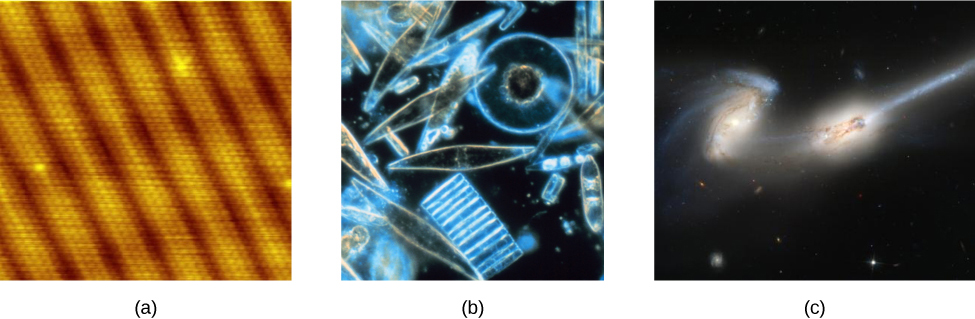
(a) Erwin Rossen, Atomic resolution Au100, public domain. (b) Prof. Gordon T. Taylor, Stony Brook University; NOAA Corps Collections, public domain. (c) NASA, H. Ford (JHU), G. Illingworth (UCSC/LO), M. Clampin (STScI), G. Hartig (STScI), the ACS Science Team, and ESA, CC BY 4.0. Modified in OpenStax University Physics Volume 1. · CC BY 4.0 composition; public-domain components · Source出典

Figure 1.3図 1.3
(a) Using a scanning tunneling microscope, scientists can see the individual atoms (diameters around 10–10 m) that compose this sheet of gold. (b) Tiny phytoplankton swim among crystals of ice in the Antarctic Sea. They range from a few micrometers (1 μm is 10–6 m) to as much as 2 mm (1 mm is 10–3 m) in length. (c) These two colliding galaxies, known as NGC 4676A (right) and NGC 4676B (left), are nicknamed “The Mice” because of the tail of gas emanating from each one. They are located 300 million light-years from Earth in the constellation Coma Berenices. Eventually, these two galaxies will merge into one. (credit a: modification of work by "Erwinrossen"/Wikimedia Commons; credit b: modification of work by Prof. Gordon T. Taylor, Stony Brook University; NOAA Corps Collections; credit c: modification of work by NASA, H. Ford (JHU), G. Illingworth (UCSC/LO), M. Clampin (STScI), G. Hartig (STScI), the ACS Science Team, and ESA)
英語のヒント
(a) 走査型トンネル顕微鏡を使うと、この金の薄膜を構成する個々の原子(直径はおよそ10–10 m)を見ることができる。(b) 南極海では、小さな植物プランクトンが氷の結晶の間を泳いでいる。その長さは数マイクロメートル(1 μmは10–6 m)から、最大で2 mm(1 mmは10–3 m)に及ぶ。(c) 衝突しているこの二つの銀河は、NGC 4676A(右)とNGC 4676B(左)として知られ、それぞれから伸びるガスの尾にちなんで「ねずみ銀河」と呼ばれている。地球から3億光年離れた、かみのけ座に位置する。やがて、この二つの銀河は一つに合体する。(出典a:「Erwinrossen」/Wikimedia Commonsの作品を改変。出典b:Prof. Gordon T. Taylor, Stony Brook University、NOAA Corps Collectionsの作品を改変。出典c:NASA、H. Ford(JHU)、G. Illingworth(UCSC/LO)、M. Clampin(STScI)、G. Hartig(STScI)、ACS Science Team、ESAの作品を改変)
Order of magnitude桁の大きさ
The order of magnitude of a number is the power of 10 that most closely approximates it. Thus, the order of magnitude refers to the scale (or size) of a value. Each power of 10 represents a different order of magnitude. For example, and so forth, are all different orders of magnitude, as are and To find the order of magnitude of a number, take the base-10 logarithm of the number and round it to the nearest integer, then the order of magnitude of the number is simply the resulting power of 10. For example, the order of magnitude of 800 is 103 because which rounds to 3. Similarly, the order of magnitude of 450 is 103 because which rounds to 3 as well. Thus, we say the numbers 800 and 450 are of the same order of magnitude: 103. However, the order of magnitude of 250 is 102 because which rounds to 2.
英語のヒント
数の桁の大きさとは、その数に最も近い10の累乗である。したがって、桁の大きさは値の尺度、すなわち大きさを表す。10の累乗が異なれば、桁の大きさも異なる。例えば、などはすべて桁の大きさが異なり、とについても同様である。ある数の桁の大きさを求めるには、その数の常用対数をとり、最も近い整数に丸める。その整数を指数とする10の累乗が、その数の桁の大きさになる。例えば、800の桁の大きさは103である。を最も近い整数に丸めると3になるからである。同様に、450の桁の大きさは103である。も丸めると3になるからである。したがって、800と450は同じ桁の大きさ103を持つという。一方、250の桁の大きさは102である。を丸めると2になるからである。
An equivalent but quicker way to find the order of magnitude of a number is first to write it in scientific notation and then check to see whether the first factor is greater than or less than The idea is that is halfway between and on a log base-10 scale. Thus, if the first factor is less than then we round it down to 1 and the order of magnitude is simply whatever power of 10 is required to write the number in scientific notation. On the other hand, if the first factor is greater than then we round it up to 10 and the order of magnitude is one power of 10 higher than the power needed to write the number in scientific notation. For example, the number 800 can be written in scientific notation as Because 8 is bigger than we say the order of magnitude of 800 is The number 450 can be written as so its order of magnitude is also 103 because 4.5 is greater than 3. However, 250 written in scientific notation is and 2.5 is less than 3, so its order of magnitude is
英語のヒント
数の桁の大きさを求める、これと同等でより速い方法は、まず科学的記数法で表し、最初の因数がより大きいか小さいかを調べることである。考え方は、底が10の対数目盛上では、がとの中間にあるということである。したがって、最初の因数がより小さければ、それを1へ切り下げる。このとき桁の大きさは、その数を科学的記数法で表すのに必要な10の累乗そのものである。一方、最初の因数がより大きければ、それを10へ切り上げる。このとき桁の大きさは、その数を科学的記数法で表すのに必要な10の累乗より、指数が一つ大きくなる。例えば、800は科学的記数法でと書ける。8はより大きいため、800の桁の大きさはである。450はと書け、4.5は3より大きいため、その桁の大きさも103である。しかし、250を科学的記数法で表すとであり、2.5は3より小さいため、その桁の大きさはである。
The order of magnitude of a number is designed to be a ballpark estimate for the scale (or size) of its value. It is simply a way of rounding numbers consistently to the nearest (on a logarithmic scale) power of 10. In other words, if numbers differ by one order of magnitude, the one is larger than the other by a multiplicative factor of about ten. This makes doing rough mental math with very big and very small numbers easier. For example, the diameter of a hydrogen atom is on the order of 10−10 m, whereas the diameter of the Sun is on the order of 109 m, so it would take roughly hydrogen atoms to stretch across the diameter of the Sun. This is much easier to do in your head than using the more precise values of for a hydrogen atom diameter and for the Sun’s diameter, to find that it would take hydrogen atoms to stretch across the Sun’s diameter. In addition to being easier, the rough estimate is also nearly as informative as the precise calculation.
英語のヒント
数の桁の大きさは、その値の尺度、すなわち大きさの概算を与えるためのものである。対数目盛上で最も近い10の累乗へ、一貫した方法で数を丸めるやり方にすぎない。言い換えれば、桁の大きさが一つ異なる二つの数では、一方が他方のおよそ10倍である。これによって、非常に大きな数や非常に小さな数の大まかな暗算がしやすくなる。例えば、水素原子の直径は10−10 mの桁であり、太陽の直径は109 mの桁である。そのため、太陽の直径の端から端まで水素原子を並べるには、およそ個必要になる。これは、水素原子の直径と太陽の直径という、より正確な値を用いて、太陽の直径を横切るには水素原子が個必要だと求めるより、はるかに暗算しやすい。大まかな見積もりは簡単なだけでなく、正確な計算とほぼ同程度に有益な情報も与える。