第1章単位と測定
Units of Time, Length, and Mass: The Second, Meter, and Kilogram時間・長さ・質量の単位:秒・メートル・キログラム
The initial chapters in this textbook are concerned with mechanics, fluids, and waves. In these subjects all pertinent physical quantities can be expressed in terms of the base units of length, mass, and time. Therefore, we now turn to a discussion of these three base units, leaving discussion of the others until they are needed later.
英語のヒント
この教科書の最初の数章では、力学、流体、波を扱う。これらの分野では、関係するすべての物理量を、長さ・質量・時間の基本単位で表せる。そこで、これからこの三つの基本単位について論じ、残りの単位については、後で必要になったときに取り上げる。
The second秒
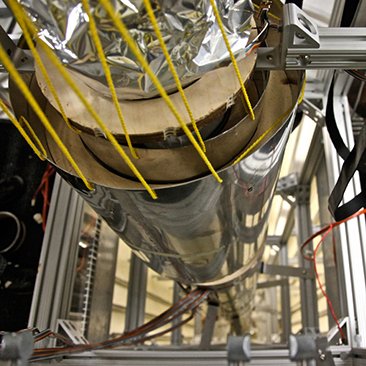
The SI unit for time, the second (abbreviated s), has a long history. For many years it was defined as 1/86,400 of a mean solar day. More recently, a new standard was adopted to gain greater accuracy and to define the second in terms of a nonvarying or constant physical phenomenon (because the solar day is getting longer as a result of the very gradual slowing of Earth’s rotation). Cesium atoms can be made to vibrate in a very steady way, and these vibrations can be readily observed and counted. In 1967, the second was redefined as the time required for 9,192,631,770 of these vibrations to occur (Figure 1.8). Note that this may seem like more precision than you would ever need, but it isn’t—GPSs rely on the precision of atomic clocks to be able to give you turn-by-turn directions on the surface of Earth, far from the satellites broadcasting their location.
英語のヒント
時間のSI単位である秒(記号s)には、長い歴史がある。長年にわたり、秒は平均太陽日の86,400分の1と定義されていた。より最近になって、正確さを高め、変化しない一定の物理現象によって秒を定義するため、新しい標準が採用された。地球の自転が非常にゆっくりと減速しているため、太陽日は長くなっているからである。セシウム原子は、非常に安定した振動をするようにでき、その振動は容易に観測して数えられる。1967年に、秒は、この振動が9,192,631,770回起こるのに必要な時間として再定義された(図1.8)。これは、今後どんなときにも必要になりそうにないほどの精密さに思えるかもしれないが、そうではない。GPSは、位置を放送する衛星からはるかに離れた地表で、曲がる場所を一つずつ案内できるよう、原子時計の精密さに依存している。
Steve Jurvetson, Atomic Fountain. Modified in OpenStax University Physics Volume 1. CC BY 2.0. · CC BY 2.0 · Source出典

Figure 1.8図 1.8
An atomic clock such as this one uses the vibrations of cesium atoms to keep time to a precision of better than a microsecond per year. The fundamental unit of time, the second, is based on such clocks. This image looks down from the top of an atomic fountain nearly 30 feet tall. (credit: Steve Jurvetson)
英語のヒント
このような原子時計は、セシウム原子の振動を利用し、1年あたり1マイクロ秒より小さい誤差で時を刻む。時間の基本単位である秒は、このような時計に基づいている。この画像は、高さ約30フィートの原子泉の上部から見下ろしたものである。(出典:Steve Jurvetson)
The meterメートル
The SI unit for length is the meter (abbreviated m); its definition has also changed over time to become more precise. The meter was first defined in 1791 as 1/10,000,000 of the distance from the equator to the North Pole. This measurement was improved in 1889 by redefining the meter to be the distance between two engraved lines on a platinum–iridium bar now kept near Paris. By 1960, it had become possible to define the meter even more accurately in terms of the wavelength of light, so it was again redefined as 1,650,763.73 wavelengths of orange light emitted by krypton atoms. In 1983, the meter was given its current definition (in part for greater accuracy) as the distance light travels in a vacuum in 1/299,792,458 of a second (Figure 1.9). This change came after knowing the speed of light to be exactly 299,792,458 m/s.
英語のヒント
長さのSI単位はメートル(記号m)である。その定義も、精密さを増すために時代とともに変わってきた。1791年、メートルは最初、赤道から北極までの距離の1,000万分の1と定義された。1889年には、現在パリ近郊に保管されている白金・イリジウム製の棒に刻んだ二本の線の間隔として再定義され、この測定は改善された。1960年までには、光の波長を使ってさらに正確に定義できるようになり、クリプトン原子が放出するオレンジ色の光の波長の1,650,763.73倍として、再び定義し直された。1983年、メートルは、真空中を光が299,792,458分の1秒間に進む距離という現在の定義になった(図1.9)。この変更の理由の一つは、正確さをさらに高めることであった。この変更は、光の速さが正確に299,792,458 m/sであると分かった後に行われた。

OpenStax / Rice University, University Physics Volume 1, CC BY 4.0. Source-book artwork retained. · CC BY 4.0 · Source出典

Figure 1.9図 1.9
The meter is defined to be the distance light travels in 1/299,792,458 of a second in a vacuum. Distance traveled is speed multiplied by time.
英語のヒント
メートルは、光が真空中を299,792,458分の1秒間に進む距離と定義される。移動距離は、速さに時間を掛けたものである。
The kilogramキログラム
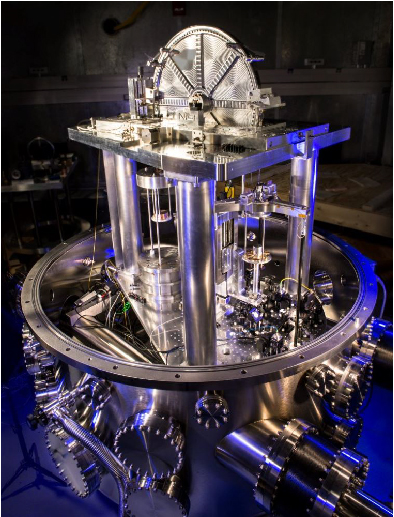
The SI unit for mass is the kilogram (abbreviated kg); From 1795–2018 it was defined to be the mass of a platinum–iridium cylinder kept with the old meter standard at the International Bureau of Weights and Measures near Paris. However, this cylinder has lost roughly 50 micrograms since it was created. Because this is the standard, this has shifted how we defined a kilogram. Therefore, a new definition was adopted in May 2019 based on the Planck constant and other constants which will never change in value. We will study Planck’s constant in quantum mechanics, which is an area of physics that describes how the smallest pieces of the universe work. The kilogram is measured on a Kibble balance (see Figure 1.10). When a weight is placed on a Kibble balance, an electrical current is produced that is proportional to Planck’s constant. Since Planck’s constant is defined, the exact current measurements in the balance define the kilogram.
英語のヒント
質量のSI単位はキログラム(記号kg)である。1795年から2018年まで、パリ近郊の国際度量衡局に古いメートル原器とともに保管されている、白金・イリジウム製の円柱の質量と定義されていた。しかし、この円柱の質量は、作られてから約50マイクログラム減少した。これが標準であるため、キログラムの定義の仕方も変動してしまった。そこで2019年5月、プランク定数と、値が決して変わらないほかの定数に基づく新しい定義が採用された。プランク定数は、宇宙の最小の構成要素の働きを記述する物理学の分野である、量子力学で学ぶ。キログラムはキブル天秤で測定する(図1.10)。キブル天秤に重りを載せると、プランク定数に比例する電流が生じる。プランク定数が定義されているので、天秤での正確な電流測定がキログラムを定める。
OpenStax / Rice University, University Physics Volume 1, CC BY 4.0. Source-book artwork retained. · CC BY 4.0 · Source出典

Figure 1.10図 1.10
Redefining the SI unit of mass. The U.S. National Institute of Standards and Technology’s Kibble balance is a machine that balances the weight of a test mass with the resulting electrical current needed for a force to balance it.
英語のヒント
質量のSI単位を再定義する。米国国立標準技術研究所のキブル天秤は、試験用の質量の重さを、それにつり合う力を得るために必要な電流とつり合わせる装置である。
Metric Prefixesメートル法の接頭語
SI units are part of the metric system, which is convenient for scientific and engineering calculations because the units are categorized by factors of 10. Table 1.2 lists the metric prefixes and symbols used to denote various factors of 10 in SI units. For example, a centimeter is one-hundredth of a meter (in symbols, 1 cm = 10–2 m) and a kilometer is a thousand meters (1 km = 103 m). Similarly, a megagram is a million grams (1 Mg = 106 g), a nanosecond is a billionth of a second (1 ns = 10–9 s), and a terameter is a trillion meters (1 Tm = 1012 m).
英語のヒント
SI単位はメートル法の一部であり、単位が10の累乗によって分類されるため、科学や工学の計算に便利である。表1.2に、SI単位で10のさまざまな累乗を表すための接頭語と記号を示す。例えば、センチメートルは1メートルの100分の1(記号では1 cm = 10–2 m)、キロメートルは1000メートル(1 km = 103 m)である。同様に、メガグラムは100万グラム(1 Mg = 106 g)、ナノ秒は1秒の10億分の1(1 ns = 10–9 s)、テラメートルは1兆メートル(1 Tm = 1012 m)である。
Prefix 接頭語 |
Symbol 記号 |
Meaning 意味 |
Prefix 接頭語 |
Symbol 記号 |
Meaning 意味 |
|---|---|---|---|---|---|
yotta- ヨタ |
Y |
1024 |
yocto- ヨクト |
y |
10–24 |
zetta- ゼタ |
Z |
1021 |
zepto- ゼプト |
z |
10–21 |
exa- エクサ |
E |
1018 |
atto- アト |
a |
10–18 |
peta- ペタ |
P |
1015 |
femto- フェムト |
f |
10–15 |
tera- テラ |
T |
1012 |
pico- ピコ |
p |
10–12 |
giga- ギガ |
G |
109 |
nano- ナノ |
n |
10–9 |
mega- メガ |
M |
106 |
micro- マイクロ |
10–6 |
|
kilo- キロ |
k |
103 |
milli- ミリ |
m |
10–3 |
hecto- ヘクト |
h |
102 |
centi- センチ |
c |
10–2 |
deka- デカ |
da |
101 |
deci- デシ |
d |
10–1 |
The only rule when using metric prefixes is that you cannot “double them up.” For example, if you have measurements in petameters (1 Pm = 1015 m), it is not proper to talk about megagigameters, although In practice, the only time this becomes a bit confusing is when discussing masses. As we have seen, the base SI unit of mass is the kilogram (kg), but metric prefixes need to be applied to the gram (g), because we are not allowed to “double-up” prefixes. Thus, a thousand kilograms (103 kg) is written as a megagram (1 Mg) since
英語のヒント
メートル法の接頭語を使うときの唯一の規則は、「二つ重ねてはいけない」ということである。例えば、測定値がペタメートル(1 Pm = 1015 m)で与えられた場合、ではあっても、メガギガメートルと呼ぶのは正しくない。実際にこの点が少し紛らわしくなるのは、質量を扱うときだけである。すでに見たように、質量のSI基本単位はキログラム(kg)だが、接頭語を重ねることは許されないため、メートル法の接頭語はグラム(g)に付けなければならない。したがって、1000キログラム(103 kg)は1メガグラム(1 Mg)と書く。これは次の関係による。
Incidentally, 103 kg is also called a metric ton, abbreviated t. This is one of the units outside the SI system considered acceptable for use with SI units.
英語のヒント
なお、103 kgはメートルトンとも呼び、記号はtである。これは、SI単位と併用してよいと認められている、SIに属さない単位の一つである。
As we see in the next section, metric systems have the advantage that conversions of units involve only powers of 10. There are 100 cm in 1 m, 1000 m in 1 km, and so on. In nonmetric systems, such as the English system of units, the relationships are not as simple—there are 12 in. in 1 ft, 5280 ft in 1 mi, and so on.
英語のヒント
次の節で見るように、メートル法の単位系には、単位換算に10の累乗しか必要ないという利点がある。1 mは100 cm、1 kmは1000 mであり、以下も同様である。英米単位系などの非メートル法単位系では、関係はそれほど単純ではない。1 ftは12 in.、1 miは5280 ftである。
Another advantage of metric systems is that the same unit can be used over extremely large ranges of values simply by scaling it with an appropriate metric prefix. The prefix is chosen by the order of magnitude of physical quantities commonly found in the task at hand. For example, distances in meters are suitable in construction, whereas distances in kilometers are appropriate for air travel, and nanometers are convenient in optical design. With the metric system there is no need to invent new units for particular applications. Instead, we rescale the units with which we are already familiar.
英語のヒント
メートル法のもう一つの利点は、適切な接頭語を付けて尺度を変えるだけで、極めて広い値の範囲に同じ単位を使えることである。接頭語は、目の前の課題でよく扱う物理量の桁の大きさに応じて選ぶ。例えば、建設ではメートルで表す距離が適しているのに対し、空の旅ではキロメートルが適切であり、光学設計ではナノメートルが便利である。メートル法では、特定の用途ごとに新しい単位を発明する必要はない。すでによく知っている単位の尺度を変えればよい。
Example 1.1例題 1.1
Using Metric Prefixesメートル法の接頭語を使う
Restate the mass using a metric prefix such that the resulting numerical value is bigger than one but less than 1000.
英語のヒント
質量を、数値が1より大きく1000より小さくなるように、メートル法の接頭語を使って表し直せ。
Strategy方針
Since we are not allowed to “double-up” prefixes, we first need to restate the mass in grams by replacing the prefix symbol k with a factor of 103 (see Table 1.2). Then, we should see which two prefixes in Table 1.2 are closest to the resulting power of 10 when the number is written in scientific notation. We use whichever of these two prefixes gives us a number between one and 1000.
英語のヒント
Solution解答
Replacing the k in kilogram with a factor of 103, we find that
英語のヒント
キログラムのkを103という因数に置き換えると、次のようになる。
From Table 1.2, we see that 1016 is between “peta-” (1015) and “exa-” (1018). If we use the “peta-” prefix, then we find that since Alternatively, if we use the “exa-” prefix we find that since Because the problem asks for the numerical value between one and 1000, we use the “peta-” prefix and the answer is 19.3 Pg.
英語のヒント
表1.2から、1016は「ペタ」(1015)と「エクサ」(1018)の間にあると分かる。「ペタ」の接頭語を使うと、なのでとなる。一方、「エクサ」の接頭語を使うと、なのでとなる。問題では1と1000の間の数値を求めているため、「ペタ」の接頭語を使い、答えは19.3 Pgである。
Significance意味の検討
It is easy to make silly arithmetic errors when switching from one prefix to another, so it is always a good idea to check that our final answer matches the number we started with. An easy way to do this is to put both numbers in scientific notation and count powers of 10, including the ones hidden in prefixes. If we did not make a mistake, the powers of 10 should match up. In this problem, we started with so we have 13 + 3 = 16 powers of 10. Our final answer in scientific notation is Pg, so we have 1 + 15 = 16 powers of 10. So, everything checks out.
英語のヒント
接頭語を切り替えるときは、単純な計算ミスをしやすい。そのため、最終的な答えが最初の数値と一致するか、いつも確認するとよい。簡単な確認方法は、両方を科学的記数法で表し、接頭語に隠れた分も含め、10の指数を数えることである。誤りがなければ、10の指数は一致するはずである。この問題ではから始めたため、10の指数は13 + 3 = 16である。最終的な答えは科学的記数法で Pgなので、10の指数は1 + 15 = 16である。したがって、すべてつじつまが合っている。
If this mass arose from a calculation, we would also want to check to determine whether a mass this large makes any sense in the context of the problem. For this, Figure 1.4 might be helpful.
英語のヒント
この質量が計算で得られたものなら、問題の状況を考えたとき、これほど大きな質量が理にかなっているかも確認したい。そのためには、図1.4が役立つだろう。