第1章単位と測定
Known ranges of length, mass, and time既知の長さ・質量・時間の範囲
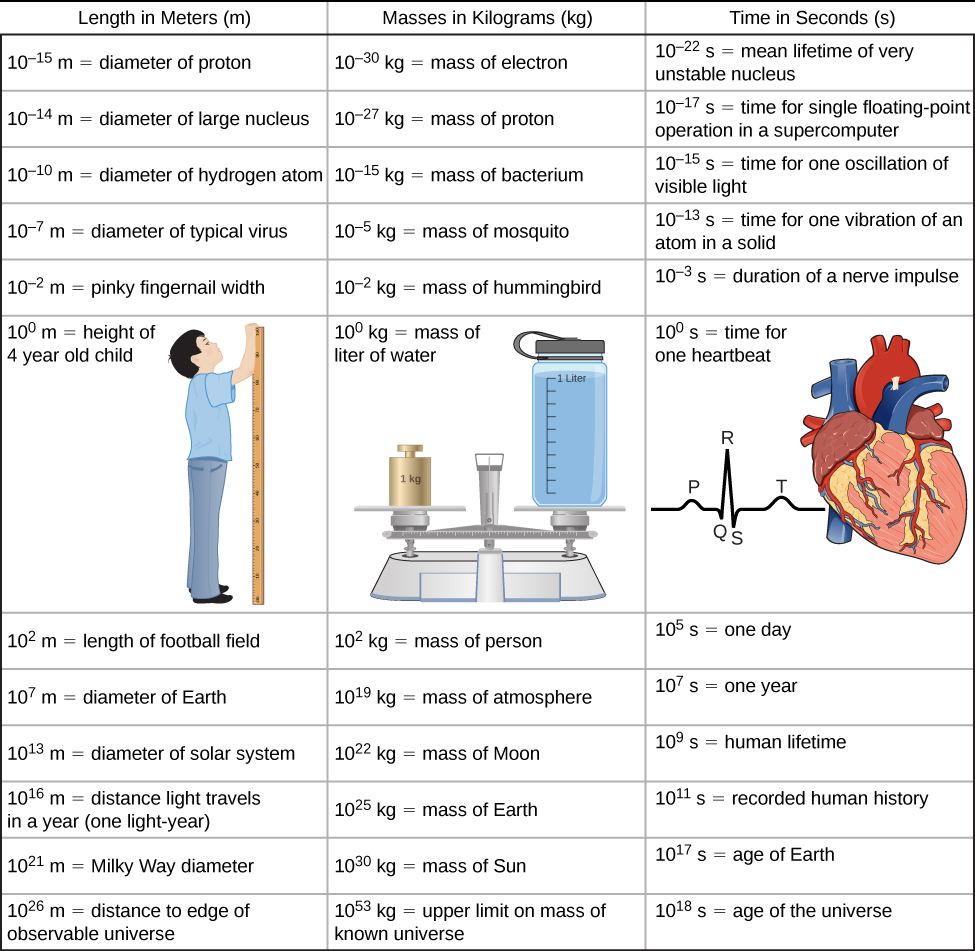
The vastness of the universe and the breadth over which physics applies are illustrated by the wide range of examples of known lengths, masses, and times (given as orders of magnitude) in Figure 1.4. Examining this table will give you a feeling for the range of possible topics in physics and numerical values. A good way to appreciate the vastness of the ranges of values in Figure 1.4 is to try to answer some simple comparative questions, such as the following:
英語のヒント
- How many hydrogen atoms does it take to stretch across the diameter of the Sun?
(Answer: 109 m/10–10 m = 1019 hydrogen atoms)英語のヒント
太陽の直径の端から端まで並べるには、水素原子が何個必要か。(答え:109 m/10–10 m = 水素原子1019個) - How many protons are there in a bacterium?
(Answer: 10–15 kg/10–27 kg = 1012 protons)英語のヒント
細菌一個には、陽子が何個あるか。(答え:10–15 kg/10–27 kg = 陽子1012個) - How many floating-point operations can a supercomputer do in 1 day?
(Answer: 105 s/10–17 s = 1022 floating-point operations)英語のヒント
スーパーコンピューターは1日に何回の浮動小数点演算を行えるか。(答え:105 s/10–17 s = 浮動小数点演算1022回)
In studying Figure 1.4, take some time to come up with similar questions that interest you and then try answering them. Doing this can breathe some life into almost any table of numbers.
英語のヒント
図1.4を調べるときは、時間をかけて、自分が興味を持つ同様の問いを考え、それに答えてみよう。こうすることで、ほとんどどんな数表にも、いくらか生気を与えられる。
OpenStax / Rice University, University Physics Volume 1, CC BY 4.0. Source-book artwork retained. · CC BY 4.0 · Source出典

Figure 1.4図 1.4
This table shows the orders of magnitude of length, mass, and time.
英語のヒント
この表は、長さ・質量・時間の桁の大きさを示す。
Additional Resources追加教材
Building Modelsモデルを作る
How did we come to know the laws governing natural phenomena? What we refer to as the laws of nature are concise descriptions of the universe around us. They are human statements of the underlying laws or rules that all natural processes follow. Such laws are intrinsic to the universe; humans did not create them and cannot change them. We can only discover and understand them. Their discovery is a very human endeavor, with all the elements of mystery, imagination, struggle, triumph, and disappointment inherent in any creative effort (Figure 1.5). The cornerstone of discovering natural laws is observation; scientists must describe the universe as it is, not as we imagine it to be.
英語のヒント
私たちは、自然現象を支配する法則を、どのようにして知るようになったのだろうか。自然法則と呼んでいるものは、周囲の宇宙を簡潔に記述したものである。あらゆる自然の過程が従う、根底の法則や規則を、人間が言葉で表したものである。こうした法則は宇宙に本来備わっている。人間が作ったものではなく、変えることもできない。できるのは、発見して理解することだけである。法則の発見は、とても人間的な営みであり、どんな創造的な活動にも内在する、謎、想像、苦闘、勝利、失望というあらゆる要素を伴う(図1.5)。自然法則を発見するための礎は観察である。科学者は、想像した宇宙の姿ではなく、実際の宇宙の姿を記述しなければならない。
Enrico Fermi portrait: U.S. Department of Energy. Marie Curie portrait: Henri Manuel, circa 1920. Public-domain photographs; composition modified in OpenStax University Physics Volume 1, CC BY 4.0. · Public-domain photographs; OpenStax composition CC BY 4.0 · Source出典

Figure 1.5図 1.5
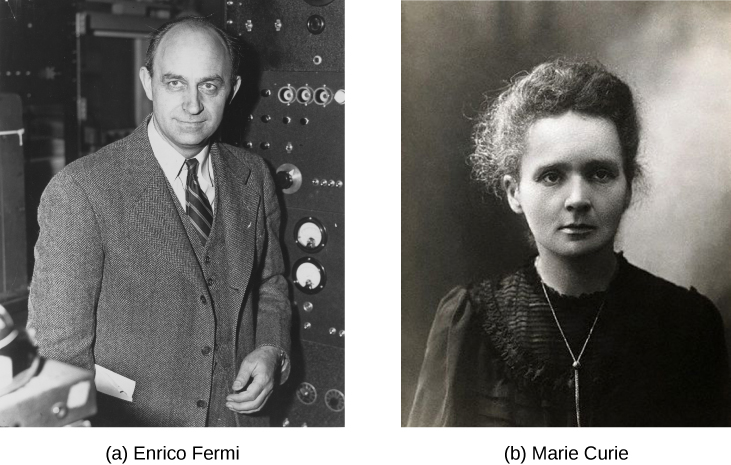
(a) Enrico Fermi (1901–1954) was born in Italy. On accepting the Nobel Prize in Stockholm in 1938 for his work on artificial radioactivity produced by neutrons, he took his family to America rather than return home to the government in power at the time. He became an American citizen and was a leading participant in the Manhattan Project. (b) Marie Curie (1867–1934) sacrificed monetary assets to help finance her early research and damaged her physical well-being with radiation exposure. She is the only person to win Nobel prizes in both physics and chemistry. One of her daughters also won a Nobel Prize. (credit a: modification of work by United States Department of Energy)
英語のヒント
(a) エンリコ・フェルミ(1901〜1954年)はイタリアで生まれた。中性子によって生じる人工放射能に関する研究により、1938年にストックホルムでノーベル賞を受賞すると、当時の政府が権力を握る故国へ戻らず、家族を連れてアメリカへ渡った。彼はアメリカ市民となり、マンハッタン計画の主要な参加者になった。(b) マリー・キュリー(1867〜1934年)は、初期の研究の資金を賄うために財産を投じ、放射線への被曝によって健康を損なった。物理学と化学の両方でノーベル賞を受賞した唯一の人物である。娘の一人もノーベル賞を受賞した。(出典a:米国エネルギー省の作品を改変)
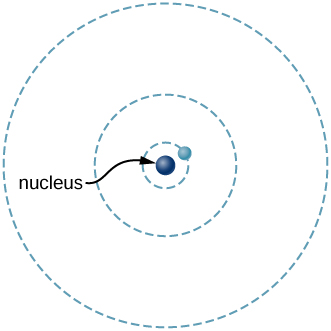
A model is a representation of something that is often too difficult (or impossible) to display directly. Although a model is justified by experimental tests, it is only accurate in describing certain aspects of a physical system. An example is the Bohr model of single-electron atoms, in which the electron is pictured as orbiting the nucleus, analogous to the way planets orbit the Sun (Figure 1.6). We cannot observe electron orbits directly, but the mental image helps explain some of the observations we can make, such as the emission of light from hot gases (atomic spectra). However, other observations show that the picture in the Bohr model is not really what atoms look like. The model is “wrong,” but is still useful for some purposes. Physicists use models for a variety of purposes. For example, models can help physicists analyze a scenario and perform a calculation or models can be used to represent a situation in the form of a computer simulation. Ultimately, however, the results of these calculations and simulations need to be double-checked by other means—namely, observation and experimentation.
英語のヒント
モデルとは、直接示すのが難しい、あるいは不可能なものを表現したものであることが多い。モデルは実験的な検証によって正当化されるが、物理系の特定の側面を記述する場合にしか正確ではない。一例が、一電子原子のボーア模型である。この模型では、惑星が太陽を回るように、電子が原子核の周囲を回る姿を描く(図1.6)。電子の軌道を直接観察することはできないが、この頭の中の像は、高温の気体からの光の放出(原子スペクトル)など、実際に観測できる現象の一部を説明する助けになる。しかし、ほかの観測結果から、ボーア模型の描く像が実際の原子の姿ではないことが分かる。模型は「間違っている」が、特定の目的には今なお役立つ。物理学者はさまざまな目的でモデルを使う。例えば、モデルはある状況を解析して計算する助けになり、ある状況をコンピューターシミュレーションの形で表すためにも使える。ただし最終的には、こうした計算やシミュレーションの結果を、別の手段、すなわち観察と実験によって改めて確かめる必要がある。
OpenStax / Rice University, University Physics Volume 1, CC BY 4.0. Source-book artwork retained. · CC BY 4.0 · Source出典

Figure 1.6図 1.6
What is a model? The Bohr model of a single-electron atom shows the electron orbiting the nucleus in one of several possible circular orbits. Like all models, it captures some, but not all, aspects of the physical system.
英語のヒント
モデルとは何か。一電子原子のボーア模型は、いくつかの可能な円軌道のうち一つを、電子が原子核の周りに回る姿を示す。あらゆるモデルと同じく、この模型も物理系の一部の側面を捉えるが、すべてを捉えるわけではない。
The word theory means something different to scientists than what is often meant when the word is used in everyday conversation. In particular, to a scientist a theory is not the same as a “guess” or an “idea” or even a “hypothesis.” The phrase “it’s just a theory” seems meaningless and silly to scientists because science is founded on the notion of theories. To a scientist, a theory is a testable explanation for patterns in nature supported by scientific evidence and verified multiple times by various groups of researchers. Some theories include models to help visualize phenomena whereas others do not. Newton’s theory of gravity, for example, does not require a model or mental image, because we can observe the objects directly with our own senses. Although models are meant only to describe certain aspects of a physical system accurately, a theory should describe all aspects of any system that falls within its domain of applicability. In particular, any experimentally testable implication of a theory should be verified. If an experiment ever shows an implication of a theory to be false, then the theory is either thrown out or modified suitably (for example, by limiting its domain of applicability).
英語のヒント
科学者にとって、theory(理論)という語は、日常会話でよく用いられるときとは異なる意味を持つ。とりわけ、科学者にとって理論は、「推測」や「思いつき」、さらには「仮説」とも同じではない。「それは単なる理論だ」という言い方は、科学者には無意味でばかげて聞こえる。科学は理論という考え方に基づいているからである。科学者にとって理論とは、科学的証拠によって支えられ、さまざまな研究者の集団によって何度も確かめられた、自然界のパターンに対する検証可能な説明である。現象の視覚化を助けるモデルを含む理論もあれば、含まない理論もある。例えばニュートンの重力理論では、対象を自分の感覚で直接観察できるため、モデルや頭の中の像を必要としない。モデルは、物理系の特定の側面だけを正確に記述することを意図しているが、理論は、その適用領域に入るあらゆる系のすべての側面を記述するものでなければならない。とりわけ、理論から導かれる、実験で検証可能な帰結は、すべて確かめる必要がある。実験によって理論の帰結が一つでも誤りだと分かれば、その理論は棄却されるか、例えば適用領域を制限するなどして、適切に修正される。
A law uses concise language to describe a generalized pattern in nature supported by scientific evidence and repeated experiments. Often, a law can be expressed in the form of a single mathematical equation. Laws and theories are similar in that they are both scientific statements that result from a tested hypothesis and are supported by scientific evidence. However, the designation law is usually reserved for a concise and very general statement that describes phenomena in nature, such as the law that energy is conserved during any process, or Newton’s second law of motion, which relates force (F), mass (m), and acceleration (a) by the simple equation A theory, in contrast, is a less concise statement of observed behavior. For example, the theory of evolution and the theory of relativity cannot be expressed concisely enough to be considered laws. The biggest difference between a law and a theory is that a theory is much more complex and dynamic. A law describes a single action whereas a theory explains an entire group of related phenomena. Less broadly applicable statements are usually called principles (such as Pascal’s principle, which is applicable only in fluids), but the distinction between laws and principles often is not made carefully.
英語のヒント
法則は、科学的証拠と繰り返しの実験に支えられた、自然界の一般化されたパターンを、簡潔な言葉で記述する。法則は、一つの数式で表せることも多い。法則と理論は、検証された仮説から得られ、科学的証拠に支えられた科学的な記述であるという点で共通している。しかし、法則という名称は通常、自然現象を記述する、簡潔で非常に一般的な命題に使われる。例えば、どんな過程でもエネルギーが保存されるという法則や、力(F)・質量(m)・加速度(a)を単純な式で関係づけるニュートンの運動の第二法則である。対照的に、理論は観測された振る舞いについての、より簡潔さに欠ける記述である。例えば、進化論や相対性理論は、法則とみなせるほど簡潔には表せない。法則と理論の最大の違いは、理論のほうがはるかに複雑で、動的だという点である。法則は一つの作用を記述するのに対し、理論は関連する現象の集まり全体を説明する。適用範囲がより狭い命題は、通常、原理と呼ばれる(例えば、流体にしか適用できないパスカルの原理)。ただし、法則と原理は、しばしば厳密には区別されない。
The models, theories, and laws we devise sometimes imply the existence of objects or phenomena that are as yet unobserved. These predictions are remarkable triumphs and tributes to the power of science. It is the underlying order in the universe that enables scientists to make such spectacular predictions. However, if experimentation does not verify our predictions, then the theory or law is wrong, no matter how elegant or convenient it is. Laws can never be known with absolute certainty because it is impossible to perform every imaginable experiment to confirm a law for every possible scenario. Physicists operate under the assumption that all scientific laws and theories are valid until a counterexample is observed. If a good-quality, verifiable experiment contradicts a well-established law or theory, then the law or theory must be modified or overthrown completely.
英語のヒント
私たちが考案するモデル・理論・法則は、ときに、まだ観測されていない物体や現象の存在を示唆する。こうした予測は驚くべき成果であり、科学の力を示す証でもある。科学者にこのような見事な予測を可能にするのは、宇宙の根底にある秩序である。しかし、実験が予測を裏づけなければ、その理論や法則は、どれほど優美でも便利でも誤りである。法則を絶対的に確実なものとして知ることは、決してできない。あらゆる状況において法則を確かめるため、想像可能なすべての実験を行うことは不可能だからである。物理学者は、反例が観測されるまでは、すべての科学法則と理論が有効であるという仮定のもとで研究を進める。質が高く、検証可能な実験が、十分に確立された法則や理論と矛盾するなら、その法則や理論は修正されるか、完全に覆されなければならない。
The study of science in general, and physics in particular, is an adventure much like the exploration of an uncharted ocean. Discoveries are made; models, theories, and laws are formulated; and the beauty of the physical universe is made more sublime for the insights gained.
英語のヒント
科学一般、とりわけ物理学を学ぶことは、海図のない海の探検によく似た冒険である。発見が生まれ、モデル・理論・法則が組み立てられ、得られた洞察によって、物理的な宇宙の美しさはいっそう崇高なものとなる。