第3章直線上の運動
Average Velocity平均速度
To calculate the other physical quantities in kinematics we must introduce the time variable. The time variable allows us not only to state where the object is (its position) during its motion, but also how fast it is moving. How fast an object is moving is given by the rate at which the position changes with time.
英語のヒント
運動学のほかの物理量を計算するには、時間という変数を導入する必要がある。時間という変数によって、運動中の物体がどこにあるか(位置)だけでなく、どれだけ速く動いているかも述べられる。物体がどれだけ速く動くかは、時間とともに位置が変わる割合で与えられる。
For each position , we assign a particular time . If the details of the motion at each instant are not important, the rate is usually expressed as the average velocity . This vector quantity is simply the total displacement between two points divided by the time taken to travel between them. The time taken to travel between two points is called the elapsed time .
英語のヒント
各位置に、特定の時刻を割り当てる。一瞬一瞬の運動の詳細が重要でないなら、位置が変わる割合を通常、平均速度で表す。このベクトル量は、単に二点間の全変位を、その間の移動に要した時間で割ったものである。二点間の移動に要した時間を、経過時間という。
It is important to note that the average velocity is a vector and can be negative, depending on positions and .
英語のヒント
平均速度はベクトルであり、位置とによって負にもなることに注意する必要がある。
Example 3.1例題 3.1
Delivering Flyersチラシの配達
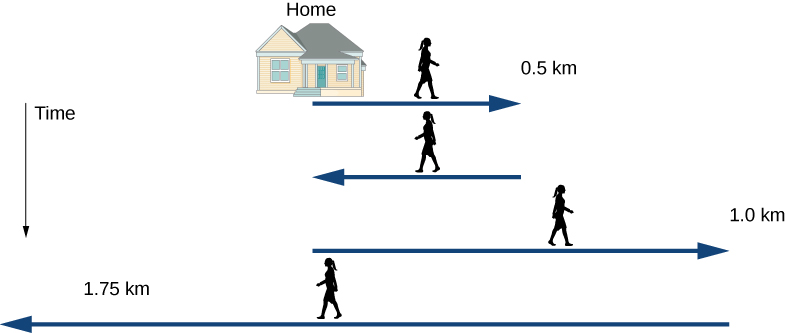
Jill sets out from her home to deliver flyers for her yard sale, traveling due east along her street lined with houses. At km and 9 minutes later she runs out of flyers and has to retrace her steps back to her house to get more. This takes an additional 9 minutes. After picking up more flyers, she sets out again on the same path, continuing where she left off, and ends up 1.0 km from her house. This third leg of her trip takes minutes. At this point she turns back toward her house, heading west. After km and minutes she stops to rest.
英語のヒント
ジルは自宅の庭で開く不用品販売のチラシを配るため、家が並ぶ通りを真東へ進む。9分後、 kmの地点でチラシがなくなり、追加分を取るために同じ道を自宅へ戻る。この帰路にも9分かかる。チラシを補充すると再び同じ道を出発し、配り終えたところから続けて、家から1.0 kmの地点まで来る。この第3区間には分かかる。そこで自宅の方向へ引き返し、西へ進む。 km進んで分たったところで、休むために止まる。
- What is Jill’s total displacement to the point where she stops to rest?
英語のヒント
休憩のために止まった地点までの、ジルの全変位はいくらか。 - What is the magnitude of the total displacement?
英語のヒント
全変位の大きさはいくらか。 - What is the average velocity during her entire trip?
英語のヒント
移動全体での平均速度はいくらか。 - What is the total distance traveled?
英語のヒント
全移動距離はいくらか。 - Make a graph of position versus time.
英語のヒント
位置を時間に対してグラフにせよ。
OpenStax / Rice University, University Physics Volume 1, CC BY 4.0. Source-book artwork retained. · CC BY 4.0 · Source出典

Figure 3.4図 3.4
Timeline of Jill’s movements.
英語のヒント
ジルの移動の時間順の図。
Strategy方針
The problem contains data on the various legs of Jill’s trip, so it would be useful to make a table of the physical quantities. We are given position and time in the wording of the problem so we can calculate the displacements and the elapsed time. We take east to be the positive direction. From this information we can find the total displacement and average velocity. Jill’s home is the starting point . The following table gives Jill’s time and position in the first two columns, and the displacements are calculated in the third column.
英語のヒント
問題にはジルの各移動区間のデータがあるため、物理量を表にすると役立つ。問題文で位置と時刻が与えられているので、変位と経過時間を計算できる。東を正方向とする。この情報から、全変位と平均速度を求められる。ジルの自宅が出発点である。次の表の最初の二列は時刻と位置を示し、第3列で変位を計算する。
Time ti (min) 時刻ti(min) |
Position (km) 位置(km) |
Displacement (km) 変位(km) |
|---|---|---|
Solution解答
- From the above table, the total displacement is
英語のヒント
上の表より、全変位は次のようになる。 - The magnitude of the total displacement is .
英語のヒント
全変位の大きさはである。 - The total distance traveled (sum of magnitudes of individual displacements) is .
英語のヒント
全移動距離(各変位の大きさの和)はである。 - We can graph Jill’s position versus time as a useful aid to see the motion; the graph is shown in Figure 3.5.
英語のヒント
運動を把握する助けとして、ジルの位置を時間に対してグラフにできる。図3.5に示す。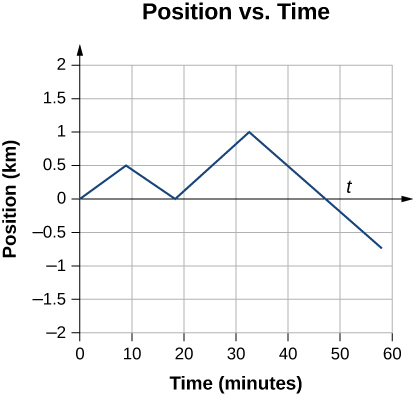
OpenStax / Rice University, University Physics Volume 1, CC BY 4.0. Source-book artwork retained. · CC BY 4.0 · Source出典
Figure 3.5図 3.5This graph depicts Jill’s position versus time. The average velocity is the slope of a line connecting the initial and final points.英語のヒント
ジルの位置と時間の関係を示すグラフ。平均速度は、最初と最後の点を結ぶ直線の傾きである。

Significance意味の検討
Jill’s total displacement is −0.75 km, which means at the end of her trip she ends up due west of her home. The average velocity means if someone was to walk due west at km/min starting at the same time Jill left her home, they both would arrive at the final stopping point at the same time. Note that if Jill were to end her trip at her house, her total displacement would be zero, as well as her average velocity. The total distance traveled during the 58 minutes of elapsed time for her trip is 3.75 km.
英語のヒント
ジルの全変位は−0.75 kmであり、移動の最後に自宅から真西への地点にいることを意味する。平均速度の意味は、ジルが自宅を出るのと同時に誰かが真西へ km/minで歩き始めれば、二人が最後の停止地点へ同時に着くということである。ジルが自宅で移動を終えたなら、全変位も平均速度も0になることに注意しよう。この移動の経過時間58分の間に進んだ全距離は、3.75 kmである。