第3章直線上の運動
3.1 Position, Displacement, and Average Velocity3.1 位置、変位、平均速度
Learning Objectives学習目標
Learning Objectives学習目標
By the end of this section, you will be able to:
英語のヒント
本節を学ぶと、次のことができるようになる。
- Define position, displacement, and distance traveled.
英語のヒント
位置、変位、移動距離を定義する。 - Calculate the total displacement given the position as a function of time.
英語のヒント
位置が時間の関数として与えられたとき、全変位を計算する。 - Determine the total distance traveled.
英語のヒント
全移動距離を求める。 - Calculate the average velocity given the displacement and elapsed time.
英語のヒント
変位と経過時間が与えられたとき、平均速度を計算する。
When you’re in motion, the basic questions to ask are: Where are you? Where are you going? How fast are you getting there? The answers to these questions require that you specify your position, your displacement, and your average velocity—the terms we define in this section.
英語のヒント
運動しているとき、基本となる問いは、「どこにいるか」「どこへ向かっているか」「どれだけの速さでそこへ向かっているか」である。これらに答えるには、位置、変位、平均速度を指定する必要がある。本節では、この用語を定義する。
Position位置
To describe the motion of an object, you must first be able to describe its position (x): where it is at any particular time. More precisely, we need to specify its position relative to a convenient frame of reference. A frame of reference is an arbitrary set of axes from which the position and motion of an object are described. Earth is often used as a frame of reference, and we often describe the position of an object as it relates to stationary objects on Earth. For example, a rocket launch could be described in terms of the position of the rocket with respect to Earth as a whole, whereas a cyclist’s position could be described in terms of where she is in relation to the buildings she passes Figure 3.2. In other cases, we use reference frames that are not stationary but are in motion relative to Earth. To describe the position of a person in an airplane, for example, we use the airplane, not Earth, as the reference frame. To describe the position of an object undergoing one-dimensional motion, we often use the variable x. Later in the chapter, during the discussion of free fall, we use the variable y.
英語のヒント
物体の運動を記述するには、まず位置(x)、すなわち任意の時刻にどこにあるかを記述できなければならない。より正確には、都合のよい基準系に対して位置を指定する必要がある。基準系とは、物体の位置と運動を記述するための、任意に選んだ軸の組である。地球を基準系として使うことは多く、物体の位置を、地球上の静止物との関係で表すことも多い。例えばロケットの打ち上げは、地球全体に対するロケットの位置で記述できる。自転車で走る人の位置は、通り過ぎる建物との関係で記述できる(図3.2)。別の場合には、地球に対して静止せず運動する基準系を使う。例えば、飛行機内の人の位置は、地球ではなく飛行機を基準系として表す。1次元運動をする物体の位置には、しばしば変数xを使う。本章の後半で自由落下を扱うときは、変数yを使う。
Image omitted because its reuse rights could not be verified.権利の確認ができないため画像を割愛。
Figure 3.2図 3.2
These cyclists in Vietnam can be described by their position relative to buildings or a canal. Their motion can be described by their change in position, or displacement, in a frame of reference. (credit: modification of work by Suzan Black)
英語のヒント
ベトナムのこの自転車の乗り手たちは、建物や運河に対する位置で記述できる。運動は、基準系における位置の変化、つまり変位で記述できる。(出典:Suzan Blackによる作品を改変)
Displacement変位
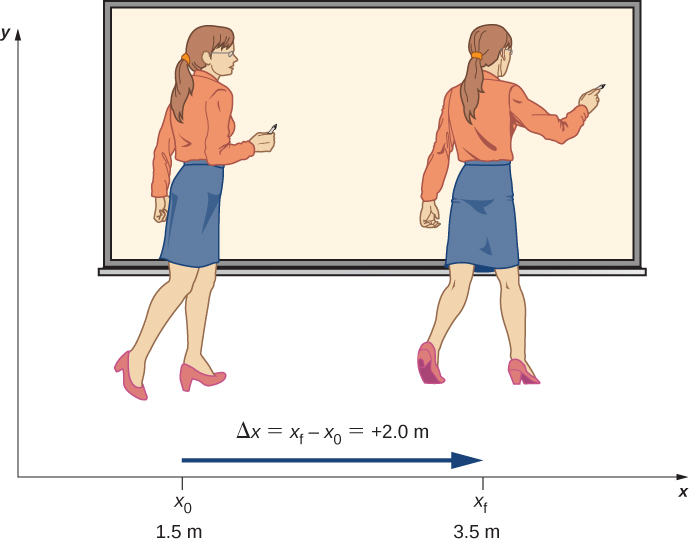
If an object moves relative to a frame of reference—for example, if a professor moves to the right relative to a whiteboard Figure 3.3—then the object’s position changes. This change in position is called displacement. The word displacement implies that an object has moved, or has been displaced. Although position is the numerical value of x along a straight line where an object might be located, displacement gives the change in position along this line. Since displacement indicates direction, it is a vector and can be either positive or negative, depending on the choice of positive direction. Also, an analysis of motion can have many displacements embedded in it. If right is positive and an object moves 2 m to the right, then 4 m to the left, the individual displacements are 2 m and m, respectively.
英語のヒント
物体が基準系に対して動くと、その位置は変化する。例えば、図3.3で教員がホワイトボードに対して右へ動く場合である。この位置の変化を変位という。displacement(変位)という語は、物体が動いた、つまり位置を移されたことを含意する。位置が、物体のありうる直線上のxの数値であるのに対し、変位はその直線に沿う位置の変化を与える。変位は方向を示すためベクトルであり、正方向の選び方によって正にも負にもなる。また、一つの運動の分析には、多くの変位を含められる。右を正とし、物体が右へ2 m、次に左へ4 m動けば、各変位はそれぞれ2 mと mである。
OpenStax / Rice University, University Physics Volume 1, CC BY 4.0. Source-book artwork retained. · CC BY 4.0 · Source出典

Figure 3.3図 3.3
A professor paces left and right while lecturing. Her position relative to Earth is given by x. The +2.0-m displacement of the professor relative to Earth is represented by an arrow pointing to the right.
英語のヒント
教員が講義中、左右に歩き回る。地球に対する位置をxで与える。地球に対する+2.0 mの変位を、右向きの矢印で表す。
We use the uppercase Greek letter delta (Δ) to mean “change in” whatever quantity follows it; thus, means change in position (final position less initial position). We always solve for displacement by subtracting initial position from final position . Note that the SI unit for displacement is the meter, but sometimes we use kilometers or other units of length. Keep in mind that when units other than meters are used in a problem, you may need to convert them to meters to complete the calculation (see Appendix B).
英語のヒント
ギリシャ文字の大文字デルタ(Δ)は、その後ろに続く量の「変化」を表す。したがって、は位置の変化(最後の位置から最初の位置を引いたもの)を意味する。変位を求めるときは、常に最後の位置から最初の位置を引く。変位のSI単位はメートルだが、キロメートルや、ほかの長さの単位を使うこともある。問題でメートル以外の単位が使われている場合、計算を終えるためにメートルへ換算する必要があるかもしれないことを覚えておこう(付録B参照)。
Objects in motion can also have a series of displacements. In the previous example of the pacing professor, the individual displacements are 2 m and m, giving a total displacement of −2 m. We define total displacement , as the sum of the individual displacements, and express this mathematically with the equation
英語のヒント
運動する物体は、一連の変位をすることもある。歩き回る教員の先の例では、各変位は2 mと mで、全変位は−2 mである。全変位を各変位の和と定義し、数式で次のように表す。
where are the individual displacements. In the earlier example,
英語のヒント
ここでは各変位である。先の例では、
Similarly,
英語のヒント
同様に、
Thus,
英語のヒント
したがって、
The total displacement is 2 − 4 = −2 m along the x-axis. It is also useful to calculate the magnitude of the displacement, or its size. The magnitude of the displacement is always positive. This is the absolute value of the displacement, because displacement is a vector and cannot have a negative value of magnitude. In our example, the magnitude of the total displacement is 2 m, whereas the magnitudes of the individual displacements are 2 m and 4 m.
英語のヒント
全変位は、x軸に沿って2 − 4 = −2 mである。変位の大きさを計算することも役立つ。変位の大きさは常に正であり、変位の絶対値である。変位はベクトルで、大きさが負にはならないからだ。この例では、全変位の大きさが2 mなのに対し、各変位の大きさは2 mと4 mである。
The magnitude of the total displacement should not be confused with the distance traveled. Distance traveled , is the total length of the path traveled between two positions. In the previous problem, the distance traveled is the sum of the magnitudes of the individual displacements:
英語のヒント
全変位の大きさと移動距離を混同してはいけない。移動距離は、二つの位置の間を進んだ経路の全長である。前の問題では、移動距離は各変位の大きさの和になる。