第3章直線上の運動
Instantaneous Acceleration瞬間加速度
Instantaneous acceleration a, or acceleration at a specific instant in time, is obtained using the same process discussed for instantaneous velocity. That is, we calculate the average acceleration between two points in time separated by and let approach zero. The result is the derivative of the velocity function v(t), which is instantaneous acceleration and is expressed mathematically as
英語のヒント
瞬間加速度a、すなわち特定の瞬間の加速度は、瞬間速度で述べたのと同じ手順で得られる。つまり、だけ離れた二つの時刻の間の平均加速度を計算し、を0に近づける。その結果は速度関数v(t)の導関数となる。これが瞬間加速度であり、数式では次のように表される。
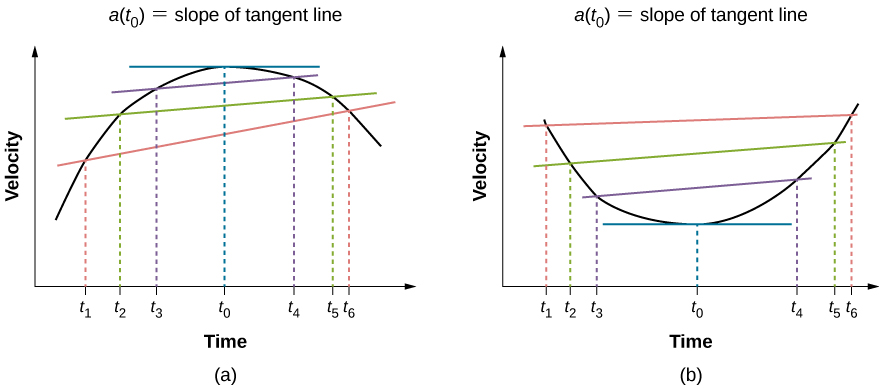
Thus, similar to velocity being the derivative of the position function, instantaneous acceleration is the derivative of the velocity function. We can show this graphically in the same way as instantaneous velocity. In Figure 3.14, instantaneous acceleration at time t0 is the slope of the tangent line to the velocity-versus-time graph at time t0. We see that average acceleration approaches instantaneous acceleration as approaches zero. Also in part (a) of the figure, we see that velocity has a maximum when its slope is zero. This time corresponds to the zero of the acceleration function. In part (b), instantaneous acceleration at the minimum velocity is shown, which is also zero, since the slope of the curve is zero there, too. Thus, for a given velocity function, the zeros of the acceleration function give either the minimum or the maximum velocity.
英語のヒント
このように、速度が位置関数の導関数であるのと同様に、瞬間加速度は速度関数の導関数である。これは瞬間速度と同じようにグラフで示せる。図3.14では、時刻t0での瞬間加速度は、速度と時間のグラフの時刻t0における接線の傾きである。が0に近づくにつれて、平均加速度は瞬間加速度へ近づく。また、図(a)では、傾きが0になるとき速度が最大になる。この時刻は加速度関数が0となる時刻に対応する。(b)には速度が最小となるときの瞬間加速度が示され、ここでも曲線の傾きが0なので、瞬間加速度は0である。したがって、与えられた速度関数に対して、加速度関数が0となる点から速度の最小値または最大値が得られる。
OpenStax / Rice University, University Physics Volume 1, CC BY 4.0. Source-book artwork retained. · CC BY 4.0 · Source出典

Figure 3.14図 3.14
In a graph of velocity versus time, instantaneous acceleration is the slope of the tangent line. (a) Shown is average acceleration between times , and . When , the average acceleration approaches instantaneous acceleration at time t0. In view (a), instantaneous acceleration is shown for the point on the velocity curve at maximum velocity. At this point, instantaneous acceleration is the slope of the tangent line, which is zero. At any other time, the slope of the tangent line—and thus instantaneous acceleration—would not be zero. (b) Same as (a) but shown for instantaneous acceleration at minimum velocity.
英語のヒント
速度と時間のグラフでは、接線の傾きが瞬間加速度である。(a)時間間隔およびに対する平均加速度を示す。のとき、平均加速度は時刻t0での瞬間加速度に近づく。(a)では、速度が最大となる速度曲線上の点での瞬間加速度を示している。この点の瞬間加速度は接線の傾きであり、0である。それ以外の時刻では接線の傾き、したがって瞬間加速度も0にはならない。(b)は(a)と同様だが、速度が最小のときの瞬間加速度を示す。
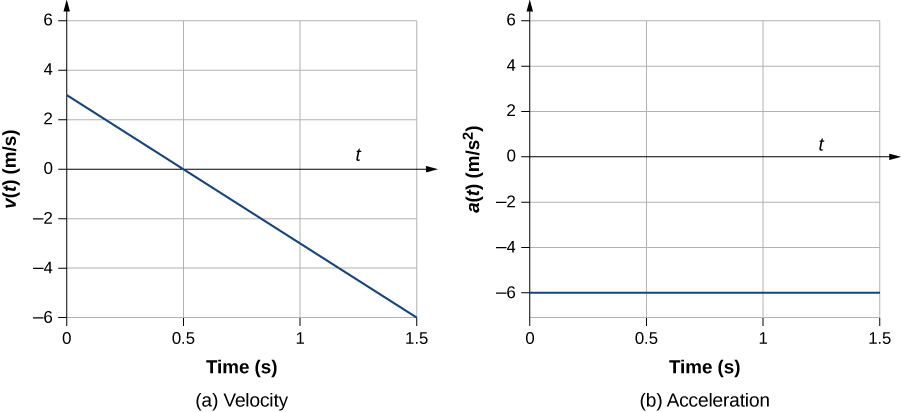
To illustrate this concept, let’s look at two examples. First, a simple example is shown using Figure 3.9(b), the velocity-versus-time graph of Example 3.4, to find acceleration graphically. This graph is depicted in Figure 3.15(a), which is a straight line. The corresponding graph of acceleration versus time is found from the slope of velocity and is shown in Figure 3.15(b). In this example, the velocity function is a straight line with a constant slope, thus acceleration is a constant. In the next example, the velocity function has a more complicated functional dependence on time.
英語のヒント
OpenStax / Rice University, University Physics Volume 1, CC BY 4.0. Source-book artwork retained. · CC BY 4.0 · Source出典

Figure 3.15図 3.15
(a, b) The velocity-versus-time graph is linear and has a negative constant slope (a) that is equal to acceleration, shown in (b).
英語のヒント
(a、b)速度と時間のグラフ(a)は直線で、負の一定の傾きを持つ。この傾きが(b)に示す加速度に等しい。
If we know the functional form of velocity, v(t), we can calculate instantaneous acceleration a(t) at any time point in the motion using Equation 3.9.
英語のヒント
速度の関数形v(t)が分かれば、式3.9を使い、運動中の任意の時刻の瞬間加速度a(t)を計算できる。
Example 3.6例題 3.6
Calculating Instantaneous Acceleration瞬間加速度を求める
A particle is in motion and is accelerating. The functional form of the velocity is .
英語のヒント
粒子が加速しながら動いている。速度の関数形はである。
- Find the functional form of the acceleration.
英語のヒント
加速度の関数形を求めよ。 - Find the instantaneous velocity at t = 1, 2, 3, and 5 s.
英語のヒント
t = 1、2、3、5 sでの瞬間速度を求めよ。 - Find the instantaneous acceleration at t = 1, 2, 3, and 5 s.
英語のヒント
t = 1、2、3、5 sでの瞬間加速度を求めよ。 - Interpret the results of (c) in terms of the directions of the acceleration and velocity vectors.
英語のヒント
加速度ベクトルと速度ベクトルの向きに着目し、(c)の結果を解釈せよ。
Strategy方針
We find the functional form of acceleration by taking the derivative of the velocity function. Then, we calculate the values of instantaneous velocity and acceleration from the given functions for each. For part (d), we need to compare the directions of velocity and acceleration at each time.
英語のヒント
速度関数を微分して加速度の関数形を求める。次に、それぞれの関数から瞬間速度と瞬間加速度を計算する。(d)では、各時刻の速度と加速度の向きを比較する必要がある。
Solution解答
- , , ,
- , , ,
- At t = 1 s, velocity is positive and acceleration is positive, so both velocity and acceleration are in the same direction. The particle is moving faster.
英語のヒント
t = 1 sでは、速度も加速度も正なので、速度と加速度は同じ向きである。粒子はより速くなっている。
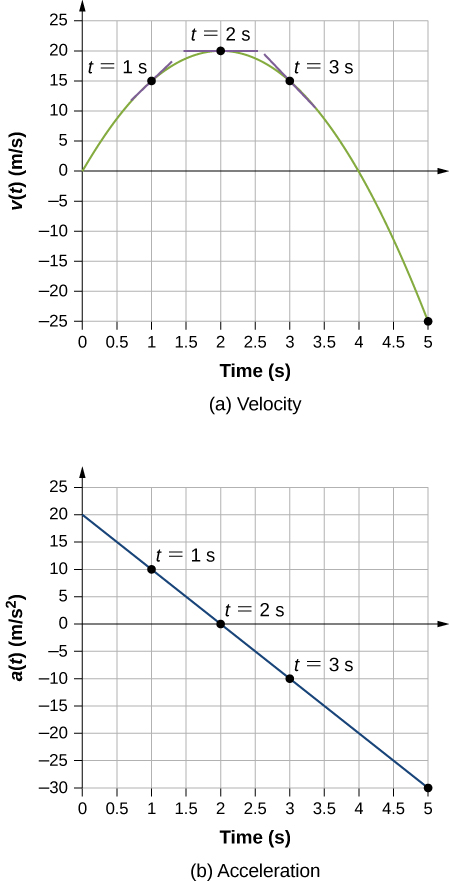
At t = 2 s, velocity has increased to, where it is maximum, which corresponds to the time when the acceleration is zero. We see that the maximum velocity occurs when the slope of the velocity function is zero, which is just the zero of the acceleration function.
英語のヒント
t = 2 sでは、速度は最大値まで増加する。これは加速度が0になる時刻に対応する。速度関数の傾きが0となるとき、つまり加速度関数が0となるときに、速度が最大になることが分かる。
At t = 3 s, velocity is and acceleration is negative. The particle has reduced its velocity and the acceleration vector is negative. The particle is slowing down.
英語のヒント
t = 3 sでは、速度はで、加速度は負である。粒子の速度は低下しており、加速度ベクトルは負方向である。粒子は遅くなっている。
At t = 5 s, velocity is and acceleration is increasingly negative. Between the times t = 3 s and t = 5 s the particle has decreased its velocity to zero and then become negative, thus reversing its direction. The particle is now speeding up again, but in the opposite direction.
英語のヒント
t = 5 sでは、速度はで、加速度は負の向きにさらに大きくなっている。t = 3 sからt = 5 sの間に、粒子の速度は0まで減少してから負となり、運動の向きが逆転した。粒子は再び速くなっているが、向きは反対である。
OpenStax / Rice University, University Physics Volume 1, CC BY 4.0. Source-book artwork retained. · CC BY 4.0 · Source出典

Figure 3.16図 3.16
(a) Velocity versus time. Tangent lines are indicated at times 1, 2, and 3 s. The slopes of the tangent lines are the accelerations. At t = 3 s, velocity is positive. At t = 5 s, velocity is negative, indicating the particle has reversed direction. (b) Acceleration versus time. Comparing the values of accelerations given by the black dots with the corresponding slopes of the tangent lines (slopes of lines through black dots) in (a), we see they are identical.
英語のヒント
(a)速度と時間の関係。時刻1、2、3 sにおける接線を示す。接線の傾きが加速度である。t = 3 sでは速度は正である。t = 5 sでは速度は負で、粒子が向きを逆にしたことを示す。(b)加速度と時間の関係。黒い点が示す加速度を、(a)の対応する接線の傾き(黒い点を通る直線の傾き)と比較すると、両者が等しいことが分かる。
Significance意味の検討
By doing both a numerical and graphical analysis of velocity and acceleration of the particle, we can learn much about its motion. The numerical analysis complements the graphical analysis in giving a total view of the motion. The zero of the acceleration function corresponds to the maximum of the velocity in this example. Also in this example, when acceleration is positive and in the same direction as velocity, velocity increases. As acceleration tends toward zero, eventually becoming negative, the velocity reaches a maximum, after which it starts decreasing. If we wait long enough, velocity also becomes negative, indicating a reversal of direction. A real-world example of this type of motion is a car with a velocity that is increasing to a maximum, after which it starts slowing down, comes to a stop, then reverses direction.
英語のヒント
粒子の速度と加速度を数値とグラフの両方で分析すれば、その運動について多くが分かる。数値による分析はグラフによる分析を補い、運動の全体像を与える。この例では、加速度関数が0となる点が速度の最大値に対応する。また、この例では加速度が正で速度と同じ向きのとき、速度は増加する。加速度が0に近づき、やがて負になると、速度は最大値へ達した後に減少し始める。十分に時間がたてば速度も負となり、向きが反転したことを示す。現実の例としては、速度を最大まで上げた後、減速して停止し、向きを逆にする自動車が挙げられる。