第3章直線上の運動
Putting Equations Together複数の式を組み合わせる
In the following examples, we continue to explore one-dimensional motion, but in situations requiring slightly more algebraic manipulation. The examples also give insight into problem-solving techniques. The note that follows is provided for easy reference to the equations needed. Be aware that these equations are not independent. In many situations we have two unknowns and need two equations from the set to solve for the unknowns. We need as many equations as there are unknowns to solve a given situation.
英語のヒント
次の例でも1次元運動を調べるが、もう少し代数的な変形を必要とする状況を扱う。これらの例から、問題を解く技法も学べる。必要な式を簡単に参照できるよう、以下にまとめておく。これらの式は互いに独立ではないことに注意しよう。未知量が二つあり、式の組から二つを使って解く必要がある状況は多い。与えられた状況を解くには、未知量の数だけ式が必要である。
Before we get into the examples, let’s look at some of the equations more closely to see the behavior of acceleration at extreme values. Rearranging Equation 3.12, we have
英語のヒント
例に進む前に、いくつかの式を詳しく調べ、極限で加速度がどう振る舞うかを見よう。式3.12を変形すると、次のようになる。
From this we see that, for a finite time, if the difference between the initial and final velocities is small, the acceleration is small, approaching zero in the limit that the initial and final velocities are equal. On the contrary, in the limit for a finite difference between the initial and final velocities, acceleration becomes infinite.
英語のヒント
この式から、有限の時間に対して初速度と最終速度の差が小さければ、加速度も小さくなり、両速度が等しくなる極限で0へ近づくことが分かる。逆に、初速度と最終速度に有限の差があるとき、の極限では加速度は無限大になる。
Similarly, rearranging Equation 3.14, we can express acceleration in terms of velocities and displacement:
英語のヒント
同様に、式3.14を変形すれば、速度と変位を使って加速度を表せる。
Thus, for a finite difference between the initial and final velocities acceleration becomes infinite in the limit the displacement approaches zero. Acceleration approaches zero in the limit the difference in initial and final velocities approaches zero for a finite displacement.
英語のヒント
したがって、初速度と最終速度の差が有限なら、変位が0へ近づく極限で加速度は無限大になる。変位が有限の場合、初速度と最終速度の差が0へ近づく極限では加速度は0へ近づく。
Example 3.10例題 3.10
How Far Does a Car Go?自動車はどれだけ進むか
On dry concrete, a car can accelerate opposite to the motion at a rate of 7.00 m/s2, whereas on wet concrete it can accelerate opposite to the motion at only 5.00 m/s2. Find the distances necessary to stop a car moving at 30.0 m/s (about 110 km/h) on (a) dry concrete and (b) wet concrete. (c) Repeat both calculations and find the displacement from the point where the driver sees a traffic light turn red, taking into account their reaction time of 0.500 s to get their foot on the brake.
英語のヒント
乾いたコンクリート上では、自動車は運動と逆向きに7.00 m/s2で加速できるが、濡れたコンクリート上では5.00 m/s2でしか加速できない。30.0 m/s(約110 km/h)で走る自動車を止めるのに必要な距離を、(a)乾いたコンクリートと(b)濡れたコンクリートについて求めよ。(c)運転者が足をブレーキへ移すまでの反応時間0.500 sを考慮し、両方の場合を再計算せよ。運転者が信号の赤への変化に気づいた地点からの変位を求めよ。
Strategy方針
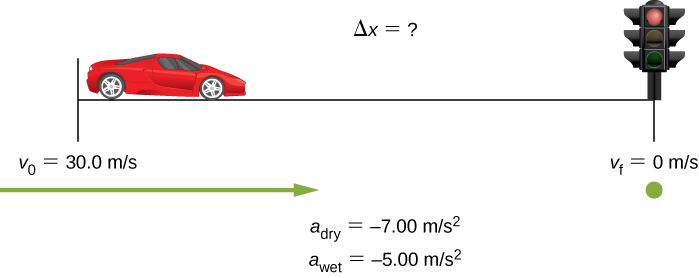
First, we need to draw a sketch Figure 3.22. To determine which equations are best to use, we need to list all the known values and identify exactly what we need to solve for.
英語のヒント
まず略図を描く必要がある(図3.22)。最適な式を選ぶため、既知の値をすべて列挙し、求めるものを正確に確認する。
OpenStax / Rice University, University Physics Volume 1, CC BY 4.0. Source-book artwork retained. · CC BY 4.0 · Source出典

Figure 3.22図 3.22
Sample sketch to visualize acceleration opposite to the motion and stopping distance of a car.
英語のヒント
自動車の運動と逆向きの加速度と停止距離を視覚化する略図の例。
Solution解答
- First, we need to identify the knowns and what we want to solve for. We know that v0 = 30.0 m/s, v = 0, and a = −7.00 m/s2 (a is negative because it is in a direction opposite to velocity). We take x0 to be zero. We are looking for displacement , or x − x0.
Second, we identify the equation that will help us solve the problem. The best equation to use is英語のヒント
まず既知量と求めるものを確認する。v0 = 30.0 m/s、v = 0、a = −7.00 m/s2である(aが負なのは速度と逆向きだからである)。x0は0に取る。求めるのは変位、すなわちx − x0である。次に、問題を解くのに役立つ式を確認する。最も適した式は次のものである。This equation is best because it includes only one unknown, x. We know the values of all the other variables in this equation. (Other equations would allow us to solve for x, but they require us to know the stopping time, t, which we do not know. We could use them, but it would entail additional calculations.)
Third, we rearrange the equation to solve for x:英語のヒント
この式には未知量がx一つしか含まれず、それ以外の変数の値はすべて分かっているため、最も適している。(ほかの式でもxを求められるが、未知の停止時間tが必要になる。使うことはできるものの、追加の計算が伴う。)三番目に、xを求める形へ式を変形する。and substitute the known values:英語のヒント
既知の値を代入すると、Thus,英語のヒント
したがって、 - This part can be solved in exactly the same manner as (a). The only difference is that the acceleration is −5.00 m/s2. The result is
英語のヒント
この場合も、(a)とまったく同じ方法で解ける。唯一の違いは加速度が−5.00 m/s2であることだ。結果は次のようになる。 - When the driver reacts, the stopping distance is the same as it is in (a) and (b) for dry and wet concrete. So, to answer this question, we need to calculate how far the car travels during the reaction time, and then add that to the stopping time. It is reasonable to assume the velocity remains constant during the driver’s reaction time.
To do this, we, again, identify the knowns and what we want to solve for. We know that , , and . We take to be zero. We are looking for .
Second, as before, we identify the best equation to use. In this case, works well because the only unknown value is x, which is what we want to solve for.
Third, we substitute the knowns to solve the equation:英語のヒント
運転者が反応した後の停止距離は、乾いたコンクリートでも濡れたコンクリートでも、それぞれ(a)、(b)と同じである。したがって、反応時間の間に自動車が進む距離を計算し、それを停止時間に加える必要がある。運転者の反応時間中は、速度が一定に保たれると仮定するのが合理的である。再び既知量と求めるものを確認する。、、である。は0に取る。求めるのはである。次に、先ほどと同じように最適な式を選ぶ。この場合はが適している。唯一の未知量xが、求めたいものだからである。三番目に、既知量を代入して式を解く。This means the car travels 15.0 m while the driver reacts, making the total displacements in the two cases of dry and wet concrete 15.0 m greater than if he reacted instantly.
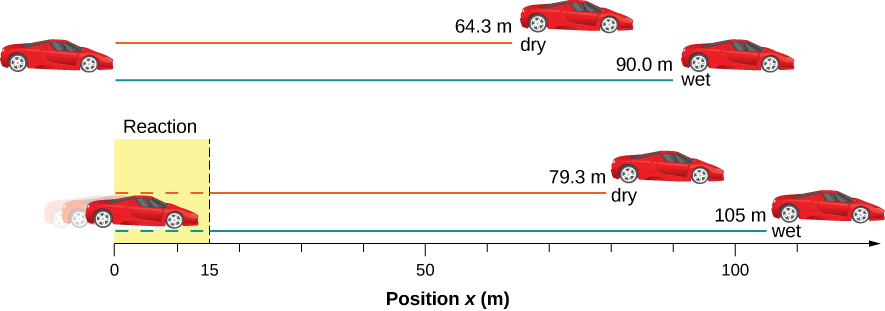
Last, we then add the displacement during the reaction time to the displacement when braking (Figure 3.23),英語のヒント
つまり、運転者が反応する間に自動車は15.0 m進む。乾いたコンクリートと濡れたコンクリートのどちらでも、瞬時に反応した場合より総変位が15.0 m大きくなる。最後に、反応時間中の変位を、ブレーキをかけている間の変位へ加える(図3.23)。and find (a) to be 64.3 m + 15.0 m = 79.3 m when dry and (b) to be 90.0 m + 15.0 m = 105 m when wet.英語のヒント
こうして、乾いた場合(a)は64.3 m + 15.0 m = 79.3 m、濡れた場合(b)は90.0 m + 15.0 m = 105 mとなる。
OpenStax / Rice University, University Physics Volume 1, CC BY 4.0. Source-book artwork retained. · CC BY 4.0 · Source出典

Figure 3.23図 3.23
The distance necessary to stop a car varies greatly, depending on road conditions and driver reaction time. Shown here are the braking distances for dry and wet pavement, as calculated in this example, for a car traveling initially at 30.0 m/s. Also shown are the total distances traveled from the point when the driver first sees a light turn red, assuming a 0.500-s reaction time.
英語のヒント
自動車の停止に必要な距離は、路面の状態と運転者の反応時間によって大きく変わる。この例で計算した、初速度30.0 m/sの自動車の制動距離を、乾いた路面と濡れた路面について示す。反応時間を0.500 sと仮定し、運転者が信号の赤への変化に気づいた地点からの総移動距離も示している。
Significance意味の検討
The displacements found in this example seem reasonable for stopping a fast-moving car. It should take longer to stop a car on wet pavement than dry. It is interesting that reaction time adds significantly to the displacements, but more important is the general approach to solving problems. We identify the knowns and the quantities to be determined, then find an appropriate equation. If there is more than one unknown, we need as many independent equations as there are unknowns to solve. There is often more than one way to solve a problem. The various parts of this example can, in fact, be solved by other methods, but the solutions presented here are the shortest.
英語のヒント
この例で得られた変位は、高速で走る自動車の停止距離として妥当に思える。濡れた路面では乾いた路面より停止に長くかかるはずである。反応時間が変位をかなり増やす点も興味深いが、より重要なのは問題を解く一般的な方法である。既知量と求める量を確認し、適切な式を見つける。未知量が複数ある場合は、解くべき未知量と同じ数の独立した式が必要である。問題の解き方は一つとは限らない。実際に、この例の各部分も別の方法で解けるが、ここに示した解法が最も短い。
Example 3.11例題 3.11
Calculating Time時間を求める
Suppose a car merges into freeway traffic on a 200-m-long ramp. If its initial velocity is 10.0 m/s and it accelerates at 2.00 m/s2, how long does it take the car to travel the 200 m up the ramp? (Such information might be useful to a traffic engineer.)
英語のヒント
自動車が長さ200 mの進入路から高速道路の流れへ合流するとする。初速度が10.0 m/sで、加速度2.00 m/s2で加速する場合、この進入路を200 m進むのにどれだけ時間がかかるか。(このような情報は交通技術者に役立つだろう。)
Strategy方針
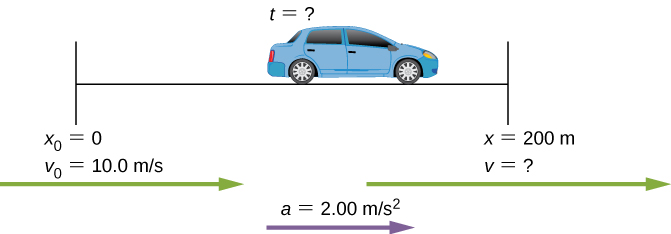
First, we draw a sketch Figure 3.24. We are asked to solve for time t. As before, we identify the known quantities to choose a convenient physical relationship (that is, an equation with one unknown, t.)
英語のヒント
まず略図を描く(図3.24)。求めるのは時間tである。先ほどと同じように既知量を確認し、都合のよい物理的関係、つまり未知量がt一つの式を選ぶ。
OpenStax / Rice University, University Physics Volume 1, CC BY 4.0. Source-book artwork retained. · CC BY 4.0 · Source出典

Figure 3.24図 3.24
Sketch of a car accelerating on a freeway ramp.
英語のヒント
高速道路の進入路で加速する自動車の略図。
Solution解答
Again, we identify the knowns and what we want to solve for. We know that
, and x = 200 m.
, and x = 200 m.
英語のヒント
再び既知量と求めるものを確認する。、x = 200 mである。
We need to solve for t. The equation works best because the only unknown in the equation is the variable t, for which we need to solve. From this insight we see that when we input the knowns into the equation, we end up with a quadratic equation.
英語のヒント
tを求める必要がある。式には、求めたい変数t以外に未知量がないため、最も適している。このことから、既知量を式へ代入すると2次方程式になると分かる。
We need to rearrange the equation to solve for t, then substituting the knowns into the equation:
英語のヒント
tを求められるよう式を変形し、既知量を代入する。
We then simplify the equation. The units of meters cancel because they are in each term. We can get the units of seconds to cancel by taking t = t s, where t is the magnitude of time and s is the unit. Doing so leaves
英語のヒント
次に式を簡単にする。すべての項にメートルの単位があるので、約分して消せる。t = t sとし、tを時間の大きさ、sを単位とすれば、秒の単位も消せる。こうすると、次の式が残る。
We then use the quadratic formula to solve for t,
英語のヒント
次に2次方程式の解の公式を使ってtを求める。
which yields two solutions: t = 10.0 and t = −20.0. A negative value for time is unreasonable, since it would mean the event happened 20 s before the motion began. We can discard that solution. Thus,
英語のヒント
これから二つの解t = 10.0とt = −20.0を得る。時間が負であると、運動開始の20 s前に出来事が起きたことになるので、この値は不合理である。この解は除外できる。したがって、
Significance意味の検討
Whenever an equation contains an unknown squared, there are two solutions. In some problems both solutions are meaningful; in others, only one solution is reasonable. The 10.0-s answer seems reasonable for a typical freeway on-ramp.
英語のヒント
式に未知量の2乗が含まれるとき、解は二つある。問題によっては両方の解が意味を持ち、別の問題では一方だけが合理的となる。10.0 sという答えは、一般的な高速道路の進入路として妥当に思える。
Example 3.12例題 3.12
Acceleration of a Spaceship宇宙船の加速
A spaceship has left Earth’s orbit and is on its way to the Moon. It accelerates at 20 m/s2 for 2 min and covers a distance of 1000 km. What are the initial and final velocities of the spaceship?
英語のヒント
宇宙船が地球の軌道を離れ、月へ向かっている。20 m/s2で2分間加速し、1000 km進む。宇宙船の初速度と最終速度はいくらか。
Strategy方針
We are asked to find the initial and final velocities of the spaceship. Looking at the kinematic equations, we see that one equation will not give the answer. We must use one kinematic equation to solve for one of the velocities and substitute it into another kinematic equation to get the second velocity. Thus, we solve two of the kinematic equations simultaneously.
英語のヒント
求めるのは宇宙船の初速度と最終速度である。運動学の式を見ると、一つの式だけでは答えが出ないと分かる。一つの式で片方の速度を求め、それを別の式へ代入してもう片方の速度を得なければならない。つまり、二つの運動学の式を連立して解く。
Solution解答
First we solve for using
英語のヒント
まずを使ってを求める。
Then we substitute into to solve for the final velocity:
英語のヒント
次にをへ代入し、最終速度を求める。
Significance意味の検討
There are six variables in displacement, time, velocity, and acceleration that describe motion in one dimension. The initial conditions of a given problem can be many combinations of these variables. Because of this diversity, solutions may not be as easy as simple substitutions into one of the equations. This example illustrates that solutions to kinematics may require solving two simultaneous kinematic equations.
英語のヒント
1次元の運動を記述する変位、時間、速度、加速度には六つの変数がある。問題の初期条件には、これらの変数の多くの組合せがありうる。この多様性のため、解法は一つの式への単純な代入だけで済むとは限らない。この例は、運動学の問題を解くには、二つの運動学の式を連立させる必要がある場合を示す。
With the basics of kinematics established, we can go on to many other interesting examples and applications. In the process of developing kinematics, we have also glimpsed a general approach to problem solving that produces both correct answers and insights into physical relationships. The next level of complexity in our kinematics problems involves the motion of two interrelated bodies, called two-body pursuit problems.
英語のヒント
運動学の基礎が整ったので、さらに多くの興味深い例や応用へ進める。運動学を組み立てる過程で、正しい答えと物理的関係への理解の両方をもたらす、一般的な問題解決の方法にも触れてきた。次に扱う、もう一段複雑な問題は、互いに関係する二つの物体の運動、すなわち追跡問題である。