第3章直線上の運動
3.3 Average and Instantaneous Acceleration3.3 平均加速度と瞬間加速度
Learning Objectives学習目標
Learning Objectives学習目標
By the end of this section, you will be able to:
英語のヒント
この節を終えると、次のことができるようになる。
- Calculate the average acceleration between two points in time.
英語のヒント
二つの時刻の間の平均加速度を計算する。 - Calculate the instantaneous acceleration given the functional form of velocity.
英語のヒント
速度の関数形から瞬間加速度を計算する。 - Explain the vector nature of instantaneous acceleration and velocity.
英語のヒント
瞬間加速度と速度が持つベクトルとしての性質を説明する。 - Explain the difference between average acceleration and instantaneous acceleration.
英語のヒント
平均加速度と瞬間加速度の違いを説明する。 - Find instantaneous acceleration at a specified time on a graph of velocity versus time.
英語のヒント
速度と時間のグラフから、指定された時刻の瞬間加速度を求める。
The importance of understanding acceleration spans our day-to-day experience, as well as the vast reaches of outer space and the tiny world of subatomic physics. In everyday conversation, to accelerate means to speed up; applying the brake pedal causes a vehicle to slow down. We are familiar with the acceleration of our car, for example. The greater the acceleration, the greater the change in velocity over a given time. Acceleration is widely seen in experimental physics. In linear particle accelerator experiments, for example, subatomic particles are accelerated to very high velocities in collision experiments, which tell us information about the structure of the subatomic world as well as the origin of the universe. In space, cosmic rays are subatomic particles that have been accelerated to very high energies in supernovas (exploding massive stars) and active galactic nuclei. It is important to understand the processes that accelerate cosmic rays because these rays contain highly penetrating radiation that can damage electronics flown on spacecraft, for example.
英語のヒント
加速度を理解することの重要性は、日々の経験から、広大な宇宙、さらに原子より小さな物理の世界にまで及ぶ。日常会話では、加速するとは速くなることを意味し、ブレーキペダルを踏むと乗り物は遅くなる。例えば自動車の加速は身近である。加速度が大きいほど、一定の時間における速度の変化も大きい。実験物理学でも加速度は広く見られる。例えば線形粒子加速器による衝突実験では、原子より小さな粒子を非常に高い速度まで加速する。このような実験から、原子より小さな世界の構造や宇宙の起源についての情報が得られる。宇宙線とは、超新星(大質量の星の爆発)や活動銀河核で非常に高いエネルギーへ加速された、原子より小さな粒子である。宇宙線を加速する過程を理解することは重要である。宇宙線には透過力の高い放射線が含まれ、例えば宇宙船に搭載された電子機器を損傷することがあるためである。
Average Acceleration平均加速度
The formal definition of acceleration is consistent with these notions just described, but is more inclusive.
英語のヒント
加速度の正式な定義は、今述べた考えと整合するが、より広い意味を持つ。
Because acceleration is velocity in meters per second divided by time in seconds, the SI units for acceleration are often abbreviated m/s2—that is, meters per second squared or meters per second per second. This literally means by how many meters per second the velocity changes every second. Recall that velocity is a vector—it has both magnitude and direction—which means that a change in velocity can be a change in magnitude (or speed), but it can also be a change in direction. For example, if a runner traveling at 10 km/h due east slows to a stop, reverses direction, and continues her run at 10 km/h due west, her velocity has changed as a result of the change in direction, although the magnitude of the velocity is the same in both directions. Thus, acceleration occurs when velocity changes in magnitude (an increase or decrease in speed) or in direction, or both.
英語のヒント
加速度はm/sで表した速度をsで表した時間で割ったものなので、SI単位はしばしばm/s2と略記される。これはメートル毎秒の毎秒、すなわちメートル毎秒毎秒を意味する。文字どおり、1秒ごとに速度が何m/s変わるかを示す。速度は、大きさと向きを併せ持つベクトルであることを思い出そう。したがって速度の変化は、大きさ(速さ)の変化でも、向きの変化でもよい。例えば、真東へ10 km/hで走っていた人が減速して停止し、向きを逆にして真西へ10 km/hで走り続ける場合、両方向で速度の大きさは同じでも、向きが変わるため速度は変化している。このように、速度の大きさ(速さの増減)、向き、あるいはその両方が変わるとき、加速度が生じる。
Keep in mind that although acceleration is in the direction of the change in velocity, it is not always in the direction of motion. When an object slows down, its acceleration is opposite to the direction of its motion. Although this is commonly referred to as deceleration Figure 3.10, we say the train is accelerating in a direction opposite to its direction of motion.
英語のヒント
加速度は速度の変化の向きであり、必ずしも運動の向きではないことに注意しよう。物体が遅くなるとき、その加速度は運動と逆向きである。普通はこれを減速と呼ぶが(図3.10)、ここでは列車が運動と逆の向きに加速しているという。
Image omitted because its reuse rights could not be verified.権利の確認ができないため画像を割愛。
Figure 3.10図 3.10
A subway train in Sao Paulo, Brazil, accelerates opposite to the motion as it comes into a station. It is accelerating in a direction opposite to its direction of motion. (credit: modification of work by Yusuke Kawasaki)
英語のヒント
ブラジルのサンパウロで、地下鉄の列車が駅へ進入しながら運動と逆向きに加速している。加速度の向きは運動の向きと反対である。(出典:Yusuke Kawasakiの作品を改変)
The term deceleration can cause confusion in our analysis because it is not a vector and it does not point to a specific direction with respect to a coordinate system, so we do not use it. Acceleration is a vector, so we must choose the appropriate sign for it in our chosen coordinate system. In the case of the train in Figure 3.10, acceleration is in the negative direction in the chosen coordinate system, so we say the train is undergoing negative acceleration.
英語のヒント
「減速」という語は、ベクトルではなく、座標系に対する特定の向きも示さないので、分析を混乱させることがある。このため、ここでは使わない。加速度はベクトルなので、選んだ座標系に適した符号を選ばなければならない。図3.10の列車では、選んだ座標系における加速度が負方向なので、列車には負の加速度が生じているという。
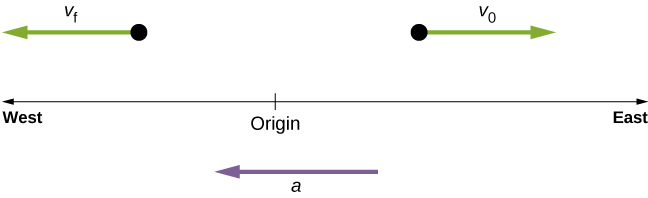
If an object in motion has a velocity in the positive direction with respect to a chosen origin and it acquires a constant negative acceleration, the object eventually comes to a rest and reverses direction. If we wait long enough, the object passes through the origin going in the opposite direction. This is illustrated in Figure 3.11.
英語のヒント
選んだ原点に対して正方向の速度で動く物体が、一定の負の加速度を受けると、やがて停止して向きを逆にする。十分に時間がたてば、物体は反対方向へ進みながら原点を通過する。図3.11にこの様子を示す。
OpenStax / Rice University, University Physics Volume 1, CC BY 4.0. Source-book artwork retained. · CC BY 4.0 · Source出典

Figure 3.11図 3.11
An object in motion with a velocity vector toward the east under negative acceleration comes to a rest and reverses direction. It passes the origin going in the opposite direction after a long enough time.
英語のヒント
速度ベクトルが東向きの物体は、負の加速度のもとで停止し、向きを逆にする。十分に時間がたつと、反対方向へ進みながら原点を通過する。
Example 3.5例題 3.5
Calculating Average Acceleration: A Racehorse Leaves the Gate平均加速度を求める:ゲートを飛び出す競走馬
A racehorse coming out of the gate accelerates from rest to a velocity of 15.0 m/s due west in 1.80 s. What is its average acceleration?
英語のヒント
競走馬がゲートから飛び出し、1.80 sで静止状態から真西向き15.0 m/sの速度まで加速する。平均加速度はいくらか。
Image omitted because its reuse rights could not be verified.権利の確認ができないため画像を割愛。
Figure 3.12図 3.12
Racehorses accelerating out of the gate. (credit: modification of work by Jon Sullivan)
英語のヒント
ゲートから加速して飛び出す競走馬。(出典:Jon Sullivanの作品を改変)
Strategy方針
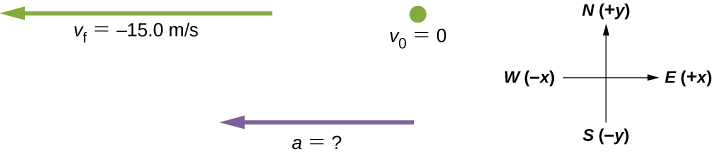
First we draw a sketch and assign a coordinate system to the problem Figure 3.13. This is a simple problem, but it always helps to visualize it. Notice that we assign east as positive and west as negative. Thus, in this case, we have negative velocity.
英語のヒント
まず略図を描き、問題に座標系を設定する(図3.13)。簡単な問題でも、図にして考えることは常に役立つ。東を正、西を負としていることに注意しよう。したがって、この場合の速度は負である。
OpenStax / Rice University, University Physics Volume 1, CC BY 4.0. Source-book artwork retained. · CC BY 4.0 · Source出典

Figure 3.13図 3.13
Identify the coordinate system, the given information, and what you want to determine.
英語のヒント
座標系、与えられた情報、求めたいものを確認する。
We can solve this problem by identifying from the given information, and then calculating the average acceleration directly from the equation .
英語のヒント
与えられた情報からを確認し、式によって平均加速度を直接計算すれば、この問題を解ける。
Solution解答
First, identify the knowns: (the negative sign indicates direction toward the west), Δt = 1.80 s.
英語のヒント
まず既知量を確認する。(負の符号は西向きを表す)、Δt = 1.80 sである。
Second, find the change in velocity. Since the horse is going from zero to –15.0 m/s, its change in velocity equals its final velocity:
英語のヒント
次に速度の変化を求める。馬の速度は0から−15.0 m/sになるので、速度の変化は最終速度に等しい。
Last, substitute the known values () and solve for the unknown :
英語のヒント
最後に既知の値()を代入し、未知量を求める。
Significance意味の検討
The negative sign for acceleration indicates that acceleration is toward the west. An acceleration of 8.33 m/s2 due west means the horse increases its velocity by 8.33 m/s due west each second; that is, 8.33 meters per second per second, which we write as 8.33 m/s2. This is truly an average acceleration, because the ride is not smooth. We see later that an acceleration of this magnitude would require the rider to hang on with a force nearly equal to his weight.
英語のヒント
加速度の負の符号は、西向きであることを表す。真西向き8.33 m/s2の加速度とは、馬の西向きの速度が1秒ごとに8.33 m/sずつ増すという意味である。すなわち8.33メートル毎秒毎秒であり、8.33 m/s2と書く。馬の走りは滑らかではないため、これは実際に平均加速度である。後で見るように、この大きさの加速度のもとでは、騎手は自分の体重にほぼ等しい力でしがみつかなければならない。